
The universe has been expanding for 13.8 billion years and shows no sign of pausing to explain itself.
In that time, it has produced hydrogen and helium, then heavier elements forged in the cores of dying stars, then carbon — that promiscuous atom that bonds with nearly everything — then, in conditions so unlikely that physicists still argue about the odds, self-replicating chemistry, multicellular life, nervous systems, and finally a species that looks back at the whole improbable cascade and asks: did someone mean this to happen?
Two men spent their careers at the frontlines of that question. Both were professional astronomers. Both published in peer-reviewed journals. Both attended the same conferences, read the same data, inhabited the same universe. And they arrived at conclusions so opposed that their decades-long written exchange reads less like a scientific debate than a Socratic dialogue across an unbridgeable metaphysical gap.
The Man Who Read Copernicus and Saw God
Owen Gingerich spent four decades at the Harvard-Smithsonian Center for Astrophysics cataloguing every surviving copy of Copernicus’s De Revolutionibus — the 1543 book that moved Earth from the center of the solar system to its third orbit. He found and annotated nearly 600 copies held in libraries across the world. It was the kind of scholarly project that requires not just intelligence but patience — the patience of someone comfortable with long timescales, with the slow accumulation of evidence, with the idea that understanding requires the full view.
In 2006, Harvard University Press published his Dwight H. Terry Lectures as God’s Universe — a slim book that argues, without apology, that a theist can be a fully credentialed scientist and that the fine-tuned universe provides, if not proof, then at least reasonable grounds for theological inference. Gingerich was careful to frame the argument epistemologically: he was not claiming scientific proof of God. He was claiming that the data, interpreted honestly, did not rule out the hypothesis of purposeful creation — and that the extraordinary improbability of the physical constants required for life to exist was consistent with, and perhaps suggestive of, intentional design.
The anthropic principle — the observation that the constants of physics appear to be fine-tuned with remarkable precision to permit the existence of life — was, for Gingerich, not a coincidence to be explained away but a phenomenon worth taking seriously on its own terms.
The Man Who Won the Nobel and Found Pointlessness
Steven Weinberg took the Nobel Prize in Physics in 1979 for his work unifying the electromagnetic and weak nuclear forces — one of the genuine landmarks of twentieth-century science. In The First Three Minutes (1977), he had already demonstrated his capacity to make particle physics legible to general readers. In Dreams of a Final Theory (1993, Pantheon), he published the sentence that has followed him ever since:
“The more the universe seems comprehensible, the more it also seems pointless.”
It is a sentence of extraordinary precision. Weinberg was not saying the universe is meaningless in some casual, nihilistic sense. He was saying that scientific understanding, as it deepens, does not reveal purpose — it reveals mechanism. And mechanism, however elegant, is not the same as meaning. The universe, as physics describes it, is a place where particles obey laws, where stars burn and expire, where consciousness arises as an emergent property of sufficiently complex chemistry — and where none of that process shows any evidence of being aimed at anything in particular.
For Weinberg, the fine-tuning argument — which Gingerich found theologically suggestive — was either a selection effect (any universe capable of producing observers will be observed only by the observers it produced, which proves nothing about design) or a question answered by the multiverse hypothesis (if enough universes exist with varying physical constants, some will inevitably produce the conditions for life). Neither answer requires a designer.
The Same Conferences, Different Planets
What makes the Gingerich-Weinberg exchange more than an abstract philosophical dispute is that it played out in real, documented, institutional settings. Both men participated in Templeton Foundation symposia — the venues where the science-religion dialogue of the late twentieth century most consistently brought together credentialed scientists on both sides of the question. Their arguments appear in cross-referenced academic literature, including Karl Giberson and Mariano Artigas’s Oracles of Science (2007, Oxford University Press), which documents the positions of major scientists in the debate.
What those records reveal is not two men talking past each other but two men talking to the same data and reading different texts in it. Gingerich’s archived lectures at Harvard Divinity School show him returning repeatedly to the question of the carbon resonance — the specific nuclear resonance level in carbon-12 that Fred Hoyle predicted in 1953 must exist in order for stars to produce carbon at the observed rate. Hoyle predicted it from the anthropic necessity — life requires carbon, therefore carbon must be producible, therefore the resonance must exist. It was found. Hoyle, a lifelong atheist, described the discovery as shaking his atheism in ways he never fully resolved.
Gingerich cited the carbon resonance as the clearest example of what fine-tuning actually looks like in the data. Weinberg countered that the multiverse framework dissolves the apparent improbability entirely — and that Hoyle’s discomfort said more about human psychology than about the universe’s architecture.
Both were right, within their frameworks. The problem is that the frameworks themselves rest on assumptions that neither physics nor theology can resolve from inside its own methods.

What the Fine-Tuning Argument Actually Claims
It is worth being precise here, because the fine-tuning debate is frequently misrepresented by both its advocates and its critics.
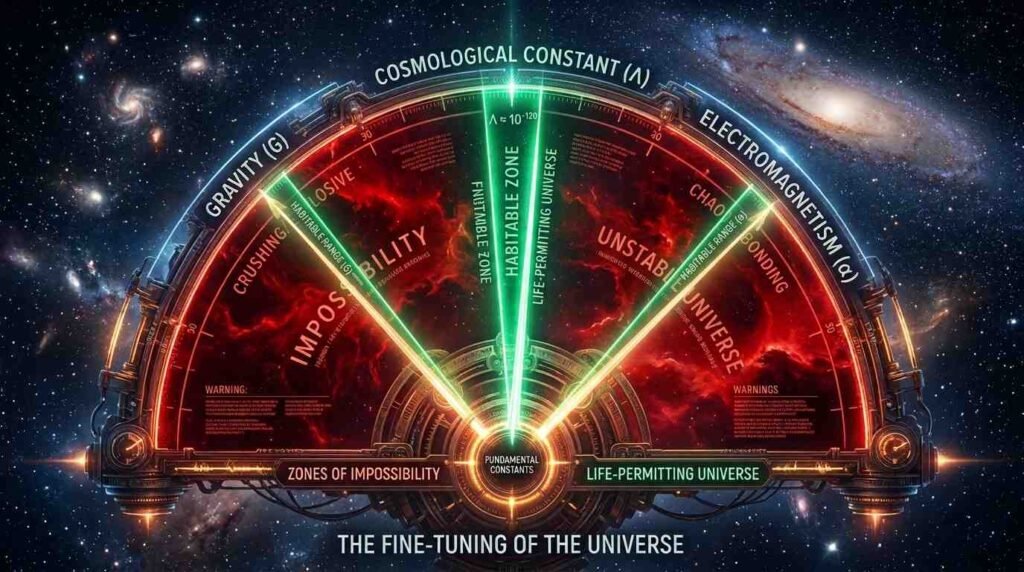
The argument is not that the universe was obviously designed because it’s so beautiful or complex. Beauty and complexity are subjective judgments. The argument is specific and mathematical: the physical constants — the gravitational constant, the electromagnetic coupling constant, the ratio of matter to antimatter, the cosmological constant — each appears to fall within extraordinarily narrow ranges that permit the existence of stable matter, chemistry, and ultimately life. Vary any of them by a small percentage in the wrong direction, and the universe produces nothing but hydrogen, or collapses in a fraction of a second, or expands so rapidly that matter never coalesces.
Gingerich’s claim was that this specificity is remarkable enough to warrant theological inference. Weinberg’s claim was that the multiverse hypothesis — the existence of a landscape of universes with different constants — renders the specificity statistically unsurprising. But the multiverse, as Weinberg acknowledged, is not directly testable by current physics. It is, in a sense, a theoretical response to a theological argument: an untestable hypothesis invoked to explain away an observation that would otherwise look theologically significant.
This is the moment in the debate where things get genuinely interesting — where you realize that the line between physics and metaphysics is less clear than either side typically admits.
There is a post I wrote some time back on the Boltzmann Brain paradox that touches on the outer edge of these questions — the place where statistical physics starts generating conclusions that feel more like theology than science. The Gingerich-Weinberg debate lives at exactly that edge.
Two Telescopes Pointed at the Same Sky
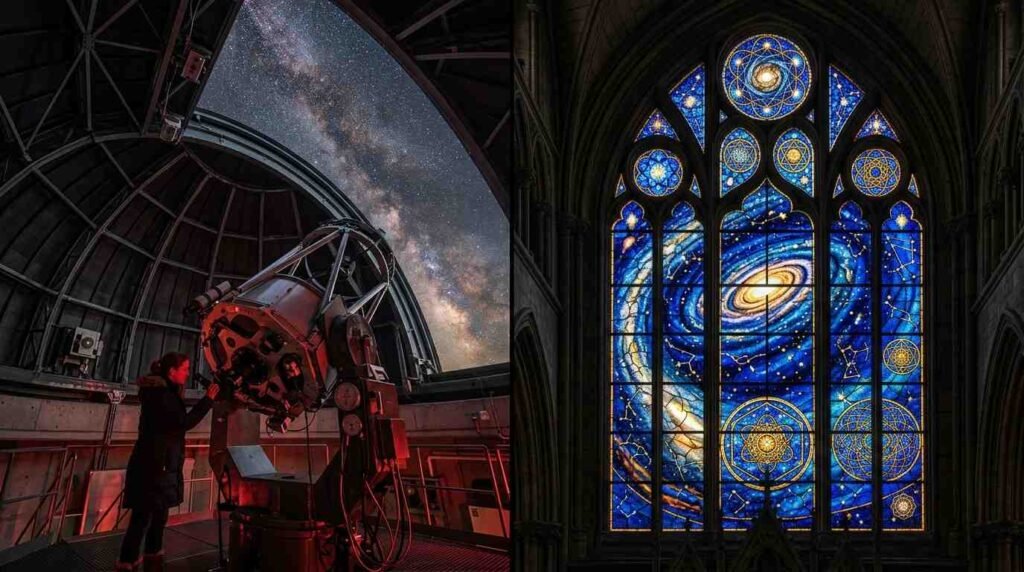
Here is the question that the Gingerich-Weinberg exchange ultimately forces: when two equally qualified scientists interpret the same data and arrive at opposite metaphysical conclusions, what does that tell us?
One answer — Weinberg’s implicit answer — is that the data genuinely underdetermines the metaphysics. The universe is what it is; questions of purpose are questions we bring to the universe, not questions we read out of it. Science describes; it does not evaluate. The “pointlessness” Weinberg described was not a finding of physics — it was an observation about the limits of what physics can find.
Another answer — Gingerich’s implicit answer — is that underdetermination cuts both ways. If the data does not prove design, it also does not disprove it. A scientist who refuses to follow inference wherever it leads, including into territory that feels theological, is not being more rigorous than Gingerich — they are making a prior metaphysical commitment of their own: that naturalistic explanations are the only valid explanations. That commitment is not itself derivable from the data.
Both answers are defensible. The fact that Gingerich and Weinberg could inhabit opposite ends of that spectrum while sharing identical scientific credentials suggests that the question is not, in fact, a scientific question at all. It is a question about what science is for — about what kind of answer counts as an answer.
What Looking Up Actually Feels Like
Carl Sagan used to say that the cosmos was within us — that we are, in a literal chemical sense, made of star stuff. He meant it as a statement of wonder, not of religious comfort. The nitrogen in our DNA and the calcium in our teeth were forged in stellar cores that exploded billions of years before the Earth formed. We are not separate from the universe watching it from outside. We are one of the things the universe is doing.
Owen Gingerich and Steven Weinberg both knew that. They both felt whatever physicists feel when they contemplate 13.8 billion years of structure emerging from a hot, dense singularity. The question that divided them was whether that feeling pointed toward anything beyond itself — whether the awe was recognition of something real, or merely a property of sufficiently developed brains encountering sufficiently complex data.
The honest answer is: we don’t know. The bracing answer — the one that makes both Gingerich and Weinberg worth reading — is that not knowing is not the same as the question being unanswerable. It may just mean we haven’t built the right instruments yet.
Or it may mean the instruments are pointing at a question the instruments cannot answer.
That tension is where cosmology becomes philosophy. And that, as far as I can tell, is exactly where the most important questions live.
Fine-tuning arguments and their theological implications are subjects of active, unresolved debate among physicists, cosmologists, and philosophers of science. This post presents documented positions of named individuals and does not endorse or refute the existence of a creator. Both perspectives have serious, credentialed advocates.
You Might Also Like:
- The Boltzmann Brain Paradox: When Statistical Physics Predicts You Shouldn’t Exist
- Atom by Lawrence Krauss — Review
- The Demarcation Problem: Karl Popper, Falsifiability, and the Boundary Between Science and Pseudoscience
Sources:
- Owen Gingerich, God’s Universe (2006, Harvard University Press): https://www.amazon.com/Gods-Universe-Owen-Gingerich/dp/0674023390
- Steven Weinberg, Dreams of a Final Theory (1993, Pantheon): https://www.amazon.com/Dreams-Final-Theory-Scientist-Ultimate/dp/0679744077
- Steven Weinberg, The First Three Minutes (1977, Basic Books): https://www.amazon.com/First-Three-Minutes-Modern-Universe/dp/0465024378
- Karl Giberson and Mariano Artigas, Oracles of Science (2007, Oxford University Press): https://www.amazon.com/Oracles-Science-Celebrity-Misrepresent/dp/0195310551
- John D. Barrow and Frank J. Tipler, The Anthropic Cosmological Principle (1986, Oxford University Press): https://www.amazon.com/Anthropic-Cosmological-Principle-John-Barrow/dp/0192821474
- Templeton Foundation symposia proceedings: https://www.templeton.org