This post presents an intellectual comparison and does not endorse or refute either worldview. The reconstruction of their public exchange is based on documented sources — books, media appearances, and institutional records. Readers should consult primary sources and form independent conclusions.
The Human Genome Project announced its working draft on June 26, 2000. Francis Collins stood beside President Clinton in the White House East Room and said that the moment was, for him, both scientifically staggering and personally overwhelming. He called the genome “the language of God.” He was not speaking metaphorically.
Stephen Jay Gould heard that. He had been thinking about this for a long time.
Two Frameworks, One Molecule
By the year 2000, these two men occupied adjacent but non-overlapping positions in American public intellectual life. Both were Harvard-affiliated evolutionary biologists with major media profiles. Both wrote for general audiences with unusual fluency. Both understood, better than most of their colleagues, that the debates happening in biology were not just scientific — they were cultural, philosophical, and ultimately theological.
The similarity ended there.
Gould, by 2000, had spent thirty years building what became his most ambitious late-career argument: that evolution was not the clean, continuous, purpose-shaped process that pop Darwinism portrayed. His concept of spandrels — developed with Richard Lewontin in their famous 1979 paper in Proceedings of the Royal Society — argued that many features of organisms are architectural byproducts rather than adaptive solutions. The human chin is the canonical example: there is no selection pressure for a chin per se. The chin is what you get when two growing bone fields collide. It is a spandrel — the triangular spaces above the arches in a cathedral that exist because the arch is there, not because someone designed a triangular space.
If biological form is substantially spandrel — if the architecture of living things is riddled with byproducts, accidents, and structural constraints that have nothing to do with adaptation — then the genome does not look like a designed document. It looks like the record of a contingent process, full of junk, repetition, and evolutionary baggage accumulated over three billion years of blind accumulation.
Collins saw it differently. His 2006 book, The Language of God, makes the case directly: the moral law within human beings — the sense of right and wrong that transcends culture — is not explicable by natural selection alone. Combined with what he saw as the fine-tuning of physical constants and the existence of the genome itself as a kind of text, Collins arrived at what he called BioLogos: the position that God used the process of evolution as the mechanism of creation. His founding of the BioLogos Foundation in 2007 institutionalized this position, which remains active and archived at biologos.org.

Cold Spring Harbor in the Room
Cold Spring Harbor Laboratory, on the North Shore of Long Island, is where these threads converge in ways that are rarely acknowledged.
The laboratory’s history with evolutionary theory is not simple. The Eugenics Record Office, established on its grounds in 1910, was one of the most influential — and ultimately most catastrophic — applications of evolutionary thinking to human populations in American history. Charles Davenport’s project of applying Darwinian mechanism to race, immigration, and “defective” heredity was a long shadow that Cold Spring Harbor spent much of the twentieth century escaping. The laboratory that later became a global center for molecular biology and genomics was built partly in reaction to that legacy.
By the time the Human Genome Project was reaching its completion in the late 1990s, Cold Spring Harbor was a central institution in the sequencing race. James Watson — the laboratory’s longtime director — had helped launch the project. Francis Collins attended all of Cold Spring Harbor’s meetings on genomics, as documented in the laboratory’s own oral history records. The laboratory’s DNA Learning Center produced educational materials on the genome that reached millions of Americans.
The institutional arc from the Eugenics Record Office to the Human Genome Project — from Davenport’s catastrophic misuse of evolutionary mechanism to Collins’s careful ethical framework around genetic information — is itself an argument about what Gould’s spandrels mean in practice. A biological mechanism without a telos is not necessarily a mechanism without consequences. The history of Cold Spring Harbor is a study in what happens when evolutionary thinking meets human institutions.
Gould’s Late Synthesis
In 2002, Gould published The Structure of Evolutionary Theory — at 1,400 pages, the most ambitious secular synthesis of evolutionary biology since Darwin. He died three months after its publication, at 60, of cancer. The book is dense, argumentative, and not easily summarized. But its core claim is worth sitting with: that the Modern Synthesis — the mid-twentieth century merger of Darwinian natural selection with Mendelian genetics — had become too narrow. That it had underweighted developmental constraints, punctuated equilibrium, and the role of higher-level selection. That evolution was a more complex, more contingent, more architecturally interesting process than the standard model admitted.
Gould also published Rocks of Ages in 1999, a slim book that laid out his framework for the relationship between science and religion: Non-Overlapping Magisteria, or NOMA. Science covers the empirical realm of fact and theory. Religion covers questions of ultimate meaning and moral value. They do not overlap. They cannot conflict, because they address different domains.
Collins found NOMA inadequate — polite, but ultimately evasive. The problem with NOMA, from Collins’s perspective, is that it concedes too much. If religion can say nothing about the physical world, and science can say nothing about ultimate meaning, then the genetic evidence for shared ancestry, for the contingency of the human genome, for the fact that 98% of our DNA is shared with chimpanzees — none of this has any bearing on the God question. Collins thought that was wrong. He thought the evidence bore on theology, and that it bore on it in a way that was compatible with faith rather than destructive of it.
The PBS NOVA documentary Cracking the Code of Life (2001) documents the cultural moment around the genome completion. Collins is interviewed at length. His position — that the genome’s existence fills him with reverence for its creator — is stated clearly, without hedging. Gould was in the last years of his life dealing with his illness, but his public interventions in exactly this debate — in Natural History magazine, in The New York Review of Books — were consistently skeptical of what he saw as the colonization of biological language by theological conclusion.

Who Persuaded Whom, and By What Metric
This is where honest analysis requires separating three axes.
On scientific accuracy, Gould’s spandrel argument is well-supported. The genome, as it has been decoded in the two decades since the working draft, is substantially junk — full of repetitive sequences, ancient viral insertions, and non-coding regions that look nothing like a designed document. Collins’s point about the moral law is not a scientific argument, and he has never claimed it is. His scientific work on the genome is not compromised by his theological conclusions. But his theological conclusions are not derivable from his scientific work.
On rhetorical effectiveness in the short run, Collins won — or at least drew a larger crowd. The Language of God sold hundreds of thousands of copies. The BioLogos Foundation reached millions of religious Americans who might otherwise have felt that evolutionary biology was incompatible with faith. Collins’s ability to be both rigorous and devout gave permission structures to a large population. Gould’s Rocks of Ages sold well but narrowed as it deepened. NOMA, for all its clarity, satisfied nobody: atheists found it too accommodating, theists found it too restrictive.
On long-term cultural influence, Gould’s framework has proven more durable inside evolutionary biology itself. The field has moved toward greater appreciation of developmental constraints, epigenetics, and the limits of adaptationism — exactly the directions Gould pointed. Collins’s BioLogos remains influential in religious communities, but it has not substantially changed the practice of evolutionary biology.
What the Genome Actually Says
There is a temptation, when examining this debate, to assume that the molecule will eventually settle it. It won’t.
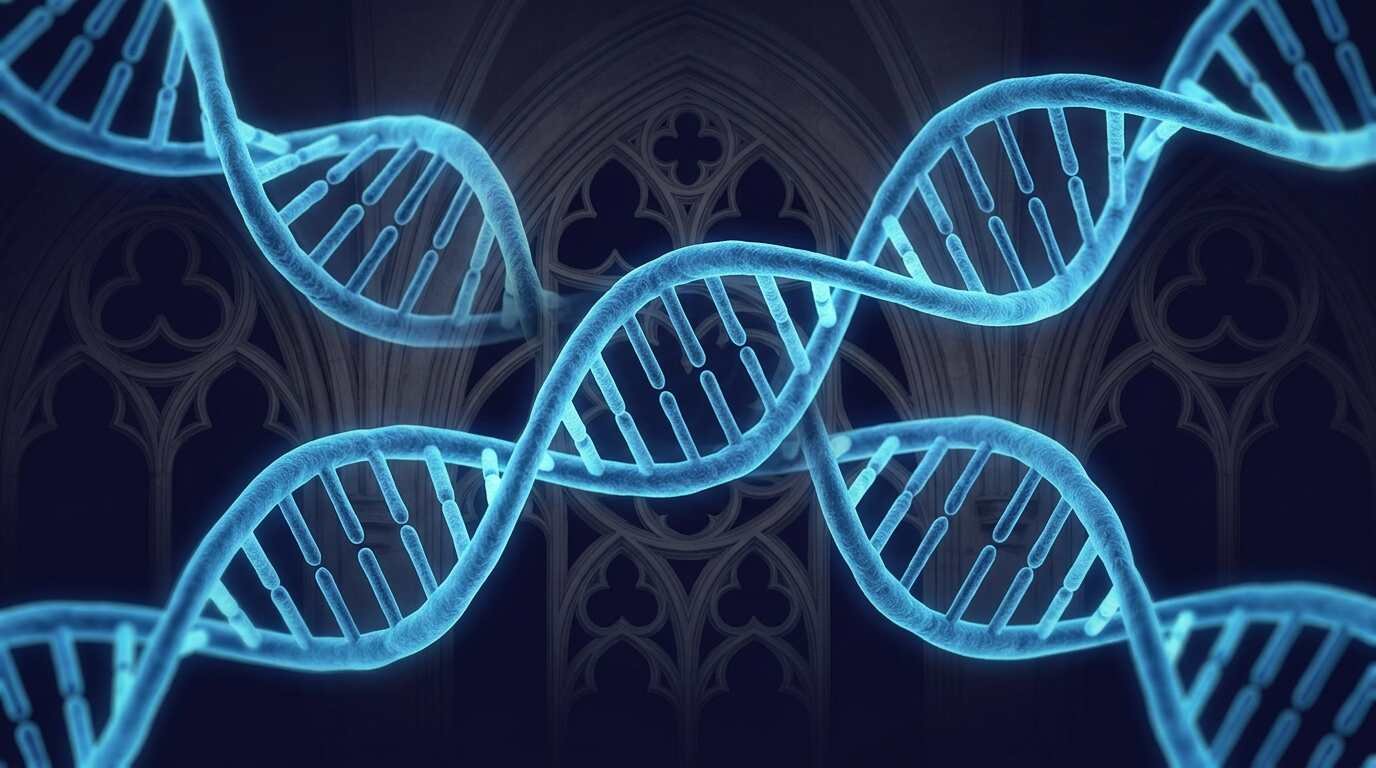
The genome tells us that human beings and chimpanzees share a common ancestor. It tells us that evolution is a historical process leaving a traceable record. It tells us that the process was not linear, not directed toward humans, and not obviously concerned with us. What it does not tell us is whether the process was initiated, guided, or witnessed by anything. That question is not in the data. Gould knew this. Collins knows this. The disagreement is not about what the genome says — it is about what frame you bring to what the genome says.
That framing question is one I have been sitting with since my graduate work on evolutionary theory and memetics. The genome is a text. Whether it has an author is a question the text cannot answer about itself. What we can say — what the sequence data since 2000 has made increasingly clear — is that the text is stranger, more contingent, more riddled with the marks of time than either simple Darwinism or simple theism anticipated. The spandrels are real. The language is remarkable. Both things are true. They do not resolve each other.
I wrote about some of this in my review of The Selfish Gene — the book that first made the gene’s-eye view of evolution legible to me. And in looking at Freedom Evolves by Daniel Dennett, another thinker in this territory who takes the secular-mechanism position without apology. The conversation is not closed. It is, if anything, getting more interesting as the data accumulates.
You Might Also Like
The Extended Phenotype: How Your Genes Build Structures Beyond Your Body
The Theory of Evolution by John Maynard Smith — A Review
The Boltzmann Brain Paradox: When Statistical Physics Predicts You Shouldn’t Exist
Sources
Gould, S.J. (1999). Rocks of Ages. Ballantine Books.
Gould, S.J. & Lewontin, R. (1979). “The Spandrels of San Marco.” Proceedings of the Royal Society of London B, 205(1161): 581–598.
Gould, S.J. (2002). The Structure of Evolutionary Theory. Belknap Press.
Collins, F.S. (2006). The Language of God. Free Press.
BioLogos Foundation
Cold Spring Harbor Laboratory — Francis Collins oral history
Cold Spring Harbor Laboratory — Eugenics Record Office history
NOVA (PBS), Cracking the Code of Life (2001)
Wikipedia: Francis Collins