Walk into any Long Island supermarket — Stop & Shop in Smithtown, Whole Foods in Jericho, even the Costco in Melville — and you will find two types of ground beef sitting side by side in the meat case. One is labeled “grass-fed.” The other is not. The grass-fed package costs $2 to $4 more per pound. And you are left standing there, cart in hand, wondering whether that premium translates into anything you can actually taste, feel, or measure.
It is a question worth taking seriously because the grass-fed beef market has grown into a multi-billion-dollar industry. According to the USDA, consumer demand for grass-fed beef has increased steadily over the past decade, driven by health claims, environmental concerns, and a general cultural shift toward more “natural” food sources. But what does the science actually say? And does the difference survive the journey from pasture to pan to plate?
First, the Basics: What “Grass-Fed” and “Grain-Fed” Actually Mean
Nearly all cattle in the United States start life the same way: born on pasture, nursing from their mothers, and eating grass. The divergence happens later. Grain-fed cattle are moved to feedlots — called concentrated animal feeding operations, or CAFOs — where they are finished on a diet of corn, soy, and other energy-dense grains for the final 90 to 120 days before slaughter. This grain finishing accelerates weight gain and promotes the intramuscular fat known as marbling.
Grass-fed cattle, by contrast, spend their entire lives on pasture, eating grasses, forbs, and other forage. As N.C. Cooperative Extension explains, because grass-fed beef comes from animals eating a lower-calorie diet, it takes longer for them to reach market weight, which is one of the primary reasons grass-fed beef commands a higher price (N.C. Cooperative Extension, 2021).
An important distinction that many consumers miss: “grass-fed” and “grass-finished” are not always the same thing. Some beef labeled “grass-fed” may have been given grain supplements at various points in its life. “Grass-fed and grass-finished” means the animal ate nothing but forage from birth to slaughter. As a beef farmer from Feast and Farm explains, the terms grass-fed or grain-fed tell you nothing about how that cow was raised or its health at slaughter — only what it ate (Feast and Farm, 2023).
The Nutritional Differences: What the Research Actually Shows
The nutritional gap between grass-fed and grain-fed beef is real, measurable, and — depending on what metrics you care about — potentially significant. A landmark 2021 study led by Dr. Stephan Van Vliet at Utah State University, published as the Beef Nutrient Density Project, found that grass-finishing compared to grain-finishing increases a wide variety of health-promoting compounds in meat (Understanding Ag, 2022).
Specifically, the research showed that grass-fed beef contains higher concentrations of omega-3 fatty acids, which play important roles in heart and brain health. It also contains higher levels of conjugated linoleic acid (CLA), a fatty acid that has been associated in some studies with reduced body fat and improved immune function. Grass-fed beef was also found to be richer in phytochemicals — plant-derived bioactive compounds including polyphenols, tocopherols, and carotenoids — that were present in the meat as a result of the animal’s diverse forage diet.
A 2022 review published in Frontiers in Sustainable Food Systems confirmed these findings, noting that grass-fed beef contains a healthier fatty acid profile including more omega-3 polyunsaturated fatty acids and increased concentrations of phytochemicals desired by health-conscious customers. The study also noted higher levels of hippurate in grass-fed beef — a compound associated with improved gut microbial diversity and lower odds of metabolic syndrome in humans.
However — and this is an important however — the basic macronutrient profiles are quite similar. Both types provide roughly equivalent amounts of protein, zinc, iron, and B vitamins. The calorie difference is modest: grass-fed beef is leaner (typically 2 to 3 percent less total fat), which means slightly fewer calories per serving but also less of the marbling that contributes to tenderness and flavor.
The Taste Test: Where Opinions Diverge Sharply
If the nutritional debate has a clear winner, the taste debate emphatically does not. According to sensory studies conducted in Chicago and San Francisco and cited in a Frontiers review (2022), only about 23 percent of consumers preferred the taste of grass-fed beef over grain-fed. The majority found grain-fed beef to be juicier, more tender, and more consistently flavored.
Grass-fed beef is frequently described as having a more mineral-heavy, nuttier, and slightly gamier taste profile — a direct result of the diverse forage diet and the higher concentrations of omega-3 fatty acids (The MeatStick, 2023). Grain-fed beef, by contrast, tends to be milder, sweeter, and butterier, with the heavy marbling that American palates have come to associate with a “good steak.”
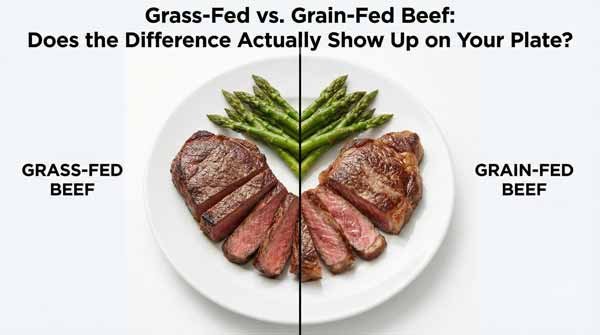
As a beef farmer candidly puts it: anyone who has grown up eating local beef knows the answer. Grass-fed beef usually tastes less rich and feels drier and tougher because it is so much lower in fat. Grain-fed beef has more fat, and that fat adds juiciness and flavor (Feast and Farm, 2023). This is not a knock against grass-fed beef — it is simply a recognition that the two products are genuinely different eating experiences.
For keto dieters specifically, the leaner profile of grass-fed beef means you may need to add supplemental fat (butter, olive oil, avocado) during cooking to meet your macro targets. Grain-fed ribeye, with its generous marbling, may actually be the more “keto-ready” product straight out of the package.
The Environmental and Ethical Dimensions
Grass-fed beef production generally requires more land per animal and takes longer to bring cattle to market weight, which has mixed environmental implications. On one hand, well-managed rotational grazing can improve soil health, sequester carbon, and support biodiversity. On the other hand, the lower efficiency of grass-based systems means more total land use per pound of beef produced.
Texas A&M University’s nutrition research notes that grass-fed cattle production is generally considered more sustainable but tends to be more expensive for farmers due to slower growth rates and lower slaughter weights (Texas A&M, 2024). The higher retail price reflects these real costs of production, not just marketing markup.
For consumers who prioritize animal welfare, grass-fed and pasture-raised systems generally offer cattle a more natural lifestyle — open pasture, fresh air, and the ability to engage in natural grazing behaviors. However, it is worth noting that the “grass-fed” label alone does not guarantee any specific welfare standards. Third-party certifications like the American Grassfed Association or Animal Welfare Approved provide additional assurance.
The Price Question: Is the Premium Justified?
On Long Island, grass-fed ground beef typically retails for $8 to $12 per pound, compared to $5 to $7 for conventional grain-fed. For steaks, the differential can be even steeper — a grass-fed ribeye might run $18 to $25 per pound versus $12 to $16 for grain-fed. Industry data suggests that grass-fed beef carries a premium of 20 to 50 percent over conventional options (The MeatStick, 2023).
Whether that premium is justified depends on your priorities. If you are primarily concerned with the omega-3 content and phytonutrient density of your beef, the research suggests that grass-fed delivers measurably more of these compounds. If you are primarily concerned with taste, tenderness, and value, grain-fed may be the better choice for your household.
A middle-ground approach that many Long Island families find practical: buy grass-fed for ground beef and stew meat (where the taste difference is less noticeable and the nutritional benefits still apply), and buy quality grain-fed for steaks and roasts (where marbling and tenderness matter most for the dining experience).
Watch: Grass-Fed vs Grain-Fed Beef Explained — Dr. Mark Hyman — A clear breakdown of the nutritional science behind grass-fed beef from a leading functional medicine physician.
The Plate Is the Final Arbiter
After reviewing the research, talking to farmers, and eating a lot of both types of beef, the honest answer to the title question is: yes, the difference shows up on your plate — but perhaps not in the way you expect. The nutritional differences are real and scientifically documented, but they are incremental rather than transformative for most people. The taste differences are genuine and, for many diners, point in grain-fed’s favor. The ethical and environmental considerations are meaningful but complex.
The best advice is to eat the beef you can afford, prepared well, from the most trustworthy source you can find. On Long Island, that might mean grass-fed ground beef from the Huntington farmers’ market, grain-fed ribeyes from Costco, or a mix of both depending on the week’s sales. As Healthline’s nutrition team concludes, both grass-fed and grain-fed beef are nutritious foods that can be part of a healthy diet (Healthline, 2019). The most important thing is that you are eating real food — and cooking it in a cast iron pan, naturally.
Related: Keto at a Steakhouse: What to Order, What to Skip, and What to Ask the Kitchen | Is Dirty Keto Worth It? What Happens When You Stop Caring About Food Quality | Keto Meal Prep for the Week Using Nothing But a Cast Iron Pan
Paola Meyer, Associate Broker, Realty Connect USA — Helping Long Island families find their perfect home. Search properties now