Somewhere north of the noise, two hours up the Hudson from Manhattan, where the Berkshire Mountains rise in the distance and heirloom rye bends in the wind like something out of an older America, there is a 1806 Georgian farmhouse that watches over a working distillery the way a grandfather watches over a craftsman’s bench — with quiet authority and the weight of everything it has seen. That house, and the hundred acres of rolling field below it, belong to Hillrock Estate Distillery — and what Jeffrey Baker built here is one of the most serious, most soulful expressions of American whiskey that this country has produced since Prohibition closed the door on a way of making spirits that had defined the Hudson Valley for generations.
I have thought about Hillrock the way I think about a well-constructed English bridle leather briefcase. Not the finished object alone, but the entire chain of intention behind it: the selection of the hide, the chemistry of the tannin, the years of slow transformation in a dark room. The whiskey in a Hillrock bottle follows the same logic. It begins with the soil.
From Breadbasket to Barrel: The History Behind the Mission
Before the word “craft” was attached to anything that could be sold in a boutique, before the Brooklyn distillery boom that turned reclaimed warehouses into tasting rooms, the Hudson Valley was America’s granary. In the early nineteenth century, New York produced more than half of the young nation’s barley and rye. Over a thousand farm distilleries operated across the region, each one an expression of its particular ground — the mineral content of its water, the character of its grain, the microclimate that shaped harvest after harvest. Then Prohibition arrived, and the whole tradition was dismantled. Not just slowed. Dismantled.
Jeffrey Baker grew up working on farms and came to the idea of Hillrock as a true farm advocate — someone who understood soil not as backdrop but as primary ingredient. He founded the distillery in 2011 on his family’s land in Ancram, a Columbia County town that sits in that particular Hudson Valley pocket where the air is clean and cold, the water runs clear, and the elevation creates a maturation environment that is, in the truest sense, unreplicable elsewhere. He wanted to revive what Prohibition had buried: a field-to-glass whiskey tradition in which every variable — from the heirloom seed to the final bottle — remained under one roof, on one estate.
To do it properly, he needed the right partner. He found him in David Pickerell.
David Pickerell: The Founding Father Who Left His Mark on Every Bottle
There are names in the American whiskey world that carry their own gravity, and David Pickerell’s name is perhaps the heaviest of them. A West Point graduate with a chemistry degree, a veteran of fourteen years as Master Distiller at Maker’s Mark — where he grew production twenty-fold and positioned the brand as one of America’s definitive bourbons — Pickerell left to become, as the industry came to call him, the “Johnny Appleseed of American Craft Distilling.” He consulted on more than a hundred distilleries. He helped restore George Washington’s distillery at Mount Vernon. He collaborated with WhistlePig, J. Rieger & Co., and eventually with Metallica on their Blackened American Whiskey, aging the liquid using low-frequency sound waves broadcasting the band’s music through the barrels — which is the kind of creative audacity that only a man with absolute technical confidence could attempt.
In 2010, Baker convinced Pickerell to come to Ancram. The pairing made complete sense: one man who understood every molecular dimension of fermentation, distillation, and barrel chemistry, and another who had the land, the vision, and the patience to let a whiskey become what it was meant to be. Together they would build something that had not existed in American distilling since before the Volstead Act: an estate that floor malted its own grain, distilled in a custom-built 250-gallon copper pot still, and aged the result with the obsessive attention of people who understood that time was not the enemy but the whole point.
Pickerell passed away on November 1, 2018, at 62 years old. His absence is felt in the industry the way a master craftsman’s absence is felt in a workshop — but his fingerprints are on every Hillrock bottle. The team he built continues his work with the reverence it deserves.
Floor Malting, Copper Stills, and the Art of Doing It the Hard Way
Most distilleries buy their malted grain. They purchase a standardized ingredient from a commercial maltster, removing one entire layer of the production process from their hands and their story. Hillrock does not do this. They malt their own grain — specifically, they floor malt it, which is the oldest and most labor-intensive malting technique in the world. Steeped barley is spread across a stone floor and turned, raked, and managed by hand over three to four days while it germinates. This controls the conversion of starch to fermentable sugar at a granular level that industrial drum malting simply cannot match.
This matters not as a technical footnote but as a philosophical statement. It is the distillery equivalent of hand-stitching a briefcase when a machine could close the same seam in thirty seconds. The choice to floor malt is the choice to maintain intimacy with the material, to refuse the shortcut, to accept that the slow method is the only method that produces a result you can truly call your own. Hillrock is the first American distillery since before Prohibition to revive this practice on-site. That distinction is not marketing — it is history in the most concrete sense.
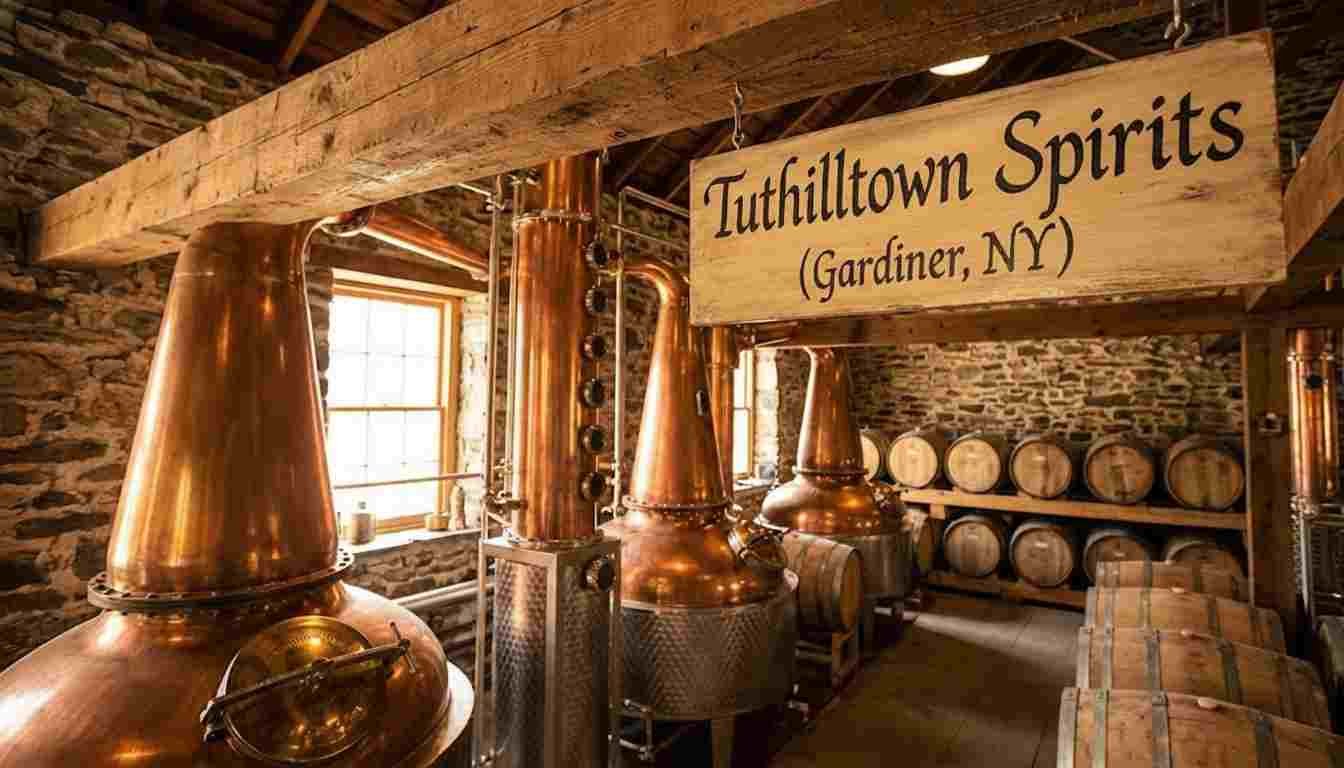
The spirits produced from this process are distilled in a custom copper pot still and then aged on the estate using a rotating cast of barrels that includes American oak, Oloroso sherry casks, and occasionally wine barrels from some of the country’s finest producers. The result is a portfolio of three core expressions that have earned Hillrock a place alongside the most decorated small distilleries in the country.
The Spirits: What’s in the Bottle
Solera Aged Bourbon — This is the flagship, and it is extraordinary by any standard. Hillrock produces what is widely credited as the world’s first Solera Aged Bourbon, a method borrowed from the sherry and port traditions of Jerez and the Douro, in which barrels are never fully emptied. New spirit is added to partially depleted casks, and the oldest whiskey is never separated from the youngest. The result is a product with an average age exceeding six years, finished in 20-year-old ex-Oloroso sherry barrels, arriving at 92.6 proof with a profile of honey, vanilla, caramel, dried fruit, and a long finish of toasted oak and warm spice. It is the kind of bourbon that makes you stop talking mid-sentence.
Estate Single Malt — Made entirely from estate-grown, floor-malted barley, this expression is Hillrock’s most direct argument for terroir as a concept in American whiskey. Reviewers consistently note its depth and complexity — stone fruit, malt, a hint of the earthiness that only comes from grain that grew in the same ground where the spirit was made.
Double Cask Rye — Hillrock’s rye is distilled from estate-grown grain and then finished in a second cask, typically a Cabernet Sauvignon barrel, which introduces a wine-derived layer of complexity that reads as dried cherry and baking spice over the rye’s natural peppery backbone. In a region that was once defined by rye production before Prohibition erased the tradition, this whiskey carries genuine historical weight.
Limited releases appear periodically — special barrel finishes, extended age statements, collaboration expressions — and they tend to sell out quickly. The estate ships throughout New York State via ShopHillrock.com.
The Estate Itself: A Place Worth the Drive
The physical experience of Hillrock is inseparable from the whiskey. The 1806 Georgian house — built by a grain merchant and Revolutionary War Captain, meticulously restored — crowns the property and looks down over the distillery complex and the rolling barley fields below. The Malthouse, Granary, and Visitor Center sit within walking distance of the copper still. On a clear day, the Berkshire Mountains appear in the distance, blue and steady, like a promise that the world beyond the Hudson is still beautiful.
Tours are available by reservation, and they are genuinely educational. Guests walk through the full production process, from the malting floor to the barrel house to the tasting room, and the guides — many of them with backgrounds in chemistry and brewing science — speak about the craft with the precision of people who genuinely love what they are doing. The tasting typically includes five to six expressions, and the estate’s most prized limited releases are often available exclusively on-site.
The Berkshire Mountains are two and a half hours from the North Shore of Long Island. That drive is not a detour — it is the point.
Recognition, Community, and the Legacy of a Vision
Hillrock has been recognized by sommeliers, whiskey critics, spirits competitions, and the kind of serious collectors who understand that authenticity cannot be engineered in a boardroom. The distillery counts among its admirers Honest Man Hospitality, the group behind the Hamptons institution Nick & Toni’s, which has poured Hillrock’s Estate Single Malt as a signature selection. Its products have been featured by the Financial Times, Cool Hunting, Drink Insider, and every serious publication that covers American craft spirits with appropriate gravity.
Jeffrey Baker’s early advocacy of the farm-to-table movement — years before the phrase became a restaurant menu cliché — connects directly to everything Hillrock represents. The same ethos that drove responsible ingredient sourcing in food has found its most rigorous expression in his distillery: grow your own grain, control every variable, refuse every shortcut, and trust that the people who care about these things will find you.
They have.
Practical Information
Address: 408 Pooles Hill Road, Ancram, NY 12502 Phone: (518) 329-1023 Email: info@hillrockdistillery.com Website: hillrockdistillery.com Online Shop: shophillrock.com Hours: Monday–Sunday, 11:00 AM – 5:00 PM (tours by reservation) Social: @hillrockestatedistillery on Instagram | Facebook
Tours can be reserved by contacting the distillery directly via email or phone. The Founder’s Tour is the most immersive option and includes an extended tasting with limited-release access. Amtrak service to Hudson Station provides a scenic alternative to driving, and the distillery is a reasonable car ride from the station.
A Final Reflection on What This Place Represents
Marcus Aurelius wrote that you should do everything as if it might be the last thing you do. Not from anxiety, but from the understanding that full attention is the only way to do anything properly. There is a version of that philosophy embedded in every decision Hillrock makes — in the choice to floor malt when drum malting would be cheaper and faster, in the choice to use a copper pot still when modern continuous stills would increase volume tenfold, in the choice to let a Solera barrel age and deepen across years when the market always wants more product sooner.
Hillrock is a reminder that the things built slowly, with full attention, in the right place, with the right hands — those things last. They do not compete with mass-market products. They occupy a different category entirely, the way a hand-stitched briefcase occupies a different category from a factory bag, or the way a 25-year neighborhood restaurant occupies a different category from a franchise. The category has no name, really. It is simply the category of things made with the intention of being worthy of the person who receives them.
That is what Hillrock is. And it is two hours north of the city, waiting.