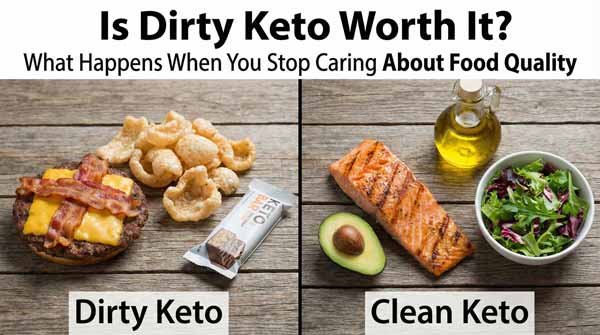
There is a joke in keto circles that goes something like this: “I lost 30 pounds eating bunless fast-food cheeseburgers and pork rinds.” The punchline is that it is not a joke — it is a real thing that happens, and it has a name. It is called dirty keto, and it is one of the most controversial developments in the low-carb world since somebody first put butter in coffee.
Dirty keto follows the same macronutrient framework as traditional keto — roughly 70 to 80 percent of daily calories from fat, 10 to 20 percent from protein, and 5 to 10 percent from carbohydrates (U.S. News & World Report, 2024). The critical difference is that dirty keto places no restrictions on food quality. If it fits your macros, it is in bounds. Bunless Wendy’s Baconators, gas station cheese sticks, sugar-free Jell-O — all fair game.
The question is not whether dirty keto can produce weight loss. The evidence is clear that it can, at least in the short term. The real question is what you sacrifice along the way — and whether the tradeoff is worth it.
The Appeal: Why Dirty Keto Has Millions of Followers
The appeal of dirty keto is almost embarrassingly simple: it is easy. There is no hunting for grass-fed beef, no calculating omega-3 ratios, no fermenting your own sauerkraut. You count carbs, keep them below 50 grams, and call it a day. As Matthew Black, a registered dietitian at Ohio State University Wexner Medical Center, explains, dirty keto followers believe they can have more freedom to eat whatever they want as long as they maintain a low-enough carbohydrate intake (U.S. News & World Report, 2024).
This accessibility has real value. For people who are overwhelmed by the precision of clean keto, dirty keto lowers the barrier to entry. It meets people where they are — at the drive-through, at the gas station, at the office break room — and says, “You can still do this.” The keto community site KetoLogic notes that the best type of keto diet is whatever works best for you and your lifestyle needs — whatever helps you make the keto lifestyle sustainable (KetoLogic, 2024).
And the weight loss results can be dramatic. Because carbohydrate restriction is the primary driver of ketosis — not food quality — dirty keto can produce the same metabolic shift as clean keto. Your body does not distinguish between the ketones generated from a grass-fed ribeye and those generated from a fast-food burger patty.
The Science of What You Are Missing: Micronutrients, Phytonutrients, and Fiber
Here is where the story gets more complicated. While your body may not care about the source of its ketones, it cares deeply about the source of its vitamins, minerals, and antioxidants. And dirty keto, by its nature, tends to fall dramatically short in these areas.
A 2021 review published by Cambridge University Press linked chronic consumption of processed foods with increased systemic inflammation, which is itself a risk factor for depression, cardiovascular disease, and metabolic syndrome. Healthline (2024) reports that dirty keto followers are at elevated risk for deficiencies in calcium, magnesium, zinc, folic acid, and vitamins C, D, and K — nutrients that are abundant in whole vegetables, nuts, and quality animal products but largely absent from processed convenience foods.
Perhaps more importantly, research suggests that the body absorbs and utilizes nutrients more effectively from whole foods than from supplements (Healthline, 2024). You can take a magnesium pill, but your body processes the magnesium in a handful of almonds differently — and, according to multiple studies, more efficiently.
Fiber is another critical gap. Dirty keto diets tend to be extremely low in fiber because they replace vegetables with processed alternatives. A 2013 study in the European Journal of Pain demonstrated that diets high in processed foods produced measurably higher levels of inflammatory markers in animal models compared to whole-food diets — even when macronutrient ratios were identical.
The Sodium Problem and the Inflammation Question
Processed foods are, almost universally, high in sodium. A single fast-food bacon cheeseburger (without the bun) can contain 800 to 1,200 milligrams of sodium. Multiply that across three meals a day and you are easily exceeding the American Heart Association’s recommended daily limit of 2,300 milligrams.
The Lakanto nutrition team notes that dirty keto is much higher in sodium overall, resulting in higher risk of hypertension and heart disease compared to clean keto approaches (Lakanto, 2021). When you combine excess sodium with the dehydrating effects that many keto dieters experience during the initial adaptation phase, the cardiovascular risks compound.
Inflammation is the less visible but potentially more significant concern. Processed vegetable oils (soybean, canola, corn) are staples of dirty keto cooking at fast-food restaurants, and these oils are high in omega-6 fatty acids. While omega-6 fats are not inherently harmful, an imbalanced omega-6 to omega-3 ratio — common in processed food-heavy diets — has been consistently linked to chronic inflammation in the medical literature.
The Psychological Dimension: Does Dirty Keto Build Bad Habits?
There is a subtler argument against dirty keto that goes beyond nutrition science. Clean keto, with its emphasis on whole foods and mindful preparation, tends to change your relationship with food. You learn to cook. You become familiar with ingredients. You develop an intuitive sense for what your body needs. Dirty keto, by contrast, can reinforce the same convenience-driven patterns that contributed to weight gain in the first place.
As the team at 310 Nutrition points out, over time, eating heavily processed meals can raise your chance of developing heart disease and inflammation — and the nutrient deficits can compound into more serious health problems (310 Nutrition, 2023). The short-term weight loss may mask long-term metabolic damage that only becomes apparent when you return to a standard diet.
That said, context matters enormously. A busy parent working two jobs on Long Island who maintains ketosis through convenience foods is making a fundamentally different calculus than someone with the time and resources to source organic, grass-fed everything. Dirty keto can serve as a valuable on-ramp — a way to experience the benefits of carb restriction and then gradually upgrade food quality over time.
The Middle Path: Strategic Dirty Keto
The most practical approach, according to multiple nutritionists and the keto community at large, is what might be called strategic dirty keto. The core idea is simple: eat clean when you can, go dirty when you must, and never let perfection become the enemy of progress.
Keto Mojo (2024) recommends aiming for a mostly clean diet while acknowledging that there is a place for convenient keto foods when you are traveling, rushed, or just in need of some simplicity. The emphasis on food quality as much as possible, even when eating dirty, ensures your body still receives some essential nutrients.
Practical strategies include: keeping clean keto snacks (nuts, cheese, hard-boiled eggs) prepared in advance for busy days; using dirty keto only as an emergency fallback rather than a default; and gradually replacing processed staples with whole-food alternatives as your cooking skills and schedule allow.
Watch: Dirty Keto vs Clean Keto Explained — Dr. Eric Berg — A detailed comparison of the two approaches with practical advice for finding your balance.
The Verdict: Worth It, With Asterisks
Is dirty keto worth it? The answer depends entirely on your goals, your timeline, and your starting point. If your primary objective is rapid weight loss and you are coming from a standard American diet of 300-plus grams of carbs per day, dirty keto is a massive improvement that will produce real results. If your goals extend to long-term metabolic health, cognitive function, reduced inflammation, and sustainable well-being, clean keto is the clearly superior path.
The best approach for most people is to start wherever you can, stay in ketosis, and steadily improve your food quality over time. As Bulletproof founder Dave Asprey puts it, clean keto emphasizes food quality, and that quality shows up in every system of your body — energy, mood, skin, sleep, and long-term disease risk (Bulletproof, 2024). The macros get you into ketosis. The food quality determines what ketosis does for you.Related: Keto at a Steakhouse: What to Order, What to Skip, and What to Ask the Kitchen | Grass-Fed vs. Grain-Fed Beef: Does the Difference Actually Show Up on Your Plate?