
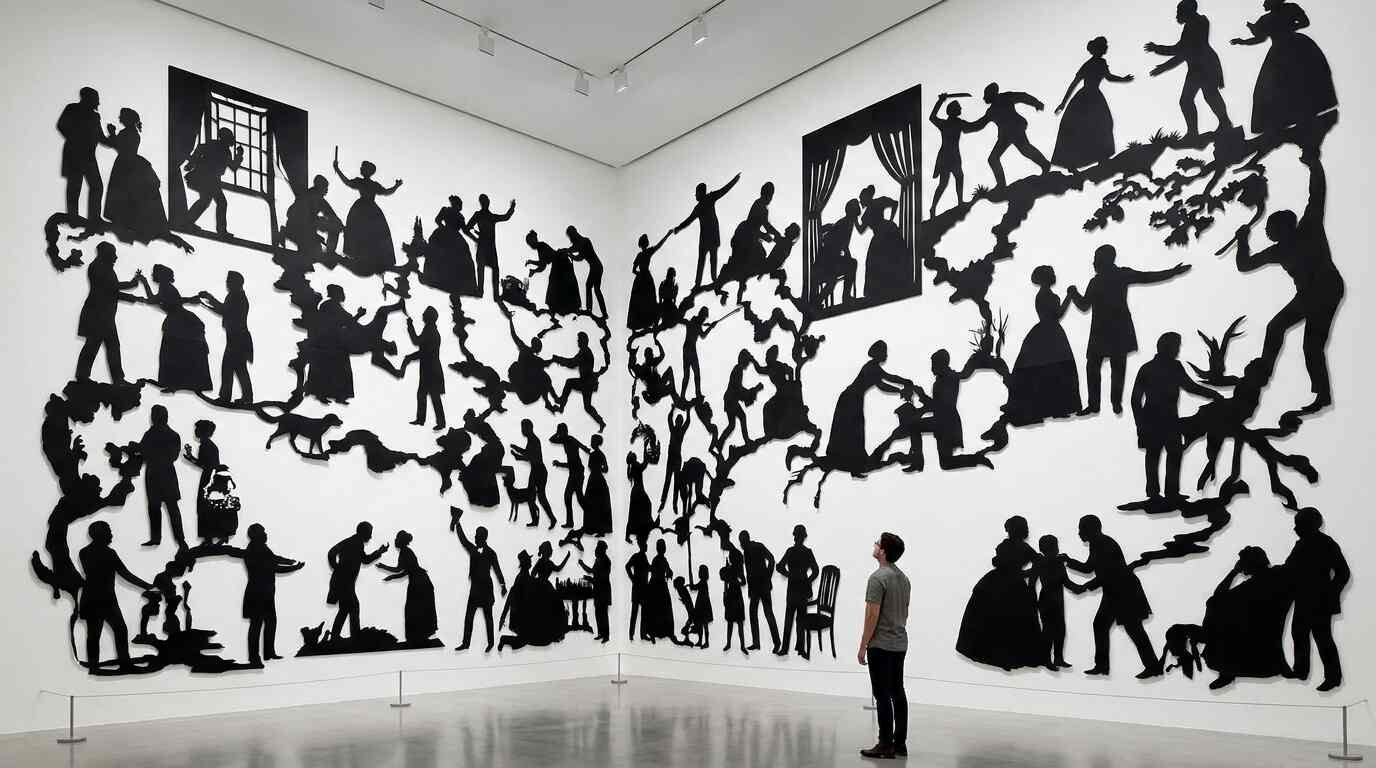
You walk into the room and it looks almost decorative. Then you read what’s happening in the image and your stomach drops. That’s the whole point.
Kara Walker understood something most artists spend careers trying to figure out: the container shapes what the contents do to you. She chose the silhouette — a format associated with Victorian parlors, children’s book illustrations, genteel 18th-century portraiture — and filled it with the unprocessed, uncomfortably specific violence of American slavery. The elegance of the form is not accidental. It’s the setup. The drop is the content. And by the time your stomach lands, you’ve already looked long enough to be implicated.
That’s the mechanism. That’s how she does it. And it’s been working for thirty years.
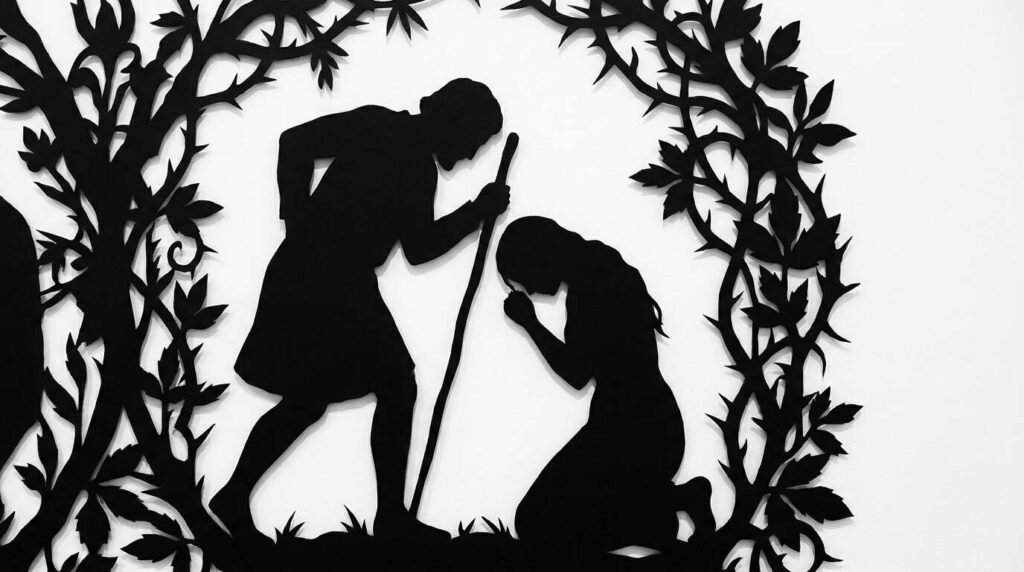
The Silhouette Was a Genteel Art Form. Walker Used It as a Weapon.
The silhouette portrait peaked in the late 18th and early 19th centuries, when it was the affordable option for people who couldn’t commission a painted portrait. A good silhouette artist could produce a likeness in minutes. The format carried no social weight beyond that — decorative, accessible, slightly quaint. By the time Walker encountered it as a graduate student at the Rhode Island School of Design in the early 1990s, the silhouette was essentially a relic.
She chose it deliberately. Walker has said that she gravitated toward cut black paper because it was a “second-class kind of art form” — one that she saw as resonant with the idea of not counting, of mattering less. She was, as she described it, looking for forms that would reflect a certain cultural erasure, and then deploy that erasure against itself. The silhouette gave her anonymity and visibility simultaneously. The figures are Black against white. They’re also shadows — defined by absence, by what light skips over.
What she put inside that formal container was something the format had never been asked to hold: elaborate, large-scale tableaux depicting plantation life, sexual violence, racial degradation, and the mythologies that American culture has always used to metabolize its history of slavery without confronting it directly. The results cover gallery walls, sometimes entire rooms. The imagery is drawn from antebellum genre paintings, plantation romances, historical accounts, and the visual archive of racist caricature — all of it pressed flat, stripped of color, rendered in the same gentle format used for profile portraits in wealthy homes.
The scholar Gwendolyn DuBois Shaw has written that Walker’s silhouettes make spectatorship itself part of the work — that there is no neutral position from which to encounter what’s happening in these images. The racial and cultural identity of the viewer shapes what they see and how they experience it. That instability is structural to the piece.
What the Black-and-White Format Actually Does to the Viewer
Color does a lot of protective work in figurative art. It keeps scenes at a representational distance. It gives the eye somewhere to go that isn’t the subject. Black and white — especially in this extreme binary of cut paper, where the figures are pure silhouette against a white wall — removes that protection completely.
Walker’s forms are unmistakably human in shape, even at the level of crude caricature. The poses tell stories. The spatial relationships between figures encode power and violation. And because there is no color, no texture, no gradation, the viewer’s eye is pulled immediately to the geometry of the scene. What’s happening here? What is that figure doing to that one? The brain reads body language and spatial composition before it reads moral content, which means you’ve already understood what you’re looking at before you’ve decided whether you should be looking at it.
This is not shock art in the sense of transgressive spectacle. The offense in Walker’s work is structural, not sensational. It doesn’t hit you like a slap. It works more like a sustained quiet pressure, the kind that doesn’t feel like pain until you move. By then you’ve been standing in the room for twenty minutes, looking at things you’ve been looking at all along, and the question the work is actually asking — what does your looking mean? — has already been answered by the fact that you stayed.
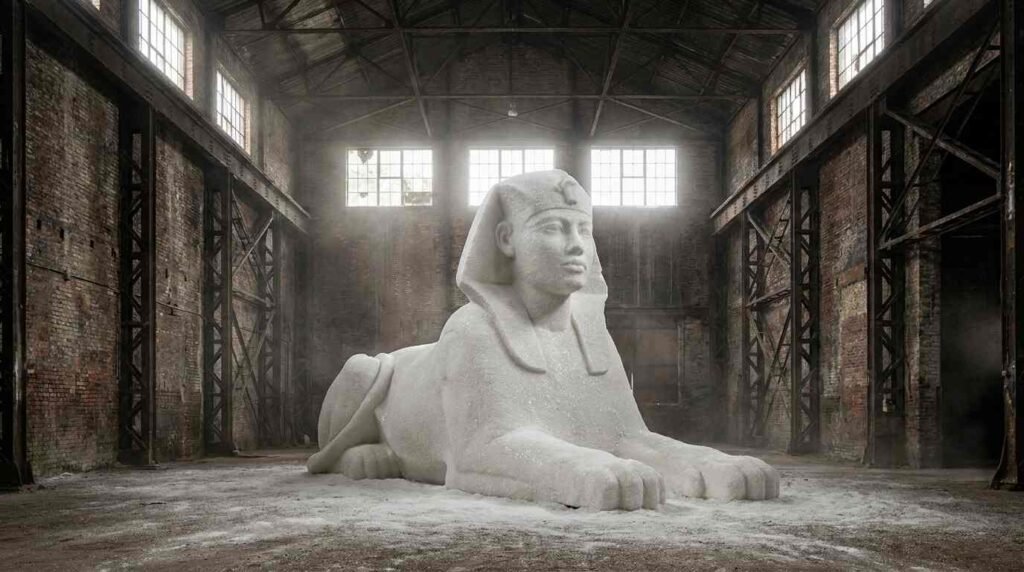
The Sugar Sphinx and What That Scale Was Saying
In 2014, Walker scaled up in a way that made everything visible at once.
Commissioned by Creative Time and installed in the former Domino Sugar Refinery in Williamsburg, Brooklyn, A Subtlety, or the Marvelous Sugar Baby was a monument — 75 feet long, 35 feet tall, constructed from 330 blocks of polystyrene and coated with approximately 80 tons of white granulated sugar donated by Domino Foods. The figure was a sphinx-like sculpture of a Black woman rendered in the Mammy archetype: kerchief, exaggerated features, posed to serve. She presided over a 30,000-square-foot industrial space where the walls were still stained with molasses from a century of sugar processing. Surrounding her were fifteen smaller male attendant figures, five of solid sugar, the rest resin coated in molasses. The attendants repeatedly collapsed in the summer heat and had to be rebuilt — a fact that Walker noted without pretending it was unplanned irony.
Over 130,000 people visited the installation before it closed. Frieze magazine later ranked A Subtlety third on its list of the 25 best works of the 21st century. The installation space itself had been the largest operating sugar refinery in the world during the mid-19th century — a facility whose profits were directly tied to the slave trade in sugar that Walker’s work was addressing. The building was slated for demolition. Creative Time reached out to Walker specifically because of the obvious historical layering.
Walker entered the project not to deliver a monument to suffering but, as she described it, to make an object that would “force you to rethink everything you think you know about yourself and shakes you to your core.” The sphinx’s left hand was preserved after demolition. It remains in her gallery. It’s twisted into a figa — a gesture that functions variously as a protection against evil, a fertility symbol, and an obscene insult, depending on which culture you’re referencing. Walker left that ambiguity deliberately in place.
How Walker Learned to Make You Complicit Before You Realize It
The mechanism of complicity in Walker’s work is worth dwelling on because it’s what separates her from artists who simply make difficult art about difficult subjects.
Difficult subject matter, handled straight, produces a particular viewer response: sympathy, discomfort, the moral satisfaction of being troubled by the right things. Walker’s work doesn’t produce that. It produces something less comfortable, because it implicates the viewer in the act of looking. The imagery is drawn from the same visual culture — sentimental plantation fantasies, racist caricature, the romanticized iconography of the antebellum South — that the culture at large has always consumed without reckoning with its content. Walker doesn’t indict that visual culture from the outside. She inhabits it. She makes you inhabit it with her.
The controversy that followed her early work — particularly the criticism from older African-American artists who accused her of producing pornography that white audiences could enjoy without guilt — was not simply generational conflict. It was a genuine argument about strategy. Was Walker’s work reclamation or capitulation? Was she subverting racist imagery or reproducing it for a predominantly white art market? Walker has never resolved this argument. She’s left it open, inside the work itself, as part of the work’s function.
She received the MacArthur Fellowship in 1997 at age 28, one of the youngest recipients in the award’s history. The speed and enthusiasm with which the predominantly white art establishment embraced her was itself part of the problem, and part of the point.

Why Museums Keep Buying Her Work and What That Tension Means
Walker’s work is held by the Museum of Modern Art, the Metropolitan Museum of Art, the Guggenheim, and Tate Modern in London, among many others. Her 2007 survey exhibition My Complement, My Enemy, My Oppressor, My Love was organized by the Walker Art Center and traveled to the Whitney. Her Tate Modern commission Fons Americanus — a large-scale fountain installation addressing colonialism and the transatlantic slave trade — arrived in 2019. The institutional appetite for her work has never flagged.
This is, as the Los Angeles Review of Books noted during the A Subtlety run, part of the problem the work is interrogating. Museums are not neutral spaces. Galleries are not neutral spaces. The white cube and the restored industrial ruin both carry their own histories of capital, taste, and power. When institutions buy Walker’s work and hang it on their walls, they are not simply supporting important art. They are also, as the work itself keeps pointing out, doing something with their looking. Participating in something. The question of what that participation means — for the institution, for the collector, for the viewer — is not resolved by the purchase. It’s opened by it.
Walker appears to find this tension generative rather than paralyzing. She has continued expanding her medium over three decades — film, animation, large-scale sculpture, painting, watercolor, printmaking. Her 2019 Tate commission was the largest work she had produced since A Subtlety. Her work has been exhibited on nearly every continent. None of it has resolved into a simple moral position, which is precisely what makes it art instead of argument.
There is a kind of art that tells you what to feel and confirms that you felt it correctly. Walker doesn’t make that kind. She makes the kind that follows you home and asks the wrong question at the right moment.
Sources
– Kara Walker — Wikipedia – A Subtlety — Wikipedia – Creative Time — A Subtlety project documentation – Harvard Gazette — A Bittersweet Confection (2014) – Los Angeles Review of Books — Kara Walker: A Subtlety at the Domino Sugar Factory – Sikkema Jenkins — Afterword exhibition documentation – Walker Art Center — Mack Lecture: Kara Walker – MacArthur Foundation Fellowship documentation, 1997