He takes the check from a gallery sale and buys a burned-out building on the South Side. Then he fills it with an archive, a listening room, a kiln. The art is what funds the infrastructure.
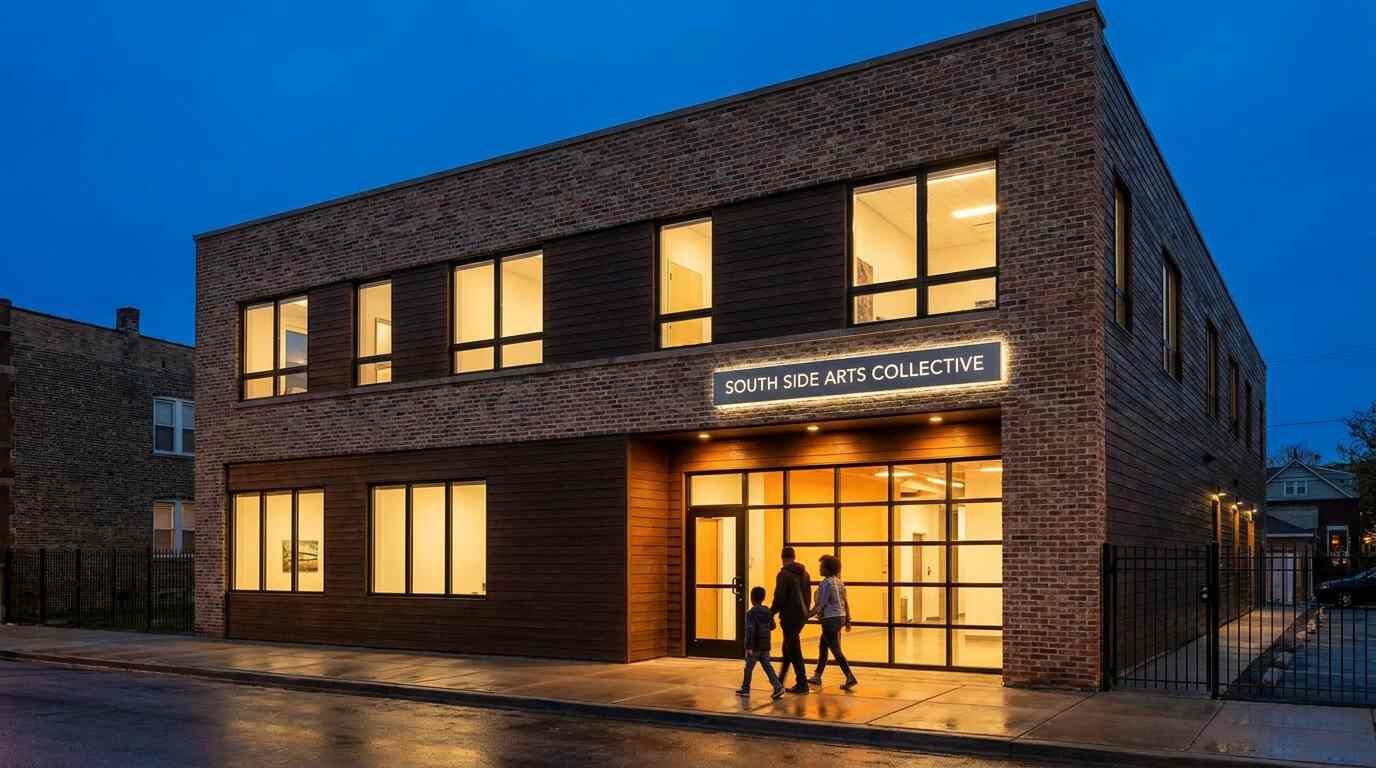
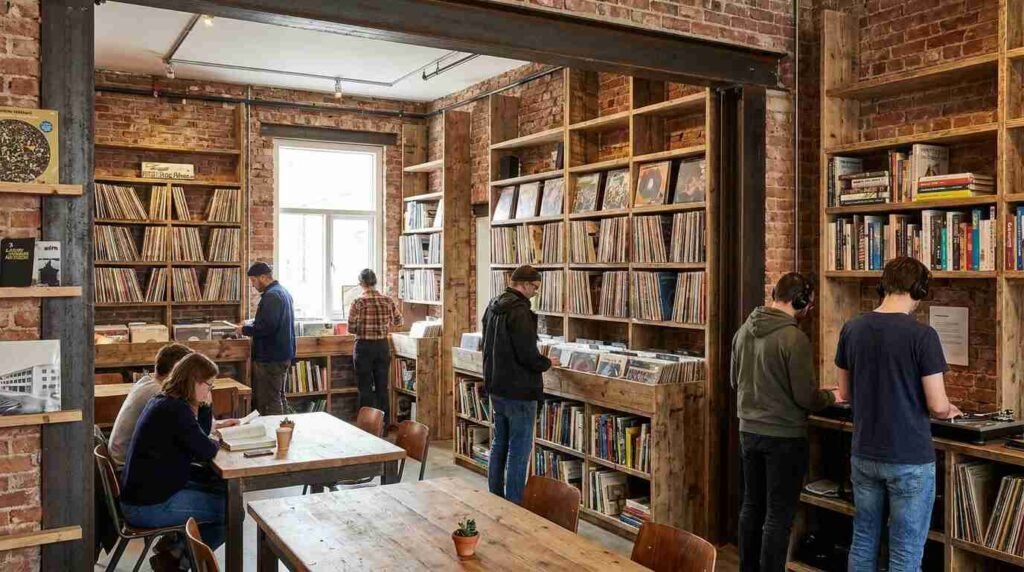
There is a building on the South Side of Chicago that holds 14,000 architecture books from a defunct bookseller, 8,000 vinyl records from the final inventory of Dr. Wax Records, and a collection of slides from the University of Chicago and the Art Institute. The building used to be a candy store. Theaster Gates bought it, renovated it with salvaged materials, and named it the Listening House. It is not a gallery. It is not a library in any formal sense. It is a community archive and gathering space, maintained by the Rebuild Foundation, the nonprofit Gates founded in 2009 and which has since grown into an organization managing multiple South Side properties including the Archive House, the Stony Island Arts Bank, the Black Cinema House, and the Dorchester Art and Housing Collaborative.
The art world has spent fifteen years trying to decide what category this belongs to. Socially engaged art. Community development. Philanthropy. Institutional critique. None of these frames quite fit, and the difficulty of categorization is not a weakness of the work. It is the work.
What the Dorchester Projects Actually Are and How They Started
Gates grew up in East Garfield Park on the West Side of Chicago. His father was a roofer, his mother a teacher. He studied urban planning and ceramics at Iowa State University, spent time studying ceramics in Tokoname, Japan in the late 1990s, earned a master’s in urban planning and a master’s in religious studies from Iowa State and the University of Chicago respectively, and eventually joined the faculty at the University of Chicago. The hybrid background — urban planning, ceramics, religious studies — is not incidental. It is what makes the practice possible.
The Dorchester Projects began around 2006 when Gates acquired a derelict building on Dorchester Avenue in Chicago’s Grand Crossing neighborhood, on the South Side. He paid approximately $16,000 for what became the Archive House. He renovated it using salvaged and reclaimed materials, installed the 14,000 architecture books, and opened it to the neighborhood. A second acquisition followed — the building that became the Listening House — and the logic of the project clarified itself: each building would house a specific kind of cultural archive or resource, and each would be open as a community space rather than a private collection.
The Rebuild Foundation gained 501(c)(3) nonprofit status in December 2010. Under Gates’s leadership, it has since grown to include the Stony Island Arts Bank — a former bank building that Gates purchased from the City of Chicago in 2013 and renovated to house the Johnson Publishing Company archive (publisher of Ebony and Jet), the record collection of house music pioneer Frankie Knuckles, and a permanent exhibition and events program — and the Dorchester Art and Housing Collaborative, a mixed-income residential development on former Chicago Housing Authority land in Greater Grand Crossing that provides 32 townhomes with an arts center at its core.
These are not art installations. They are buildings. They are operational community institutions. The question of whether they are “art” is the question Gates has deliberately left open.
How He Uses Art Sales to Fund Community Real Estate
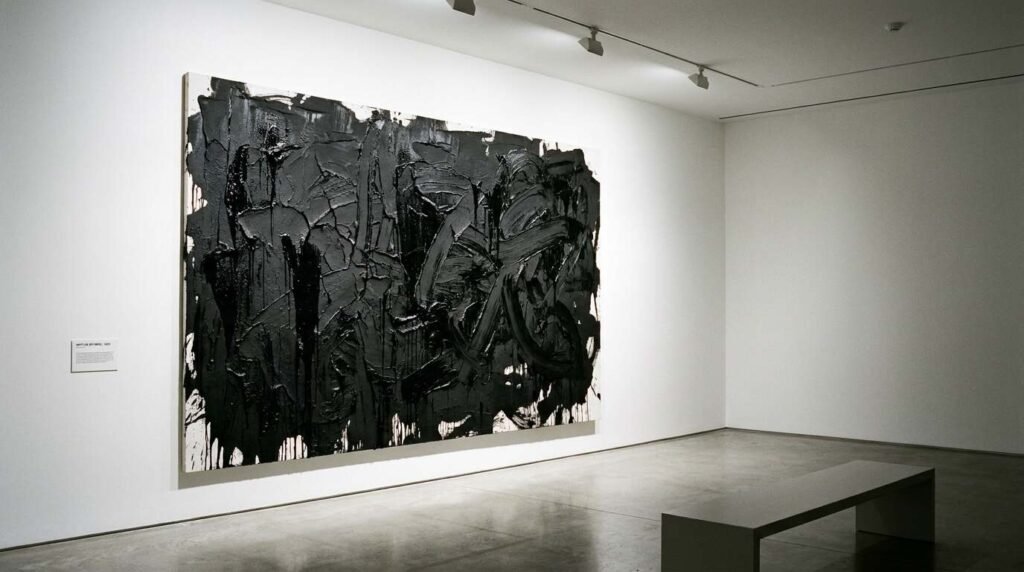
Gates makes objects. Ceramic vessels. Tar paintings. Salvaged-material sculptures. These objects are shown in galleries and museums worldwide, represented by White Cube and Gagosian — two of the most commercially powerful gallery operations in the contemporary art world. They sell for significant sums.
The money from those sales funds the real estate operations. This is not a secondary outcome or a coincidence. It is the model, stated clearly by Gates in multiple contexts. The gallery is the mechanism that generates the capital. The capital goes into buildings. The buildings become cultural infrastructure for communities that have been systematically disinvested.
The calculus involves some uncomfortable arithmetic. For the Dorchester Art and Housing Collaborative, Gates partnered with Brinshore Development, the Chicago Housing Authority, and Rebuild Foundation to redevelop the site of the former Dante Harper housing project into 32 mixed-income rental townhomes with a central arts center, dance studio, public meeting space, and community garden. The City of Chicago contributed $3.5 million. The CHA provided the land. Brinshore brought development expertise. Gates and Rebuild Foundation brought the institutional architecture and the cultural programming. Artists were selected to live in five of the units, with a requirement to contribute ten volunteer hours per month to Rebuild’s programming.
The funding model means Gates’s commercial market success is not incidental to the social project — it is what makes the social project possible. He has said directly that the gallery relationships are not separate from the community work. They are the same thing, running in different registers simultaneously.
The Influence of Japanese Pottery and Black Church Music on the Same Practice
Gates’s early pottery practice was shaped by time in Tokoname, Japan, one of Japan’s six ancient kiln sites and a center of traditional ceramic production. He studied there in the late 1990s, absorbing a tradition in which ceramic craft is understood as continuous with spiritual practice and community life — not decorative, not luxury goods, but a discipline that connects making to meaning in ways that Western fine art categories struggle to accommodate.
Black church music is the other major influence, and Gates has been explicit about this. He grew up in and around Black church traditions in Chicago. The music — gospel, spiritual, the call-and-response structure of communal worship — informs both his own musical practice (he performs with his ensemble the Black Monks) and his understanding of what art can do in community. The church is, among other things, an institution that holds a community together, that provides gathering space and cultural continuity and resources in places where those resources don’t otherwise exist. Gates is building secular institutions with similar functions.
His tar paintings — large abstract works using roofing tar as a primary medium, referencing both minimalist abstraction and the labor of his father’s trade — hold this tension explicitly. They look, from a distance, like serious objects in the conversation of post-painterly abstraction. Up close, the material is literally what roofers use. The formal vocabulary is Western and contemporary; the material is working-class and Black and familial.
What Institutions Like the Rebuild Foundation Actually Do on the Ground
The Rebuild Foundation’s operational portfolio in 2026 includes seven distinct projects in Chicago. Each one is a functioning institution rather than a completed work. Programs run. Buildings are maintained. Residents live in the housing. Events happen at the Stony Island Arts Bank.
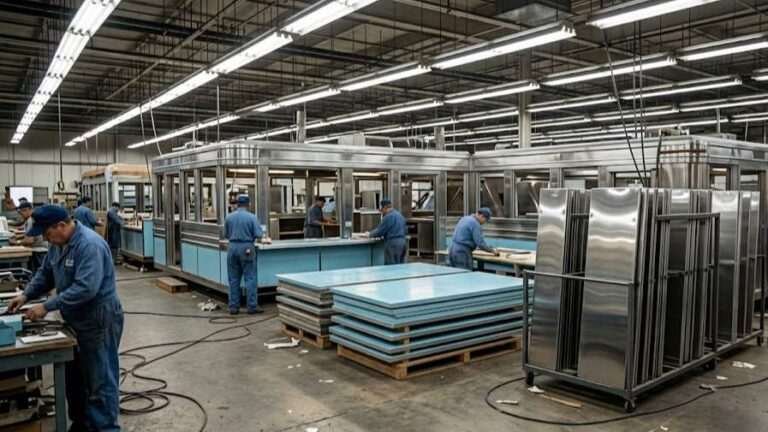
The Dorchester Industries component — founded 2016 — functions as a vocational training program embedded in the art practice. Salvaged materials donated by the City of Chicago are used to produce furniture, architectural elements, and artworks by participants who are learning trades and craft skills. It is simultaneously a production studio, a job training program, and an art operation. The people who come through it are South Side residents, and the skills they gain are transferable to construction, design, and the trades.
The Archive House — 14,000 architecture books — serves researchers, students, and community members. The Listening House — 8,000 records, the Dr. Wax inventory — is a resource for music and a gathering point. The Black Cinema House, located at the Chicago Public Library’s Greater Grand Crossing Branch, hosts screenings and programming focused on Black film culture. These are not museums in the traditional sense. They are archives that are alive because the community can use them.
This is what Gates means when he says he is more interested in activating the potential already existing in a community than in creating something new from nothing. The books were already in Chicago. The records were there. The buildings existed, abandoned and derelict. What he is doing is providing the structure — organizational, financial, architectural — that allows those resources to function as community goods rather than sitting unused or being lost.
The work at the Stony Island Arts Bank makes me think about what it means to build something that stays. Running the Heritage Diner for twenty-five years teaches you that a building people depend on is different from a business that serves people. The obligation is different. Gates has built institutions that have that obligation now. They have to keep working. That’s a different kind of art.
Why the Art World Keeps Trying to Frame This as Philanthropy Instead of Practice
The philanthropy frame is comfortable because it lets the art world maintain its categories. If Gates is a philanthropist who happens to make art, then the gallery objects are the art and the community buildings are the good deeds. The objects can be evaluated on formal grounds. The community work can be admired from a distance.
Gates has resisted this framing consistently. In interviews and critical conversations, he has positioned the community work as continuous with the object-making, not separate from it. The tar painting and the Listening House are made by the same person operating from the same set of values and the same body of knowledge. The separation is an artifact of how the art world needs to organize what it sells — as discrete objects with clear provenance, not as ongoing operations that don’t fit neatly into a collector’s home.
The more honest framing is that Gates is practicing something that doesn’t have a settled name. Social practice art has been the critical category most frequently applied, and it is accurate as far as it goes. But social practice as an art world category tends to preserve the assumption that the art is the activity and the social good is the byproduct. In Gates’s work, the relationship is more integrated than that. The kiln matters. The building matters. The community that uses both matters. These are not illustrative. They are the work.
The retrospective Theaster Gates: Unto Thee at Chicago’s Smart Museum in 2025 was described as the first large-scale attempt by a Chicago institution to place a traditional museum framework around an artist best known for twenty years of non-traditional, not-always-gallery-obvious work. That’s an honest description of the difficulty. And it may be that the most significant art Gates is making is the difficulty itself — the sustained refusal to let the object and the community be separated into the categories the market finds most convenient.
The parallel that keeps coming to mind: El Anatsui’s bottle cap tapestries make an argument about colonial trade not by illustrating it but by being made of it. Gates makes an argument about disinvestment not by depicting it but by doing something about it with the same hands and the same capital that make the gallery work. Both artists are operating in the space where the material and the argument are inseparable. The art world finds this inconvenient. The work doesn’t care.
You Might Also Like:
- El Anatsui Weaves Bottle Caps Into Tapestries Worth Millions
- Basquiat’s Crown Symbol: What the Three-Point Mark Actually Meant to the Kid from Brooklyn
- When the Museum Leaves Its Walls: The Power of Traveling and Pop-Up Exhibitions in Public Spaces
Sources:
- Rebuild Foundation — Wikipedia
- Theaster Gates — Wikipedia
- Theaster Gates official site — Projects
- City of Chicago — Mayor Emanuel, CHA Announce Grand Opening of Dorchester Art + Housing Collaborative
- IFF — Dorchester Art + Housing Collaborative
- Artwizard — Theaster Gates: From Chicago Roots to Dorchester Projects
- White Cube and Gagosian Gallery — artist representation documentation
- Smart Museum of Art, University of Chicago — Theaster Gates: Unto Thee (2025) exhibition records