He studied the Western painting tradition carefully. Then he put it back together with the people it left out. That’s not activism dressed up as art. That’s craft with a long memory.
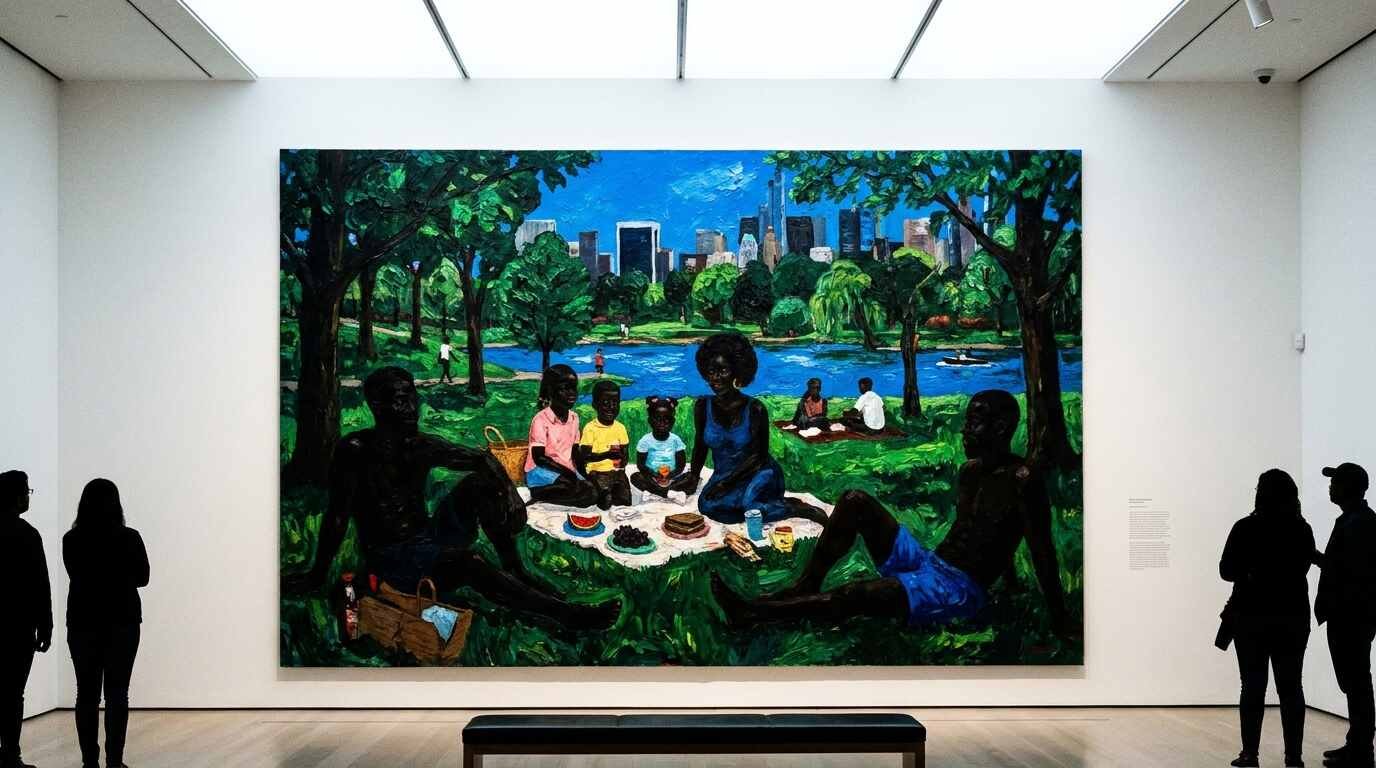
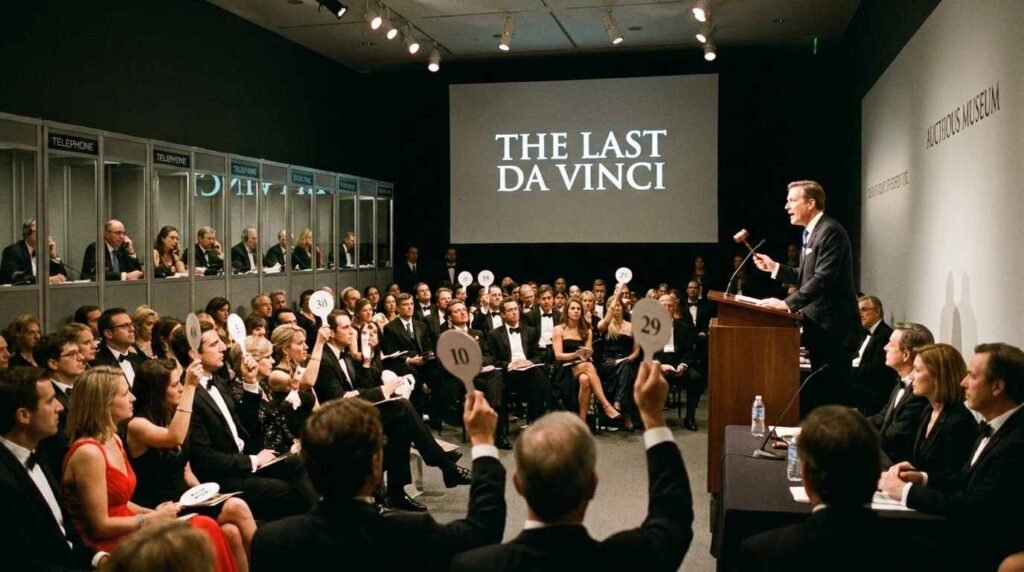
In May 2018, a painting called Past Times sold at Sotheby’s New York for $21.1 million. The work — acrylic and collage on unstretched canvas, made in 1997 — shows a Black family in an urban park by a lake, taking in the day. People golfing and water skiing in the background. A leisure scene. It had been hanging in McCormick Place, Chicago’s convention center, since a public arts authority bought it from a Los Angeles gallery for $25,000. The convention center eventually decided the insurance and security costs for a painting now worth that much exceeded their institutional mission. So they sold it. Sean Combs — Diddy — won the phone bidding war. The hammer came down, there was applause in the room, and Kerry James Marshall became the highest-priced living African American artist at auction.
The number matters because of what it took to get there. Marshall had been doing this work for thirty years before that auction. Thirty years of large-scale, technically demanding, philosophically serious paintings of Black figures in the Western tradition. The market wasn’t looking yet. Then it was.
The Watts Riots, Birmingham, and the Childhood That Built the Work
Marshall was born in Birmingham, Alabama in 1955. His own words about this are direct: “You can’t be born in Birmingham, Alabama in 1955 and grow up in South Central near the Black Panthers headquarters, and not feel like you’ve got some kind of social responsibility.” He moved to South Central Los Angeles as a child, grew up in Watts in the years after the 1965 uprising, attended the Otis College of Art and Design, and graduated in 1978.
The civil rights movement wasn’t history when Marshall was growing up. It was the present. The Panthers were organizing in his neighborhood. The aftermath of Watts was the landscape he walked through. This is not background detail. It is the foundation of everything that came after. An artist who spent his formative years watching Black political life assert itself in contested American space, and who then spent his adult career insisting that Black figures belong in the space of Western art history — that continuity is not a coincidence.
What’s notable about Marshall’s work is that it doesn’t look like protest art in the conventional sense. It looks like paintings. Ambitious, formally rigorous paintings that know their Manet, their Velázquez, their genre painting tradition, their post-painterly abstraction. The politics are embedded in the content, but the execution is the business of someone who has studied seriously and practiced seriously and expects to be evaluated on those terms.
What He Learned from Art History That He Decided to Correct
Marshall has been explicit about his project in interviews and critical conversations over three decades. He observed that the Western painting tradition — the canonical tradition taught in art schools, hung in major museums, discussed in the dominant critical literature — had systematically excluded Black figures as subjects of dignity. Black people appeared in European painting as servants, as background, as exotic element. Almost never as the subject of the kind of monumental, serious attention that Rubens gave to mythological figures or that Vermeer gave to domestic interiors.
Marshall decided this was a problem he could address directly, through the practice of painting itself. He studied the tradition not to assimilate into it but to correct it from within. He learned the compositional language, the handling of light, the genre conventions — and then deployed all of that skill in service of painting Black people as the full, complex, dignified subjects they always were.
His figures are painted very dark — a deliberate choice that has drawn significant critical attention. In a tradition where light typically functions as a marker of importance and visibility, Marshall paints his subjects in deep, saturated blackness, and then he makes you look. The darkness is not invisibility. It is presence. It demands a recalibration of how you read a figure in a painting, a disruption of the reflexive association between light and importance that the European tradition has trained you to make.
This is technically demanding work that makes a philosophical argument without ever interrupting itself to explain. The argument is in the painting.
Why the Figures Are Always That Dark and What It Demands of the Viewer
Marshall has addressed the figure’s darkness directly. He has said that he wanted to reclaim the word “black” as a descriptive term for his figures — not as a pejorative, not as a metaphor, but as the accurate visual fact of how dark human skin can be, and to make that fact the center of the painting rather than something to be softened or modulated for a presumed white viewer’s comfort.
The effect on the viewer is real and measurable. You have to adjust. The paintings don’t accommodate you. They present their subjects at full force, in full color, in full compositional authority, and if you’ve spent your visual life in a tradition that normalized lighter figures as the center of attention, something recalibrates when you stand in front of Marshall’s work. That’s not an accident. That’s craft deployed with precision.
His retrospective Mastry — a title that plays on mastery, on history, and on a deliberately reclaimed spelling — traveled from MCA Chicago to the Met Breuer to MOCA Los Angeles in 2016 and 2017. It was the kind of sustained, major institutional moment that confirms a reputation that has been building for decades. By the time Past Times sold the following year, the critical architecture was already in place. The market was ratifying what the institutions had already said.
I keep thinking about this when I look at work that has been patient. Work that didn’t get famous fast because the conditions for its recognition hadn’t arrived yet. The leather briefcase at Marcellino NY is not in a hurry either — it takes six months to make, it’s built to last forty years, and it will be recognized by the right person when the right person finds it. Not everyone’s on that timeline. Marshall wasn’t, and it cost him nothing except time.

The $21 Million Sale and What It Said About the Market’s Blind Spots
The Past Times sale was structured in a way that reveals something about the art market’s mechanisms. The Chicago Metropolitan Pier and Exposition Authority — the public body that manages McCormick Place — had owned the painting for twenty years. They bought it through their public arts program for $25,000 in 1997 from a Los Angeles gallery. By 2018, the insurance and security requirements for a painting now valued in the millions exceeded what a convention center authority could responsibly carry. So they sold it.
This means that a public institution — publicly funded, serving the public — had been stewarding this work through the period of Marshall’s rising reputation and had to monetize it precisely because that reputation had grown. The cultural stewardship and the market economics pulled in opposite directions. The public lost access to a major work by a major artist. Sean Combs gained a painting.
The pre-sale estimate was $8 million to $12 million. It sold for $21.1 million, four times Marshall’s previous auction record. That spread — between what experts expected and what the room actually paid — is the measure of pent-up recognition. The market was making up for years of undervaluation in a single afternoon.
Marshall’s work is now held in the collections of the Art Institute of Chicago, MoMA, the Los Angeles County Museum of Art, the National Gallery of Art, and the Walker Art Center, among others. His gallery representation is with David Zwirner in New York. These are the institutions and structures of the highest tier of the contemporary art market.
How His Work Functions as Both Critique and Celebration
The misreading of Marshall’s work — a common one — is to see it as primarily corrective. As art that is about what was missing, organized around absence and grievance. That reading misses half of what’s happening.
Marshall’s paintings are also celebrations. Past Times is a painting of people having a good day. They’re by the water, they’re playing, they’re together. The leisure is real, not ironic. The painting doesn’t undercut its own subjects with commentary. It puts them in the park and lets them be in the park and does it with all the formal skill of someone who has studied every great genre painter who ever depicted leisure as a subject.
The double work is the point. The painting is a critique of a tradition that excluded these figures, and it is a genuine representation of these figures, and it is formally beautiful, and it is specific, and it is neither purely political nor purely aesthetic. It is both things simultaneously, which is what painting at the highest level does.
This is also what makes Marshall’s career coherent across three decades. He didn’t change his project when recognition came. He didn’t moderate it when the market caught up. He has been making the same argument since the 1970s, with increasing technical power and scope, and the world eventually arrived at a place where it could see what was always there.
The Basquiat post I wrote earlier looked at how one artist used a single symbol to carry multiple contradictory arguments at once. Marshall’s entire body of work operates on that same principle at a much larger scale and over a much longer career. The paintings know what they’re doing. The question is always whether the viewer does.
You Might Also Like:
- Basquiat’s Crown Symbol: What the Three-Point Mark Actually Meant to the Kid from Brooklyn
- Goya’s Saturn Devouring His Son — When the Enlightenment Ate Itself
- Nobody Talks in a Hopper Painting: A Diner Owner’s Guide to the 2 A.M. Silence
Sources:
- Culture Type — Kerry James Marshall’s ‘Past Times’ Soars to Record-Setting $21.1 Million at Sotheby’s
- ARTnews — Kerry James Marshall Painting Sells for Record-Smashing $21.1 M.
- Kerry James Marshall — Wikipedia
- MacArthur Foundation fellowship documentation, 1997
- Metropolitan Museum of Art — Kerry James Marshall: Mastry exhibition records (2016–17)
- MCA Chicago retrospective catalog
- Artnet — Kerry James Marshall artist page
- David Zwirner Gallery artist representation records