Pellegrino Artusi never cooked a meal in his life. The Florentine banker and literary man — born in the small Romagnol town of Forlimpopoli in 1820 — spent his retirement collecting recipes from every corner of a newly unified Italy, testing them through his housekeeper Marietta Sabatini and his household cook, then publishing them at his own expense in an 1891 volume that would become the foundational text of Italian national cuisine: La Scienza in Cucina e l’Arte di Mangiar Bene — The Science of Cookery and the Art of Eating Well (University of Toronto Press, 2012). Italian historian Piero Camporesi once argued that Artusi’s cookbook accomplished more for Italian unification than the nation’s most beloved novel. The book so thoroughly embedded itself into domestic life across the peninsula that Italians simply refer to it by the author’s surname: L’Artusi (Atlas Obscura, 2023).
When Joe Campanale and Gabe Thompson opened a restaurant bearing that name on West 10th Street in December 2008, they were staking a philosophical claim as much as a culinary one. The timing was almost absurd — weeks after the collapse of Lehman Brothers, in the teeth of the worst financial crisis since the Depression — and the early critical reception was unforgiving. Frank Bruni’s lukewarm New York Times review and harsh notices in three major publications should have buried the place before the first lease renewal. Instead, L’Artusi did what every great neighborhood institution does: it ignored the gatekeepers and answered directly to its community. Seventeen years later, it remains one of the most coveted reservations in Manhattan, a TripAdvisor Travelers’ Choice winner, and an establishment that holds a 4.6-star rating across nearly 2,500 Google reviews — numbers that speak to a consistency few restaurants at any price point can match.
I know something about that kind of stubbornness. Twenty-five years behind the flat-top at The Heritage Diner in Mount Sinai has taught me that the restaurants that survive are never the ones with the flashiest openings. They are the ones that show up identically on a Tuesday in February and a Saturday in July. L’Artusi belongs to that rare category of New York restaurants that have transcended the hype cycle entirely, operating instead on the quiet authority of repetition done right.
The Origin Story: Campanale, Thompson, and the West Village Italian Empire
The partnership that built L’Artusi traces back to an Italian wine shop in Union Square. Joe Campanale — a Queens native who abandoned a pre-law track at NYU after a semester abroad in Florence rewired his palate — was working at Italian Wine Merchants while finishing his Masters in Food Studies (Wine & Spirits Magazine, 2011). August Cardona, a colleague at the shop, convinced him to look at an empty commercial space in the West Village. Campanale brought in chef Gabe Thompson, whom he had also met through the Italian Wine Merchants orbit, along with Thompson’s wife Katherine, a pastry chef, and operations director Kevin Garry. Dell’anima opened on that block in 2007 and became an immediate neighborhood fixture. The team followed it with L’Artusi in 2008 and the wine bar Anfora in 2010, establishing what wine critics would call a small West Village Italian empire under the umbrella of Epicurean Management Company (Institute of Culinary Education, 2015).
Campanale was barely twenty-three when dell’anima opened. Forbes named him to their “30 Under 30: Food and Wine” list. Food & Wine magazine recognized him as Sommelier of the Year. But what distinguished the Epicurean Group from other young-gun restaurant ventures was a philosophical restraint that ran counter to the ego-driven chef culture of that era. These were casual places where the food and wine lists consistently outperformed the décor — where the attitude was conspicuously absent even as the dining rooms filled to capacity every night (New York Journal, 2010).
Founding chef Gabe Thompson departed the group in October 2015. Joe Vigorito, an Ohio native who had trained at The French Culinary Institute and worked kitchens at Morandi, Lupa, and the short-lived Carmine Club Café, stepped into the executive chef role in 2016 after serving as Thompson’s executive sous chef. Campanale eventually moved on to open Fausto in Brooklyn in 2017. Kevin Garry returned to L’Artusi in 2019 as Managing Partner and Owner after a stint helping scale Shake Shack from fewer than 20 locations to over 200 (L’Artusi, 2024). The restaurant today operates under the stewardship of Garry, Vigorito, Group Beverage Director Anncherie Saludo — who holds an MA in Food Studies from NYU and has been with the restaurant since its earliest days — and Executive Pastry Chef Christy Stewart-Jenkins, a Columbia University earth science graduate who pivoted to pastry at the Auguste Escoffier School of Culinary Arts.
The Philosophy of the Name
Naming a restaurant after Pellegrino Artusi was not a marketing gimmick. It was a mission statement. Artusi’s 1891 cookbook was radical precisely because of what it rejected: the French-influenced, aristocratic culinary tradition that had dominated Italian cooking for centuries. Before Artusi, Italian cookbooks were written by professional chefs for the kitchens of nobility. Artusi wrote for the emerging middle class — families who wanted to eat well without pretension, who understood that cooking was simultaneously science, art, and an act of cultural identity (Gastro Obscura, 2023). His book grew from 475 recipes in the first edition to 790 by the time of his death in 1911, each new addition contributed by home cooks across Italy who corresponded with Artusi in a kind of proto-crowdsourced culinary project.
L’Artusi the restaurant carries that same democratic instinct into its dining room. The 110-seat space, designed by Brooke Maples, distributes its guests across two floors of banquette seating, an extended traditional bar, a cheese bar, and a chef’s counter overlooking the open kitchen. The wine program — originally Campanale’s masterwork, now curated by Saludo — covers all twenty of Italy’s wine-producing regions, presented with a map of DOCs and DOCGs alongside traditional local pairings. The intent is educational without being didactic: a guest can spend twelve dollars on a glass or navigate deep into a 2,500-bottle walk-in cellar that doubles as a private dining room.
This mirrors something I think about constantly in my own work at the Marcellino NY workshop in Huntington. The best bespoke leather goods — like the best Italian cooking — are defined not by exclusivity but by the refusal to cut corners. Artusi’s cookbook was self-published because no publisher would take it. My briefcases are hand-saddle-stitched because the machine cannot replicate the tension of the human hand. L’Artusi’s spaghetti is handmade because dried pasta, however excellent, will never carry the same weight of intention. These are parallel commitments to the proposition that excellence is a process, not a price point.
The Kitchen: Joe Vigorito and the Architecture of Simplicity
Executive Chef Joe Vigorito grew up in an Italian family in Ohio where everything centered around food. His earliest kitchen work was at his uncle’s sub shop, a detail that carries the unmistakable DNA of the family-run American food business — the same DNA that has kept The Heritage Diner operating on Route 25A for a quarter century. Vigorito studied social work at Ohio State before enrolling at The French Culinary Institute in Manhattan, and his career since then reads like a master class in the specific grammar of Italian-American cooking: Morandi under Keith McNally’s operation, Lupa in Mario Batali’s orbit, then the Epicurean Group kitchens where Gabe Thompson became his mentor (L’Artusi, 2024).
The menu at L’Artusi organizes itself into crudi, vegetable starters, pastas, fish, meats, and sides. Pastas dominate, as they should in any restaurant that takes the Artusi name seriously. The spaghetti, tagliatelle, and cacio e pepe rotate through seasonal inflections, but signature dishes like the roasted mushrooms with pancetta, ricotta salata, and poached egg, or the beef carpaccio, have achieved a kind of totemic status among regulars. Yelp reviewers consistently point to the olive oil cake as a destination dessert — a textural study in restraint that Stewart-Jenkins executes with the precision of someone who came to pastry from earth science, understanding that baking is, at its molecular core, applied geology.
What strikes me about Vigorito’s kitchen is the architecture of simplicity. Every dish on the menu sounds like something you could make at home. None of them taste like anything you have made at home. That gap — between the apparent simplicity of the ingredient list and the depth of the finished plate — is where craft lives. It is the same gap that exists between a piece of vegetable-tanned leather and a finished Marcellino briefcase, between a raw egg and a Heritage Diner omelette folded at exactly the right second. The unseen details are what define a masterpiece.
The 2024 Expansion: L’Artusi Supper Club on Christopher Street
In early 2024, the Epicurean Group opened L’Artusi Supper Club at 105 Christopher Street, a private dining and event space located just around the corner from the main restaurant. The move was born of necessity: Kevin Garry told press that the restaurant had been receiving hundreds of private dining requests per month for a very limited number of available slots (Aspire Metro, 2024).
Designer Elizabeth Bolognino — whose portfolio includes signature residences for musicians and celebrities and international projects with Ralph Lauren — conceived the space as a luxurious train car, an homage to the golden age of European rail dining. An elaborate mirrored ceiling runs the length of the room, creating an illusion of spaciousness within what is, by Manhattan standards, an intimate footprint: twenty-eight seated, forty-five standing. The velvet chairs in jewel tones, the curated color palette of pink, blue, and green, and the wallpapered bathroom that has already become an Instagram destination all reinforce Bolognino’s commitment to immersive design (Kristy May Journal, 2025).
The Supper Club hosts a regular calendar of ticketed communal dining events where guests share an elegant long table while Vigorito and his team present seasonal, multi-regional Italian menus that go beyond the main restaurant’s regular offerings. A guest chef series adds further dimension. The space also accommodates rehearsal dinners, intimate weddings, corporate events, and private celebrations — a natural extension of L’Artusi’s longstanding role as the backdrop for milestone moments in the lives of its guests.
As someone preparing to launch Maison Pawli — our boutique real estate venture on the North Shore with my wife, broker Paola — I watch expansions like this with professional interest. The Supper Club is not a second restaurant. It is an amplification of a brand that already carries seventeen years of equity. That distinction matters in real estate, in hospitality, and in craft. You do not dilute a legacy by growing it. You dilute it by losing the thread. The Epicurean Group, to their credit, has held that thread tightly.
The Epicurean Ecosystem: B’artusi, Via Porta, and the Neighborhood Footprint
L’Artusi does not exist in isolation. The Epicurean Group’s West Village footprint now includes b’artusi, a vibrant cocktail and wine bar with Italian-inspired small plates at Hudson and West 10th Street, and Via Porta, a café and sandwich shop offering Italian provisions including L’Artusi’s signature ragus and fresh pasta for takeaway. These sibling concepts — both opened in 2021 with Vigorito as partner and executive chef — function as satellites that extend the L’Artusi experience across different meal occasions and price points without cannibalizing the flagship.
This kind of neighborhood ecosystem thinking is increasingly rare in a restaurant industry that has bifurcated into two camps: the celebrity-chef spectacle and the ghost-kitchen delivery optimization play. The Epicurean Group occupies neither lane. Their model is rooted in a very specific stretch of the West Village, anchored by relationships with the people who live and work on those blocks. That is, in essence, a real estate philosophy as much as a hospitality one — an understanding that the value of a business is inseparable from the value of its context.
Heidegger wrote about dwelling — the idea that human beings do not merely occupy space but actively constitute it through the care they invest in their surroundings. The Epicurean Group’s West Village presence is a commercial expression of that idea. L’Artusi, b’artusi, Via Porta, and the Supper Club are not four businesses. They are four modes of dwelling in the same neighborhood, each reinforcing the others, each deepening the group’s relationship to the community it serves. On the North Shore of Long Island, where I have spent twenty-five years learning what it means to be a permanent fixture on a single stretch of road, that kind of commitment reads as the most persuasive business plan there is.
Practical Information: How to Dine at L’Artusi
All reservations at L’Artusi are available exclusively through Resy and release on a two-week rolling basis each day at 9:00 AM. Walk-in seating is available at the bar and counter on a first-come, first-served basis — a feature that regulars swear by, as the bar offers approximately thirty seats with full views of the open kitchen and frequently yields complimentary tastings from the team.
Address: 228 West 10th Street (between Bleecker & Hudson), New York, NY 10014
Telephone: General inquiries via info@lartusi.com | Press and media via marketing@lartusi.com
Website: lartusi.com
Reservations: Resy — L’Artusi
Hours:
- Lunch: Monday–Friday, 12:00 PM – 2:30 PM
- Dinner: Sunday–Thursday, 5:00 PM – 11:00 PM | Friday–Saturday, 5:00 PM – Midnight
- Weekend Brunch: Saturday & Sunday, 11:00 AM – 2:30 PM
L’Artusi Supper Club: 105 Christopher Street, New York, NY 10014 (private events and ticketed dinners)
Sister Concepts: b’artusi (wine bar and small plates) and Via Porta (café and provisions) — both on Hudson and West 10th Street
Nationwide Shipping: Select L’Artusi dishes available via Goldbelly
Instagram: @lartusi (49K followers) | @lartusisupperclub
Google Rating: 4.6 stars (2,494 reviews)
Price Range: $$$ — Expect approximately $75–$150 per person with wine
Parking: Public parking garage located directly across the street
Private Dining: Wine Cellar Room (up to 14 guests), Upstairs Mezzanine (up to 55 for cocktails and seated events), Full Restaurant Buyout (up to 90 guests), Supper Club at 105 Christopher Street (28 seated, 45 standing)
The Long Table and the Long Game
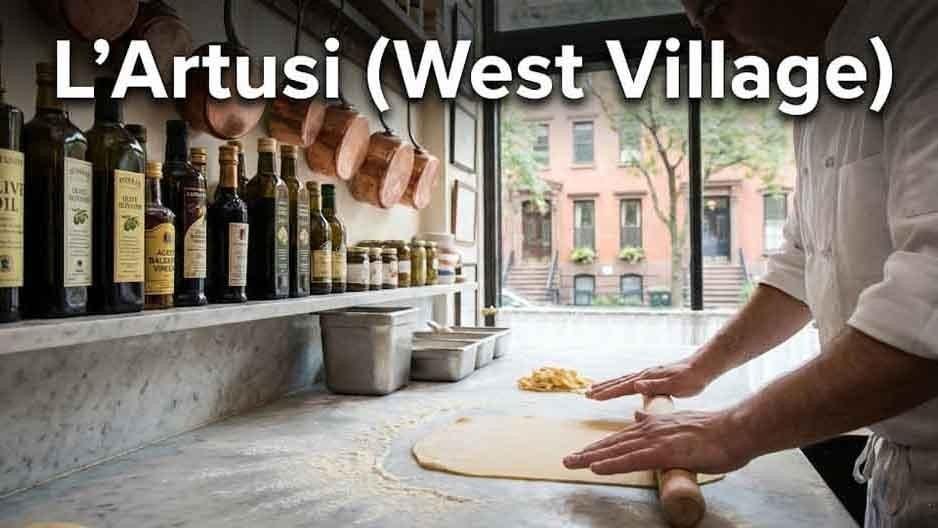
Pellegrino Artusi died in Florence in 1911, leaving behind a cookbook that has never gone out of print. His housekeeper, Marietta Sabatini, described his life as a continuous alternation between the study and the kitchen — the pen and the saucepans. That image captures something essential about L’Artusi the restaurant as well: the oscillation between intellectual ambition and the deeply physical work of feeding people, between the conceptual elegance of a regional wine program that spans an entire nation and the blunt reality of handmade pasta hitting a wooden board at six in the morning.
I have spent much of my professional life navigating that same oscillation. The Heritage Diner requires the pen and the saucepan in equal measure. Marcellino NY demands that the philosophy of bespoke craftsmanship survive contact with the actual hide — that the hundred-year briefcase begins with a twenty-minute conversation about grain direction and hardware weight. The restaurants that endure, like the leather goods that outlast their owners, are the ones where the idea and the execution are indistinguishable from each other.
L’Artusi has endured for seventeen years in a city that devours restaurants like kindling because the people who built it understood something that Pellegrino Artusi understood in 1891: that the science of cooking and the art of eating well are not separate disciplines. They are the same discipline, viewed from different angles. Walk into 228 West 10th Street on any given evening, take a seat at the bar, order the roasted mushrooms and a glass of something from Piedmont, and you will understand immediately why this place has outlasted every trend, every recession, and every critical verdict that has been leveled against it. The food is serious. The wine is serious. The hospitality is warm. And the unseen details — the thread count of the pasta, the temperature of the plate, the precise moment when the sommelier appears at your elbow — are what make it a masterpiece.
Peter is the owner of The Heritage Diner, a 25-year landmark at 275 Route 25A in Mount Sinai, NY; the founder of Marcellino NY, a bespoke English bridle leather workshop in Huntington; and co-founder with his wife Paola of Maison Pawli, a boutique real estate venture launching on the North Shore in 2026. He holds graduate degrees in Philosophy from Long Island University and The New School in New York City.