Somewhere in the collective memory of every family that grew up within earshot of the Great South Bay, there is a kitchen — someone’s grandmother’s, maybe a neighbor’s — where a whole weakfish once came out of the oven glistening, split open with fennel fronds, white wine pooled in the pan, the kind of smell that stopped conversation cold. That dish does not exist on most menus today. It barely exists at all. The fish that fed South Shore Long Island for centuries, that Native Americans called peskwiteag and colonial settlers eventually called the weakfish, is now classified as a depleted species by the Atlantic States Marine Fisheries Commission (ASMFC). Its commercial landings have fallen from over 19 million pounds in 1982 to under 200,000 pounds in recent years — a collapse so severe it nearly erased an entire regional food tradition without a single public obituary.
This is the story of that fish, that dish, and the failure of appetite and oversight that took both away.
The Squeteague and Its Deep Local Roots
Long before European settlers arrived on Long Island’s South Shore, the Algonquian-speaking peoples of the Northeast had named this fish with precision. Squeteague — sometimes rendered as peskwiteag, meaning roughly “those that give glue by boiling” in Narragansett — described a fish so oily and rich that it could be rendered down into a binding substance. The name survived colonization, and older fishermen on the North Fork and eastern bays still use it today (On The Water, 2023). In the Mid-Atlantic states it went by “gray trout” or “sea trout.” In the Chesapeake it was simply “trout.” Every name reflects a different regional intimacy with the same animal: Cynoscion regalis, silver-sided, iridescent blue and copper, with canine teeth and a fragile mouth that would strip a hook free if you weren’t careful — which is where “weakfish” ultimately came from.
The fish was not considered delicate in character, only in jaw. Charter boats working the South Shore inlets from Captree State Park to Moriches Inlet filled their decks with weakfish every spring from the 1940s through the early 1980s. During the years shortly after World War II, fleets of charter boats and commercial seiners were unable to more than dent the vast schools of tide-runners that invaded eastern Long Island from late April to July. Whole families planned vacations around the weakfish run. The fish was abundant enough, and affordable enough, that it appeared on dinner tables the way striped bass never quite did — not as a trophy, but as a Tuesday night meal.
The Long Island Weakfish Bake: A Dish That Defined the Season
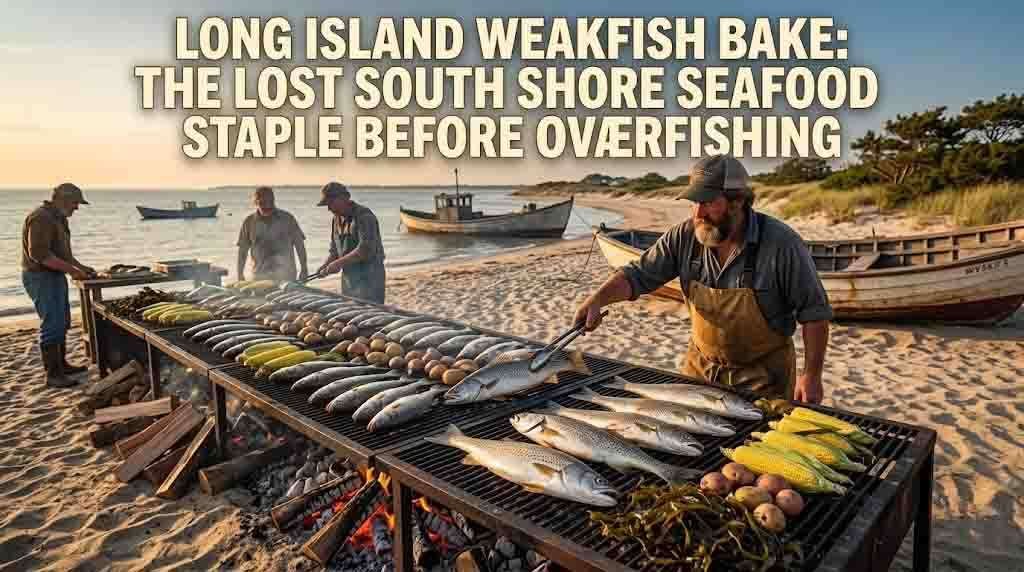
The classic Long Island weakfish bake was not a complicated preparation. It was an expression of coastal restraint — the kind of cooking that demands fresh fish because there is nowhere to hide behind a sauce. A whole weakfish, cleaned and beheaded, slashed diagonally three times on each side to allow heat and aromatics to penetrate, was placed into a roasting pan over sliced fennel bulb, doused with a cup of dry white wine and melted butter, and baked at high heat until the skin blistered and the flesh lifted cleanly from the bone.
The East Hampton Star’s long-running food column “Long Island Larder” documented this preparation in detail: a whole 10-pound weakfish baked over two bulbs of fresh fennel, with minced tarragon, dry white wine, and a finishing jigger of Pernod to deepen the anise notes — serving eight at a summer table (East Hampton Star, 1989). The method was common across South Shore households without being identical anywhere. Some families rubbed the cavity with garlic, lemon zest, and coarse salt an hour before roasting. Others lined the pan with sliced tomatoes or stuffed the fish with a mixture of oysters and seasoned breadcrumbs, fastening the fillets with skewers, a technique that appears in cookbooks dating to the early 1900s. What united every version was the insistence on immediacy: weakfish flesh softens rapidly after death, and the dish only worked if the fish went from the water to the pan with minimal delay.
This is why the weakfish bake was a coastal dish. It couldn’t travel. It couldn’t be replicated with a fish that had sat two days in a distribution center. It required proximity to the water — which is precisely why Long Island’s South Shore, with its network of barrier islands, estuaries, and productive back bays, was one of the last places it was prepared with any regularity.
The Numbers Behind the Collapse
Weakfish have been one of the most important components of a mixed-stock fishery on the Atlantic coast since the 1800s. In the late 1990s, however, weakfish biomass began to decline, reaching an all-time low of 342,990 pounds in 2011, compared to 45.6 million pounds in 1981. That is not a statistical correction or a natural trough. That is a 99.2% reduction in population biomass over thirty years.
Commercial landings have dramatically declined since the early 1980s, dropping from over 19 million pounds landed in 1982 to 190,176 pounds in 2022. The 2016 benchmark stock assessment by the ASMFC concluded the stock was depleted, and the 2019 update showed spawning stock biomass at 1,922 metric tons — well below the 6,170 metric ton threshold considered necessary for stock health (ASMFC, 2019). Despite strict harvest limits for both recreational and commercial fishermen, the stock has yet to show any signs of recovery — attaining a near-mythical status for anglers north of New Jersey, many of whom have never seen one.
The causes are multiple and intertwined. Overfishing, particularly gillnetting of juvenile fish in Delaware Bay through the 1980s and 1990s, removed entire year-classes before they could reproduce. In 1974, unknown to sportsmen in the northeast, a large percentage of weakfish were being taken off the coast of North Carolina to be used as pet food. High natural mortality compounded the problem: predation by striped bass and bluefish — both of which rebounded strongly through conservation efforts during the same decades — kept weakfish populations suppressed even as fishing pressure was reduced. Both overfishing and increased predation by other fish such as striped bass have been implicated in the low relative abundance of adult fish. The weakfish, which grows quickly and matures at age one, should theoretically be resilient. Instead, the total mortality rate — fishing plus natural causes — has remained so high that recoveries have been brief and incomplete, each population peak followed by a steeper decline than the last.
The Cyclic History Nobody Remembered
What makes the weakfish collapse genuinely tragic, and not simply a straightforward regulatory failure, is that it had happened before. Weakfish virtually disappeared in the early 1950s and showed no sign of recovery until 1972. In the 1920s and 1930s, over 60 tons of weakfish went to an already glutted market to be used as fish scraps. Then, weakfish were so scarce in the 1960s that the Schaefer Fishing Contest eliminated that category because no fish were being caught or registered in the annual event. By the early 1970s, the weakfish had returned in great numbers — for the first time in memory, it was possible to catch 30, 40, or even 50 squeakers or more per tide.
That recovery — the one that fueled the back-bay charter boat industry, the South Shore fish markets, the kitchen tradition described above — lasted barely thirty years before the same pattern of overcapitalization and under-regulation reproduced itself at a larger scale. The tools that should have prevented a repeat collapse existed. The political will to use them consistently did not.
The weakfish, it turns out, is not just a fish. It is a stress test for institutional memory. Whether that memory lives in a fisheries management agency or in a family’s recipe box, its absence has the same result: the loss of something that seemed permanent because it had always been there.
What the Table Has Lost
Talk to anyone who grew up on the South Shore and fished through the 1970s, and the weakfish appears in the conversation the way certain neighborhoods appear — as a place that existed, vivid and specific, before it didn’t anymore. The fish had a flavor somewhere between striped bass and sea trout: lean, sweet, and delicate, with a texture that rewarded high-heat cooking and punished hesitation. It was the fish Long Island knew best before it learned the vocabulary of bluefin tuna and fluke, before the North Fork wine country and the Hamptons food scene arrived and began curating the region’s culinary identity for an outside audience.
The weakfish bake belonged to the other Long Island — the one of Portuguese fishing families in Greenport, of South Shore diners serving flounder and bluefish at laminate tables, of backyard fish frys where the fish had been swimming that morning. It was democratic food. A 10-pound weakfish could feed eight people, and during the flush years, the fish was cheap enough that it posed no financial stretch for working families in Babylon or Bay Shore or Islip. That accessibility — the seasonality, the provenance, the cost — is inseparable from what the dish meant.
The Long Island Sound Trawl Survey, conducted annually by Connecticut DEEP since 1984, shows weakfish abundance in the Sound stabilized at low levels over the past decade, with most caught fish being small and juvenile — suggesting the Sound now functions primarily as a nursery, not a productive fishery (Long Island Sound Study, 2025). The recipe survives. The fish, for practical purposes, does not.
Is Recovery Possible?
Coastwide commercial landings rebounded modestly to 809,395 pounds in 2023 — the highest since 2012 — but remain far below historical peaks. The ASMFC has implemented size limits, catch restrictions, and bycatch reduction gear requirements. New York State and Connecticut have instituted more restrictive recreational regulations. These are steps in the right direction, but the weakfish’s recovery is complicated by factors no regulation can fully address: menhaden and other forage fish depletion, eelgrass loss in critical estuarine nursery habitat, and sustained predation pressure from recovered striped bass populations that now occupy the same inshore waters.
Save the Sound, an organization working across the Long Island Sound watershed, has framed the broader issue plainly: once there were millions of river herring and menhaden in the Sound, and now there are a few hundred thousand — a reduction that cascades through every species above them on the food chain (Save the Sound). Restoring the weakfish without restoring the ecosystem that sustains it is like trying to season a pan that has no heat underneath it. The conditions have to be right for the result to hold.
Recovery is biologically possible. The weakfish matures at age one and produces enormous egg counts — it has the reproductive machinery to rebuild quickly under the right conditions. But “quickly” in fisheries terms means a decade or more of sustained low mortality and healthy forage base. The question is whether the institutional patience exists to see that through, given how poorly that patience held during the last recovery.
An Elegy Written in Fennel and White Wine
Every cuisine is an archive. What a community eats, how it prepares that food, and which dishes survive into the next generation encodes something about geography, economics, and the natural world that surrounded people’s lives. The Long Island weakfish bake was a document of place — specific to these bays, this coast, these seasonal rhythms — that is now largely unreadable because the primary source has been depleted.
What remains are the recipes, scattered across old food columns and regional cookbooks and handwritten index cards in kitchen drawers in Amityville and Patchogue. The East Hampton Star’s version with Pernod and fennel. J&J Sports Fishing’s weakfish salad made from steamed fillets, mayonnaise, celery, and Old Bay, served with crackers. The Coastal Angler’s method of grilling fillets over hardwood charcoal with fresh basil and a local Pinot Gris. These preparations survive in print long after the fish that inspired them became difficult to find at any price.
The next time weakfish runs in the bays — if the management holds, if the forage recovers, if the cycle completes itself — the dish deserves to be cooked again with the same care and attention it received for a century. Not as nostalgia. As recognition. The weakfish was not a specialty item or an endangered delicacy in its time. It was South Shore Long Island’s fish — abundant, honest, and perfectly suited to the people and the place that caught it.
It should be again.
Sources:
- Atlantic States Marine Fisheries Commission. Weakfish Species Page. https://asmfc.org/species/weakfish/
- Long Island Sound Study. Game Fish Abundance Indicators. https://longislandsoundstudy.net/ecosystem-target-indicators/game-fish/
- On The Water. What Happened to Weakfish? https://onthewater.com/what-happened-to-weakfish
- On The Water. Weakfish in Narragansett Bay. https://onthewater.com/weakfish-in-narragansett-bay
- On The Water. Squeteague and Why We Fish. https://onthewater.com/squeteague-and-why-we-fish
- The East Hampton Star. Long Island Larder: Almost Time for Weakfish. https://www.easthamptonstar.com/food/198954/long-island-larder-almost-time-weakfish
- Save the Sound. Restoring Fisheries and Wildlife Habitat. https://www.savethesound.org/what-we-do/healthy-waters/restoring-fisheries-wildlife-habitat/
- Wikipedia. Cynoscion regalis. https://en.wikipedia.org/wiki/Cynoscion_regalis
- Native Long Island. Chequit. https://nativelongisland.com/listing/chequit/
- J&J Sports Fishing. Ron’s Seafood Recipes. https://www.jjsportsfishing.com/blogs/news/recipes