here’s a moment that happens in every diner kitchen — and I’ve lived it a thousand times in 25 years behind the pass at The Heritage Diner in Mt. Sinai — when a piece of protein hits the flat-top and you know, in the first three seconds of the Maillard reaction, whether the sourcing was right. The fat renders with a certain language. The muscle fiber relaxes at a specific rate. The smell is either honest or it isn’t. No algorithm, no subscription algorithm, no silicon-optimized supply chain can fake what a properly aged, locally sourced cut of beef communicates to a trained nose and eye. And yet, in 2025, the question I’m asked more than almost any other — by my neighbors here on the North Shore who understand that material provenance is everything — is this: Should I get a ButcherBox, or should I still drive out to see my butcher?
The answer, as with most things worth arguing about, is more complex than either camp will admit. So let’s do what we do here: apply some rigor.
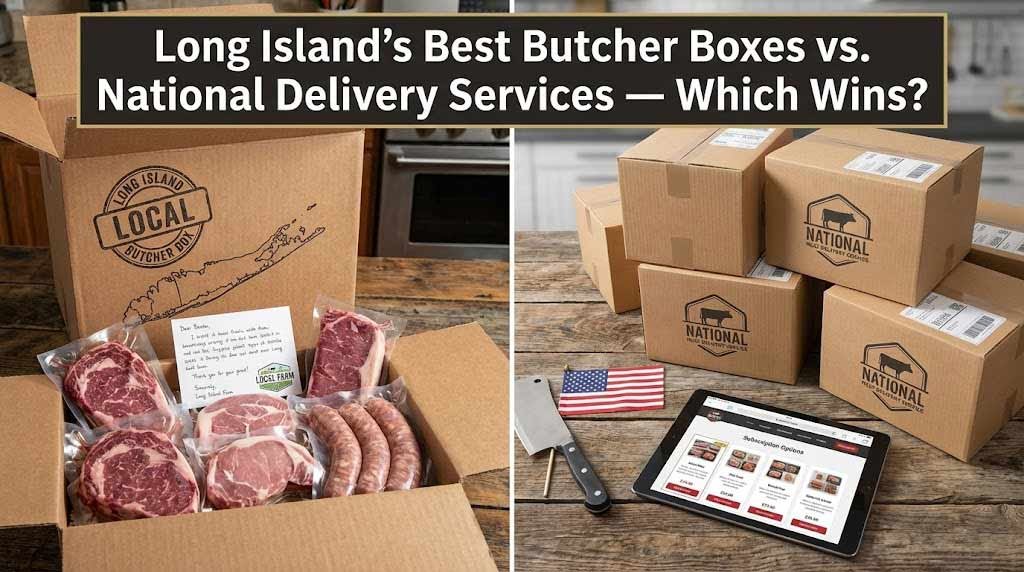
The Rise of the Subscription Meat Box — And Why Long Island Was Always Ahead of the Curve
The national meat delivery business exploded out of the pandemic. ButcherBox, founded in Boston in 2015, became a household name when millions of Americans discovered that their local supply chains were fragile. ButcherBox offers curated subscription boxes and has staked its identity on sourcing standards, while competitors like Crowd Cow built their model on farm-level transparency and a la carte flexibility. Subscriboxer Porter Road, the Nashville-born craft butcher that went national, brought the sensibility of a genuine pork shop to your FedEx doorstep. Founded in 2010 by chefs Chris Carter and James Peisker, Porter Road built its reputation on pasture-raised, hormone-free, antibiotic-free meats with dry-aging practices rooted in the craft of traditional butchery. Timbo’s Food Box
These are good companies. I want to say that clearly, because what follows is not a dismissal — it is a calibration.
But here on Long Island, we’ve always had something those national platforms are now trying to algorithmically approximate: terroir in the supply chain. The same instinct that drives a Maison Pawli buyer to insist on inspecting a property’s foundation before the appraisal — rather than trusting a Zillow estimate — is the instinct that should drive anyone serious about their table to understand where their protein was raised, who cut it, and how long it has been traveling.
The Local Landscape: Long Island’s Artisan Butcher Ecosystem
Let’s ground this in geography. For over 25 years, Prime Time Butcher has been Long Island’s trusted source for premium meat and poultry, hand-cutting every order, vacuum-sealing individually, and shipping overnight — Monday through Wednesday — from their Long Island location directly to the customer’s door. Prime Time Butcher That’s a national-caliber delivery operation built on a local institution’s reputation. Worth understanding.
Scott’s Five Star Meat Center in Commack has spent 18 years building a reputation on premium cuts, custom burger blends, and holiday specials — a neighborhood butcher that functions as a community anchor. Best of Long Island Chubs Meats in Medford on Route 112 serves USDA Choice meat with custom slicing, online ordering, and local delivery — and publishes their own signature recipes, turning each purchase into a culinary education. Best of Long Island
Then there is Farmingdale Meat Market on Main Street — a multi-generational institution. Three generations of the same family have been delivering excellent products at great prices with neighborhood service since 1946. Farmingdale Meat Market A customer on Yelp, referencing a comparison to national brands, put it plainly: the filet mignon she ordered online was, in her estimation, unambiguously superior to anything Omaha Steaks or Kansas City Steaks had delivered (Yelp, 2024).
Frank and Maria’s Italian Market in Bay Shore rounds out the picture — a family-owned butcher, deli, and Italian pork store offering custom-cut meats, homemade sausages, fresh mozzarella, and delivery throughout eastern Long Island and Fire Island. Fandmmarket This is the kind of place where the handmade sausage casing is the equivalent of a hand-stitched welt on a Marcellino briefcase: the detail no machine replicates with full integrity.
Long Island’s Own (longislandsown.com) represents the bridge model — a locally branded delivery platform emphasizing proteins raised without hormones, antibiotics, or additives, positioned specifically for the North Shore and South Shore customer who wants convenience without compromise.
What the National Platforms Actually Deliver — and Where the Seams Show
I have tested the nationals extensively — both personally and through the Heritage Diner’s kitchen, where sourcing decisions affect 200 covers on a busy Sunday. Here is a candid assessment.
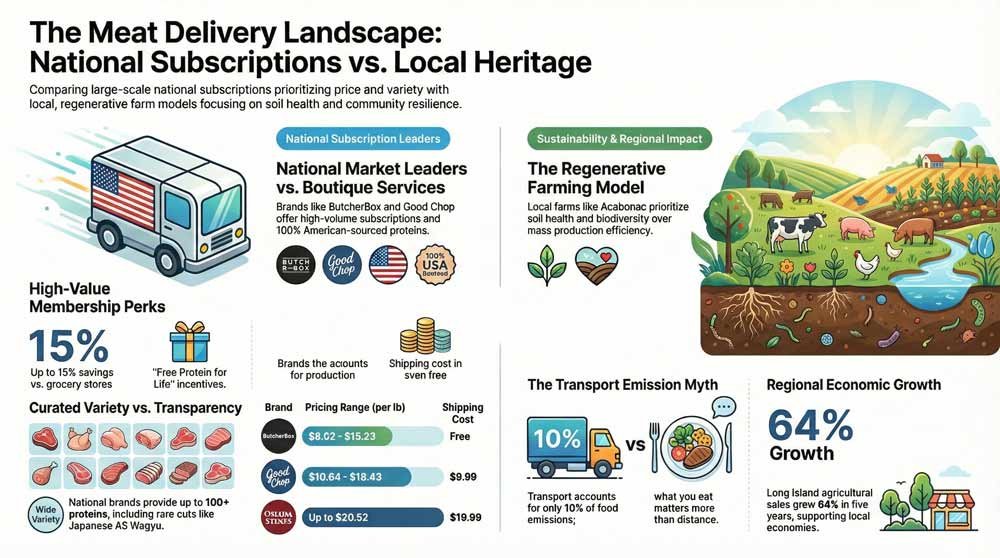
ButcherBox is the most widely known and arguably the most scalable. ButcherBox ships monthly with skip options, offers 100% grass-fed beef, free-range organic chicken, humanely raised pork, and wild-caught seafood — frozen with dry ice — and provides a refund policy for damaged or missing items. Artofgrill The value proposition is real for families who want a consistent baseline of ethically raised protein without doing research every week. What it is not is bespoke. You are subscribing to a tier, not a relationship.
The complaints that surface in aggregate reviews are instructive. Reports of orders shipped to wrong addresses, late deliveries arriving fully thawed, and difficulties securing replacements have surfaced across multiple review platforms. Simpsons Meats These are logistics failures — the inevitable friction of a national fulfillment model at scale. When a Marcellino briefcase strap fails, I know who hand-stitched it and I can correct it. When a ButcherBox ribeye arrives compromised, you are navigating a customer service queue.
Crowd Cow offers something philosophically closer to the local model: the ability to shop a la carte by farm of origin, customize a recurring box, and receive fully carbon-neutral delivery in biodegradable packaging. Food Box HQ The sourcing transparency — knowing the specific farm, the specific practice — resonates with the same impulse that drives a Maison Pawli buyer to request a full property disclosure before signing. Trust is built on information, not branding.
Porter Road occupies an interesting position — craft butchery at national scale. Porter Road ships refrigerated with biodegradable gel packs rather than frozen on dry ice, offers subscription and a la carte options, and features cuts not commonly found elsewhere — including lamb. Carnivore Style The argument for refrigerated-over-frozen is not trivial. In a professional kitchen, the distinction between never-frozen and previously-frozen protein is, as Heidegger might say, a difference in Dasein — the being-in-the-world of the thing itself. Texture. Cell structure. Water retention under heat.
The Philosophy of Provenance: What Leather Taught Me About Meat
When I source English bridle leather for Marcellino NY, I am not ordering from a catalog. I am engaging with a tannery’s history — the specific oak-bark pit tannage, the pull weight of the hide, the climate in which the beast was raised. The leather communicates its provenance in the hand. It has memory. It has tension. A hide that was stressed in life produces a hide that is stressed in the finished product.
Protein is no different. This is not mysticism — it is biochemistry and animal husbandry colliding in the pan. Grass-finished beef raised on Suffolk County’s North Fork farmland, processed regionally and arriving fresh (not frozen, not thawed, not re-chilled), carries a different physiological profile than the same breed raised in a feedlot in the midwest and flash-frozen for national distribution. The myoglobin content is different. The omega-3 to omega-6 fatty acid ratio is measurably different (Journal of Animal Science, 2010). The flavor is narratively different.
Running The Heritage Diner for 25 years has made this an economic and ethical imperative, not merely a preference. When you are serving the same community for a quarter century — the families of Mt. Sinai, the professors from Stony Brook, the contractors and teachers and ferry captains of the North Shore — your sourcing decisions are moral ones. The diner is a covenant.
A YouTube channel worth studying in this context: the Heritage Cooking Crash Course series at https://www.youtube.com/watch?v=9sXIo9lRFbc, which documents the art of preparation from first principles — the kind of foundational literacy that makes provenance visible rather than abstract.
Price, Value, and the Boutique Calculus
The national services price themselves aspirationally. ButcherBox runs approximately $6.00–$9.00 per serving depending on the box tier and current promotional pricing (ButcherBox.com, 2025). Crowd Cow’s a la carte pricing is higher per unit — premium Wagyu ribeyes reaching $35–$60 per steak — but the flexibility means you’re not carrying surplus cuts you didn’t want. Porter Road boxes run similarly to ButcherBox in total spend, with the added value of less-common cuts.
Now compare that to what Prime Time Butcher or Farmingdale Meat Market delivers: USDA Choice and Prime cuts, hand-selected, vacuum-packed, shipped overnight from Long Island, at competitive per-pound prices — with zero relationship overhead. When you establish an account with a local butcher, you are building an asset in the same way a Maison Pawli client builds equity: through consistency, through communication, through the compound interest of a trusted relationship.
The hidden cost of national subscriptions is the one nobody puts in the brochure: the cognitive load of managing a subscription, pausing deliveries when you’re traveling, handling fulfillment errors remotely, and reconciling the gap between what the brand promises and what arrives at your door in February on the North Shore of Long Island, where FedEx and UPS have their own interpretations of “overnight.”
Hybrid Strategy: The Intelligent Approach for the North Shore Consumer
The answer is not binary. I run the Heritage Diner and I order from multiple sources, because the menu demands it and because intellectual honesty demands it. Here is the framework I use — and the one I share with clients:
Use local first — Prime Time Butcher, Farmingdale Meat Market, Chubs, Frank and Maria’s — for fresh cuts, custom preparations, and relationship-dependent sourcing. For Heritage Diner’s weekend specials and for anyone serious about a dinner party in Port Jefferson or a barbecue in Miller Place, there is simply no substitute for what these shops do.
Use Crowd Cow or Porter Road for specialty access — specific breed profiles, American Wagyu, heritage pork cuts that your local butcher may not carry — where the provenance transparency justifies the price and the specialty justifies the national logistics.
Avoid ButcherBox as a primary source if you live within reach of Long Island’s artisan infrastructure. Its value is real for consumers in meat deserts. If you can drive to Farmingdale or call Prime Time, you are already inside a better system.
The same logic applies to real estate. A national platform will show you every listing in Setauket. It will not tell you that the micro-neighborhood on the east side of the development has flooding patterns that never make it into a disclosure, or that the property three blocks over will list in 30 days and is exactly what you need. That is what Maison Pawli does. That is what your local butcher does. The boutique advantage is information asymmetry deployed in your favor.
The Covenant of the Local Table
There is a Stoic principle — Marcus Aurelius articulates it in Meditations with characteristic economy — that holds that the quality of an action is inseparable from the quality of attention brought to it. The meat on your table is the end product of thousands of decisions: the grass in the field, the handling in the barn, the cut of the knife, the temperature of the cold chain, the hand that packed the box and the person who drove the route.
When I plate a dish at the Heritage Diner, I am accountable to all of those decisions. When a national subscription service delivers a box to your door, accountability is distributed across a supply chain of dozens of entities, none of whom know your name.
Chubs Meats shares its signature recipes on its website. Best of Long Island Prime Time Butcher answers the phone. Farmingdale Meat Market has served the same families for three generations. These are not trivial details. They are the texture of a community that eats well together — the same texture that makes Mt. Sinai’s North Shore a place worth living in, worth buying into, worth stitching your name to.
The national services are not the enemy. They are the industrialization of an impulse — toward quality, toward ethics, toward something better than the supermarket — that local artisans on Long Island have been serving, without fanfare, for decades. They simply cannot replicate what happens when the supply chain is short, the faces are known, and the covenant between butcher and table is personal.
For more on sourcing and the philosophy of the professional kitchen, visit The Heritage Diner at heritagediner.com/blog and explore the craft behind Marcellino NY’s bespoke leather goods at marcellinony.com
The cut matters. So does who makes it.