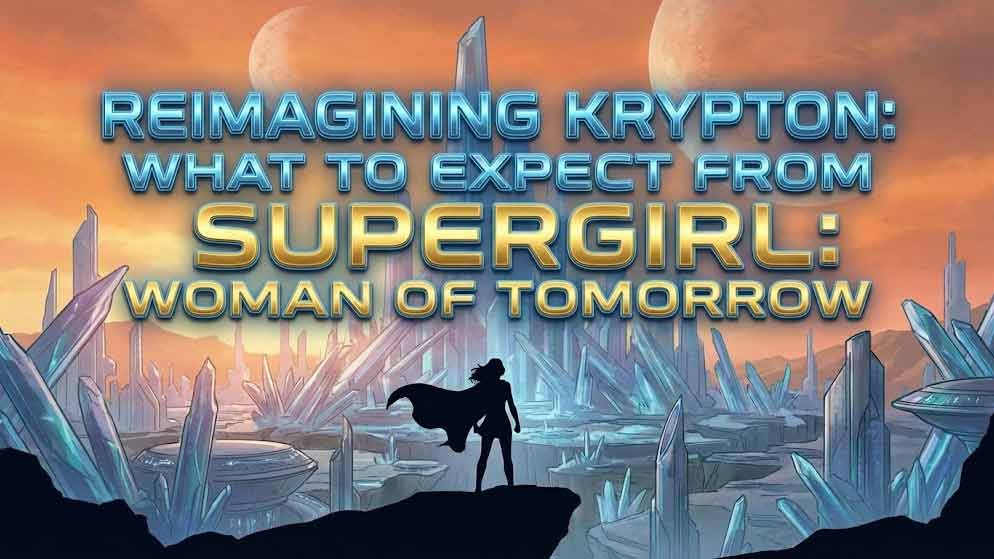
Grief doesn’t vanish when you’re invulnerable. It just goes somewhere deeper, somewhere the yellow sun can’t reach. That, in essence, is the central proposition of Supergirl — the upcoming DC Studios film directed by Craig Gillespie, arriving in theaters on June 26, 2026 — and it is the reason this particular superhero film deserves a far more serious conversation than the genre typically invites.
James Gunn and Peter Safran, co-CEOs of DC Studios, have been methodical about the architecture of their rebooted DC Universe. Superman launched Chapter One: Gods and Monsters in the summer of 2025. The second film in that chapter is Kara Zor-El’s story — adapted from Tom King and Bilquis Evely’s acclaimed 2021–2022 eight-issue comic miniseries, Supergirl: Woman of Tomorrow. Though Gunn eventually stripped the subtitle (“I’m sick of the superhero title, colon, other-name thing,” he told Rolling Stone), the thematic weight of those four words — Woman of Tomorrow — remains embedded in every creative decision made around the project. This is a film about what a person becomes after the worst thing has already happened.
A Source Material Worth Taking Seriously
Before examining the film, the comic demands attention. King’s Supergirl: Woman of Tomorrow is not a conventional superhero narrative. It opens with Kara Zor-El on her 21st birthday, drunk on the edge of the galaxy at a bar orbiting a red sun — the only place in the universe where she can actually feel the alcohol, where her powers are stripped and she is, briefly, just a young woman trying to forget. She watched Krypton die. She remembered it. Unlike Clark Kent, sent to Earth as an infant with no memory of what was lost, Kara carries the full weight of planetary extinction as lived experience. She was fourteen when she watched her world incinerate.
The comic was a finalist for the 2023 Hugo Award for Best Graphic Story and was named one of the New York Public Library’s Best Books for Adults in 2022. It is, by any literary measure, one of the finest superhero comics published in the last decade — a road narrative, a moral interrogation, a study in survivor’s guilt. The story is filtered through the perspective of Ruthye Marye Knoll, a young alien girl who approaches Kara with a mission: avenge her father’s murder at the hands of Krem of the Yellow Hills, a warlord operating with impunity across the galaxy’s margins. Ruthye’s narration gives the whole affair an almost Victorian quality — reverent, formal, occasionally shocking in its emotional clarity.
The comic draws explicitly from Charles Portis’s True Grit. Kara and Ruthye map roughly onto Rooster Cogburn and Mattie Ross — the damaged veteran and the resolute young woman who refuses to be placated. The question of whether vengeance is justice, whether justice is possible at cosmic scale, whether a hero is defined by her ideals or by what she survives — these are King’s real subjects. Evely’s art, richly detailed and cosmically expansive, gave the story a visual language that balanced fairy tale grandeur with intimate emotional specificity. The work earned its reputation.
What the Film Is Doing Differently — and Why That Matters
Craig Gillespie is an unusual choice for a superhero film, which is precisely why it’s the right one. The Australian director built his reputation on films that use genre expectations as a kind of Trojan horse — Lars and the Real Girl turned its absurd premise into a genuinely moving study of community and compassion, I, Tonya transformed a tabloid narrative into a fractured, formally daring examination of working-class identity and media cruelty. His sensibility, described by one profile as “walking a tightrope between the comedic and the mundane,” is ideally suited to a story about a god-powered woman trying to feel something real.
Gunn has confirmed that the film follows a traditional three-act structure rather than the chapter-by-chapter episodic rhythm of the comic. That’s a meaningful adaptation choice. The comic’s structure is deliberately loose, each issue dropping Kara and Ruthye onto a new alien world with its own moral problem — a planet of systemic racism, a world where violence has been institutionalized, a society that has decided certain lives don’t count. The film will compress and distill, necessarily. What it retains — the major characters, the central journey, the thematic DNA — is the architecture that matters.
Gillespie has cited Logan (2017) as a tonal influence, which is instructive. James Mangold’s Wolverine film worked because it was willing to treat its protagonist’s suffering as genuinely costly, not merely dramatic. The violence had weight. The losses didn’t reset. Wolverine at the end of Logan is a diminished version of himself, and that diminishment is the film’s entire point. A similar seriousness of purpose is apparently guiding Supergirl. Gillespie has described the film as a road movie with a darker tone than Gunn’s Superman — a tonal contrast built deliberately into the DCU’s architecture.
Milly Alcock and the Art of Casting Against Type
Milly Alcock is carrying the film, and James Gunn has called her casting “might be the best bit of casting I’ve ever done in my entire life.” That’s not a throwaway compliment from a producer managing expectations. Gunn had been interested in adapting Woman of Tomorrow before he formally assumed leadership of DC Studios, and Alcock was on his radar from her performance as young Rhaenyra Targaryen in House of the Dragon — a role that required her to embody both a girl navigating impossible expectations and a woman slowly calcifying into something harder.
That dual quality — vulnerability and severity — is precisely what Kara Zor-El requires. The character is not likeable in the conventional sense of the word. She is prickly, self-destructive, capable of cruelty, and carrying a degree of existential resentment that most heroes are not permitted to express. She sees, as she tells her cousin Clark in the film’s teaser, “the truth” — where Superman insists on seeing “the good in people.” That philosophical split between the cousins is the film’s central dramatic tension in miniature. It is also a culturally significant shift. For decades, Supergirl has existed primarily as a softer, more accessible version of the Superman ideal. Woman of Tomorrow, both the comic and the film, refuses that framing entirely.
Comic creator Tom King endorsed the casting publicly, calling it “perfect.” That particular adjective from the source material’s author is meaningful — it suggests Alcock’s interpretation aligns with whatever King intended when he wrote a Supergirl drinking alone on the edge of the universe, trying to feel the weight of what she has lost.
Eve Ridley plays Ruthye Marye Knoll, the young alien girl through whose eyes the story unfolds. Matthias Schoenaerts takes on Krem of the Yellow Hills — a villain whose moral status the comic deliberately complicates, refusing to allow Krem to exist purely as a target. And Jason Momoa arrives as Lobo, the intergalactic bounty hunter whose inclusion is both a crowd-pleasing gesture and, per Gunn, a structural necessity — the character wasn’t in King’s original comic, but was present in King’s earliest pitch, imagined as a kind of Rooster Cogburn to Kara’s Mattie Ross, before the final version centered Ruthye in that role. Gunn describes Lobo as “the biggest comic book character that’s never been in a film,” which is both a marketing framing and an accurate observation about a character whose cinematic adaptation has been discussed and abandoned repeatedly over three decades.
The Question of Trauma in Mainstream Cinema
What Supergirl is attempting is formally ambitious for a studio tentpole. The superhero genre has spent twenty years developing increasingly sophisticated strategies for emotional stakes — loved ones at risk, cities threatened, universes on the brink — while often keeping its protagonists insulated from the actual cost of living through catastrophe. The trauma is acknowledged, then processed, then largely set aside in time for the next film’s demands.
Woman of Tomorrow, the comic, refuses that sequence. Kara’s trauma is not a backstory element that motivates her power set. It is her present-tense condition, ongoing and unresolved. She has not adapted. She has not found a framework that makes the loss of Krypton manageable. She drinks in the dark at the edge of the galaxy because there is no adequate response to having watched your world die when you were fourteen years old, and she is self-aware enough to know that heroism doesn’t address that wound.
Whether the film will maintain that emotional honesty at the scale required by a $200 million production remains the central question. Gillespie’s track record suggests a genuine commitment to the messiness of human experience — his best films don’t resolve their protagonists into comfortable lessons. I, Tonya ends ambiguously, allowing its subject to remain irreducible. Lars and the Real Girl earns its warmth through sustained specificity rather than sentiment. Those qualities, imported into a cosmic superhero narrative, could produce something genuinely unusual.
The parallel with Logan is worth sitting with. That film grossed $619 million worldwide on a $97 million budget — it demonstrated conclusively that an adult, thematically serious superhero film could find a substantial audience. The DCU’s willingness to position its second major release not as a triumphant spectacle but as a road movie about grief and vengeance and moral ambiguity is, at minimum, an interesting bet.
The DCU’s Architecture and Where Kara Fits
Gunn’s DCU is being constructed with an unusual degree of intentionality. Superman established the tone — brighter, more idealistic, grounded in Clark Kent’s essential decency. Supergirl complicates that tone immediately. By the end of Superman’s post-credits sequence, Kara appears — hungover, searching for Krypto — and the contrast is immediate and deliberate. The DCU’s second film is not an escalation of its first film’s optimism. It is its shadow.
That structural decision reflects something important about how Gunn is thinking about this universe. Superman’s goodness is not the DCU’s only moral register; it is one position on a spectrum. Kara’s cynicism, her refusal to simply believe in people the way Clark does, is equally valid — and in some ways more honest. The universe that produced both of them is the same universe, filtered through radically different experiences of loss and arrival.
David Corenswet returns briefly as Kal-El/Clark Kent, confirming the film will acknowledge the relationship between the cousins. The nature of that confrontation — whether it resolves, whether it deepens the fault lines established in the teaser — is one of the film’s most anticipated narrative moments.
Production wrapped in May 2025, with principal photography completed at Warner Bros. Studios Leavesden and on location in London and Scotland. The film is currently in post-production, with visual effects being handled by Industrial Light and Magic. Composer Tom Holkenborg (known as Junkie XL, longtime collaborator of Zack Snyder) has been confirmed to score the film after an earlier announcement of Ramin Djawadi was revised.
Why This Film Arrives at the Right Moment
Cinema has spent the better part of a decade asking whether the superhero genre has exhausted its cultural usefulness. The honest answer is that the genre has exhausted certain of its defaults — the escalating stakes, the invulnerable protagonist, the resolution that restores the world to its prior condition. What remains potentially vital is the genre’s capacity to use its formal vocabulary for something genuinely exploratory.
Woman of Tomorrow, the comic, was that kind of exploration. Tom King used Kara Zor-El’s alienation — her literal and existential displacement — to examine survivor’s guilt, the relationship between justice and vengeance, and the question of whether a person defined by catastrophe can choose a different definition. Those are not small subjects. They are the subjects of serious literature, filtered through the idiom of intergalactic adventure.
The film, if it honors its source material’s ambitions, arrives at a cultural moment well-suited to receive it. Audiences have demonstrated — with Logan, with Joker, with the darker registers of contemporary superhero television — that they are capable of engaging with genre material that takes its emotional premises seriously. Supergirl has the source material, the director, the star, and the institutional backing to be that kind of film.
Whether it succeeds will be determined by how ruthlessly Craig Gillespie and Milly Alcock resist the consolations the genre typically offers — the neat resolution, the powered-up triumph, the reassurance that the hero is fundamentally okay. Kara Zor-El, at the beginning of Tom King’s story, is not okay. The journey toward something more than survival is the film’s entire subject. That is a worthy subject for cinema of any kind.
Supergirl opens in theaters June 26, 2026. The source graphic novel, Supergirl: Woman of Tomorrow by Tom King and Bilquis Evely, is available in trade paperback from DC Comics via Amazon and at Barnes & Noble.