Before the North Fork became synonymous with wine trails and waterfront dining, before the boutique storefronts and the weekend ferry crowds, Greenport was a place of serious, unromantic labor. Its harbor — deep, well-protected, and rarely frozen — made it one of the most strategically vital maritime outposts on the Eastern Seaboard. From the official incorporation of the village in 1838 through the final decades of the 19th century, Greenport’s identity was forged entirely at sea. Its men hauled whale oil, menhaden, and oysters. Its women cured fish, kept the household accounts in salt and flour, and fed families on what the water gave and what the barrel could hold.
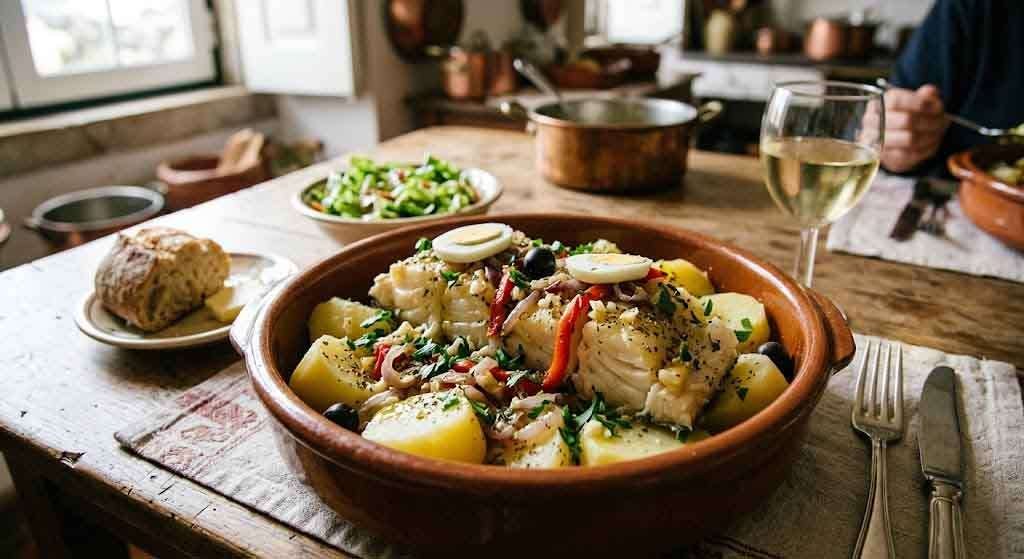
At the center of that table — through winter gales, through the lean months between seasons, through the monotonous endurance of a working maritime life — sat two things: salt cod and potatoes. Not as a romantic dish born of culinary tradition, but as a calculated act of survival. Understanding what these men ate, and why, is to understand the economic engine, the biology of preservation, and the quiet ingenuity behind a diet the modern world has largely forgotten.
A Harbor Built for Work
Whaling became a massive industry in Greenport between 1795 and 1859, helping to also drive a shipbuilding boom. The mid-1800s also saw the zenith for menhaden fishing, and later in the first half of the 20th century, oyster harvesting hit its peak. These weren’t sequential industries — they overlapped, competed for labor, and defined the rhythms of daily life in ways that made fresh food preparation nearly impossible for much of the year.
Greenport was important to this maritime area because its deep harbor rarely froze over. That geographic advantage was both gift and burden. It meant the village could sustain year-round maritime commerce when other harbors went quiet — but it also meant the men who worked there could seldom fully stop. The Long Island Railroad came to Greenport in the 1840s, boosting trade to New York City. This connection to the city accelerated the commercial pressure on local baymen and fishermen, inserting them into market cycles that demanded consistency of supply regardless of weather, season, or the state of the catch.
Over 500 vessels were built at Greenport shipyards from 1830 to 1850 alone. The East End Seaport Museum — located today in the former Greenport Long Island Railroad station at 100 Third Street, Greenport — preserves this history with exhibits devoted to LI’s baymen, oyster harvesting, lighthouse lenses, and the dramatic rise and fall of menhaden fishing. Walking those exhibits is among the clearest ways to understand that 19th-century Greenport was not a leisure destination. It was an industrial waterfront, and its people ate accordingly.
The Science of Salt: Why Cod Above All Else
To understand why salt cod became the anchor of the maritime working-class diet — from the Grand Banks of Newfoundland to the docks of Long Island — you have to understand what salt does to flesh at the molecular level. Salt draws moisture out of fish tissue through osmosis, reducing water activity to the point where spoilage bacteria and mold cannot survive. When combined with air drying, the result is a product that is shelf-stable for months, even in coastal humidity, without refrigeration of any kind.
Fish could be dry or wet salted. Herring, cod, salmon, mackerel, sardines and anchovies were very familiar to nineteenth-century consumers but were usually commercially processed rather than being done at home. In some cases, drying was employed with salting. The fish was salted for several days, then dried and for shipping, packed in boxes or barrels.
Cod was the preferred species for this process not merely by convention but by biology. Its flesh is lean — nearly devoid of fat — which means it dries without the rancidity that plagues oily fish like mackerel or herring in long-term storage. When the men returned home, the entire family helped cure the catch. Mothers, wives, daughters, and sons helped remove the cod’s head, spine, and guts before salting the fish and laying it out on wooden flakes to dry in the sun. The drying process could take weeks, and the family had to bring the product inside whenever it rained.
The nutritional logic was equally sound. Dried salted Atlantic cod derives approximately 92% of its calories from protein, with a composition of roughly 77% protein by weight. For men engaged in the backbreaking physical labor of longline fishing, dory rowing, or working the menhaden vessels off the North Fork, a protein-dense, salt-rich food was not just convenient — it was physiologically necessary. The sodium helped replace minerals lost through sustained physical exertion. The protein repaired muscle tissue. It was, in a narrow but genuine sense, performance nutrition.
The broader Atlantic world had already recognized this. By the early 18th century, cod was so central to the economy of New England that Boston Town Hall even had a golden cod hanging from its ceiling. By the time they reached 30, most fishermen retired from the trade or died from drowning, fishing accidents, or fever caught in the West Indies. The men eating salt cod in Greenport’s working households were not doing so for pleasure. They were fueling bodies that the sea used hard.
The Potato as the Working Man’s Carbohydrate
If salt cod was the protein of survival, the potato was its indispensable counterpart — the carbohydrate chassis upon which the entire dietary system ran. Potatoes stored well in root cellars through the cold months, resisted spoilage far longer than bread or grain once cooked, and provided the caloric density that protein alone could not deliver. A fisherman working a twelve-hour day on the Peconic Bay needed sustained energy, not just muscle repair.
The cod was a then-modern convenience food which you could rehydrate with hot water, add to potatoes for fish cakes, or put in warm milk sauce for codfish gravy. Sandra Oliver’s landmark study Saltwater Foodways: New Englanders and Their Food at Sea and Ashore in the Nineteenth Century (Mystic Museum Publishing, 1995) — available here — documented how salt cod and potato combinations appeared with near-universal consistency in the personal diaries and ships’ logs of 19th-century New England coastal communities. The pairing was not accidental. It was nutritional architecture refined by generations of working people who could not afford to get it wrong.
One sailor, near death from scurvy, was back at the mast ten days after the ship acquired some fresh potatoes and onions. This detail is worth sitting with. Vitamin C deficiency — the invisible killer of long maritime voyages — was corrected not by citrus, as popular history suggests, but by the humble potato, which contains meaningful amounts of ascorbic acid even after cooking. For Greenport fishermen who spent extended periods away from shore or subsisting through the restricted diet of deep winter, the potato was doing silent, life-preserving work alongside the cod.
Greenport’s agricultural hinterland made potato access more reliable than in many coastal communities. The Long Island Railroad, arriving in 1844, facilitated not just the outward movement of fish to New York City markets but the inward flow of supplies — flour, salt, dried goods — that complemented what local farms already produced. In mid-19th-century family markets, potatoes sold for 18 to 23 cents per bushel, while codfish went for 5 to 6 cents per pound — making this combination among the most economical and calorie-dense meals a working family could construct.
The Economy of Salt and the Merchant’s Grip
The preservation diet of Greenport’s fishermen was not simply a domestic practice. It was embedded in a commercial system that tied working people to merchants, credit, and commodity markets in ways that constrained their choices at every level.
Fishing people traded their salt cod to merchants to pay for gear and supplies they had previously obtained on credit. This cycle — catch, salt, cure, trade, go back into debt — meant that the men who produced salt cod often ate it not because it was their first preference, but because it was what remained after commerce had taken its share. The product they worked to create was also their sustenance when the ledger was in the wrong column.
A system of indebtedness tied the fishermen to the merchant enterprise. Although some inhabitants were able to work for themselves and sold their fish to independent buyers, most were bound to the larger commercial structure. For Greenport baymen working the scallop beds, the oyster grounds, or the menhaden fleet, this dynamic was acutely familiar. The Peconic Bay scallop industry, which anchored East End fishing communities through the late 19th century, operated on similar terms: baymen feared that conservation laws would hurt profits and their ability to feed their families. The margin between feeding a family and failing to was often measured in barrels and bushels.
Salt itself was an economic commodity with strategic weight. During the War of 1812, a scarcity of salt created serious disruptions to the North Atlantic curing trade, prompting legislative intervention across New England and Atlantic Canada. The men of Greenport, plugged into the same maritime supply chains that ran from the Grand Banks to the Caribbean, understood the value of salt not just as a kitchen staple but as a critical industrial input. Without it, there was no cod. Without cod, there was no winter.
Codfish Gravy, Fish Cakes, and the Architecture of Simple Cooking
The culinary expression of this diet was, by necessity, modest and repetitive — but it was not without its own logic and regional character. Dried salt cod required soaking in cold water for anywhere from twelve to thirty-six hours before cooking, which drew out excess sodium and began to rehydrate the flesh. What emerged after soaking was a firm, white protein that could be flaked into a pan, folded into mashed potatoes and formed into cakes, or simmered in milk with butter and onion to produce codfish gravy — a dish that appeared on Long Island tables, New England fishing households, and Maritime Canadian kitchens with near-identical form.
Fish chowders were the forerunners of clam chowder, which does not appear in a printed recipe until the 1830s. The chowders made by early settlers differed from other fish soups because they used salt pork and ship’s biscuits — the origin of the custom of crumbled crackers sprinkled on top. Salt cod chowder, built on this same structural template, was a one-pot meal that could stretch a small quantity of expensive fish across a large family. The potatoes extended the volume. The salt pork added fat and a second dimension of preserved protein. The onion — one of the few vegetables that stored reliably through winter — added the sulfurous depth that made the whole thing edible across fifty repetitions.
This was not peasant food in the romantic sense that word has acquired in modern culinary discourse. It was working-class food in the most literal sense: food designed to keep working people functional, day after day, in conditions that demanded it. The fishermen of Greenport ate this way because they had to, and because within those constraints, the combination of salt cod and potato was about as reliable and efficient a nutritional system as the 19th century could offer a coastal laboring family.
What the Menhaden Industry Tells Us About Food and Labor
A dimension of Greenport’s maritime economy that illuminates the diet question from an unexpected angle is the menhaden industry, which peaked in the mid-19th century. Menhaden — oily, bony, nearly inedible by any culinary standard — was not eaten by the men who caught it. It was rendered into oil and converted into fertilizer. The East End Seaport Museum’s exhibits feature the history of shipmaking in Greenport as well as the rise and fall of menhaden, the fish used back then to make fertilizer.
The men who worked the menhaden boats came home smelling of an industry that fed no one, and they returned to households that depended on a diet of preserved cod and root vegetables to make ends meet. This is not a small irony. Greenport was, in its 19th-century heyday, producing extraordinary volumes of marine-derived product — whale oil for the lamps of cities, oysters for the restaurants of New York, menhaden oil for the farms of New England — while the men who did that work ate salt cod and potatoes at home.
It is the logic of extraction economies everywhere: the laborer who creates the commodity rarely gets to consume it. The bayman who pulled scallops from Peconic Bay sold them to markets in Riverhead and Manhattan. The fisherman who cured salt cod for the coastal trade kept what he couldn’t sell or what he owed himself against the debt. And in between, the household ate what the season allowed and the barrel could hold.
The Legacy and the Modern Table
The salt cod and potato diet of Greenport’s 19th-century fishermen did not survive into the 20th century in any meaningful cultural form, at least not on Long Island. Refrigeration, rail transport of fresh fish, and the industrialization of food distribution dismantled the preservation economy within a generation. Fishermen who had formerly sold their fish dried and salted now sold them fresh to merchants, and it was the merchants who pickled, froze, canned, or even still salted them before forwarding them to distributors in Gloucester, Boston, or New York. The household curing tradition passed out of domestic practice and into commercial obscurity.
What remained was the landscape and the memory. The East End Seaport Museum at 100 Third Street, Greenport holds artifacts of that world — baymen’s tools, oyster rakes, lighthouse lenses, and the photographic record of an industry that shaped this stretch of Long Island more profoundly than any subsequent era has. The old Greenport LIRR station that houses it first opened in 1844, the same year the railroad arrived to pull this community into the commodity economy that would eventually replace the diet of the men who built it.
There is a lesson embedded in salt cod and potatoes that transcends food history. It is a lesson about how communities organize around scarcity, how working people build nutritional systems under constraint, and how the foods dismissed as simple by those with options were often among the most sophisticated survival technologies of their time. A fisherman soaking dried cod overnight and folding it into potato cakes at dawn was not cooking simply. He was executing a process that took centuries to optimize, that understood protein chemistry before the word protein existed, and that kept his family alive in a harbor town that the sea could take at any moment.
The North Fork’s culinary identity today — built on wine, farm-to-table produce, and the celebrated scallop — rests on a foundation laid by men who ate very differently. That foundation deserves to be named.
Sources
- AgroCouncil. “Agricultural and Maritime History of Eastern Long Island.” https://agrocouncil.org/native-american-agricultural-and-maritime-history-of-east-end-of-long-island/
- Dan’s Papers. “Greenport: A Whale of a Waterfront Destination.” https://www.danspapers.com/2021/10/salute-to-greenport-village/
- East End Seaport Museum & Marine Foundation. https://eastendseaport.org
- Gotham Center for New York City History. “The Jewel of Eastern Long Island: Precarity and the Peconic Bay Scallop Industry.” https://www.gothamcenter.org/blog/the-jewel-of-eastern-long-island-precarity-and-the-peconic-bay-scallop-industry
- Heritage Newfoundland & Labrador. “19th Century Cod Fisheries.” https://www.heritage.nf.ca/articles/economy/19th-century-cod.php
- History Today. “A History of Salt Cod.” https://www.historytoday.com/archive/historians-cookbook/history-salt-cod
- Long Island Traditions. “Fishing.” https://longislandtraditions.org/fishing/
- Northforker. “Discover Maritime History at the East End Seaport Museum.” https://northforker.com/2023/05/this-old-place-discover-maritime-history-at-the-east-end-seaport-museum/
- Oliver, Sandra. Saltwater Foodways: New Englanders and Their Food at Sea and Ashore in the Nineteenth Century. Mystic Museum Publishing, 1995. https://books.google.com/books/about/Saltwater_Foodways.html?id=k_7gAAAAMAAJ
- The Food Timeline. “History Notes — Pioneer, Civil War, Cowboy & Victorian Foods.” https://www.foodtimeline.org/foodpioneer.html
- Weston A. Price Foundation. “Saltwater Foodways by Sandra Oliver.” https://www.westonaprice.org/book-reviews/saltwater-foodways-by-sandra-oliver/
- Wikipedia. “Greenport, Suffolk County, New York.” https://en.wikipedia.org/wiki/Greenport,_Suffolk_County,_New_York