
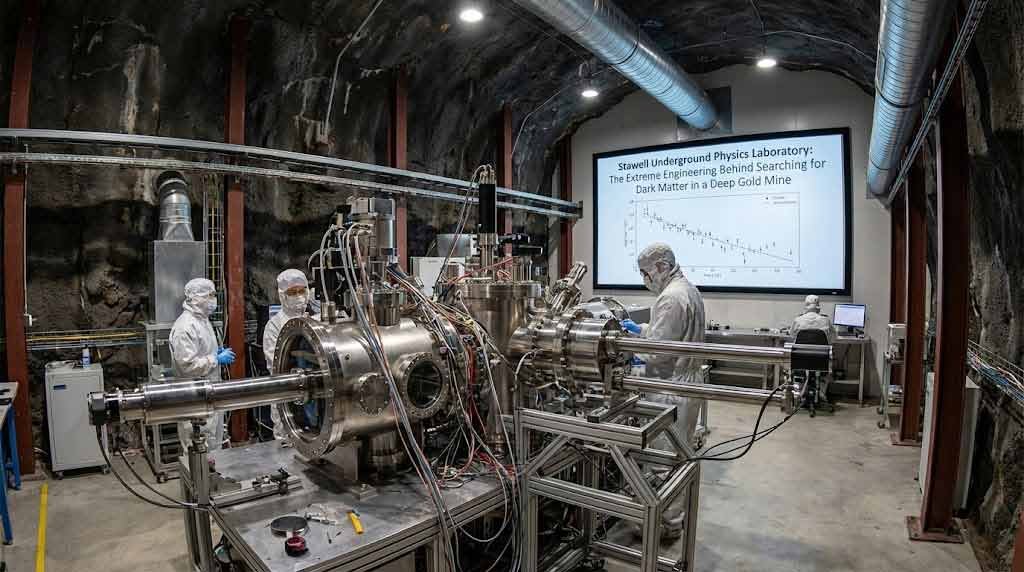
Somewhere beneath the wheat fields and red gum forests of regional Victoria, Australia — in a former gold rush town called Stawell, population roughly 6,000 — one of the most audacious scientific facilities on Earth is quietly operating one kilometre underground. Not in a purpose-built research campus. Not beneath a mountain in the European Alps. But in an active gold mine, carved into ancient bedrock, where the air smells like, as one project manager put it, “miners, sweat, kebabs, beer and blast fumes.” This is the Stawell Underground Physics Laboratory — SUPL — and it exists for a single, staggering purpose: to detect dark matter, the invisible substance that accounts for roughly 27 percent of everything the universe is made of, and which we have never directly observed.
The universe is composed of three things: ordinary visible matter at just 5%, dark matter at 27%, and dark energy at 68%. NASA Science Everything humanity has ever seen, touched, built, or eaten — every star, every galaxy, every grain of sand on every shore — makes up less than one-twentieth of what actually exists. The rest is invisible. The rest is, in a word, dark. And physicists have been hunting it for nearly a century.
SUPL is where the Southern Hemisphere joins that hunt.
A Town Built on Gold, Now Built on Questions
Stawell was founded in 1853 as ‘Pleasant Creek’ during the Victorian gold rush, and the significance of its rich underground reserves wasn’t realized until 1858, when over 9,000 prospectors began digging in what became known as the ‘Great Western Goldfield.’ Supl The gold eventually thinned out, as it always does, but the mine itself never fully closed. Although the gold had seemingly run out by the 1920s, full-scale mining recommenced in the 1980s, and more than 2.3 million ounces of the precious metal have since been extracted. Cosmos Magazine
What the town didn’t know — couldn’t know — was that its deepest shaft would one day be repurposed not for gold, but for something far more elusive. Australian physicists looking for a site to house a dark matter detection experiment needed a deep underground location, more than 800 metres down, shielded from cosmic rays and other worldly sources of interference. There are only a few deep mines in Australia that met this requirement, and the Stawell Gold Mine is the deepest. Spaceaustralia
The logic is counterintuitive but elegant: if you want to detect the rarest events in the universe, you must first eliminate every earthly disturbance. You go underground not to hide, but to listen. A kilometre of solid rock becomes the most sophisticated noise-canceling device ever devised.
Why Dark Matter Is So Hard to Find
Before understanding the engineering, you need to appreciate the quarry.
Dark matter outweighs visible matter roughly six to one, and makes up about 27% of the universe — yet it doesn’t reflect, absorb, or radiate light, making it extremely hard to detect. CERN We know it’s there because of what it does to the things we can see. Galaxies rotate at speeds that their visible mass alone cannot explain — they should be spinning apart, tearing themselves to shreds, yet they hold together with extraordinary cohesion. The only explanation that withstands scrutiny is that something invisible is providing the gravitational scaffolding.
The leading candidate for what dark matter actually is, from a particle physics standpoint, is the WIMP — the Weakly Interacting Massive Particle. WIMPs would have 1 to 1,000 times more mass than a proton and interact with ordinary matter only through gravity and the weak nuclear force. Department of Energy Billions of them, theoretically, pass through your body every second. They don’t care about you. They barely notice the Earth. They are the ultimate ghost.
To detect something this indifferent, you need a detector of extraordinary sensitivity, operating in a place of extraordinary quiet.
The DAMA/LIBRA Puzzle That Started Everything
The genesis of SUPL traces back to a controversial experiment buried under Gran Sasso mountain in central Italy. The DAMA/LIBRA collaboration, using an array of sodium iodide (NaI) scintillating crystals, has confirmed the presence of an annual modulation effect in the data from the 2-to-6 keV energy range that satisfies all the features expected for a dark matter signal, with high statistical significance, over multiple annual cycles spanning more than two decades. Wikipedia
The theoretical basis is compelling. As the Earth orbits the Sun, and the Sun moves through the Milky Way’s galactic halo, there should be a “WIMP wind” — a directional flux of dark matter particles that strengthens and weakens across the calendar year, peaking roughly in June when Earth’s orbital velocity adds to the Sun’s, and diminishing in December when it subtracts. DAMA sees exactly this pattern. The problem? No experiment using different target materials has ever observed a dark matter signal consistent with DAMA/LIBRA’s result. PubMed Central And more recently, experiments using the exact same sodium iodide target — including COSINE-100 and ANAIS-112 — have challenged the modulation signal at confidence levels exceeding three standard deviations.
The skeptics’ most damaging question is this: is DAMA detecting dark matter, or detecting the Italian seasons? Humidity, temperature gradients, changes in muon flux from cosmic rays — any of these could imprint a subtle annual rhythm into a sensitive detector. The only truly definitive way to answer this question is to run the same experiment in the opposite hemisphere, where the seasons are inverted. A repetition of this experiment in the Southern Hemisphere with the variation in phase with DAMA/LIBRA would discount the seasonal objection; if on the other hand variation was detected in the Southern Hemisphere with the same phase as DAMA, it would be very strong evidence for dark matter. Wikipedia
That is exactly what SUPL was built to do.
The Engineering of Invisibility
The construction of a precision physics laboratory inside an active gold mine is an exercise in creative constraint. SUPL sits at a depth of 1,025 metres, providing approximately 2,900 metre water equivalent shielding against background cosmic rays — and because it’s a decline (ramp) mine, cars and trucks can be driven directly to the laboratory site. Wikipedia The research hall itself measures roughly 33 metres long, 10 metres wide, and over 12 metres high — a cathedral of science hewn from ancient rock.
Around 4,700 cubic meters of rock were excavated from the site during construction, and the detector itself is shielded with approximately 110 tons of steel and polymer shielding. Interesting Engineering Special paint was applied to the walls to reduce radioactive emanations from the rock itself. Every material used in the construction was screened for trace radioactivity. Even the personnel must shower and change into low-dust jumpsuits before entering the clean-room section of the facility. The 45-minute drive down the mine tunnel in the dark is not metaphorical — it is a genuine journey into a different sensory world.
At the heart of the SABRE South detector are seven sodium iodide crystals grown to extraordinary purity. The crystals are immersed in a linear alkyl benzene-based liquid scintillator veto, further surrounded by passive steel and polyethylene shielding and a plastic scintillator muon veto — a layered defense system designed to eliminate every known source of false detection while preserving the faint signal that a genuine WIMP interaction might produce. ScienceDirect
The liquid scintillator — 12,000 litres of it — serves as an active veto: when a stray gamma ray from trace radioactivity strikes the liquid, it lights up and the associated crystal event is immediately discarded. Muon paddles span the top of the detector to catch cosmic-ray muons that still penetrate a kilometer of bedrock. The entire system is designed to achieve the lowest background rate of any sodium iodide detector ever built, so that if a WIMP-induced event does occur, nothing will be mistaken for it.
The Hemisphere Advantage and the SABRE Strategy
SABRE — Sodium iodide with Active Background Rejection — is not one experiment but two. SABRE South is located at SUPL in Victoria, Australia, and SABRE North is at the Laboratori Nazionali del Gran Sasso in Italy — a two-detector architecture designed to disentangle seasonal or site-related effects from a genuine dark matter signal by comparing results across hemispheres. arXiv
The elegance of this approach is philosophical as much as scientific. If both detectors see the same annual modulation — in phase with each other despite sitting on opposite sides of the globe with opposite seasons — that coherence becomes extraordinarily difficult to explain as anything other than the WIMP wind washing through the Earth. It would be, in the language of physicists, a smoking gun.
The SABRE South Technical Design Report was published in the Journal of Instrumentation in April 2025, and researchers expect the experiment to be taking data by the end of 2025, with equipment currently being transported into the underground lab. Phys.org The muon veto system has already been operational and transmitting data since late 2023, with first data collections confirming that by building the laboratory 1 km underground, the team has managed to reduce the cosmic radiation that will reach the dark matter detector significantly. Phys.org
What It Means to Search for Something No One Has Ever Seen
The Stoics had a concept they called kathêkon — the appropriate action, the thing that is owed in response to what reality demands of us. Marcus Aurelius spent a reign asking himself whether his actions were equal to the scale of the moment. I think often about that standard when I read about experiments like SUPL. The scale of what dark matter represents — a fundamental constituent of reality that has shaped every galaxy that has ever formed, and yet remains invisible to every instrument except inference — demands a response of commensurate ambition.
The engineers and physicists who spent a decade navigating corporate mine closures, government funding cycles, a pandemic, and the logistical nightmare of building a precision clean room inside a working gold mine in regional Victoria — these are people who understood their kathêkon. They built something not because it was easy, but because the question required it.
I’ve spent over two decades building a diner on the North Shore of Long Island, learning that the things worth doing always take longer than expected and cost more than budgeted — whether that’s sourcing the right organic sourdough culture for a slow-fermented bread program or handcrafting English bridle leather from traditional tanneries with six-month lead times. The lesson is always the same: purity of process is not a luxury. It is the entire point. At SUPL, that lesson is encoded in the design itself — ultra-pure crystals, ultra-clean rooms, ultra-careful shielding — because the signal they are hunting is so faint that a single impure element in the chain corrupts the whole.
The Future of the Search
SUPL’s ambitions extend beyond the SABRE experiment. The laboratory will house rare event physics searches beyond dark matter detection, as well as measurement facilities to support low-background physics experiments and applications including radiobiology and quantum computing. SISSA A town once defined by its gold may yet be defined by something far more valuable: the answers to fundamental questions about the nature of reality.
The laboratory sits at a junction between SUPL partner organizations in Sydney, Canberra, Melbourne, and Adelaide, and now positions itself at the centre of dark matter research globally. University of Melbourne The Australian Research Council invested $35 million in a Centre of Excellence for Dark Matter Particle Physics, and the University of Sydney joined as a member organization in 2025 — expanding the collaboration as the science moves closer to its first full data-taking season.
Whether SABRE South confirms, refutes, or reframes the DAMA/LIBRA signal remains to be seen. But the act of asking the question — with this degree of precision, from the Southern Hemisphere, inside an old gold mine in a wheat-farming town — is itself a statement about the nature of scientific ambition. The universe has been holding this secret for 13.8 billion years. Somewhere in the dark, beneath 3,363 feet of solid Australian rock, seven ultra-pure sodium iodide crystals are waiting for it to finally slip up.