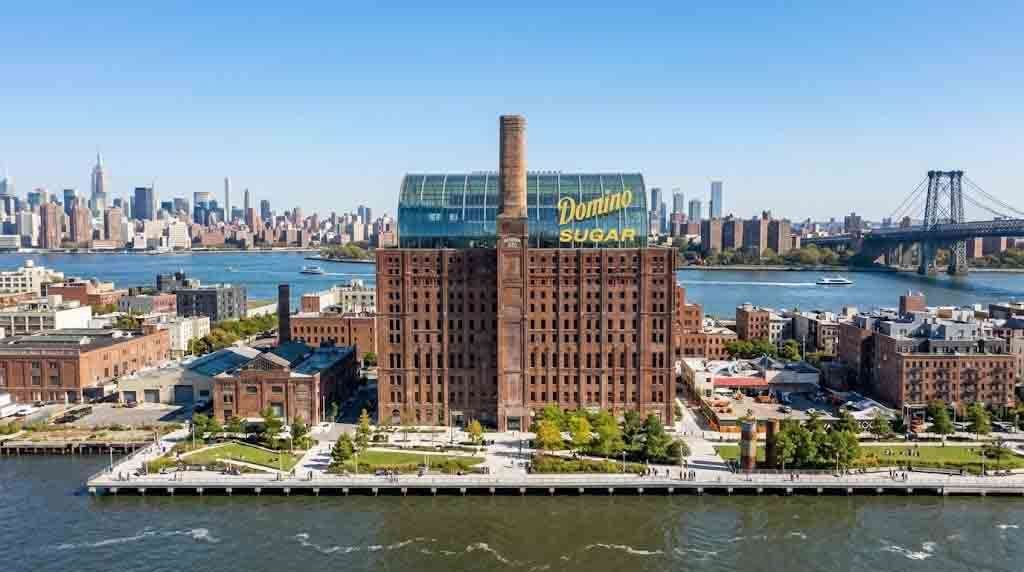
At full production, that building was refining over a million pounds of sugar per day. One million pounds, daily, moving through a facility that employed up to 4,500 workers at its peak in 1919 and processed, at certain moments in the late 19th century, as much as 98 percent of all refined sugar consumed in the United States. The Havemeyers & Elder refinery at 292 Kent Avenue in Williamsburg, Brooklyn was not a factory in any modest sense of the word. It was an industrial empire in a single block of buildings, pouring sweetness into the American diet and sweat out of thousands of human bodies, for over a century.
My family came from Greece. My parents worked in restaurants. I grew up understanding, in the physical way you understand things when you have no choice, what it means to run yourself through a machine — to give your body, your hours, your back to a place that will process you the same way it processes everything else. The Domino factory was that kind of place, scaled to a degree that the diner world I know cannot approximate. When I look at what Two Trees Management has built on that site now — the glass office tower inside the old brick shell, the riverfront park, the residential towers rising along Kent Avenue — I see what Brooklyn does with things it has used up. It polishes them. It rebrands them. It lets the expensive new interior show through the old arched windows like a ship in a bottle.
The brick is the same. The blood is not.
The Havemeyers and the Sugar That Built Brooklyn
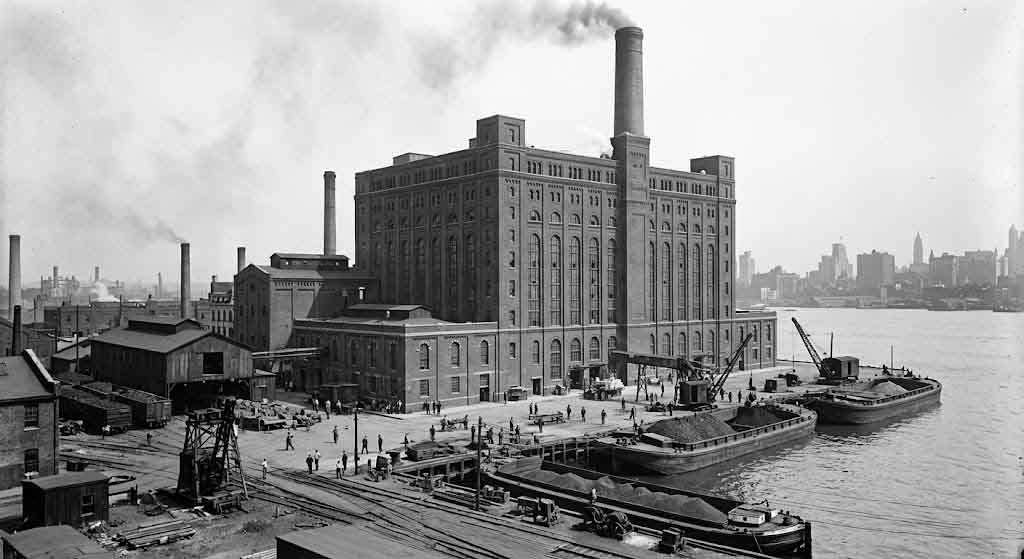
German immigrants Frederick and William Havemeyer founded what would become the Domino Sugar enterprise in 1799. Their first refinery in Williamsburg opened in 1856. The neighborhood around it was already industrializing rapidly — the East River waterfront of northern Brooklyn was developing into one of the great manufacturing corridors of the 19th century, dense with shipping, production, and the particular ecosystem of industries that grow up around a dominant one. Cooperages, candy companies, burlap bag manufacturers, railroad lines — all of them proliferating in the orbit of sugar.
A fire in January 1882 destroyed the original refinery structures between South 3rd and South 4th Streets. Theodore Havemeyer oversaw the reconstruction — this time with iron rather than wood, incorporating fireproofing technologies that were, for the era, considered cutting-edge. The rebuilt facility was one of the first structures in Brooklyn to use electricity, most likely generating its own power since no central plant yet existed in the borough. The new building was completed between 1882 and 1884 and its height, at 155 feet, matched early Manhattan skyscrapers across the water. The Havemeyer refinery was the first grand addition to the Brooklyn waterfront’s skyline.
By 1870, before the reconstruction, the neighborhood was already producing a majority of sugar consumed within the United States. By 1881, the Havemeyer facility was processing about three-quarters of all refined sugar in the nation. The scale is almost impossible to hold in your head. This was not a regional operation or a specialty manufacturer — it was the central nervous system of the American sugar supply, and it ran on human labor at an intensity that the gilded abstractions of late 19th century capitalism preferred not to examine closely.
The Body Cost
The sugar refining business was physical in ways that left marks. Raw sugar arrived by ship — the depth of the East River at Williamsburg allowed oceangoing vessels to load directly into the facility — and moved through a cascade of industrial processes: filtration, boiling in the pan house, finishing. The machines ran on heat. The workers ran alongside the machines. The building’s internal temperature in the pan house, where raw sugar was boiled in massive vacuum pans, was not a comfortable place to spend a shift.
At its peak, 4,500 workers were employed at the site. By the early 20th century, the workforce included waves of recent immigrants — many of them Eastern European, Caribbean, and eventually Puerto Rican — doing the kind of work that leaves residue in the joints and the lungs and the posture. The American Sugar Refining Company, which absorbed the Havemeyer operation along with most of its competitors in the late 1880s in a consolidation that federal antitrust investigators later scrutinized as “the Sugar Trust,” was not known as a benevolent employer. The production numbers were impressive. The conditions that produced them were not inspected with equivalent rigor.
The 240-foot smokestack that faces the western facade of the building — the one painted “Havemeyer & Elder,” the one with the iconic Domino Sugar sign that has been reinstated as an LED replica by Two Trees — was added in the 1930s. It has become the visual shorthand for the factory’s identity, the image that signals Williamsburg on the skyline the way the factory itself once signaled economic power. The sign is back, towering 30 feet, matching the original’s exact dimensions. The smokestack is still there. The people who worked beneath it are not.
A Century Runs Out
Demand for Brooklyn-refined sugar began declining in the 1920s as advances in refining technology and the construction of other facilities distributed production away from a single massive site. The Brooklyn refinery continued to operate, but its relative importance to the American sugar supply contracted steadily through the mid-20th century. Operations at the Brooklyn plant eventually shut down in 2004 — the facility’s last production had been moved to Yonkers — making it the last major active industrial operation on Brooklyn’s East River waterfront when the doors finally closed.
The buildings sat. The Landmarks Preservation Commission designated three of the surviving structures — the conjoined filter house, pan house, and finishing house that make up the main refinery complex — as New York City landmarks in 2007. The landmarking protected the 1882 facade and prevented demolition, but it did not produce a plan. For years, the brownfield site attracted competing development proposals, including an early scheme by CPC Resources that failed to gain approvals. The brick held while the proposals argued around it.
Two Trees Management purchased the site in October 2012 and began executing a plan that has been unfolding ever since. The first new residential tower — 325 Kent Avenue, a 16-story building with 522 units, 105 of them affordable, designed by SHoP Architects — opened in 2017. The wider plan calls for five residential towers totaling around 2,800 apartments, 700 of which will be affordable, along with 600,000 square feet of office space, 200,000 square feet of community and commercial space, and six acres of waterfront parkland. The entire development is projected to cost $3 billion.
The Ship in the Bottle
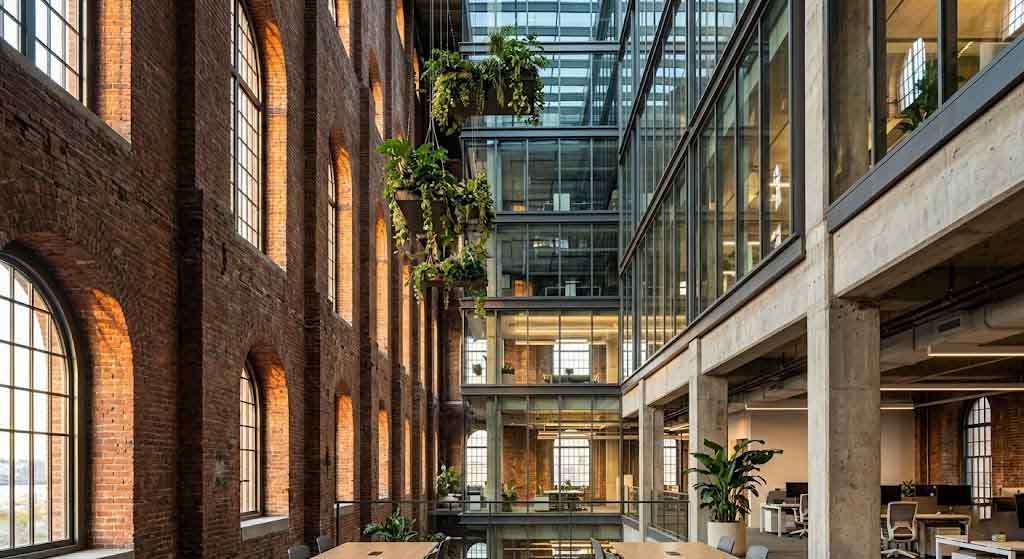
The centerpiece of the Domino redevelopment is the adaptive reuse of the original 1882 Filter, Pan, and Finishing House — the main refinery building, 250 by 70 feet, now called the Refinery at Domino. The architectural firm Practice for Architecture and Urbanism, led by Vishaan Chakrabarti, developed what might be the most technically audacious adaptive reuse approach in recent New York history: a new 15-story glass and steel office tower constructed entirely inside the original brick shell.
The gap between the new glass curtain wall and the old masonry facade ranges from 10 to 12 feet. That gap is filled with hanging gardens designed by Field Operations — myriad plantings, native pine and oak trees, American sweet gums — suspended between the old walls and the new glass. The brick functions as thermal mass, passively helping regulate the temperature of the new interior. Photon analysis was conducted to ensure sufficient natural light penetration to the lower floors of the new tower through that gap.
The interior of the new building has nothing of the original refinery left inside it. The equipment — stainless steel syrup tanks, 80-foot gantry cranes — is gone. The floor levels never aligned with the facade windows because the refinery’s machinery required idiosyncratic internal layouts, so there was no practical way to retain the original interior structure while creating standard office floor plates. The Landmarks Preservation Commission approved the design in November 2017. Critics of the approach have used the word “facadism” — the preservation of a skin while everything behind it is replaced — and the criticism has some weight. What remains of the original refinery is its silhouette, its arched windows, its smokestack, its relationship to the river. The inside is entirely new.
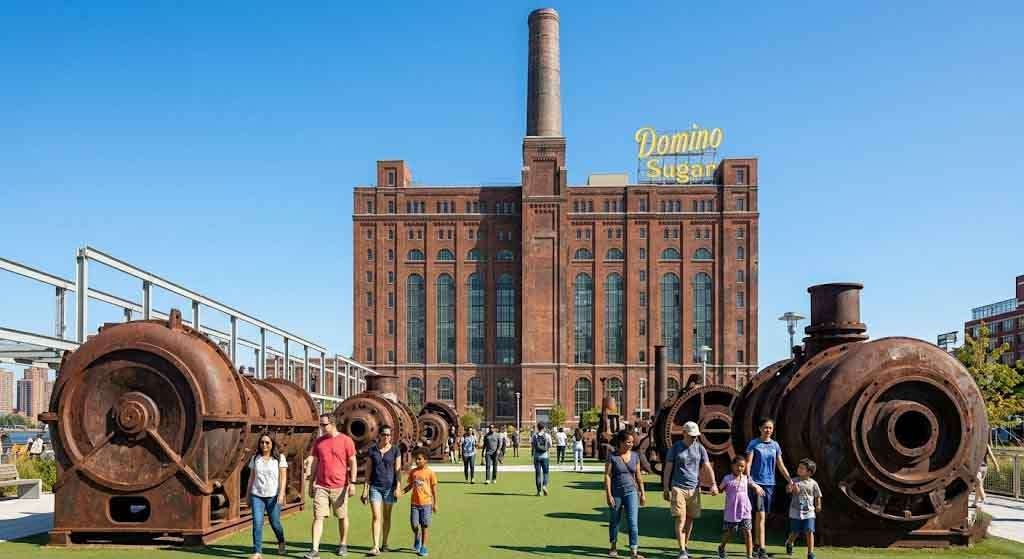
The result opened in 2023 as a 460,000-square-foot all-electric Class A office building with a triple-height atrium lobby, a 27,000-square-foot glass dome penthouse with 360-degree views, an indoor pool, bike parking, and floor plates as large as a Manhattan office tower. The Domino Sugar sign glows again in LED. The park — Domino Park — contains over 30 large-scale salvaged artifacts from the original refinery: components of the sugar-making machinery, displayed as sculpture along the waterfront.
What Preservation Owes the Workers
There is a question that every adaptive reuse project of this scale eventually forces, and the Domino redevelopment forces it more insistently than most. The original refinery site has been partially preserved, partially demolished, and substantially replaced with luxury residential and premium office space in a neighborhood where median rents have climbed for two decades. The 700 affordable units in the development plan are real and meaningful. They are also a negotiated fraction of 2,800 total apartments in a project whose financial logic depends on the premium end of the market.
The factory itself is preserved as a facade. The park below it preserves the artifacts of sugar production — the vacuum pans, the clarifying tanks — as objects of contemplation rather than function. Two Trees has commissioned oral histories and documentation of the Domino workers’ experience. The company’s own historical materials acknowledge directly: the story of this site is the story of a diverse group of people, from those who founded it to those who worked here, who shaped the neighborhood for over 160 years.
That acknowledgment matters. It is also not the same as the neighborhood staying affordable enough for the descendants of those workers to live next to the park named for the place their families helped build.
Pawli at Maison Pawli Realty has long talked about the ways that adaptive reuse projects reshape not just buildings but neighborhoods — how historic preservation and displacement can operate simultaneously, how the same brick that grounds a community’s identity can anchor a price point that prices that community out. It is not a simple story, and anyone who tells you it is has a financial interest in the simplified version. The Domino redevelopment is remarkable architecture and a genuine act of preservation and a $3 billion transformation of a working-class waterfront into a mixed-income but unmistakably premium district. All of these things are true at once.
Brooklyn’s Memory, Polished to a Price Point
I grew up with people who worked their bodies for someone else’s operation and came home tired in the specific way that kind of work makes you tired — not intellectually exhausted but physically depleted, in the shoulders and the feet and somewhere behind the eyes. The Domino refinery workers had that exhaustion in orders of magnitude I can’t claim to know. They produced something — literally, materially — that went into millions of American homes every day for over a century. The building that housed their labor is still standing, facing the East River it has faced since 1882.
That building now contains a glass office tower with a hanging garden between the new walls and the old. The smokestack is still there. The sign is back. The artifacts of sugar production are displayed in the park where children run on a Sunday afternoon. This is what Brooklyn does with its industrial past when the money comes back — it makes it beautiful, because beautiful is what sells, and what doesn’t sell doesn’t get preserved at all.
The brick is the same. It holds the memory of the work and the memory of the workers the way brick holds everything: silently, without comment, until someone asks it a direct question.
- Heritage as a Climate Strategy: Why Old Buildings Are Greener than New Glass
- The Architecture of Independence: How Victorian Buildings Gave the First Working Women a Room of Their Own
- The Ghost Station Capital: How the World’s Lost Railway Architecture Continues to Define the Cities That Erased It
- Wikipedia: Domino Sugar Refinery
- Architectural Record: After Two Decades Dormant, Brooklyn’s Domino Sugar Refinery Reopens
- Two Trees Management: Domino Sugar Factory History & Artifacts
- Fast Company: Inside the New Domino Sugar Refinery’s $2.5 Billion Renovation
- Untapped New York: The Refinery at Domino Opens
- Brooklyn Eagle: Historical Overview of the Domino Sugar Refinery