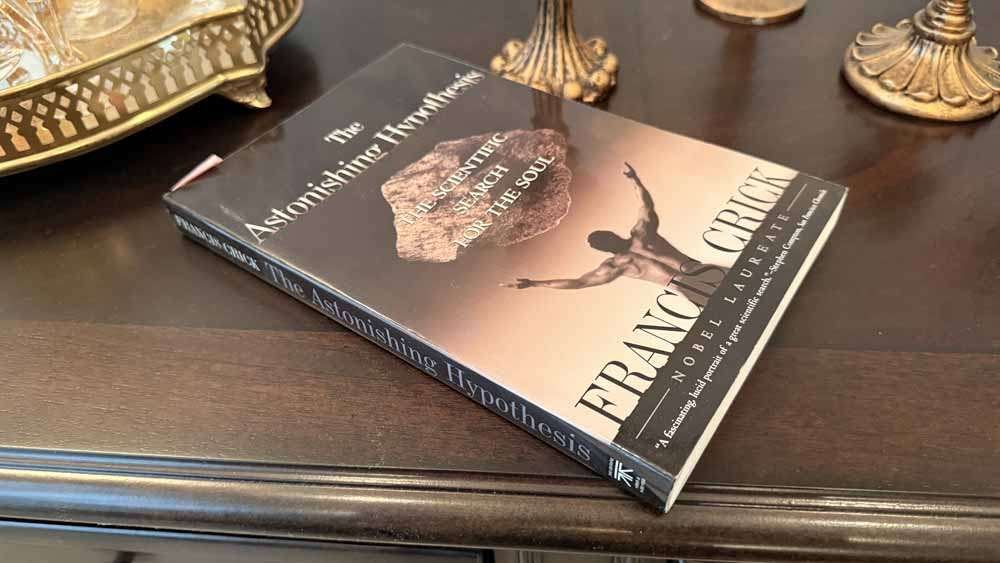
Francis Crick opens his 1994 book with a sentence that reads less like a scientific proposition and more like a provocation aimed directly at the part of you that believes it is reading this. “You, your joys and your sorrows, your memories and your ambitions, your sense of personal identity and free will,” he writes, “are in fact no more than the behavior of a vast assembly of nerve cells and their associated molecules.” He called this the Astonishing Hypothesis. Not a theory. Not a framework. A hypothesis — stated with the cool confidence of a man who had already cracked the structure of DNA and was not in the habit of being wrong.
I have been sitting with that sentence for years. It bothers me the way good philosophy is supposed to bother you — not because it is obviously false, but because you cannot be certain it is not true.
What Crick Was Actually Arguing
By the time The Astonishing Hypothesis was published, Crick had already secured his place in history. The double helix, the central dogma of molecular biology, a Nobel Prize — the man had done more to reshape our understanding of life than nearly anyone in the twentieth century. But in his later years, working at the Salk Institute in La Jolla, he became consumed by what he considered the last great unsolved problem in biology: the nature of consciousness. Specifically, what he called the binding problem — the question of how the brain stitches together separate streams of sensory input (color, shape, motion, sound) into a single, unified experience.
His answer, or rather his methodological wager, was that the question could be studied scientifically. Not through introspection, not through phenomenology, not through any appeal to something immaterial — but through neuroscience. The visual system, he argued, was the best place to start. It is the most elaborately studied of the senses, the one for which we have the most detailed anatomical and physiological data. If consciousness could be understood anywhere, it could be understood there first.
This is not a book about mysticism. It is a book about neurons firing in the visual cortex, about the thalamus acting as a relay and perhaps a regulator of attention, about 40 Hz oscillations and their possible role in binding disparate neural signals into what we experience as a coherent scene. Crick was doing real science here, or at least pointing very precisely at where real science needed to go.
The Philosophical Weight of the Claim
But the science is inseparable from the philosophical payload it carries. If Crick is right — if your sense of self, your experience of making a decision, your feeling of love or grief or wonder, are all just electrochemical events in neural tissue — then what becomes of the soul? What becomes of moral responsibility? What becomes of the self that you have been carefully cultivating for decades?
I have spent a fair amount of time with the existentialists, and what strikes me reading Crick alongside them is how radically different the threat feels. Sartre told you that existence precedes essence — that there is no pre-given human nature, no soul handed to you at birth, and that you are condemned to invent yourself through your choices. That was terrifying in a romantic way. It made you the author of your own meaning. Crick goes further and tells you that the author is an illusion. The pen moves on its own. The feeling of holding it is just another thing the neurons are doing.
This is not a trivial distinction. Sartre’s universe was empty of God but full of human agency. Crick’s universe is full of causal mechanisms and short on room for the kind of agency we think we have when we deliberate. The philosophical tradition Crick is most clearly challenging is not existentialism but the Cartesian model — the ghost in the machine, the immaterial mind that commands the body. He is not being subtle about it. He wants to bury Descartes with empirical data.
What is interesting, and what Crick is admirably honest about, is that the hypothesis cannot yet be proven. He is not claiming victory. He is claiming that the question is, for the first time in human history, answerable — that we now have the tools, or can develop them, to actually test whether consciousness reduces to neural activity. That is itself a remarkable claim, and it carries its own kind of arrogance. But it is an arrogance rooted in track record. Crick had been right before, very publicly, about things everyone thought were beyond reach.
Free Will and What You Lose
The section of the book that haunts me most is not the neuroscience. It is Crick’s brief, almost casual treatment of free will. He acknowledges that if the hypothesis is correct, free will — as traditionally conceived — is in serious trouble. He does not dwell on this. He notes it the way a surgeon might note that a procedure leaves a scar. Technically accurate, somewhat unfortunate, not a reason to avoid the operation.
But I think it deserves more dwelling. Because the question of free will is not just philosophical furniture. It is the foundation of how we treat each other. Criminal justice. Moral praise and blame. The entire architecture of personal responsibility is built on the assumption that people could have done otherwise — that when someone chooses cruelty or courage, something real happened in the choosing. If neurons are just running their program, then we are all, in some deep sense, doing exactly what we were always going to do.
Crick does not resolve this. Neither does anyone else. The compatibilists — philosophers who argue that free will and determinism can coexist — have been fighting this battle for centuries with no clear winner. What Crick does is sharpen the stakes. He takes what was once a metaphysical debate and threatens to turn it into an empirical one. And that changes the nature of the argument entirely.
I have thought about this in the context of my own choices — the ones I am proud of and the ones I would rather not examine too closely. The feeling of deliberation is vivid and immediate. It does not feel like computation. But Crick would say that is exactly what you would expect if you were a neural system sophisticated enough to model your own processing. The sensation of choosing freely is itself just more neurons.
What the Book Gets Right, and Where It Strains
Crick is at his strongest when he is doing neuroscience. The chapters on visual perception, on the layered architecture of the visual cortex, on attention as a selective spotlight that may itself be a candidate for the neural correlate of consciousness — these are genuinely illuminating, even thirty years on. He writes with the clarity of someone who has spent his life making complex biology accessible without dumbing it down.
He is less convincing, and he knows it, when he tries to connect the neuroscience to the larger philosophical claims. The gap between “here is how the visual cortex processes color” and “therefore your sense of self is an emergent property of neural activity” is not a small one. It is, arguably, the entire problem. Crick has the intellectual honesty to admit that the binding problem remains unsolved, that his 40 Hz oscillation hypothesis is speculative, that consciousness may turn out to be much harder than he hopes. But the framing of the book is tilted toward the conclusion before the evidence fully supports it.
That tension is part of what makes it worth reading. Crick is not pretending to have solved consciousness. He is arguing, passionately and with real scientific muscle, that it can be solved — and that the soul, whatever it is, will be found inside the skull or nowhere at all.
It is worth reading alongside Richard Dawkins’ The Selfish Gene, which operates at the genetic level but carries a similar philosophical undertow: that the things we thought were most essentially human — agency, purpose, identity — may be, at some foundational level, machinery. Together, Dawkins and Crick form a kind of double helix of reductionism. Each strand reinforces the other. Neither is comfortable. Both are probably pointing at something true.
Why It Still Matters
The Astonishing Hypothesis was published in 1994. Neuroscience has advanced enormously since then. We have fMRI, we have optogenetics, we have far more detailed maps of connectivity. The specific mechanisms Crick proposed have been revised or abandoned. But the central project — explaining consciousness in neural terms — has not been solved. The hard problem, as philosopher David Chalmers named it the same year Crick’s book appeared, remains unsolved: even if we knew every neuron’s firing pattern, would we know why there is something it feels like to see red? That question has not gone away.
What Crick gave us was not the answer. He gave us the permission to ask the question scientifically. And that permission has had consequences. The neuroscience of consciousness is now a legitimate field with serious funding and serious researchers. The question of whether the self is real — in the philosophical sense — is being pursued in laboratories, not just lecture halls. Whether that eventually produces an answer, or produces an even more refined version of the mystery, I genuinely do not know.
What I do know is that the book changed how I hold certain things. Not dramatically, not in a way I could have predicted before reading it. But sitting with a coffee early in the morning before the diner opens, watching the light come through the windows, I sometimes catch myself wondering whether the particular quality of that moment — the warmth, the quiet, the sense that it is mine — is something more than a very convincing story my neurons are telling me about themselves.
Crick would say yes, that is exactly what it is.
I am still deciding how I feel about that.
Sources
- Crick, Francis. The Astonishing Hypothesis: The Scientific Search for the Soul. Scribner, 1994. https://www.simonandschuster.com/books/The-Astonishing-Hypothesis/Francis-Crick/9780684801582
- Chalmers, David. “Facing Up to the Problem of Consciousness.” Journal of Consciousness Studies, 1995. https://www.ingentaconnect.com/content/imp/jcs/1995/00000002/00000003/653
- Koch, Christof. “The Neuroscience of Consciousness.” Scientific American, 2018. https://www.scientificamerican.com/article/what-is-consciousness/
- Salk Institute for Biological Studies — Francis Crick biographical profile. https://www.salk.edu/scientist/francis-crick/
- Nobel Prize biographical entry for Francis Crick. https://www.nobelprize.org/prizes/medicine/1962/crick/biographical/