Few arguments in the pizza world carry the same emotional charge as the one that erupts whenever someone conflates a grandma pie with a Sicilian. They are not the same. They have never been the same. And if you’ve spent any real time eating your way through Nassau County — through the grease-fogged windows of old-school pizza shops on Hempstead Turnpike, or the newer wave of wood-fired spots pushing into the Five Towns — you already know this in your bones.
The grandma pie is its own theology.
A Style Born in Home Kitchens, Not Pizzerias
The grandma pie did not begin in a commercial kitchen. It began exactly where the name suggests: in a Long Island home, in a well-seasoned rectangular pan, in an oven that had already baked a hundred other things that week. The style traces its origins to Italian-American households — specifically Sicilian immigrant families who settled throughout Queens, Brooklyn, and the Island — where the home cook adapted what she remembered from the old country to whatever flour, oil, and pans she had on hand.
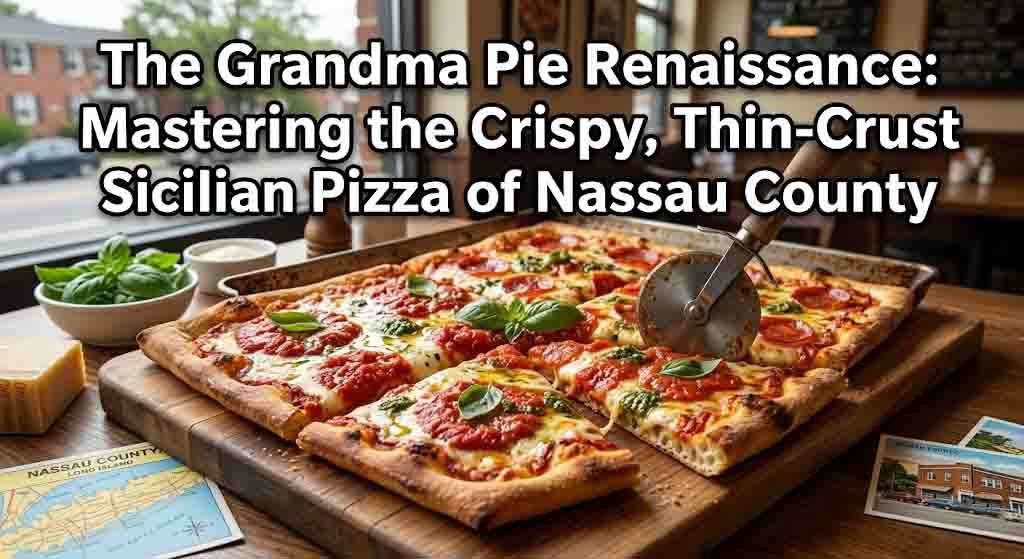
The defining characteristic that separates a grandma pie from its thicker Sicilian cousin is restraint. The dough is thinner, pressed into a well-oiled pan and left to proof for a shorter time, yielding a crust that is neither the airy focaccia-thickness of a classic Sicilian nor the tissue-thin char of a Neapolitan. It occupies its own stratum: crispy and almost fried on the bottom from the olive oil pooled in the pan, chewy in the center, and structurally sound enough to hold its toppings without folding.
The cheese — and this is not negotiable — goes on before the sauce. Low-moisture mozzarella, shredded and distributed to the very edges, melts directly onto the dough and caramelizes against the pan walls. The sauce, typically a bright, barely-cooked crushed tomato seasoned with nothing more aggressive than salt, dried oregano, and perhaps a whisper of garlic, is dolloped or spooned on top of the cheese in the Sicilian tradition. This inversion of the standard build is not an affectation. It creates a seal that keeps the crust from steaming out, letting the bottom fry properly in that shallow pool of oil beneath.
Why Nassau County Became the Proving Ground
Long Island’s relationship with pizza is not incidental. It is demographic, historical, and deeply personal. The postwar migration of Italian-American families from Brooklyn and Queens into Nassau and Suffolk counties brought with it not just recipes but entire food cultures — the whole ecosystem of Sunday gravy, the neighborhood bakery, the pizzeria on the corner that everyone’s uncle either owned or worked at for a decade.
Nassau County, sitting at the western edge of the Island and absorbing the overflow of New York City’s outer boroughs, became a pressure cooker for these traditions. The towns of Merrick, Oceanside, Valley Stream, Elmont, and the Five Towns are not simply suburbs — they are extensions of a specific Italian-American food culture that took root here and has been quietly evolving for sixty years.
The grandma pie flourished in this environment because it was democratic and efficient. One rectangular pan, baked in a commercial deck oven, produced eight squares that could be sold for less than a round pie while using similar labor. For the old-school Nassau County shop — the ones with the drop ceiling tiles, the soccer schedules pinned to the bulletin board, the same guy behind the counter since the nineties — the grandma was a workhorse. Not the marquee item. Not something you printed on a sign. Just something you made because you knew how, because your mother made it that way, and because regulars asked for it by name.
What’s changed in the last decade is that the grandma pie has graduated from workhorse to centerpiece.
The Technique Behind the Crunch
Understanding why a great grandma pie achieves what it achieves requires understanding the role of fat in baking. The olive oil — and serious grandma pie bakers are not shy about it — does more than prevent sticking. It fries the bottom of the dough from the moment the pan enters the oven. This is not the same as the oil sometimes drizzled over a Neapolitan before baking. It is a deliberate, measured pool, usually a quarter inch or more, that conducts heat directly into the dough’s underside before the oven’s ambient heat can reach it from above.
The result is a bottom crust with a texture that has no real analog in the round-pie world. It is simultaneously crispy and yielding, with a slight chew that reminds you this is leavened bread, not a cracker. The edges, where the cheese has pushed to the rim of the pan and caramelized against the metal, develop a frico-like quality — deeply browned, almost brittle, salty in a way that demands another bite immediately.
Dough hydration matters enormously here. A grandma dough typically runs higher hydration than a standard pizza dough — somewhere in the 70 to 75 percent range — which creates the open, slightly irregular crumb that lets steam escape properly without puffing the crust away from the pan. Too low and you get a dense, bready interior. Too high and the structure collapses, leaving you with something flat and gummy.
The proof time is another variable that separates the obsessive from the casual. The best versions allow the dough a cold ferment of 24 to 72 hours before a room-temperature proof in the oiled pan. This extended fermentation develops flavor compounds that a same-day dough simply cannot produce — a mild tang, a complexity in the crumb, a depth that makes the crust taste like something more than just flour and water.
Where to Find It: Nassau County’s Essential Grandma Pies
The beauty of Nassau County’s grandma pie scene is that it exists on a spectrum from the aggressively traditional to the thoughtfully evolved. The old-school shops still making it the way they always have, with no interest in explaining their process or photographing it for the internet, sit alongside newer operations that have dissected the grandma and rebuilt it with artisan flour, local dairy, and the kind of precision that comes from genuine obsession.
Some of the most consistent grandma pies in Nassau County come from shops that don’t advertise the fact. They simply make it. Walk in, order a grandma slice, and watch the counter person slide a square from a pan that’s been sitting under a heat lamp for twenty minutes but has somehow remained structurally perfect — the bottom still crackling against the cardboard plate, the cheese still pulled and caramelized at the edges, the sauce still bright enough to register as tomato and not just red.
The Five Towns corridor — Lawrence, Cedarhurst, Woodmere, Hewlett, and Valley Stream — has historically been fertile ground for serious pizza, and the grandma pie is no exception. Shops here have been serving it for generations to a clientele that knows exactly what they’re looking for and will tell you without hesitation when a place has declined.
Oceanside, Merrick, and East Meadow carry their own strong traditions, with several shops maintaining continuity over forty-plus years. These are not Instagrammable destinations. They are institutions that exist because the food is correct, the price is fair, and the neighborhood remembers.
The Modern Grandma: Artisan Flour Meets Old-World Technique
What’s happened to the grandma pie in the last few years mirrors what happened to sourdough bread a decade ago. A generation of bakers and pizza makers — many of them self-taught, deeply research-oriented, and willing to fail publicly in pursuit of something better — brought the grandma into the contemporary food conversation.
The changes they introduced are not cosmetic. High-extraction and whole-grain flour blends bring a nuttiness and complexity to the crumb that standard bread flour cannot replicate. Stone-milled grains, sourced from small American mills, create a dough that behaves differently in the pan and produces a flavor profile closer to what a Sicilian home baker might have achieved with the local grain available to her in the mid-twentieth century.
Some makers have introduced a slow, room-temperature ferment using a small percentage of commercial yeast alongside a natural starter, splitting the difference between the consistency of commercial yeast and the flavor depth of sourdough. The result is a grandma that tastes fermented without the sharpness that can overwhelm a delicate topping profile.
The toppings themselves have evolved. The classic — cheese down, sauce up, finished with dried oregano and perhaps a drizzle of oil — remains the standard against which everything else is measured. But the modern grandma has absorbed influences from the broader pizza culture: nduja stirred into the sauce, fresh basil added post-bake, a pass under the broiler to finish the cheese, high-quality anchovies distributed across the surface before the oven.
None of these additions are wrong. The question is always whether they serve the fundamental character of the pie or distract from it.
The Square Slice as Cultural Artifact
There is something almost philosophical about the grandma pie’s persistence in a food culture that constantly hunts novelty. It has not survived because it was marketed correctly or because a celebrity chef attached his name to it. It survived because it is genuinely satisfying in a way that resists easy analysis.
The square shape is part of it. A round slice performs a different kind of eating — the point first, working toward the crust. A square slice is uniform from edge to edge, every bite containing roughly the same ratio of crust, cheese, and sauce. There is no hierarchy of the slice. There is no negotiation about who takes the crust.
The communal aspect of the rectangular pan is not incidental either. A grandma pie arrives whole or in squares, placed in the center of the table, and consumed collectively. It is, by its geometry, a shared object. The round pizza can be divided into equal personal portions. The grandma pie resists that. You take what you take, and you eat together.
In Nassau County, where the Italian-American family table remains a living institution rather than a nostalgia project, that geometry still means something.
What Makes the Nassau County Grandma Different from Everyone Else’s
Every region that has adopted the grandma pie has put its own signature on it. New York City proper — particularly the Brooklyn and Queens shops that effectively invented the style — maintains its own standards. New Jersey has its own vernacular. The grandma has traveled as far as Chicago and Los Angeles, absorbed into local pizza cultures and reconfigured to suit local tastes and available ingredients.
Nassau County’s version carries something specific. It is not the rarest dough, not the most expensive cheese, not the most photogenic slice. What it carries is continuity. The shops that have been making this pie for forty years have not been making it forty different ways. They found something that worked, and they kept doing it, and the consistency itself became a form of excellence.
That continuity — the ability to return to the same shop after a decade away and find the grandma pie tasting exactly as you remembered it — is not a small thing. In a food culture that frequently mistakes novelty for progress, it is almost radical.
The grandma pie of Nassau County does not need to be reinvented. It needs to be found, ordered, and eaten standing at a counter or sitting at a table with people who know what it is and are glad to be eating it.
That has always been enough.
Sources: Pizza: A Slice of American History by Liz Barrett (Voyageur Press, 2014); interviews and field reporting from Nassau County pizza establishments; The Pizza Lab series, Serious Eats (J. Kenji López-Alt); The Food Lab: Better Home Cooking Through Science (W. W. Norton, 2015)