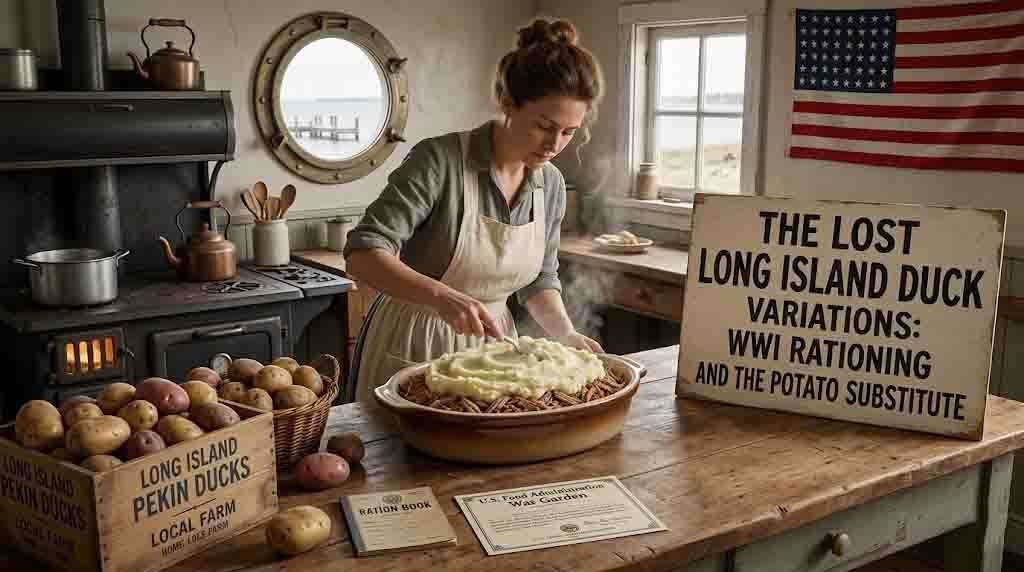
Four ducks changed everything.
That is not hyperbole. In 1873, a handful of white Pekin ducks arrived on American soil from China, and within a generation, the sandy estuaries of Suffolk County had become the duck capital of the world. Long Island’s duck industry didn’t sneak up on anyone — it exploded, riding a craze that swept restaurant menus from Manhattan to Chicago before the first shots of the Great War were ever fired. And then, like all things defined by appetite and abundance, war reshaped it entirely.
This is the story of what happened to Long Island duck when Herbert Hoover told America to eat differently — and why the old recipe variations born out of that pressure deserve to be remembered, cooked, and honored.
How Long Island Became Duck Country
Before we understand what was lost, we have to understand what was built.
The lineage of the Long Island duck traces back to a single importing moment: four breeding Pekin ducks, brought from China to Connecticut, and then ferried across the Sound to Long Island’s south shore. The island’s climate, its freshwater streams, its sandy loam terrain, and its proximity to New York City’s voracious restaurant market made it an almost perfect incubator for a duck industry that no one had planned but everyone wanted a piece of. By 1900, roughly thirty farms operated between Moriches, Eastport, and Riverhead. The Hallock family’s Atlantic Duck Farm became, briefly, the largest duck operation in the world — producing 260,000 birds a year between 1916 and 1938.
That figure — 1916 — matters. It lands directly at the edge of America’s entry into World War I. The industry was at the precise moment of its adolescence, flexing muscles it hadn’t fully developed yet, when the federal government arrived with a new set of rules about what Americans were allowed to eat and in what quantities.
When Hoover Rewrote the American Table
In August 1917, President Woodrow Wilson signed the U.S. Food Administration into existence, placing Herbert Hoover at its helm. Hoover was not a man who operated in half-measures. Under his direction, the American home front was reorganized around voluntary sacrifice: Meatless Tuesdays, Wheatless Wednesdays, Porkless Thursdays and Saturdays. Families across the country signed pledge cards. Nearly half of the nation’s twenty-four million households had committed to the program by October 1917.
The practical effect on the American kitchen was seismic. Beef, pork, sugar, butter, and wheat were the restricted commodities — the supplies most critical to feeding troops across the Atlantic. In their place, Hoover’s administration actively promoted alternatives. Poultry and fish were encouraged as protein substitutes for beef and mutton. Potatoes were practically evangelized — they were too heavy to ship efficiently across the ocean, which made them ideal for domestic consumption. The slogan “when in doubt, eat potatoes” circulated on posters and in women’s magazines with the fervor of a patriotic anthem. Potato flour, which could absorb moisture and extend baked goods further than wheat flour alone, saw domestic production hit 2.5 million pounds in 1918 across only five factories.
This was the environment that greeted Long Island’s ascending duck farmers. Duck, categorized as poultry, was not rationed. In fact, it was actively encouraged. And yet the ingredients typically paired with duck — butter, sugar glazes, wheat-thickened sauces — were the very things Americans had pledged to conserve.
The result was improvisation. And improvisation, in the kitchen, is where new traditions are born.
The Duck and the Potato: An Unlikely Partnership
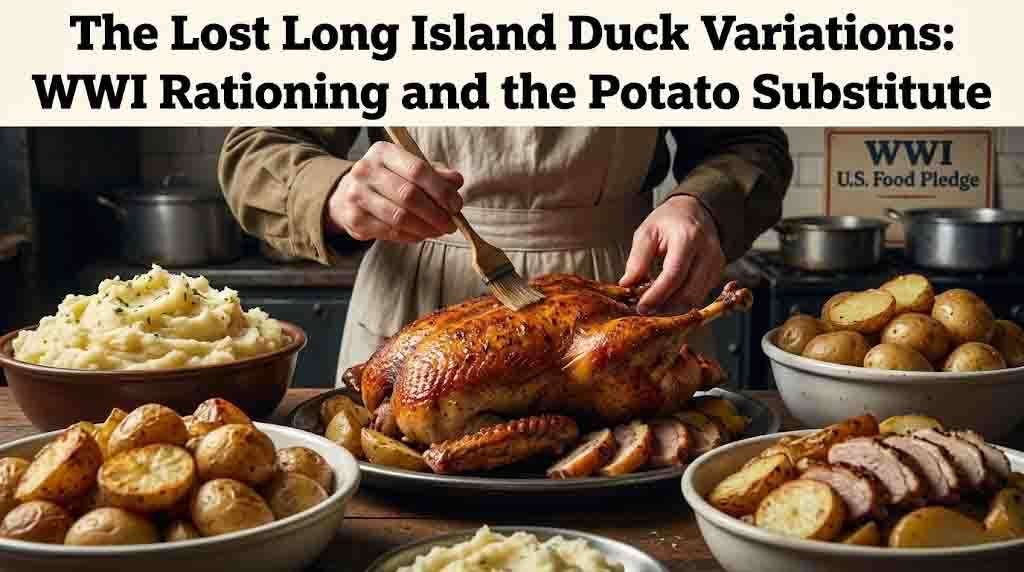
The most enduring wartime variation was not really a recipe so much as a reorganization of the plate. Duck fat — rendered abundantly from the bird’s thick subcutaneous layer during roasting — became the dominant cooking medium in households where butter had grown expensive or scarce. And what cooks reached for when they had duck fat and a patriotic obligation to serve potatoes?
They reached for the pan.
Duck-fat potatoes — sliced or rough-cut, sometimes parboiled first, then crisped in the rendered fat at the base of the roasting rack — became a wartime staple that made culinary sense even beyond the emergency that created it. The potatoes absorbed the rendered fat and the seasoned drippings, caramelized along the edges, and carried a depth of flavor that simple butter could not replicate. They weren’t a compromise. They were an accidental discovery: that the excess of one ingredient could transform something humble into something extraordinary.
What the wartime kitchen understood, and what contemporary cooks have rediscovered, is that duck fat is arguably the finest medium for cooking a potato. Its smoke point is high, its flavor profile is rich without being aggressive, and it carries the savory character of the roast itself into the side dish in a way that creates a unified plate rather than a collection of separate elements.
The U.S. Food Administration’s push for potatoes — abundant, local, heavy, and impractical to export — and the simultaneous encouragement of poultry may have been policy decisions made in Washington bureaucratic offices. But on Long Island, where the Pekin duck was already embedded in the agricultural identity of the south shore, those two directives collided into a combination that outlasted the war by a century.
The Wheat Substitute and What It Did to the Glaze
The classic Long Island duck preparation of the pre-war era — roasted whole, often finished with some form of sweetened glaze involving sugar or fruit — ran into a different wall during rationing. Sugar was being diverted to military use. The ships that had carried Caribbean sugar across the Atlantic were now military vessels. The Administration recommended that American home cooks substitute molasses, corn syrup, maple sugar, honey, and dried fruits wherever possible.
This gave birth to a generation of duck glazes that were darker, less refined in sweetness, and considerably more complex. Molasses-based glazes carried a bitterness underneath their sweetness that played differently against duck’s richness than refined sugar did. Honey glazes, applied toward the end of roasting, caramelized faster and with more volatility, demanding a lower oven temperature to prevent burning — which also meant a longer, slower cook that yielded more rendered fat and a more deeply flavored bird.
Corn syrup and maple, used in combination, created a glaze profile that Americans of the 1920s and 1930s would recognize as quintessentially regional — slightly smoky, amber-dark, with a finish that lingered differently on the palate than the European-style orange sauces that dominated fine dining duck presentations before the war.
None of this was written down in any formal culinary tradition. These were adaptations made by women in kitchens in Moriches and Eastport and Riverhead, working with what was available, feeding families during a period of declared national sacrifice. The recipes were passed laterally, neighbor to neighbor, or handed down informally across generations, rarely surviving the transition to printed cookbooks.
The Bird Breeding Variation No One Talks About
Alongside the culinary variations, the wartime period quietly accelerated a different kind of change: the selective breeding of Long Island’s Pekin ducks themselves.
The American Pekin — the bird that would become synonymous with the term “Long Island duck” — was already a hybrid story. Chinese Pekin stock had been crossed with British Aylesbury genetics somewhere along the way to Connecticut and then Long Island, producing a bird that was neither purely one nor the other. The resulting breed was distinct: horizontal in stance rather than upright, with white plumage and occasionally a faint pinkish-orange bill that betrayed its Aylesbury ancestry when the recessive gene surfaced.
During and after WWI, as demand for poultry surged and farmers were actively encouraged to expand production, Long Island duck breeders focused their selective pressure almost entirely on size, rate of growth, and feed conversion. The goal was a bird that could reach market weight of five to seven pounds within ten to twelve weeks, eating five times its body weight in scientifically mixed feed during that period. Rapid maturation became the defining characteristic.
What this breeding pressure gradually moved away from were the older color variants — the black, blue, and chocolate Pekin variations that had appeared through genetic expression in the early decades of the industry. As industrial logic came to dominate, diversity narrowed toward the commercially optimal: white-feathered, fast-growing, uniform. The old color variations didn’t disappear overnight, but they receded from commercial relevance, surviving only in backyard flocks and among the hobbyists who kept them for sentiment or curiosity rather than profit.
The white Pekin won. And Long Island duck, as a culinary identity, became associated entirely with that one expression of a breed that had once been slightly more varied.
What Crescent Duck Farm Still Carries
Today, a single farm remains active on Long Island. Crescent Duck Farm in Aquebogue — founded in 1908, now in its fifth generation under the Corwin family — is the last physical link to a Suffolk County industry that once produced 7.5 million ducks a year at its 1960 peak, employing dozens of farms spread across almost every freshwater creek between Moriches and Riverhead.
Doug Corwin has said that duck farming is a seven-day-a-week, 365-day-a-year commitment, and that you either love it or you don’t. His family has loved it across five generations. That continuity is not a small thing. What Crescent carries forward is not just the bird — it is institutional memory, the kind that records what it took to get a Suffolk County Pekin duckling from incubation to market before electric incubators existed, when kerosene heaters were fire hazards and setting hens were the preferred technology. It carries the knowledge of what selective breeding decisions look like across a century rather than a quarter.
In early 2025, Crescent was forced to cull its entire flock — roughly 100,000 birds — after a bird flu outbreak reached the farm. As of this writing, Crescent Duck Farm’s future remains uncertain, and with it, the last institutional thread connecting Long Island’s culinary identity to the industry that defined the East End for nearly a century.
The wartime recipe variations — the duck-fat potato, the molasses glaze, the improvised preparations born out of necessity between 1917 and 1918 — were never endangered in the way the birds themselves were. Ideas survive even when institutions collapse. But they need to be carried forward by people who understand what they represent: not nostalgia, but a record of how a community adapted without surrendering quality. Long Island farmers did not stop raising ducks because the war demanded sacrifice. They kept raising them, because duck was permitted, because it was local, and because what the land around them could produce was precisely what Herbert Hoover’s administration had asked American families to eat.
Why This History Belongs on the Plate Today
The question that the wartime duck kitchen raises — how do you maintain quality when the traditional ingredients are restricted? — is not an abstract historical curiosity. It is one of the most enduring creative pressures in any cooking tradition.
Constraint produces invention. The duck-fat potato was not created because some chef decided to elevate a side dish. It was created because butter was expensive and duck fat was abundant and potatoes were what Washington said to eat. The molasses glaze was not a stylistic choice. It was an available substitute that turned out to carry its own complexity and depth.
What those Long Island kitchens understood, in the urgency of wartime, is something that the best cooking always knows: the ingredient you have, used with precision and respect, often outperforms the ingredient you assumed you needed. The rendered duck fat left in the roasting pan after the bird comes out is not a by-product. It is an ingredient in its own right — one that the WWI home cook understood intuitively, because waste was not an option and nothing in the kitchen went unused.
The Big Duck in Flanders, that beloved twenty-foot ferroconcrete landmark built by farmer Martin Maurer in 1931 as a roadside retail stand for eggs and poultry, still sits along Route 25A as a monument to an industry that no longer exists at scale. It’s a gift shop now, drawing visitors from across the country who photograph it with their phones and drive on. But it was built in the direct wake of the wartime years that accelerated the Long Island duck industry toward its eventual peak — a peak built partly on the expanded consumption patterns that the Food Administration had encouraged, on the preference for poultry over rationed beef, on the Long Island farmer’s ability to supply what the country had been told to eat.
That history deserves more than a roadside monument. It deserves a plate.
Duck fat and potatoes. A molasses glaze dark with complexity. A bird bred for resilience and speed, raised on Long Island’s south shore, cooked long and slow until the skin crisps into something that needs no further justification. These are not recreations of wartime austerity. They are what happens when a great local ingredient meets intelligent constraint — and what survives, if we pay attention, is better than what came before.
Sources
- Suffolk County Department of Planning: Long Island Duck Farm History and Ecosystem Restoration Opportunities — suffolkcountyny.gov
- 27East: That’s A Big Duck: The Story of Long Island’s Duck Farming Industry — 27east.com
- SciFisland: A Brief History of Long Island’s Historic Duck Industry — scifisland.com
- Gastro Obscura / Atlas Obscura: The Meatless, Wheatless Meals of World War I America — atlasobscura.com
- U.S. Army Medical Museum: Beef, Bread, and Coffee: Food Innovations During World War I — medicalmuseum.health.mil
- Food Conservation During WWI, Together We Win: togetherwewin.librarycompany.org
- National Archives: In Freedom’s Name: Food Conservation Efforts During World War I — archives.gov
- Modern Farmer: A Brief History of Long Island Duck Farming, Before It’s Gone — modernfarmer.com
- Long Island Genealogy / Historical Records: Long Island Ducks & The Big Duck — longislandgenealogy.com
- Wikipedia: American Pekin — en.wikipedia.org