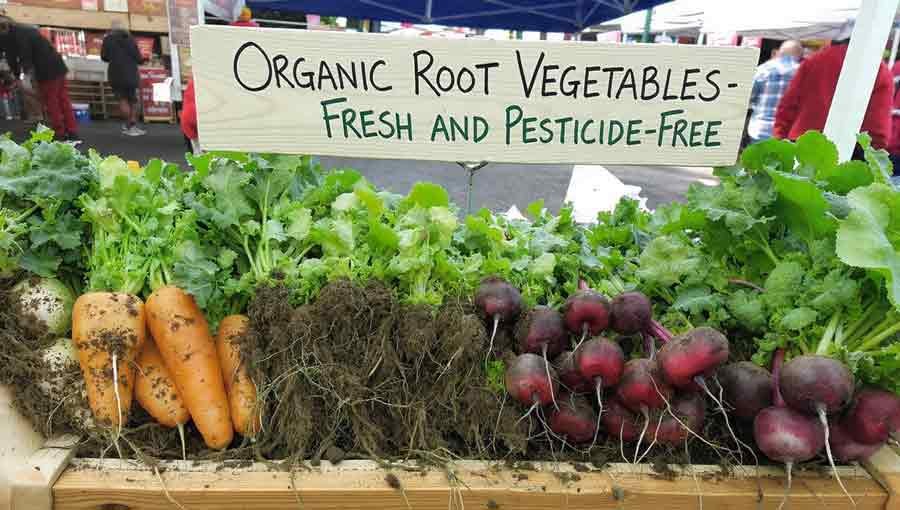
Underground is where the real story begins. While much of the public debate around pesticides and food safety focuses on the visible surface of a strawberry or the waxy skin of an apple, the more consequential chemistry is happening beneath the soil — absorbed, concentrated, and delivered without warning into the foods we consider foundational to a healthy diet. Root vegetables — carrots, potatoes, beets, parsnips, radishes, turnips — grow surrounded by the very medium where pesticide chemistry is most complex, most persistent, and most difficult to escape.
This is not a fringe concern. The science behind pesticide half-lives, soil absorption, and systemic uptake into root crops is well-established, peer-reviewed, and carries urgent implications for how you shop, how you cook, and how you think about feeding your family.

What a Pesticide Half-Life Actually Means
The concept of a half-life — borrowed from nuclear physics and applied to organic chemistry — describes the length of time it takes for half of a given pesticide to break down into secondary compounds within a specific medium. The National Pesticide Information Center at Oregon State University defines pesticide half-lives across three broad categories: low persistence (under 16 days), moderate persistence (16 to 59 days), and high persistence (over 60 days) (NPIC, Oregon State University, 2015).
What makes these numbers consequential for root vegetables specifically is the medium in question: soil. Unlike the surface of a tomato or a strawberry, where sunlight, rain, and oxidation accelerate breakdown, soil is a far more variable and forgiving host for chemical persistence. A single pesticide can behave dramatically differently depending on soil temperature, pH, microbial activity, clay content, and moisture. Glyphosate, for instance, has a documented soil half-life ranging anywhere from 2 days to nearly 200 days depending on conditions — a range so wide as to make blanket “safe period” calculations virtually meaningless in real-world farming scenarios (No More Glyphosate NZ, 2025).
Atrazine, a common herbicide, was measured with a 39-day half-life in Georgia soils at pH 6.8, and a 261-day half-life in Minnesota soils at pH 7.9 — the same compound, more than six times as persistent simply based on geography and soil chemistry (Iowa State University Extension, via NPIC data). Fipronil, a broad-spectrum insecticide used in soil, foliar, and seed treatments, has a documented soil half-life ranging from 3 days to 7 months (Scientific Reports, Nature, 2024). These are not edge-case fluctuations. They are the standard operating range of pesticide chemistry in American agricultural soil.
Why Root Vegetables Bear a Unique Burden
Most consumers understand the surface-residue problem intuitively: pesticides sprayed on crops sit on the skin and can often be reduced through washing or peeling. The USDA’s Pesticide Data Program mimics consumer behavior — washing, scrubbing, and in some cases peeling produce before testing — and even after that preparation, residues persist on the vast majority of samples (EWG, 2025).
But root vegetables introduce a compounding variable that washing simply cannot address: systemic uptake through the plant’s root system. Systemic pesticides — a category that includes widely used neonicotinoids like imidacloprid and organophosphates — are designed to be absorbed by plants and transported through their vascular tissues, entering the leaves, stems, and edible portions from the inside out. When they are present in soil, root vegetables absorb them directly as part of normal water and mineral uptake (ScienceDirect, 2024).
Consumer Reports has noted this plainly: some pesticides are systemic — taken up by the plant’s root system and distributed into the flesh — so they cannot be washed off. The USDA’s own residue measurements, conducted on produce prepared the way you would at home, still detect these internal residues. This is the fundamental difference between a leafy green contaminated on its surface and a carrot or potato carrying chemical residue embedded within its cellular structure.
A 2024 review published in a Springer Nature journal noted that leafy greens, berries, and certain root vegetables have documented higher pesticide residue accumulation compared to other produce categories. Maximum accumulation of pesticides was found in root vegetables specifically (IJCSRR, 2025). The pathway is direct: soil-applied pesticide dissolves into soil water, root crops absorb it as they grow, and it concentrates in the edible tissue.
The 2025 Dirty Dozen: Potatoes Make the List
The Environmental Working Group’s 2025 Shopper’s Guide to Pesticides in Produce, based on analysis of USDA data from 53,692 samples across 47 fruits and vegetables, introduced a revised methodology that incorporates pesticide toxicity — not just frequency and quantity — into its rankings. The result was a more precise, more damning portrait of what is actually accumulating on the American plate.
Potatoes entered the Dirty Dozen list for the first time in 2025, landing in 12th place. The driver was a specific compound: chlorpropham, a post-harvest sprout inhibitor detected in approximately 90% of conventional potato samples. The European Union banned chlorpropham in 2019 following a scientific assessment that identified health risks for both consumers and farmworkers. It remains legal in the United States. Nearly every conventional potato being sold in American supermarkets carries a chemical that Europe has formally determined poses unacceptable risk (EWG, 2025).
The 2025 guide also found more than 50 different pesticides on samples from each of the Dirty Dozen crops. Potatoes were the one exception in terms of average count — not because they’re cleaner, but because chlorpropham dominates so heavily. Across the entire Dirty Dozen, 95% of samples contained pesticide residues even after washing and standard preparation (EWG, 2025). The methodology update — incorporating toxicity weighting alongside raw counts — was published in the peer-reviewed International Journal of Hygiene and Environmental Health in September 2025, lending the annual guide new scientific credibility against its critics.

What the Science Says About Health Risk
The health literature on chronic, low-level pesticide exposure has grown considerably more specific and more alarming over the past decade. A 2024 systematic review published in a peer-reviewed journal analyzed studies from 2000 to 2024 and identified endocrine disruption, neurodevelopmental disorders, and increased cancer risk as the primary documented consequences of chronic dietary pesticide exposure (PMC, National Institutes of Health, 2024). The review noted that the cumulative effects of multiple pesticide residues — the cocktail exposure that occurs when you eat conventionally grown produce — can exacerbate health risks beyond what single-compound assessments suggest.
Specific outcomes are well-documented. A 2022 meta-analysis found that workers with occupational pesticide exposure were nearly five times more likely to have measurable DNA damage. A 2024 study found that children exposed to pesticides at an early age showed measurably poorer neurodevelopment from infancy to adolescence (CNN, 2025). The American Academy of Pediatrics has explicitly stated that pesticide exposure during pregnancy increases risk of birth defects, low birth weight, and fetal death, and that childhood exposure has been linked to attention and learning problems as well as cancer.
Fungicides — historically underscrutinized compared to insecticides — emerged as particular concerns in the 2024 EWG analysis. Four of the five most frequently detected chemicals in the Dirty Dozen were fungicides, including fludioxonil and pyrimethanil, which the EWG identified as potential endocrine disruptors with capacity to harm the male reproductive system (EWG Senior Toxicologist Alexis Temkin, PhD, 2024). Fungicides are often applied after harvest to prevent mold during shipping, which explains why their concentrations were detected at particularly high levels — applied close to consumption rather than weeks before.
The regulatory framework’s most significant weakness, as Consumer Reports has documented, is that tolerance levels are calculated for individual pesticides. There is no legal limit on the number of different pesticides allowed simultaneously on any given food. The effects of pesticide mixtures remain understudied and unknown.
The Organic Intervention: Evidence, Not Marketing
Perhaps the most direct evidence that organic root vegetables represent a meaningful health decision comes from dietary intervention studies — research designs that measure what actually happens inside a human body when the food changes.
A 2019 study published in Environmental Research (UC Berkeley School of Public Health, Hyland et al., 2019) tested four racially and geographically diverse American families across six days of their conventional diet and six days of a fully organic diet. The results were striking: urinary pesticide metabolites dropped by an average of 60.5% across all participants after just one week. Malathion — a neurotoxic organophosphate and probable human carcinogen per the World Health Organization — dropped by 95%. Clothianidin, one of the most heavily used neonicotinoid insecticides, dropped by 83%. Chlorpyrifos metabolites dropped by 61%.
A companion study published in Environmental Research in 2020 (Fagan et al.) found that mean urinary glyphosate levels dropped by nearly 71% and AMPA — the primary metabolite of glyphosate — dropped by more than 76% within six days of switching to an organic diet. The reduction was rapid: measurable drops occurred within three days of the dietary change. Diet, the researchers concluded, is the primary route of glyphosate exposure for most Americans.
The 2015 USDA carrots data is instructive about the nuance involved. While carrots make the Clean Fifteen — indicating relatively lower pesticide burden compared to Dirty Dozen items — USDA testing found 34 different pesticide residues on carrot samples. More than half were found on fewer than 1% of samples, suggesting the contamination is not uniform, but the range of compounds present reflects the chemical environment in which root vegetables grow. Sweet potatoes, also on the Clean Fifteen, had 19 different pesticide residues in USDA testing from 2016–2018, with the majority of samples containing Dicloran, a pre- and postharvest fungicide used to prevent soft rot (Food Revolution Network, 2024).
The contrast here matters: Clean Fifteen status means relatively lower contamination compared to other produce, not absence of contamination. For root vegetables in particular, the systemic uptake pathway means peeling and washing reduce but do not eliminate exposure.
A Practical Hierarchy for Organic Shopping
The evidence builds a clear and actionable case. If budget constraints require prioritization, root vegetables — especially potatoes — belong at the top of the organic shopping list.
Potatoes are the most consumed vegetable in the United States. They now occupy the Dirty Dozen, driven by a post-harvest chemical banned in the European Union. They grow entirely underground, surrounded by soil chemistry. They cannot be meaningfully detoxified by washing. Buying conventional potatoes today means consuming chlorpropham with near-certainty, along with whatever additional soil-chemistry compounds their root systems absorbed during the growing season.
Carrots and sweet potatoes occupy a more moderate position — on the Clean Fifteen, but not immune. Carrots are consumed with some frequency in their skin-on form, which carries more residue than the interior flesh. Sweet potatoes are commonly consumed with the skin for nutritional reasons, which increases exposure unless organically grown. For families who eat these vegetables regularly — roasted, mashed, blended into soups — the cumulative daily exposure across weeks and months is the relevant variable, not any single serving.
Beets, parsnips, radishes, and turnips all share the same fundamental exposure logic: they grow in soil, absorb through their roots, and concentrate chemical compounds in their flesh. USDA testing for many of these crops is less comprehensive than for more commercially dominant vegetables, which means the data is incomplete — not that the risk is absent.
The cost differential between conventional and organic root vegetables at most major grocery retailers remains among the smallest in the produce section. Organic potatoes, organic carrots, and organic sweet potatoes are available at retailers ranging from Whole Foods to Trader Joe’s to Target and Walmart, often at price premiums of one to two dollars per bag. The Berkeley study made the human rights dimension explicit: organic should not be a luxury, but it remains a practical tool available to most American households at the category of produce where it matters most.
The Soil Is the Story
Every carrot, potato, and beet pulled from conventionally treated soil carries a chemical autobiography written during its entire growing period — a record of what was applied, when, and how persistently it remained. The pesticide half-life is not an abstract laboratory concept. It is a countdown clock running in the dirt beneath every conventional farm in America, and root vegetables sit at its terminus.
The science is not designed to paralyze. It is designed to prioritize. The dietary intervention data proves, with measurable clarity, that switching to organic significantly reduces the pesticide burden in the human body within days. For root vegetables specifically, where surface washing is irrelevant and systemic uptake is the primary route of exposure, organic is not a premium lifestyle choice. It is the rational response to a well-documented chemical reality operating beneath the surface of the food system — one that, unlike so many things in nutrition science, the data has resolved into something remarkably clear.
Sources:
- National Pesticide Information Center (NPIC), Oregon State University — Pesticide Half-Life Fact Sheet
- Environmental Working Group (EWG) — 2025 Shopper’s Guide to Pesticides in Produce
- Hyland et al. (2019), UC Berkeley School of Public Health — Organic Diet Intervention Significantly Reduces Urinary Pesticide Levels in U.S. Children and Adults, Environmental Research
- Fagan et al. (2020) — Organic Diet Intervention Significantly Reduces Urinary Glyphosate Levels in U.S. Children and Adults, Environmental Research
- Scientific Reports, Nature (2024) — Investigation of dissipation kinetics and half-lives of fipronil and thiamethoxam in soil
- PMC, National Institutes of Health (2024) — A systematic review of pesticide exposure, associated risks, and long-term human health impacts
- Iowa State University Extension — Absorption of Soil-Applied Herbicides
- Food Revolution Network (2024) — The Dirty Dozen and Clean Fifteen
- Consumer Reports — Pesticides in Produce
- ScienceDirect (2024) — Pesticides impacts on human health and the environment