
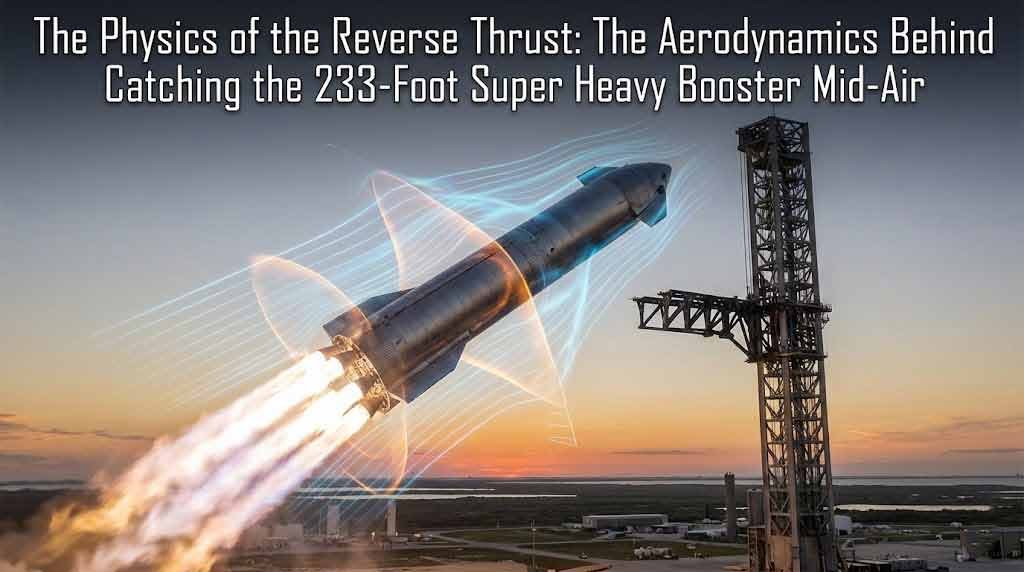
Few moments in the history of aerospace engineering have stopped the world the way October 13, 2024 did. At 8:25 a.m. EDT, a 397-foot stack of stainless steel and liquid methane lifted off from Starbase in Boca Chica, Texas, generating 16.7 million pounds of thrust — roughly twice the output of the Saturn V rockets that carried men to the Moon. Seven minutes later, the 233-foot Super Heavy booster, having separated from its upper stage, reversed its trajectory, descended from near-space, and was caught — mid-air — by a pair of mechanical arms attached to the launch tower. No parachutes. No landing legs. No splashdown. A structure taller than a 20-story building, moving at controlled velocity through turbulent lower atmosphere, intercepted by what engineers call the “chopsticks” of Mechazilla with the mechanical precision of a jeweler setting a stone.
What made that catch possible was not spectacle. It was physics — some of the most demanding, layered, and beautifully orchestrated aerodynamics ever attempted in operational spaceflight.
The Booster’s First Problem: It Was Never Meant to Come Back Down This Way
To understand what happens during the descent and catch, you first have to understand what Super Heavy is built to do on the way up. The booster carries 3,400 metric tons of liquid oxygen and liquid methane at liftoff. Its 33 Raptor engines — arranged in three concentric rings — burn through that propellant at staggering rates, accelerating the combined Starship stack to staging velocity in approximately 159 seconds. At engine cutoff, the booster is traveling downrange at hypersonic velocity, well above the sensible atmosphere, at roughly 64 kilometers altitude.
At that moment, the aerodynamic environment around the vehicle is essentially a vacuum. There is no meaningful air pressure, no lift, no drag in the conventional sense. The booster is a free-falling metal tube with residual kinetic energy directed away from its launch site. Getting it back requires working against Newtonian momentum using propulsion first, then transitioning into a regime where aerodynamics can take over. The challenge is that these two regimes — propulsive and aerodynamic — operate under fundamentally different physics, and the vehicle must navigate both within the span of a few minutes.
Stage Separation and the Flip: Where the Physics Gets Dangerous
Hot staging is the first technical maneuver that sets the recovery sequence in motion. Rather than waiting for full separation before igniting the upper stage engines, SpaceX fires Starship’s six Raptors while still connected to the booster. This “push-off” approach reduces gravity losses and adds an estimated 10 percent improvement in payload to low Earth orbit (SpaceX, 2023), but it also means the booster’s top is momentarily bathed in high-temperature exhaust from the departing upper stage.
Once separation is complete, the booster must execute a 180-degree flip — reorienting from nose-forward to engine-forward — before it can fire the boostback burn. During this rotation, the vehicle is in near-vacuum with minimal aerodynamic control authority. Cold gas thrusters, fed by residual ullage gas from the propellant tanks, provide the only attitude control available. These are small-impulse systems: precise, but limited. The vehicle’s mass and rotational inertia make any error in the flip maneuver consequential — an off-axis rotation here compounds into alignment errors kilometers below when the booster reenters denser atmosphere.
Once the flip is complete, ten of the thirteen inner gimbaling engines ignite for the boostback burn. This burn — lasting only a matter of tens of seconds — must be timed and directed with extraordinary precision. It eliminates forward velocity, reverses the trajectory, and puts the booster on an arc that terminates over a structure roughly 30 feet wide back at the launch site. Missing that commit point means a diverted splashdown in the Gulf of Mexico; the flight computer is programmed to make that call autonomously if any system reads out of spec. The margin for error is not measured in meters. It is measured in centimeters.
The Descent: Grid Fins, Aerodynamic Chines, and the Long Glide Home
After the boostback burn, the engines cut off entirely. Super Heavy enters what might be called the passive descent phase — an arc through the upper atmosphere that lasts several minutes and demands aerodynamic control at altitudes and velocities where conventional aircraft cannot operate.
Four electrically actuated grid fins, each weighing approximately 3 metric tons and made of stainless steel, are mounted at the top of the booster’s interstage section. These are not decorative. Grid fins create aerodynamic force through a lattice of intersecting surfaces that generate lift and drag with fine controllability across a wide speed range. Unlike conventional planar fins, the grid design maintains effectiveness at both supersonic and transonic regimes — an essential property for a vehicle that must decelerate from hypersonic speeds through the full atmospheric boundary layer. By differentially adjusting the angle of each fin, the flight computer can induce pitch, yaw, and roll corrections throughout the descent.
Lower on the booster’s oxygen tank, four aerodynamic chines add passive lift and lateral stability. These are fixed structures — no moving parts — that run vertically along the tank exterior. Their primary aerodynamic contribution is stabilizing the booster’s attitude as it enters denser air, helping prevent the kind of uncontrolled roll rates that destroyed earlier test vehicles. They also house batteries, COPVs (composite overwrapped pressure vessels), and CO2 fire suppression equipment, compressing structural utility with aerodynamic function in a way that reflects SpaceX’s constant attention to mass budgeting.
The entry burn — a firing of a subset of the inner engines — occurs as the booster descends into thicker air. Its purpose is twofold: to reduce the vehicle’s velocity before heating loads become destructive, and to create a region of pressurized exhaust between the engine bay and the incoming hypersonic airflow, forming a kind of propulsive heat shield. At Mach 7, the plume-atmosphere interaction is complex — computational fluid dynamics analyses have revealed detached bow shocks upstream of the exhaust plume, barrel shocks, and Mach disk formations that alter base heating in ways that took multiple test flights to characterize (ScienceDirect, 2024).
The Landing Burn Sequence: Thirteen Engines, Then Three
At approximately six minutes after liftoff, the booster transitions from passive descent to powered terminal approach. The inner 13 Raptors — the only engines equipped with gimbal actuators and the only ones capable of reigniting in flight — light simultaneously to begin decelerating the vehicle from its final descent velocity. This initial firing of all 13 provides a short, high-thrust pulse that quickly bleeds off excess speed.
Then comes the critical throttle-down: all engines except the central three are shut off. The reason is physics. The booster at this point has consumed the vast majority of its propellant. It is comparatively light — a mostly empty stainless steel cylinder descending on three engines, each capable of throttling between roughly 20 and 100 percent of rated thrust. Three engines burning at partial throttle can sustain a near-hover more precisely than 13 engines firing near their minimum throttle floor. The goal is to arrive at the catch point with near-zero vertical velocity and controlled horizontal alignment.
These three center engines are gimbaling continuously throughout the final approach. Each Raptor engine mount uses an electric thrust vector control (TVC) system — upgraded from the original hydraulic system after Integrated Flight Test 1 — that drives the nozzle through small angular deflections to steer the vehicle. The flight computer is running continuous feedback loops from inertial measurement units, GPS, and optical targeting systems, adjusting gimbal angles in real time to null out lateral drift and rotation. The tolerance required for Mechazilla’s arms to engage the catch hardpoints on the booster’s interstage is measured not in feet, but in centimeters. Bill Gerstenmaier, SpaceX’s Vice President of Build and Flight Reliability, confirmed after Flight Test 4 that the booster had achieved splashdown accuracy to within half a centimeter of its target (Wikipedia, Starship Flight Test 4).
Mechazilla and the Catch: Why Not Landing Legs?
The question most people ask when they first see the catch footage is simple: why not just land it like a Falcon 9? The answer is weight and turnaround time, and they are connected.
Super Heavy is enormous. Adding landing legs capable of supporting its mass — even at landing weight — and absorbing the shock of touchdown would add significant structural weight to a vehicle that is already mass-constrained at every design decision. Those landing legs would fly dead weight on every ascent, penalizing payload capacity for every mission. By contrast, Mechazilla’s chopstick arms are ground infrastructure. They add zero mass to the flying vehicle. The booster instead uses lightweight hardpoints on its interstage — structural features already present for tower lift operations — as the interface for catch.
The arms themselves are hydraulically actuated, can move laterally to align with the descending booster, and are positioned on the Mechazilla integration tower roughly 400 feet above the ground. As Super Heavy descends, the onboard computer and ground tracking systems are in continuous communication, verifying “thousands of distinct vehicle and pad criteria” — SpaceX’s own characterization — before the final “go for catch” command is issued manually by the flight director. If any criterion fails, the booster diverts to a Gulf splashdown. The system is explicitly designed to protect the launch infrastructure over the vehicle.
The catch on October 13, 2024 — the first successful attempt, executed on the first try — represented something qualitatively different from any previous achievement in rocketry. Apollo recovered capsules. The Space Shuttle rolled to a runway. Falcon 9 lands on legs. What Mechazilla demonstrated was the precision of a machine catching another machine: autonomous systems negotiating atmospheric physics, propulsive dynamics, and structural tolerances at a scale no human reflex could manage.
The Raptor Engine: The Heart of the Return
None of this is possible without the Raptor. The engine that powers Super Heavy uses a full-flow staged combustion cycle — a thermodynamic architecture that routes both fuel-rich and oxidizer-rich turbopump exhaust back into the main combustion chamber, achieving near-theoretical efficiency. Raptor 2 operates at chamber pressures exceeding 300 bar (NASA’s most advanced engines historically operated closer to 200 bar), and each engine produces approximately 230 metric tons of force at sea level. The Raptor 3 variant — introduced with Block 3 boosters — targets 280 metric tons and eliminates external engine shrouds by integrating plumbing and sensors into the engine’s primary structure.
The reignition capability required for the boostback, entry, and landing burns demanded engineering trade-offs that conventional rocket engines were never designed to accommodate. Most orbital rocket engines — including the Merlin engines on Falcon 9’s upper stage — do not reignite. Raptor does, reliably, at hypersonic velocities in near-vacuum, and again during terminal approach at subsonic speeds in dense lower atmosphere. Each ignition is initiated by spin-start systems powered by COPVs housed in the aerodynamic chines, using helium gas to spin up the turbopumps before propellant flow begins. The precision of these restarts, across three different flight regimes with dramatically different atmospheric conditions, represents one of the most demanding operational requirements ever imposed on a production rocket engine.
What This Means: The Craft in the Machine
There is a particular kind of discipline in engineering that resembles the discipline of craft — the understanding that the unseen details determine the outcome, that tolerances accumulate, and that mastery is demonstrated not in the grand gesture but in the margin. The catch of the Super Heavy booster made for extraordinary footage. What it actually represented was the culmination of dozens of integrated sub-disciplines — propulsion, guidance and navigation, structural mechanics, aerodynamics, software, manufacturing — each performing at its outer limits simultaneously.
The leather work I do at Marcellino NY operates at the opposite end of the scale — bespoke briefcases, hand-saddle stitched, built one at a time with English bridle leather from traditional tanneries. The philosophy, however, is not different: every stitch is load-bearing, every edge must be finished to the same standard as the visible face, and the object only earns its premium when the unseen details are as considered as the obvious ones. Mechazilla’s catch was extraordinary precisely because the systems you could not see — the gimbal control algorithms, the header tank sequencing, the TVC feedback loops — all held.
SpaceX will continue refining the Starship system toward full rapid reusability. Block 3 Super Heavy introduces Raptor 3 engines, an integrated hot-staging structure, and a redesigned three-fin grid fin arrangement with the catch points built directly into the fin hardware. The architecture is converging toward a vehicle that can be relaunched with minimal processing — the rocket equivalent of turning a wide-body jet around between flights. Whether that vision fully materializes will depend on hundreds of details yet to be resolved. But the physics of what was accomplished over Boca Chica in October 2024 is not theoretical anymore. It happened. A 233-foot rocket descended from near-space, fired its engines in a precisely calibrated terminal burn sequence, and was caught by a tower.
That is what mastery looks like when it arrives.