Physicists are not generally a mystical lot. They spend their careers dismantling wonder into equations, finding the gears beneath the ghost. And yet, for the better part of half a century, some of the most rigorous minds in theoretical physics have been quietly unsettled by a problem that sounds less like science and more like theology: Why does the universe seem built for us?
Not built in the supernatural sense — or at least, not necessarily. Built in the precise, calibrated, absurdly specific sense. The gravitational constant, the cosmological constant, the charge of the electron, the ratio of proton mass to electron mass — all of these values fall within ranges so narrow that the slightest variation would render the universe dark, structureless, and lifeless. Not uninhabitable. Nonexistent as a meaningful structure at all. Some estimates place the odds that the cosmological constant alone landed in its life-permitting range at less than one in a trillion trillion. The universe, in short, had no business working. And yet here we are, asking why.
This is the problem at the heart of the Anthropic Principle — and it is one of the most philosophically loaded questions in the history of human thought.
What the Anthropic Principle Actually Says
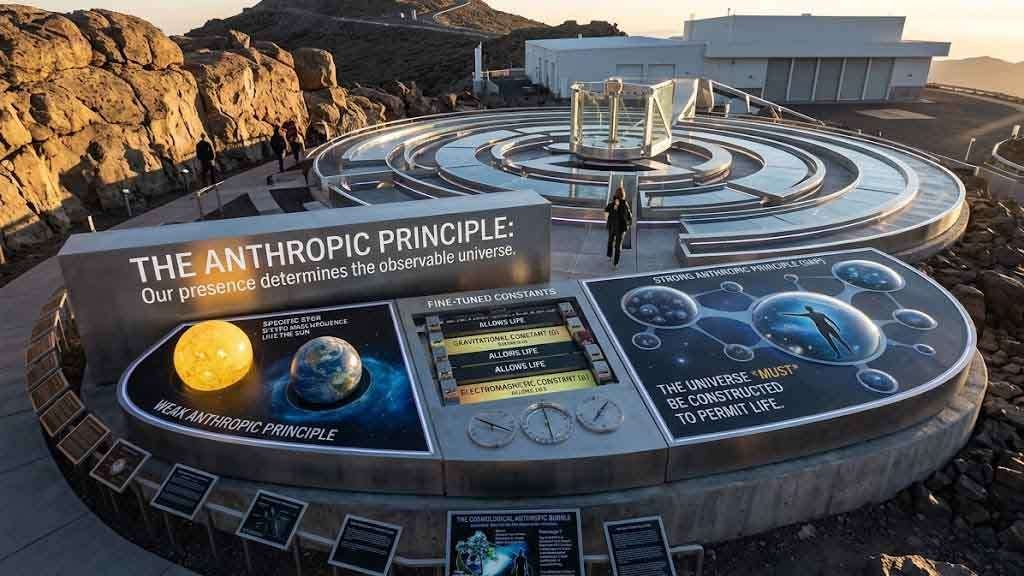
The term was coined by cosmologist Brandon Carter in 1973, offered as a correction to the hubris of assuming humanity occupies a typical position in the cosmos. Carter’s original formulation was deliberately modest: what we observe about the universe must be compatible with the existence of observers. That’s the Weak Anthropic Principle (WAP), and at its core it is almost trivially true. We cannot observe a universe that would have prevented us from existing. Our very presence here is a filter on what we can possibly see.
This sounds circular because it is, intentionally so. If you survived a firing squad of a hundred marksmen who all somehow missed, you shouldn’t conclude that there was no randomness — only that if they had hit, you wouldn’t be there to reflect on it. The selection effect explains the miracle. You are the survivor who gets to ask the question.
The Weak Anthropic Principle says: don’t be surprised that the universe fits life. You were only ever going to find yourself in one that does.
The Strong Anthropic Principle (SAP), however, is something altogether more provocative. As Barrow and Tipler developed it in their landmark 1986 work The Anthropic Cosmological Principle, the SAP asserts that the universe must have properties that allow the development of life at some stage in its history. Must. Not coincidentally does. Not happens to. Must. The distinction is the difference between a filter and a purpose — between an observer stumbling onto a hospitable planet and a cosmos that was, in some deep structural sense, oriented toward the emergence of mind.
That word — must — is where physics bleeds into philosophy, and where the conversation refuses to stay polite.
The Clockmaker Problem, Revisited
Teleology is the philosophical tradition that explains things in terms of their ends, their purposes, their telos. Aristotle built an entire understanding of nature around it. Every acorn, in his view, existed toward the oak. Every organ toward its function. The universe itself, in a teleological frame, is not an accident unfolding forward from a singularity — it is a structure oriented toward something.
The fine-tuning problem gives modern teleology its sharpest teeth. When physicists like Freeman Dyson observe that the universe seems to have “known we were coming,” they are not reaching for metaphor carelessly. The numbers are genuinely strange. The cosmological constant — Einstein’s most famous blunder, the value describing the energy density of empty space — is fine-tuned to a precision that has no scientific parallel. Too large by any significant margin and the universe expands so fast that matter never coalesces into galaxies or stars. Too small, and it collapses back in on itself long before carbon, oxygen, or nitrogen have time to arrange themselves into anything resembling life.
The gravitational constant, the strong nuclear force, the electromagnetic coupling constant — each one sits within a razor-thin corridor of life-permitting values, and they are not obviously related to one another. There is no physical reason we have yet identified that compels them to their current values. They simply are what they are, and what they are happens to be exactly what life requires.
This is the clockmaker problem, dressed in the language of modern cosmology. William Paley’s 18th-century watchmaker argument said: find a watch on the ground, and you infer a watchmaker. The watch is too complex, too functional, too precisely calibrated to be accidental. Contemporary cosmologists find themselves staring at something considerably more complex than a watch and asking the same uncomfortable question.
The Multiverse as Escape Hatch
The secular response to fine-tuning is, in a sense, audacious: propose an infinite number of universes.
If our universe is not the only one — if eternal inflation, quantum mechanics, or string theory’s landscape of possible vacuum states generates a vast or even infinite ensemble of universes, each with different physical constants — then our universe’s apparent fine-tuning becomes no more remarkable than a lottery winner. In a lottery with trillions of entrants, someone was always going to win. We are that someone, and we exist in the winning universe. Leonard Susskind argued precisely this: the existence of a large number of vacuum states puts anthropic reasoning on firm ground — only universes whose properties allow observers to exist are observed, while the possibly far larger set of lifeless universes goes unnoticed.
Steven Weinberg, who won the Nobel Prize in Physics, went further. He regarded the anthropic principle as a potential “turning point” in modern science — one that might explain how the constants of nature take values suitable for life without requiring fine-tuning by a benevolent creator.
This is the multiverse as philosophical strategy: not merely a cosmological hypothesis but a move in a much older argument. If you flood the probability space with enough universes, the improbability of ours dissolves. No designer required.
But the move carries costs that critics have been quick to identify.
First, the multiverse is not observable. By definition, the other universes in the ensemble — whether generated by eternal inflation, the many-worlds interpretation of quantum mechanics, or string theory’s landscape — exist beyond any causal horizon we could ever reach. The multiverse hypothesis, often invoked as a solution to fine-tuning, suffers from a lack of testability. While the idea of many universes is mathematically consistent in some models, the multiverse is beyond observational reach, at least with current technology. A theory that cannot, even in principle, be falsified is doing philosophy, not physics — and many physicists are uncomfortable pretending otherwise.
Second, as physicist George Ellis and others have noted, a “multiverse generator” — whatever mechanism produces the ensemble of universes — itself requires fine-tuning to do its work. Even if a “many-universes generator” exists, it seems to need to be well designed in order to produce a multitude of universes with widely varying properties. You have not eliminated the problem of design. You have pushed it back one level.
Third, there is something epistemically uncomfortable about invoking an infinite number of unobservable entities to explain the improbability of the one observable universe we have. The philosopher Elliott Sober called this the “inverse gambler’s fallacy” — assuming that because we got lucky, there must have been many attempts. But that inference is not as clean as it appears.
The Observer and the Observed
Heidegger, in his lifelong interrogation of Being, kept returning to a question that sounds simple and isn’t: Why is there something rather than nothing? He was not asking for a causal explanation — not looking for what caused the Big Bang. He was asking why existence itself has the character it does, why Dasein — being-in-the-world — finds itself thrown into a world already structured, already meaningful, already there.
The Anthropic Principle brushes up against this question from the scientific side. The cosmological version of Heidegger’s puzzle is: given all possible configurations of physical law, why this one? Why constants that permit the slow accretion of matter into stars, the nuclear fusion that forges carbon in stellar cores, the planetary chemistry that allows the long, patient work of biological evolution?
The philosopher John Wheeler, late in his career, pushed the observation deeper. His Participatory Anthropic Principle proposed that observers are not merely passive recipients of a universe that happened to cooperate — they are, in some quantum-mechanical sense, necessary to the universe’s existence. Observation, in quantum mechanics, is not passive. The observer participates in the collapse of possibility into actuality. Wheeler’s radical suggestion was that consciousness is not incidental to the cosmos. It is, perhaps, part of what the cosmos is for — or what it requires to fully exist at all.
This is not mysticism wearing a lab coat. It is a serious attempt to grapple with what the observer-dependent character of quantum mechanics means at the largest scales. Wheeler was not a careless thinker. He is the man who coined the term “black hole.” His participatory universe is strange, but it is not uninformed.
Design Without a Designer? The Teleological Tightrope
Bernard Carr of Queen Mary University in London offered what may be the field’s most compressed statement of the dilemma: “If you don’t want God, you’d better have a multiverse.”
It is a bracing line because it reveals the structure of the argument with unusual clarity. The fine-tuning data is not in dispute. What is in dispute is what the fine-tuning means. Theists read it as evidence of intentional design — the universe calibrated by intelligence for a purpose. Naturalists reach for the multiverse, knowing full well it trades one set of metaphysical commitments for another. Both camps are doing metaphysics. The disagreement is about which metaphysics is more intellectually honest.
What the teleological tradition offers — and what physics keeps rediscovering despite itself — is the idea that the universe has a direction. Not a direction imposed from outside, necessarily. Perhaps a direction that is intrinsic to what the universe is. Teilhard de Chardin, the Jesuit philosopher-paleontologist, spent his career arguing that evolution has an arrow — that the increasing complexity of matter, from subatomic particles to cells to brains, is not random walk but orientation. He called the endpoint the Omega Point. Whether or not one accepts his theology, his intuition — that the cosmos is not merely happening but becoming — remains a live philosophical position.
The Anthropic Principle, in its strongest form, asks us to take seriously that our universe is not accidentally hospitable. It does not require a bearded creator. It does not demand scripture. But it does resist the comfortable materialist assumption that existence is, at bottom, a meaningless sequence of physical events with no orientation toward anything in particular. The fine-tuning data, at minimum, demands an account. The multiverse is one account. Design is another. Wheeler’s participatory universe is a third. Lee Smolin’s cosmological natural selection — universes that reproduce through black holes, passing on physical parameters to offspring universes, with life-permitting universes becoming statistically dominant over time — is a fourth.
None of them are comfortable. All of them are serious.
The Question That Won’t Close
Philosophy has always lived in the questions that science cannot yet answer and religion answers too quickly. The Anthropic Principle is exactly such a question — one that sits at the crossroads of cosmology, quantum mechanics, and the oldest inquiry humanity has ever made: Is any of this for something?
The fine-tuning of physical constants does not prove a creator. It does not vindicate any particular religious tradition. But it does something almost more unsettling: it makes the universe’s hospitality to life look less like background noise and more like a feature. A feature that demands explanation, even if every explanation currently on offer is incomplete.
Aristotle believed that the highest form of knowledge was knowledge of causes — and specifically of final causes, the ends toward which things move. Modern science largely abandoned final causes in favor of efficient ones: not what for but how. The Anthropic Principle suggests, uncomfortably, that what for may not be so easy to dismiss.
We are, as Carl Sagan once put it, the universe’s way of knowing itself. Whether that knowledge was accidental or inevitable — whether we are cosmological surplus or cosmological intention — is the question the Anthropic Principle places before us, without the courtesy of an answer.
Sources:
- Barrow, J.D. & Tipler, F.J. (1986). The Anthropic Cosmological Principle. Oxford University Press.
- Carter, B. (1974). “Large Number Coincidences and the Anthropic Principle in Cosmology.” IAU Symposium 63.
- Stanford Encyclopedia of Philosophy: Fine-Tuning
- Wikipedia: Anthropic Principle
- Carr, B. (2007). Universe or Multiverse? Cambridge University Press.
- Dyson, F. (1979). Disturbing the Universe. Harper & Row.
- Teilhard de Chardin, P. (1955). The Phenomenon of Man. Harper & Row.
- Heidegger, M. (1927). Being and Time. Max Niemeyer Verlag.
- Sober, E. (2003). “The Design Argument.” In: Blackwell Guide to the Philosophy of Religion.
- Ellis, G.F.R. (2011). “Does the Multiverse Really Exist?” Scientific American, August 2011.
- Smolin, L. (1997). The Life of the Cosmos. Oxford University Press.
- Wheeler, J.A. (1983). “Law Without Law.” In: Quantum Theory and Measurement. Princeton University Press.