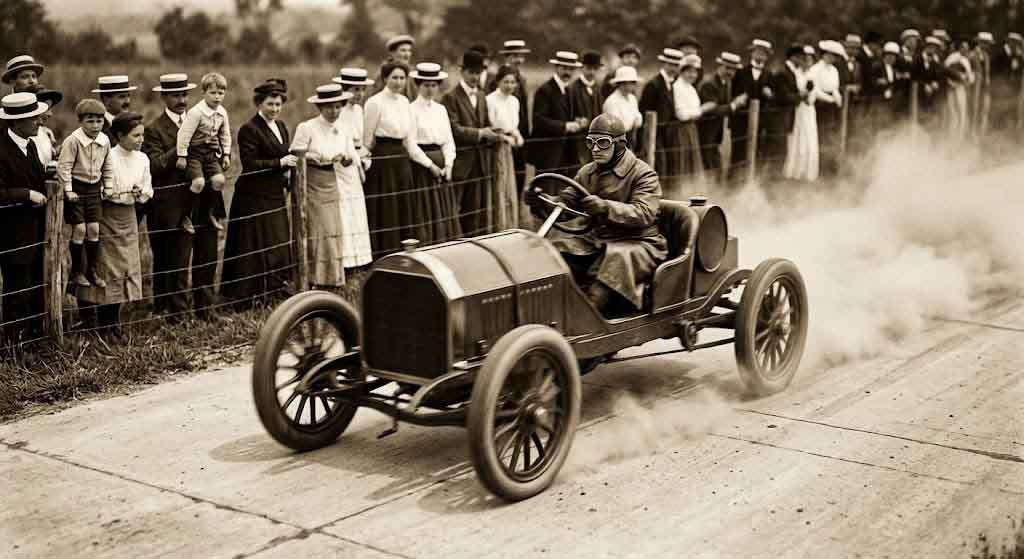
Sixty miles per hour. In 1908. On Long Island.
Not a dream, not a projection. A reality built from reinforced concrete and railroad money, stretched across forty-five miles of farmland and marsh from Queens to Lake Ronkonkoma. Before the Long Island Expressway backed up at Exit 49 and made Suffolk County commuters question their life choices, before Robert Moses drew his parkway lines through neighborhoods and called it progress — there was a single private ribbon of road that a rich man poured six million dollars into and ultimately lost to back taxes.
That road was the Long Island Motor Parkway. And it was the first highway built exclusively for automobiles anywhere in the world.
The Man Behind the Concrete
William Kissam Vanderbilt II was the great-grandson of Cornelius Vanderbilt, the shipping and railroad titan who built one of the largest fortunes in American history. By 1904, “Willie K.” had inherited enough of that money to do what seriously wealthy men do when they get obsessed with something: he built the infrastructure for it himself.
His obsession was speed. Not the genteel carriage-and-cravat speed of his grandfather’s generation, but the howling, dust-blinded, engine-roaring speed of the automobile. He’d raced across Europe in Grand Prix events. He’d set a land speed record of 92 miles per hour in Florida in 1904 — in a car, not an aircraft. And he wanted to bring that energy to Long Island, which in those early years of the twentieth century was already transforming from a patchwork of farms and fishing villages into the playground of Manhattan’s upper class.
He launched the Vanderbilt Cup Races in 1904, running the circuits on Nassau County’s existing farm roads — Jericho Turnpike, Bethpage Turnpike, Hempstead Turnpike — roads made of dirt and horse manure and prayer. The races drew enormous crowds. They also drew catastrophe. In 1906, a spectator broke through a wire fence in Mineola as the cars thundered past, and a race car tore into the crowd. One man died. Others were injured. The message was clear: open public roads and automobile racing were an incompatible combination, and someone was going to have to build something purpose-made.
Willie K. decided that someone was him.
Engineering the Future on a Private Dime
Construction began in June 1908. The ambition was staggering. Vanderbilt’s plan called for a seventy-mile road running from New York City all the way to Riverhead — essentially an automotive spine down the length of Long Island. Only forty-five miles of it would ever be built, but what was built was genuinely revolutionary.
The parkway used reinforced concrete, the first highway in the United States to do so. Previous roads — when they were paved at all — were surfaced with wood planks, oyster shells, or oiled dirt. This was a different proposition entirely: banked curves calculated for high-speed turns, guardrails, grade-separated overpasses that eliminated intersections with existing roads. Sixty-five bridges and underpasses. No traffic lights. No cross traffic. No speed limit. It was engineered for velocity the way a velodrome is engineered for cycling.
The first ten-mile stretch opened on October 10, 1908, just in time for that year’s Vanderbilt Cup Race. The toll was set at two dollars — real money in 1908, the equivalent of fifty dollars or more today. Twelve toll lodges were built along the route, six of them designed by John Russell Pope, the same architect who would later design the Jefferson Memorial in Washington. These were not wooden shacks. They were elegant stone structures with living quarters for the toll collectors, built to reflect the class of clientele Vanderbilt expected to attract.
The racing continued on the parkway in 1909 and 1910. Then the 1910 race killed four people and injured twenty others. The New York legislature banned road racing. Indianapolis became the home of American automobile competition. And Vanderbilt was left with a private forty-five-mile toll road on Long Island with no race car market to anchor it.
He pivoted. The Motor Parkway opened as a general toll road in 1912 and found its natural clientele: Manhattan’s wealthy elite traveling to their Long Island estates on weekends. The same class of people who rode Vanderbilt’s grandfather’s railroads now rode Vanderbilt’s grandson’s private road. The toll dropped from two dollars to a dollar fifty, then to a dollar. By 1920, the road had earned the nickname it would carry for the rest of its operational life: Rumrunner’s Road.
Prohibition, Speed, and the Perfect Crime Road
The confluence of a private, police-free highway and the onset of Prohibition in 1920 produced what amounts to one of Long Island’s great unintentional gifts to organized crime. Bootleggers were landing liquor from boats along the North Shore and South Shore — a tradition I wrote about in Rum Row and the Freeport Bootleggers and in the story of Mount Sinai Harbor’s own rum-running history — and the Motor Parkway was the ideal artery for moving that contraband inland. No police patrols. High speeds. Private toll collectors who had their own incentives not to ask questions.
Vanderbilt, a man who had built the road specifically to escape police interference, had inadvertently created the country’s first dedicated smuggling infrastructure. By the mid-1920s, the parkway was moving 150,000 vehicles annually. Not all of them were headed to estate dinners.
The road also sat at the intersection of an older Long Island — the North Shore estates, the Gatsby-era Gold Coast, the world where families with names like Vanderbilt and Morgan and Whitney were building cottages that had ballrooms — and the newer, democratizing force that would eventually destroy it. The automobile was no longer a rich man’s toy. Ford’s assembly line had seen to that. The machine that Vanderbilt had built his road for was multiplying beyond any elite tollbooth’s ability to contain it.
Enter Robert Moses
By 1929, Robert Moses was the president of the Long Island State Park Commission and well into the project of reshaping Long Island’s landscape with the concentrated force of a man who had both political power and a genuine contempt for anyone who challenged his vision. He was planning the Northern State Parkway, a free public road that would cut across Nassau and Suffolk Counties.
Vanderbilt saw the writing on the concrete. He offered to sell his parkway to Moses. Moses declined. He considered the road antiquated — and by the engineering standards of the late 1920s, he wasn’t wrong. The Motor Parkway was narrow: sixteen to twenty-two feet wide in most sections. Its bridges were steep. It didn’t meet the new design specifications that Moses’ parkway system demanded. More to the point, Moses didn’t need to buy it. He was building something better and giving it away for free.
Vanderbilt reduced his toll to forty cents. He was competing with zero. By 1937, the parkway was insolvent. On Easter Sunday, April 17, 1938, the Long Island Motor Parkway closed. Vanderbilt turned it over to New York State in exchange for approximately $80,000 in back taxes — without having made a single dollar of profit in thirty years of operation.
Moses dismissed it with four words: “A white elephant for the past twenty years.”
He wasn’t just describing the road’s failure. He was announcing the terms of the new dispensation. Public infrastructure, publicly financed, built at scale and given to the masses. The private toll road — however elegantly conceived, however technically superior it had been in its moment — was a relic of a class system that the automobile had abolished. You couldn’t keep a road exclusive when half the country could afford a car.
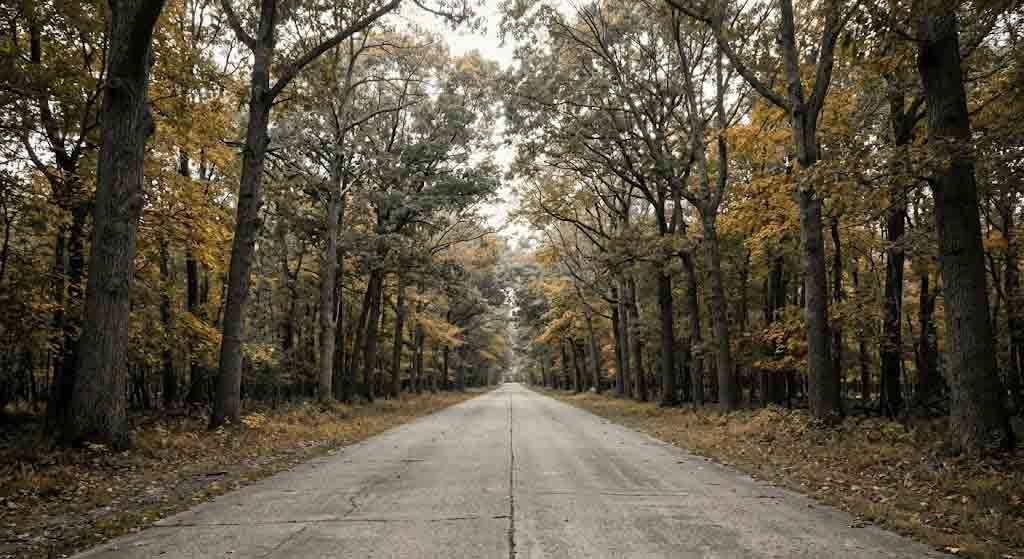
Moses converted the Queens section into a bicycle path within three months. Nassau County turned most of its section over to power line easements. Suffolk County preserved about thirteen miles for auto traffic, where it survives today as County Road 67, still called the Motor Parkway in radio traffic reports. Drive it sometime. It runs alongside the Northern State Parkway, parallel, the old road and the one that killed it sharing the same geography.
What It Left Behind
The Motor Parkway’s legacy is cleaner than its ending. It pioneered every engineering feature that defines the modern limited-access highway: the concrete surface, the grade separation, the banked curves, the controlled access points. The LIE, the Northern State, the Southern State, the Cross Island Parkway — all of them owe their basic design logic to a rich man’s race course in 1908.
The architecture survived longer than anyone expected. Five of the original toll lodges still stand. The most prominent is in Garden City, where the lodge was moved to 230 Seventh Street in 1989 and now serves as the headquarters of the Garden City Chamber of Commerce. The one in Mineola became a private residence. You drive past these things without knowing what you’re looking at, which is how most of Long Island’s history gets experienced.
In 2002, a 2.5-mile section was listed on the New York State and National Registers of Historic Places. Portions of the old roadway are still visible in Levittown, Williston Park, and along the Alley Pond Park segment in Queens, where the original reinforced concrete surface lies under a layer of asphalt, and the original fence posts and mile markers still stand at intervals like witnesses.
I think about this road sometimes when I’m on Route 25A, the old Kings Highway that predates everything on this island by centuries. The Ride Down 25A post covers some of that older history — the way roads accumulate meaning the longer they exist. The Motor Parkway barely got thirty years. But it got them first.
A Class War in Concrete
Here’s the thing about the Vanderbilt Motor Parkway that doesn’t usually get said directly: it was a class project. Not in the political-theory sense, but in the literal sense. It was built by old money for old money, with a two-dollar toll designed to screen out precisely the kind of working-class families who would eventually make the automobile an everyday object. Vanderbilt wanted a road “free of interference from the authorities,” as he said in a speech. What he meant was free of the people who needed authorities to protect them — pedestrians, farmers, working men on their way somewhere. He wanted the road for the fast and the rich.
History has a way of refusing those terms.
The same machine that Willie K. raced across Europe at ninety miles an hour rolled off a Michigan assembly line in 1908 for $825. By 1924, Ford’s Model T cost $290. The road Vanderbilt built to keep ordinary people out couldn’t survive the ordinary people buying their way in. Moses understood this and built free public parkways. The Motor Parkway, for all its engineering genius, was a private fortress that the democratization of the automobile simply walked through.
The toll lodges — those elegant Pope-designed stone buildings with their living quarters and their implied permanence — are what remain. Not the road itself, not the races, not the dream of sixty miles per hour reserved for the people with two dollars to spare. Just the gatekeeping architecture, repurposed into chambers of commerce and private homes, stripped of its original function and standing in the Long Island landscape like a reminder that every class project eventually gets reassigned.
The ground beneath us has a long memory. We just don’t always ask it what it knows.
You Might Also Like
- Rum Row and the Freeport Bootleggers: Long Island’s Clandestine War on the Water
- Shadows on the Sound: How Mount Sinai Harbor Became One of Long Island’s Most Secretive Rum-Running Corridors
- Roosevelt Field, Long Island: The Morning Charles Lindbergh Bet Everything on the Wind
- The Ground Beneath the Tower: Shoreham, New York, and the World Nikola Tesla Almost Built
- The Culper Ring of Setauket: How a Village on Long Island’s North Shore Outmaneuvered the British Empire
Sources
- NYC Parks Department — Long Island Motor Parkway History: https://www.nycgovparks.org/parks/motor-parkway/history
- Wikipedia — Long Island Motor Parkway: https://en.wikipedia.org/wiki/Long_Island_Motor_Parkway
- Forgotten New York — Long Island Motor Parkway: https://forgotten-ny.com/2000/07/long-island-motor-parkway/
- Untapped New York — Racers, Bootleggers, and Bikers: The Hidden History of Vanderbilt Parkway: https://www.untappedcities.com/vanderbilt-parkway-nyc/
- Long Island History Journal — The Long Island Motor Parkway (review of Kroplick & Velocci): https://lihj.cc.stonybrook.edu/2009/reviews/the-long-island-motor-parkway/
- Dix Hills-Melville History — Long Island Motor Parkway: https://dixhillsmelvillehistory.org/long-island-motor-parkway
- Howard Kroplick & Al Velocci, The Long Island Motor Parkway (Arcadia Publishing): https://www.amazon.com/Island-Motor-Parkway-Images-America/dp/0738557935