 275 Route 25A, Mt Sinai, NY 11766


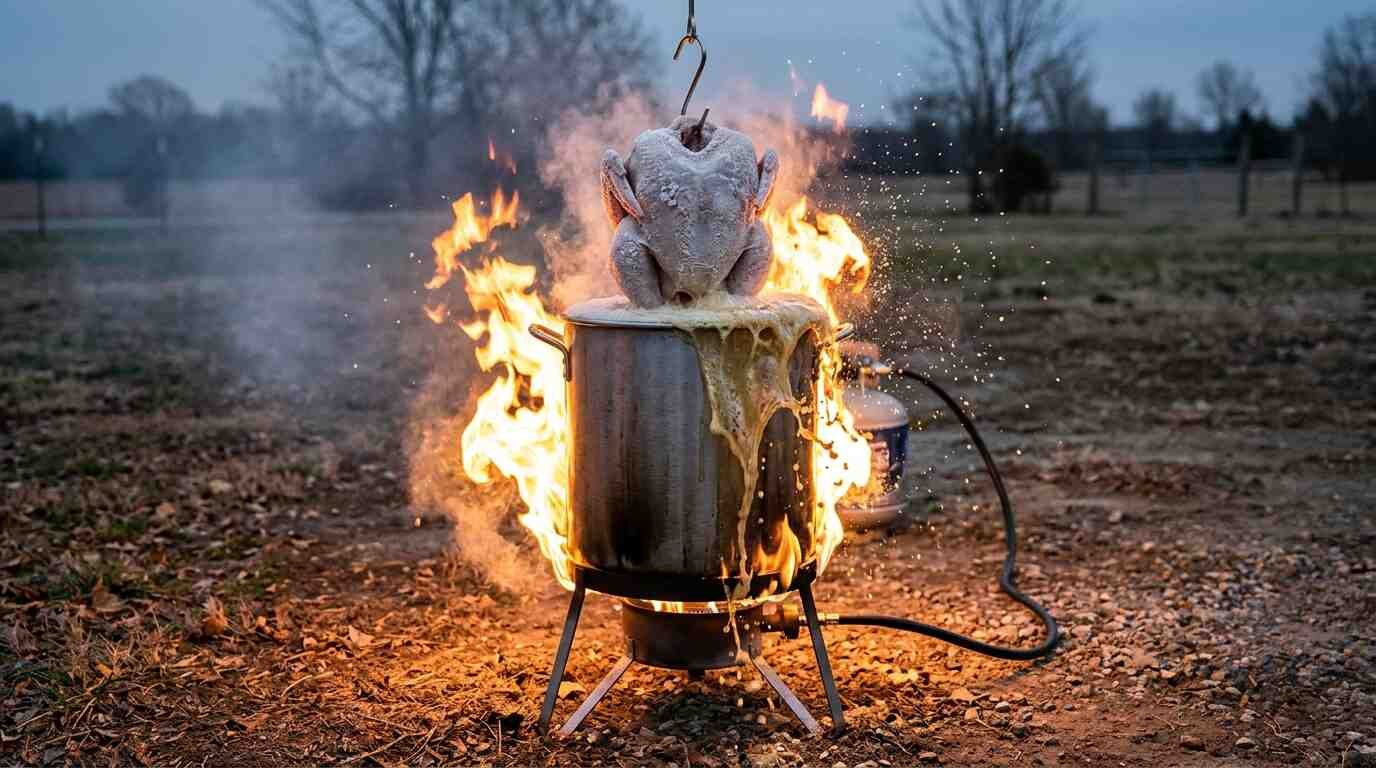
The pot holds a few gallons of peanut oil at 350 degrees, a propane ring roars underneath it, and someone in a sweatshirt is lowering a turkey that spent last night in the freezer. For a beat, nothing happens. Then the oil climbs the wall of the pot like it has somewhere to be, spills over the rim, finds the burner, and the backyard lights up orange. The turkey, for the record, is still raw.
@@YOUTUBE@@ That sequence is not bad luck. It is a chain of three ordinary facts about water and oil, each one harmless on its own, lined up in the worst possible order. Kristine Nolin, an associate professor of chemistry at the University of Richmond, put the root of it plainly: “The reason frozen turkeys explode, at its core, has to do with differences in density.” Physics does not take the holiday off, and it does not care how many people are waiting on the bird.
Ice sinks where it shouldn’t
The heaviest thing in the pot is the problem nobody can see.
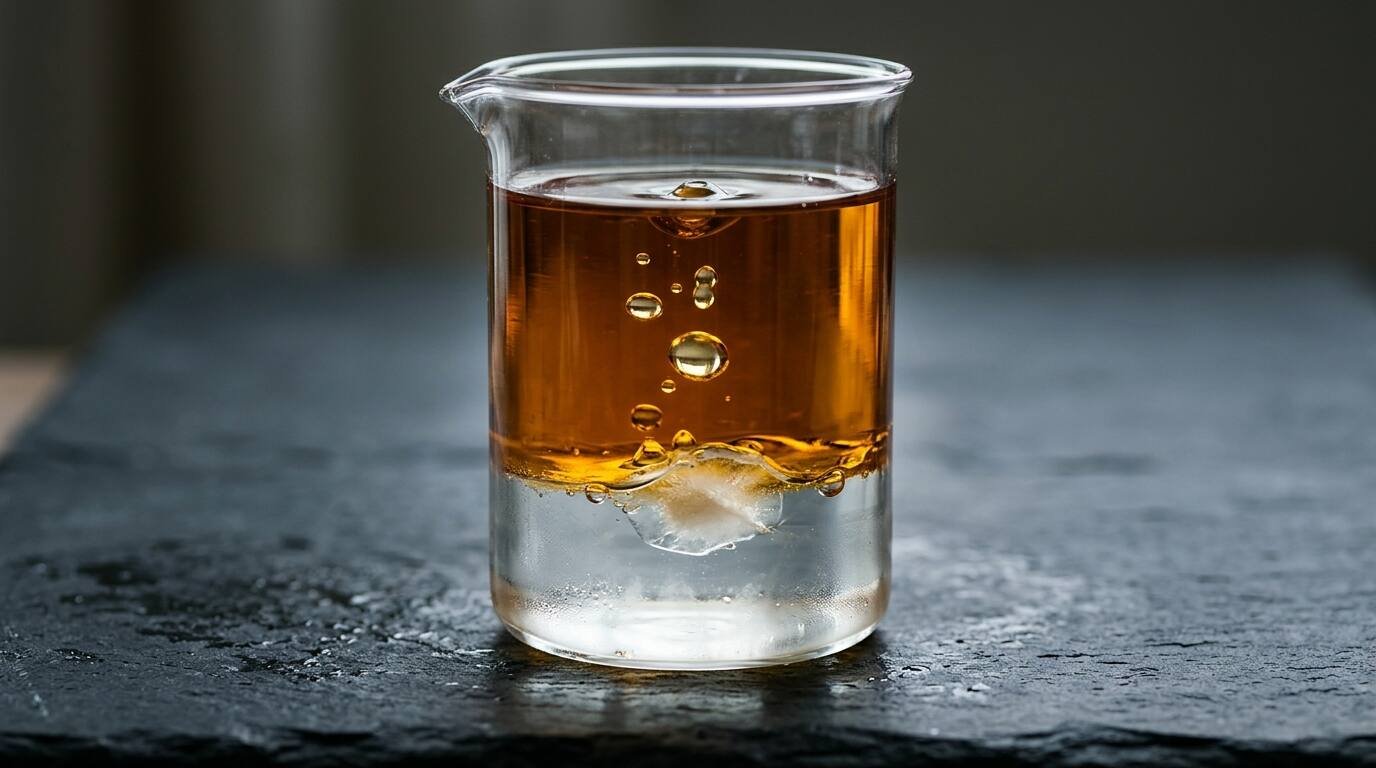
Start with weight. Water is denser than oil, which is why a salad dressing left on the counter separates with the vinegar on the bottom. Nolin’s explainer, republished by PBS NewsHour, walks through what that means in a fryer: deep-frying oil is heated to around 350°F (175°C), far above the 212°F (100°C) at which water boils, and any meltwater coming off a frozen bird is denser than the oil, so it falls to the bottom of the pot.
The bottom of the pot is the hottest place in the system. The burner sits directly under it.
So the ice melts, the meltwater drops through the oil like a stone through a pond, and it lands on steel that has been cooking over a gas flame for close to an hour. There is a lot of water to work with. The same article, as published by Britannica, notes that raw meat can be anywhere from 56% to 73% water, and a bird straight from the freezer carries a share of that water as ice.
A thawed, patted-dry turkey still has water in it, of course. The difference is that the water is locked inside muscle and leaves slowly as the meat heats, which is the steady bubbling every fried-food cook knows. Ice is loose water. It sheds, sinks and arrives all at once.
Steam needs room, and it takes it
A cup of water does not stay a cup of water for long.
When liquid water hits that hot bottom, it flashes to steam, and steam is enormous. The PBS version of Nolin’s piece gives the figure directly: steam occupies 1,700 times the volume of the same number of liquid water molecules. Firefighters work with the same number. A question sent to the University of Illinois physics department’s Q&A service starts from the premise that water expands at a ratio of 1,700:1 when it turns to steam at 212°F, and a 1995 Fire Engineering article on fire-flow calculation uses the same 1,700 baseline.
The Illinois answer adds a detail that matters at the fryer. Water vapor under those conditions behaves close to an ideal gas, so its volume at atmospheric pressure grows in proportion to absolute temperature; the responder worked out that steam at roughly 2,000°F would take up about four times the room of ordinary boiling steam, an expansion factor near 7,000. Fryer oil is nowhere near that hot. Still, the rule runs in one direction only. Steam made at the bottom of a 350-degree pot and heated further by the oil around it does not get smaller on the way up.
Then the steam rises. A bubble that big, forming under several inches of liquid, has to move everything above it, and what is above it is oil. Nolin describes the steam expanding and rising, blowing the boiling oil out of the pot. It works like a pipe with water hammer, except the pipe has no lid, and what gets thrown out is liquid hot enough to cook skin.
Overfill: the bathtub problem
Archimedes would have told them to measure first.
Even a perfectly thawed bird can push oil over the edge. Any object lowered into a full container displaces its own volume, and a whole turkey is a large object. Fill the pot to look generous, drop in twelve pounds of bird, and the oil level rises by the turkey’s volume plus the foam of the first violent bubbling.
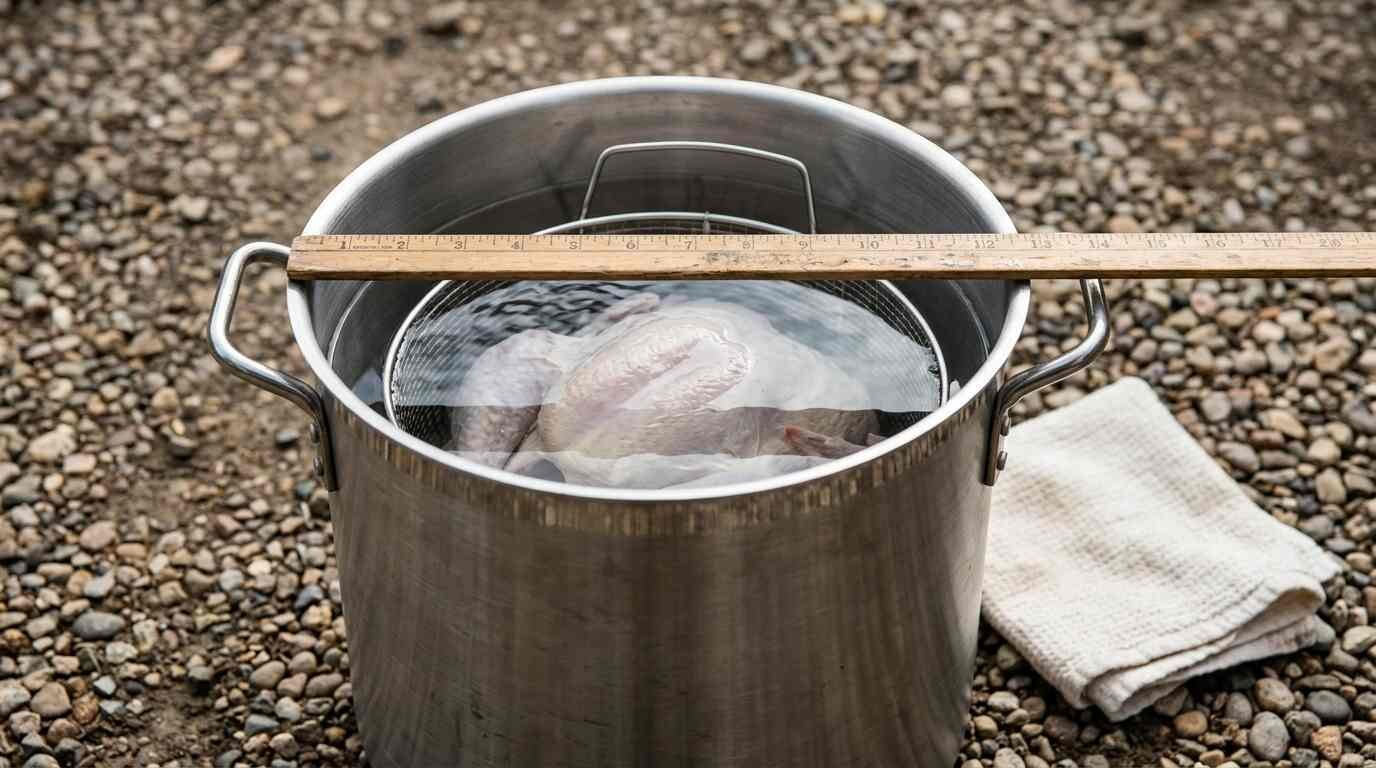
This is why the National Turkey Federation’s own frying guide starts with a bucket of water rather than a jug of oil. Its instructions at eatturkey.org are simple: put the turkey in the basket, set it in the pot, add water until it sits 1 to 2 inches above the bird, take the turkey out, and measure from the rim to the water line with a ruler. That line is the oil line. Then, in the federation’s words, “Pour out the water and dry the pot thoroughly.” The drying step is not housekeeping. A wet pot is the frozen-turkey problem in a smaller dose.
The same guide steers cooks toward birds of 8 to 10 pounds, or parts such as breast, wings and thighs, and estimates about 3 minutes per pound for a whole turkey once the oil is at 350°F, which it says usually takes 45 minutes to an hour to reach. UW-Madison Extension, drawing on USDA guidance, sets the ceiling at a turkey no larger than 12 pounds and says the oil should cover it by 1 to 2 inches. Bigger birds mean more displacement, longer cooks and more time standing next to a pot of hot oil. The guide also tells cooks to keep the fryer off wood decks for fire risk and off concrete because of oil stains, which is the only warning in the whole field that worries about the driveway.
Where the fire actually starts
Oil rarely lights itself. It usually gets help from below.
Cooking oil is hard to ignite on its own, and the numbers explain why fryer fires almost always involve a flame. NOAA’s CAMEO Chemicals database lists edible peanut oil with a flash point of 540°F and an autoignition temperature of 833°F, both figures from U.S. Coast Guard data. Frying temperature is 350°F. There is a wide margin between the oil doing its job and the oil catching fire by itself.
That margin disappears the moment oil leaves the pot. Spilled oil running down the outside of the vessel lands on a burner flame, which is far hotter than any of those thresholds, and Nolin notes that as the displaced oil comes into contact with a burner or flame, it can catch fire.
The other route is slower and quieter. A burner set high and left alone works like a flat-top nobody turned down, pushing heat into the oil long after the oil has stopped needing it. State Farm’s safety guidance tells cooks to turn off the heat if the oil starts to smoke, never move the fryer while it is in use, and never pour water on a fryer or grease fire. Water on burning oil is the frozen turkey all over again, only aimed at a fire. Different oils start smoking at different points, and the published charts disagree with each other more than most cooks realize, a mess laid out in this site’s look at smoke point charts.
The numbers don’t count the same thing
Every agency has a turkey fryer figure, and no two of them are measuring the same night.
Here is where the story gets less tidy. The Consumer Product Safety Commission, in a November 2023 holiday release, said that since 2000 it was aware of 217 fire or scald and burn incidents involving turkey fryers, resulting in 83 injuries and $9.5 million in property loss. Five years earlier, a 2018 CPSC release counted more than 214 fryer-related fires, burns, explosions or incidents since 1998, with 80 injuries, none fatal, and over 9.6 million in property damage.
Read side by side, those look almost frozen in place, three incidents in five years. That reading is wrong. The two windows start in different years, so one total cannot be subtracted from the other, and the 2023 wording says CPSC is “aware of” the incidents, which describes reports that reached the agency rather than a national estimate. It is a floor, not a census.
The broader Thanksgiving numbers swing too. CPSC’s 2023 release put the Thanksgiving Day average at 1,600 cooking fires. Its November 2024 release and its November 19, 2025 release both say 1,400, more than three times the daily average. The National Fire Protection Association, as reported by Security Sales & Integration, estimated 1,610 home cooking fires on Thanksgiving in 2022, 399% above the daily average. The U.S. Fire Administration’s Thanksgiving snapshot counts residential building fires of every cause, an average of 2,300 a year from 2017 to 2019, with an estimated 5 deaths, 25 injuries and $26 million in property loss annually, cooking behind 74% of them and 54% happening between 10 a.m. and 5 p.m.
None of these is a lie. They are different nets cast in different years. What they agree on is the shape. CPSC’s 2023 release says Thanksgiving Day is when most home cooking fires in the U.S. occur, and the fryer is a small, violent slice of that day.
The case for staying out of the pot
The safest fryer may be the one that never gets lit.
The obvious take is that turkey fryers are dangerous and careful people can make them safe. The fire safety establishment does not fully accept the second half. NFPA, per the same Security Sales report, strongly discourages the use of turkey fryers that use cooking oil, citing devastating burns, and points people toward buying a fried turkey from a grocery store or restaurant or using a fryer that does not use oil. State Farm lists electric, infrared and air-fryer-style turkey cookers as alternatives.
CPSC takes the middle road. Its 2025 release opens the fryer section bluntly, “Turkey fryers create particular risks, causing fires, injuries and property damage,” then offers a mnemonic, COOK: carefully follow the manufacturer’s instructions, never overheat the oil and use one with a high smoke point, never overfill, and keep the fryer out of the garage, off the deck and away from the house. Its 2024 release adds never using one in an enclosed area like a garage or porch. The turkey federation says never indoors, in a garage, or in any structure attached to a building, and recommends two people to lower and lift the bird.
Food safety rides along with fire safety. UW-Madison Extension puts safe refrigerator thawing at 4 to 5 pounds per day, so a 12-pound bird needs two and a half to three days, and the turkey is done at a minimum of 165°F in the innermost part of the thigh and wing. The thaw schedule is also the fire schedule. A turkey bought Tuesday for a Thursday fry is already late, a squeeze that a backward-counted Thanksgiving timeline makes painfully visible.
There is a fair argument on the other side. The 217 fryer incidents CPSC knew of in 2023 sit next to the agency’s estimate, in the same release, of 165,600 home cooking fires every year, and the stovetop is the far bigger arsonist. The physics does not say frying is reckless. It says the failure is fast, hot and unforgiving, and that the routes to it covered here (ice, overfill, a flame under spilled oil) can each be checked with a ruler, a thermometer and patience. A turkey that ends up sliced over bread and drowned in gravy, the way a diner hot turkey sandwich handles it, never needed to go near a propane ring at all.
The water in the bird was always going to boil. The only open question is whether it boils inside the meat or underneath the oil, and anyone who has stood next to a fryer on a cold November afternoon has a view on how close that call gets. How long did the thaw take the last time a fried turkey showed up at the table?
You Might Also Like
- After the Bird: Eight Ways to Use Leftover Turkey
- Lump-Free Turkey Gravy: A Roux Timeline for Thanksgiving Week
- Thanksgiving Dinner Restaurants on Long Island’s North Shore, 2026
Sources
- NPR, “Frying turkeys can explode. Here’s how to avoid that” (Nov. 22, 2023): https://www.npr.org/2023/11/22/1214667773/frying-turkey-safely-thanksgiving
- Kristine Nolin, “Why do frozen turkeys explode when deep-fried?” PBS NewsHour: https://www.pbs.org/newshour/science/why-do-frozen-turkeys-explode-when-deep-fried
- Kristine Nolin, same article, Britannica: https://www.britannica.com/story/why-do-frozen-turkeys-explode-whendeep-fried
- University of Illinois Physics Van, “Expansion of Very hot Steam”: https://van.physics.illinois.edu/ask/listing/31550
- Keith Royer, “Iowa Rate-of-Flow Formula for Fire Control,” Fire Engineering (Sept. 1, 1995): https://www.fireengineering.com/firefighting/iowa-rate-of-flow-formula-for-fire-control/
- National Turkey Federation, “How To Deep Fry Turkey”: https://www.eatturkey.org/how-to-deep-fry-turkey/
- UW-Madison Extension Winnebago County, “Don’t Make Turkey Frying a Disastrous Situation This Thanksgiving” (Nov. 19, 2022): https://winnebago.extension.wisc.edu/2022/11/19/dont-make-turkey-frying-a-disastrous-situation-this-thanksgiving
- NOAA CAMEO Chemicals, “Oils, Edible: Peanut”: https://cameochemicals.noaa.gov/chemical/18015
- State Farm, “Turkey fryer safety tips”: https://www.statefarm.com/simple-insights/residence/turkey-fryer-safety-tips
- U.S. CPSC, “CPSC Is Working to Keep Families Safe this Holiday Season” (2023): https://www.cpsc.gov/Newsroom/News-Releases/2023/CPSC-Is-Working-to-Keep-Families-Safe-this-Holiday-Season
- U.S. CPSC, “Stand By Your Pan: Thanksgiving Cooking Tips That You Can Be Thankful For” (2018): https://www.cpsc.gov/Newsroom/News-Releases/2018/Stand-By-Your-Pan-Thanksgiving-Cooking-Tips-That-You-Can-Be-Thankful-For
- U.S. CPSC, “Happy Holidays Start with Safety” (Nov. 19, 2024, release 25-049): https://www.cpsc.gov/Newsroom/News-Releases/2025/Happy-Holidays-Start-with-Safety-CPSC-Urges-Families-to-Cook-Decorate-and-Select-Toys-with-Care-This-Season
- U.S. CPSC, “Put Safety on the Menu” (Nov. 19, 2025, release 26-093): https://cpsc.gov/Newsroom/News-Releases/2026/Put-Safety-on-the-Menu-Consumer-Product-Safety-Commission-Offers-Safe-Cooking-Tips-for-a-Joyful-Holiday-Season
- Security Sales & Integration, “NFPA Urges Fire Caution When Preparing Thanksgiving Feast” (Nov. 18, 2024): https://www.securitysales.com/news/nfpa-fire-caution-thanksgiving/163296/
- U.S. Fire Administration, “Thanksgiving Day Fires in Residential Buildings (2017-2019)”: https://usfa.fema.gov/statistics/reports/fire-causes/snapshot-thanksgiving.html
- NFPA, “Dangers of Turkey Fryers” (YouTube): https://www.youtube.com/watch?v=kjUynq0HXdQ
Suggested category: Food & Cooking
Leave a Reply