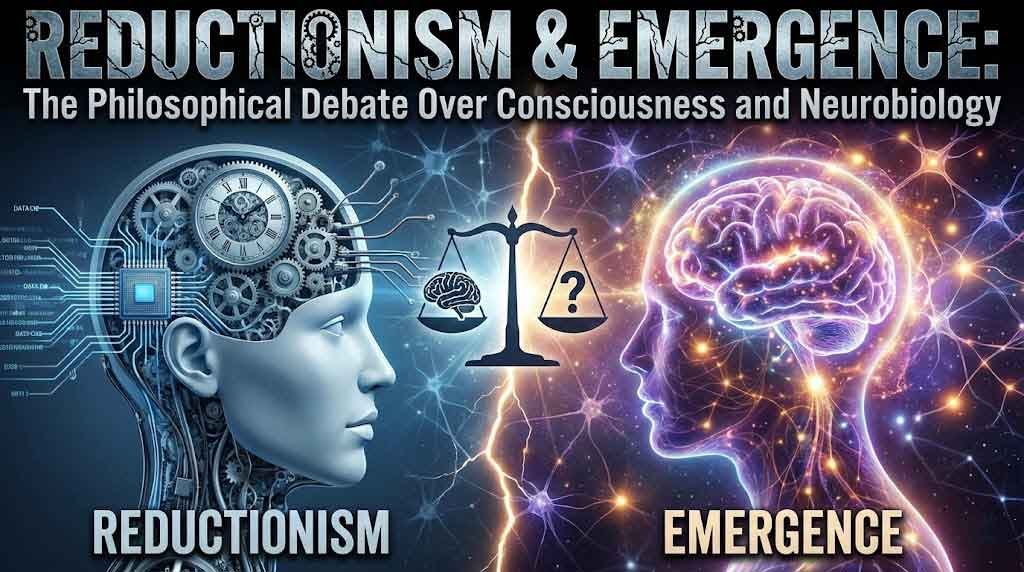
Somewhere inside the three-pound electrochemical universe sitting behind your eyes, something extraordinary is happening — not just the firing of neurons or the cascade of neurotransmitters, but the felt experience of reading these words. The warmth of light on a page. The particular quiet of a Tuesday morning. The way a chord in a minor key can unmoor you from the present moment before you even understand why.
That experience — irreducible, subjective, stubbornly first-person — is what philosophers call qualia, and it is the central battleground of one of the oldest and most consequential debates in the history of human thought. How does the physical brain give rise to the inner life of the mind? Can consciousness be fully explained by biology, chemistry, and physics? Or does awareness represent something genuinely new — a property that emerges from complexity in a way that no reduction to neurons can capture?
This is not an abstract academic skirmish. Its outcome will determine how we think about artificial intelligence, how we treat non-communicative patients, how we define personhood itself. The debate between reductionism and emergence in consciousness science is, in its deepest sense, a debate about what it means to be human.
The Reductionist Case: Everything Is Atoms
Reductionism, as a philosophical tradition, holds that the truth about any complex phenomenon can be fully explained by analyzing its constituent parts and their interactions. In the words of physicist Richard Feynman: “There is nothing that living things do that cannot be understood from the point of view that they are made of atoms acting according to the laws of physics.” Applied to consciousness, this view suggests that the mind is — however complex — ultimately a function of neurons, synapses, and electrochemical signals. Understand the parts deeply enough, and the whole follows. No remainder.
The most aggressive version of this view is eliminative materialism, advanced by philosopher Paul Churchland, who argued that folk-psychological concepts like “beliefs,” “desires,” and “feelings” would eventually be eliminated and replaced by precise neuroscientific descriptions — much like we no longer speak of “phlogiston” when describing combustion (Churchland, 1985). In this framework, consciousness is not a mystery to be solved; it is a confusing description to be replaced.
Less extreme but still firmly reductionist are scientists like Francis Crick, who proposed in The Astonishing Hypothesis (1994) that your joys, sorrows, and sense of personal identity are nothing more than the behavior of a vast assembly of nerve cells. The project of neuroscience, in this view, is straightforward in principle: map the brain completely, understand its causal architecture, and consciousness will be explained the way any other natural phenomenon is explained.
Columbia University physicist Brian Greene, in his work on complex systems, articulated the reductionist position with careful nuance: understanding an electron is one thing; understanding a tornado requires the same physics but at staggering scale. The principles are derivative — relaying, in a terribly complicated way, on lower-level physical laws (Big Think, 2022). There is no new stuff, only new complexity.
The Explanatory Gap: Where Reductionism Falters
In 1983, philosopher Joseph Levine coined the phrase “explanatory gap” to describe the intuitive difficulty of connecting physical brain processes to subjective experience. But it was David Chalmers, in his landmark 1995 paper “Facing Up to the Problem of Consciousness” (Journal of Consciousness Studies), who sharpened this intuition into what he called “the hard problem of consciousness.”
Chalmers distinguished between what he called the “easy problems” — explaining how the brain integrates information, focuses attention, discriminates stimuli, generates behavior — and the genuinely hard problem: why any of this physical processing is accompanied by experience at all. Why doesn’t cognition proceed “in the dark,” without any inner feel? Why, when electromagnetic waveforms impinge on a retina, is there the sensation of seeing red?
His thought experiment remains one of philosophy’s most famous: imagine “Mary,” a neuroscientist who has lived her entire life in a black-and-white room. She knows everything physical there is to know about color vision — the wavelengths, the photoreceptors, the neural pathways. When she finally steps outside and sees red for the first time, does she learn something new? Our intuitions say yes — she gains the experience of red, something irreducible to her prior physical knowledge (Jackson, 1982).
Philosopher and cognitive scientist Stanislas Dehaene has pushed back, arguing that Chalmers’ hard problem is built on ill-defined intuitions that dissolve as neuroscience advances, suggesting the “hard problem” will eventually evaporate when our intuitions are educated by cognitive neuroscience and computer simulation. Steven Pinker, more temperately, concluded in 2018 that the hard problem is a meaningful conceptual problem but likely not a meaningful scientific one.
Significantly, a 2024 review in Acta Analytica noted that while empirical progress in neuroscience is indisputable, philosophical progress on the hard problem has been much less pronounced — the two trajectories appear essentially uncoupled. In fact, in 2023, Chalmers won a bet made in 1998 — for a case of wine — with neuroscientist Christof Koch, that the neural underpinnings of consciousness would not be resolved by the year 2023. The hard problem stands.
Emergence: When the Whole Is More Than the Sum
The alternative to reductionism is not mysticism. It is emergence — the idea that certain properties of complex systems are genuinely novel, arising from the interactions between parts in ways that cannot be predicted from an analysis of those parts alone.
The classic illustration is water. A single water molecule is not wet. Wetness is a property of water in bulk — an emergent property of collective behavior. No amount of studying individual H₂O molecules in isolation will reveal it. Each neuron in the brain carries out simple tasks; a single neuron is not conscious. Yet the system those billions of neurons have created together possesses something far beyond their aggregate — something that arises from their interactions in a way that studying the parts alone cannot reveal.
Philosophers distinguish between two kinds of emergence. Weak emergence holds that higher-level properties arise from lower-level interactions but are, in principle, reducible to them — they only seem irreducible because the calculations would be impossibly complex. Strong emergence makes a bolder claim: some properties are fundamentally irreducible, requiring new kinds of laws to explain. Consciousness, on this view, is not just hard to derive from neurons — it is impossible to so derive.
The Stanford Encyclopedia of Philosophy places emergence historically between extreme dualism, which denies that higher-level entities depend on lower-level ones, and reductionism, which denies that higher-level entities have any genuine autonomy. Emergence mediates between these poles, conjoining dependence and autonomy.
Modern formulations of emergence stem from early 20th-century efforts to understand the nature of life itself, when both dominant hypotheses — vitalism (a mysterious life force) and reductionism (life as the mere sum of its parts) — were found scientifically inadequate. The term “emergence” was first used philosophically by George Henry Lewes in 1875, then given new life by the British Emergentists in the early 20th century, and has experienced a revival in the age of complexity science.
As physicist and writer Adam Frank argues, a reductionist world is a world without fundamental novelty — a universe in which all of future history, all of evolution, is merely a rearrangement of electrons and quarks. Emergence claims that new stuff and new laws can arise that are not predictable from the components alone.
The Neurobiology of Consciousness: Three Competing Frameworks
Modern consciousness neuroscience has developed several theoretical frameworks to navigate this terrain, each carrying different implications for the reductionism-emergence debate.
Global Workspace Theory (GWT), developed by neuroscientist Bernard Baars and elaborated by Stanislas Dehaene, holds that consciousness arises when information is “broadcast” to a global neural workspace, making it available to multiple cognitive processes — memory, attention, language, executive function. This view is broadly reductionist and functionalist: consciousness is what a certain type of neural broadcasting does. It is widely influential in experimental neuroscience and has guided decades of empirical research on the neural correlates of consciousness.
Predictive Processing / Active Inference, championed by neuroscientist Karl Friston and philosopher Andy Clark, proposes that the brain is a prediction machine constantly modeling the world and updating those models with incoming sensory data. Conscious experience, in this view, is the brain’s generative model — a kind of controlled hallucination. This framework is compatible with reductionism but sophisticated enough to be taken seriously by emergentists as well.
Integrated Information Theory (IIT), developed by neuroscientist Giulio Tononi at the University of Wisconsin-Madison in 2004 and later developed with Christof Koch, represents perhaps the boldest attempt to build a mathematical theory of consciousness. IIT proposes that a system’s consciousness — what it is like subjectively — is mathematically described by its causal structure, what it is like objectively, and that it should be possible to account for the conscious experience of a physical system by unfolding its complete causal powers.
IIT introduces a measure called phi (Φ) — a quantification of the amount of integrated information in a system, above and beyond the information generated by its parts. If a system has a high phi value, it is considered highly integrated and thus highly conscious; if phi is zero, the system is not conscious at all. Remarkably, IIT predicts that the cerebellum — which contains roughly 80% of the brain’s neurons — contributes little to consciousness, while the much smaller thalamocortical system, which has the right architecture for integration, is central to it. This counterintuitive claim has found some empirical support.
IIT remains controversial: in 2023, a number of scholars characterized it as unfalsifiable pseudoscience for lacking sufficient empirical support, a claim reiterated in a 2025 Nature Neuroscience commentary. Defenders, including Koch and philosopher David Chalmers, have maintained that the theory’s core insights about integration and experience are worth pursuing.
The Panpsychist Turn — and What It Reveals About the Debate
When reductionism cannot close the explanatory gap, and when strong emergence seems to demand something almost supernatural, some philosophers and scientists have turned to panpsychism — the view that experiential properties are fundamental features of reality, present in some form at every level of physical organization.
This is not, as is often assumed, a fringe position. Philosopher Philip Goff, in his 2019 book Galileo’s Error, argues that Galileo’s founding of modern science involved a deliberate exclusion of consciousness from the physical description of the world — and that correcting this error requires treating experience as ontologically basic. Chalmers himself has entertained the idea, noting that if consciousness cannot be derived from the physical, perhaps it must be woven into the fabric of reality from the ground up.
IIT, with its suggestion that any system with non-zero phi is conscious to some degree — including simple thermostats — has been criticized for its panpsychist implications by philosopher John Searle and embraced by others as an intellectually courageous confrontation with the hard problem. The debate between reductionism and emergentism in consciousness research has reached what some scholars describe as a stalemate, with both sides declaring victory on empirical grounds while the philosophical questions remain unresolved.
Weak Emergence as a Working Synthesis
The most scientifically productive position may be one that refuses the binary. Philosopher Carl Gillett’s 2016 book Reduction and Emergence in Science and Philosophy (Cambridge University Press) argues that both reductionism and emergence are necessary frameworks — not competing answers, but complementary tools. The view that reductionism and emergentism are mutually inclusive and complementary — rather than counterparts — leads to better understanding of consciousness than applying either framework alone.
The neuroscientist Anil Seth, in his 2021 book Being You, argues for what might be called “controlled hallucination” — a model in which consciousness is neither eliminated by neuroscience nor irreducible to it, but genuinely explained through the predictive architecture of the brain. Seth accepts the weak emergence view: consciousness arises from brain processes in a way that is non-obvious and complex, but not in principle inexplicable. The explanatory gap, on his reading, is a gap in our current understanding, not an ontological chasm in nature.
The formulation “Life + Special Neurobiological Features → Phenomenal Consciousness” expresses an emergentist position that treats consciousness as an example of standard, or “weak,” emergence without a scientific explanatory gap — though an “experiential” or epistemic gap remains, one that is ontologically untroubling.
The starkest way to frame the remaining disagreement: strong emergentists hold that no future neuroscience will explain the redness of red, the painfulness of pain, the felt character of any experience at all. Weak emergentists hold that this is a failure of current science, not a permanent feature of nature.
Why This Debate Matters Now
The question of whether consciousness is reducible has urgent practical implications that extend well beyond academic philosophy.
In clinical neuroscience, the question of when and whether a patient is conscious — a patient with locked-in syndrome, a patient in a vegetative state, a patient under anesthesia — is literally a matter of life and death. IIT’s phi metric has been proposed as a diagnostic tool for disorders of consciousness (Tononi et al., 2016, Nature Reviews Neuroscience). Its validity turns entirely on whether integrated information actually is consciousness, or merely correlates with it.
In artificial intelligence, the debate shapes how we think about machine minds. In 2023, Chalmers analyzed whether large language models could be conscious and suggested that they were probably not, but could become serious candidates for consciousness within a decade. If consciousness is purely functional — if it is what certain information-processing arrangements do — then sufficiently sophisticated AI systems may be conscious. If consciousness requires a specific biological substrate, or a particular kind of causal integration, the answer may be permanently no.
And in ethics, the stakes could not be higher. If strong emergence is correct, and consciousness is a genuinely novel property that cannot be read off from physical description, then we cannot be confident that our functional descriptions of other minds — human or animal — actually capture what it is like to be those minds. The philosophical zombie, Chalmers’ famous thought experiment of a being physically identical to a person but utterly without inner experience, forces us to confront the possibility that the relationship between physical structure and subjective life is not as transparent as we assume.
The Mystery That Refuses to Dissolve
The most honest assessment of where this debate stands in 2026 is this: we know far more than we did, and the mystery has not shrunk.
We can map the neural correlates of consciousness with remarkable precision. We understand that global broadcasting in the thalamocortical system is associated with conscious awareness. We can measure integrated information in simple systems. We can detect the difference between conscious and unconscious processing with neuroimaging. And yet the question Chalmers asked in 1995 — why does any of this physical processing give rise to experience? — remains unanswered.
Aristotle understood, two millennia ago, that a human being is not merely the sum of material elements. His hylomorphic vision — form arising from matter in ways that cannot be captured by the matter alone — is, in a sense, the oldest version of the emergence hypothesis. René Descartes drew a sharp line between matter and mind. The British Emergentists of the early 20th century proposed that life and mind were irreducibly new. And now, in laboratories at Wisconsin and NYU and Oxford and the Allen Institute for Brain Science, some of the most rigorous scientific minds alive are wrestling with the same question.
The brain is not a mystery because it is too simple. It is a mystery because it is the only thing in the known universe that looks at itself and asks: what am I?
That question — asked by three pounds of tissue running on roughly 20 watts — may be the most important one we have ever posed. The fact that we cannot yet answer it is not a failure of intelligence. It is a measure of the depth of the thing we are trying to understand.
Sources
- Chalmers, D. J. (1995). “Facing Up to the Problem of Consciousness.” Journal of Consciousness Studies, 2(3), 200–219. https://consc.net/papers/facing.pdf
- Chalmers, D. J. (1996). The Conscious Mind: In Search of a Fundamental Theory. Oxford University Press.
- Feinberg, T. E., & Mallatt, J. M. (2020). “Phenomenal Consciousness and Emergence: Eliminating the Explanatory Gap.” Frontiers in Psychology, 11, 1041. https://www.frontiersin.org/journals/psychology/articles/10.3389/fpsyg.2020.01041/full
- Tononi, G., Boly, M., Massimini, M., & Koch, C. (2016). “Integrated Information Theory: From Consciousness to Its Physical Substrate.” Nature Reviews Neuroscience, 17(7), 450–461. https://www.nature.com/articles/nrn.2016.44
- Albantakis, L., et al. (2023). “Integrated Information Theory (IIT) 4.0.” PLOS Computational Biology, 19(10), e1011465.
- Jackson, F. (1982). “Epiphenomenal Qualia.” Philosophical Quarterly, 32, 127–136.
- Levine, J. (1983). “Materialism and Qualia: The Explanatory Gap.” Pacific Philosophical Quarterly, 64, 354–361.
- Churchland, P. M. (1985). “Reduction, Qualia, and the Direct Introspection of Brain States.” Journal of Philosophy, 82, 8–28.
- Wagner-Altendorf, T. (2024). “Progress in Understanding Consciousness? Easy and Hard Problems.” Acta Analytica. https://link.springer.com/article/10.1007/s12136-024-00584-5
- Gillett, C. (2016). Reduction and Emergence in Science and Philosophy. Cambridge University Press. https://www.cambridge.org/core/books/reduction-and-emergence-in-science-and-philosophy/DFAEA13005357E04AAC14D002173AE29
- Berent, I. (2023). “The Hard Problem of Consciousness Arises from Human Psychology.” Open Mind, 7, 564–587. https://pmc.ncbi.nlm.nih.gov/articles/PMC10449398/
- Frank, A. (2022). “Reductionism vs. Emergence: Are You ‘Nothing But’ Your Atoms?” Big Think. https://bigthink.com/13-8/reductionism-vs-emergence-science-philosophy/
- Stanford Encyclopedia of Philosophy. “Emergent Properties.” https://plato.stanford.edu/entries/properties-emergent/
- Internet Encyclopedia of Philosophy. “Hard Problem of Consciousness.” https://iep.utm.edu/hard-problem-of-conciousness/
- University of Wisconsin Center for Sleep and Consciousness. IIT Overview. https://centerforsleepandconsciousness.psychiatry.wisc.edu/integrated-information-theory/
- Seth, A. (2021). Being You: A New Science of Consciousness. Dutton.
- Goff, P. (2019). Galileo’s Error: Foundations for a New Science of Mind. Pantheon.