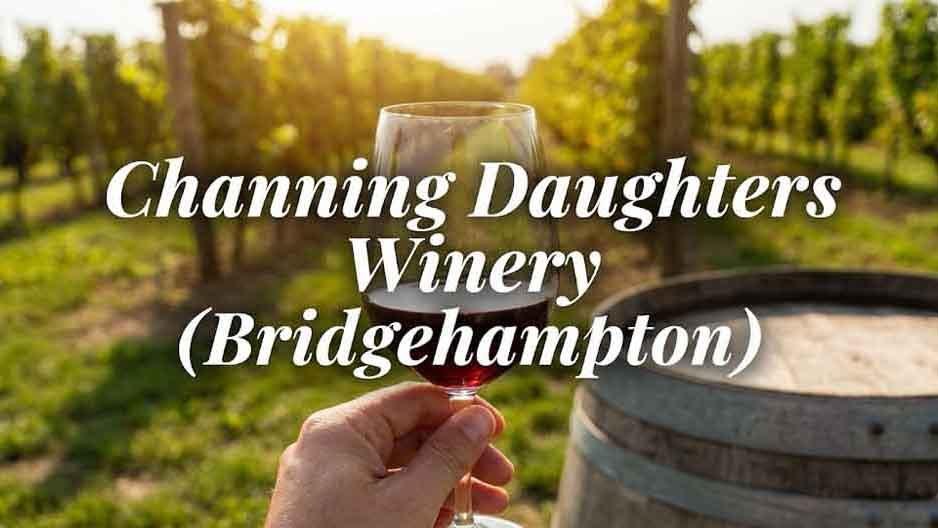
Walter Channing Jr. once told George Plimpton, in a sprawling interview for The Paris Review, that no one ever does anything with a stump — and yet a stump is a fascinating thing. He was talking about wood sculpture at the time, but the observation might serve as the defining ethos of the entire estate he built on twenty-eight acres off Scuttlehole Road in Bridgehampton. Where others saw a vacant potato field on Long Island’s South Fork, Channing saw Chardonnay vines. Where others saw discarded pier timbers from the Hudson River docks, he saw monumental pencils and sphinxes and upside-down oak trees with their roots clawing at the sky. And where the East End wine establishment had consolidated itself comfortably on the North Fork by the early 1980s, Channing chose the road less planted — the Hamptons — and built something that forty years later remains among the most creatively uncompromising wineries in America (27East, 2015; The East Hampton Star, 2002).
I have spent a quarter century behind the griddle at The Heritage Diner in Mount Sinai, and one lesson has been beaten into me by repetition and flame: the best things emerge from people who refuse to treat their craft as a category. The cook who also reads philosophy. The leather worker who also studies architecture. The vintner who was, before anything else, an artist. Channing Daughters is the rare winery that was born not from a business plan but from an act of sculptural imagination — and it has remained faithful to that origin story across four decades of harvests, three Long Island AVAs, and more than two dozen grape varieties that most East End producers wouldn’t dare attempt.
A Sculptor’s Vineyard: The Walter Channing Origin Story
The property’s genesis belongs to Walter Channing Jr. — Harvard-educated venture capitalist, wood sculptor, avid swimmer, and the kind of man who, according to the Louisa Hargrave remembrance published by Northforker in 2015, once married the actress Stockard Channing (his first wife, whom he met at Harvard/Radcliffe) and allegedly lost her affections by leaping between rooftops at parties. He was born in Dover, Massachusetts, in 1940, a descendant of William Ellery Channing, the father of American Unitarianism, and of William Ellery, a signer of the Declaration of Independence (Wikipedia; 27East, 2015). After co-founding the healthcare venture capital firm C.W. Group in 1983, which invested in over forty biotechnology companies, Channing pursued his deeper calling: salvaging fallen trees and discarded stumps from an East Hampton dump and carving them into large-scale art — inverted root systems, trompe l’oeil tapestries in wood, a giant golf pencil inscribed with “THE MAIDSTONE CLUB” as if it had washed ashore.
In 1977, he purchased a sprawling tract of land off Scuttlehole Road with the artist Jack Youngerman. By 1982, Channing planted his first acre of vines — roughly half Chardonnay, with Cabernet Franc and Cabernet Sauvignon filling the balance — in what had been a potato field. The Cabernet Sauvignon died of crown gall. The Chardonnay flourished. That surviving half-acre of vines, now over forty years old, remains the oldest Chardonnay planting on the South Fork and forms the backbone of the estate’s flagship bottling, L’Enfant Sauvage (Millesima; Channing Daughters Winery).
Channing’s second wife, Rosina Secco, passed away from Hodgkin’s lymphoma in 1987, leaving him to raise their two young daughters — Francesca and Isabella — as a single father. He married Molly Webb Seagrave in 1990 at Bridgehampton Presbyterian Church, and they added two more daughters, Sylvia and Nina. The winery’s name honors all four girls (27East, 2015). Walter Channing died on March 12, 2015, of complications from frontotemporal dementia, surrounded by his wife and daughters. He was seventy-four. Louisa Hargrave, the woman who co-founded East End wine culture at Hargrave Vineyards in Cutchogue, called Channing Daughters “the love winery” — a place where the vines, the sculptures, and the people all seemed to exist in a state of irrepressible affection (Northforker Archives, 2015).
Christopher Tracy: The Chef Who Became the Winemaker
If Walter Channing provided the vision, Christopher Tracy has provided the vocabulary. Tracy’s path to winemaking was spectacularly unconventional: he trained as an actor, earned a Grand Diplôme from the French Culinary Institute of New York, and spent years working as a chef in acclaimed restaurants before his palate led him toward fermentation instead of sauté pans. He holds a Diploma from the Wine & Spirits Education Trust (D.W.S.), a Certified Wine Educator (CWE) designation from the Society of Wine Educators, and was a student candidate for the Masters of Wine program (Channing Daughters Winery; Millesima).
Tracy’s initial involvement with Channing Daughters was as a Wine Club member, then a volunteer for “Team Merlot” during harvest. In 2001, he began developing new cuvées. By 2002, he was the full-time winemaker; by 2006, a partner. When he arrived, the estate was producing roughly four thousand cases per year. Today, under his stewardship, Channing Daughters releases approximately fourteen thousand cases annually across nearly three dozen separate bottlings — each one a distinct expression of variety, vineyard, and technique (Northforker, 2016; Southforker, 2024).
His philosophy is disarmingly simple: deliciousness first. He has described winemaking as an exercise in problem-solving and storytelling, and his cellar reads like the library of a restless polymath. Indigenous yeast fermentations sit alongside commercially managed ones. Skin-contact white wines age in Slovenian oak hogsheads while stainless steel tanks hold crisp, unoaked Chardonnay. Red grapes are foot-stomped and punched down by hand. Every grape is hand-picked. Every bottle is gravity-filled. Tracy co-ferments white and red fruit, produces pétillant naturel sparkling wines in ten different bottlings per vintage, and creates a rotating series of VerVino vermouths made from locally foraged botanicals — beets and arugula in the spring version, Asian pear and butternut squash in the autumn red. His collaborator and wife, Allison Dubin, oversees daily operations with a focus on sustainability and quality. Their children have helped pick grapes since the age of two (Northforker, 2016; New York Wines, 2024).
The Vineyards: Bridgehampton Silt Loam and Atlantic Breezes
Channing Daughters cultivates six separate vineyard blocks on its Bridgehampton estate, planted between 1982 and 2007, and sources approximately half of its fruit from prized North Fork sites, most notably the legendary Mudd Vineyard — vines dating to the mid-1970s that rank among the oldest on Long Island. The estate sits on Bridgehampton Silt Loam, a soil profile distinguished by a peculiar eight-inch vein of blue-grey clay roughly thirty inches below the surface. This is the same subsurface clay that was historically mined for brickmaking at the local kiln — hence the winery’s Brick Kiln Chardonnay takes its name from the nearby road where the clay deposits were excavated for the village of Sag Harbor (Channing Daughters Winery).
Atlantic breezes moderate the growing season, extending hang time and imparting a saline minerality that runs through nearly every bottle in the portfolio. The maritime climate proves hospitable to a range of grapes that would startle Napa Valley orthodoxy: Tocai Friulano, Ribolla Gialla, Blaufränkisch, Dornfelder, Teroldego, Refosco, Lagrein, Muscat Ottonel, and Malvasia grow alongside the expected Chardonnay, Merlot, and Cabernet Franc. Channing Daughters is the only winery on the East End cultivating many of these varieties, and it produces wines under all three Long Island AVAs — The North Fork of Long Island, The Hamptons, and Long Island (Channing Daughters Winery; Long Island Wine Country).
The Sculpture Garden Vineyard, originally planted to Merlot in 1987 and since interplanted with Blaufränkisch and Teroldego, occupies the same terrain that Walter Channing dotted with his monumental wood carvings — a convergence of art and agriculture that remains one of the more extraordinary sights on the East End. Walking the rows between vine and sculpture, you understand instinctively that this place was never about commerce alone.
The Wines: Orange, Rosato, Pét-Nat, and Beyond
Channing Daughters was among the first wineries in the United States to produce skin-fermented white wines — the amber-hued category now universally known as “orange wine” — and was the first on the East Coast to offer them commercially, beginning in 2004 (Southforker, 2024; Loving Long Island). The Ramato, a skin-contact Pinot Grigio made in the Friulian tradition, is a copper-tinged revelation: earthy, textured, and aromatic in a way that redefines what most Americans expect from that grape. The Meditazione unites as many as seven varieties into a single glass — a wine, as David Schildknecht wrote in Robert Parker’s The Wine Advocate, that is sufficiently thought-provoking and synergistic to justify its name.
The portfolio reads like a sommelier’s wish list. L’Enfant Sauvage, fermented with wild indigenous yeast from those original 1982 Chardonnay vines, channels full Burgundian ambition. Scuttlehole Chardonnay, fermented and matured in stainless steel without malolactic fermentation, delivers the kind of crisp maritime purity that makes you taste the Atlantic. The Vino Bianco — a Friulian-inspired blend that has been produced since Tracy’s first vintage — has been called one of the most accomplished white wines in America. Rosso Fresco is an ever-changing red blend whose varietal proportions shift with each harvest, a wine built for the table rather than the cellar (Channing Daughters Winery; The Wine Advocate; Flatiron Wines).
Then there are the VerVino vermouths — artisanal fortified wines steeped in more than thirty botanicals, all sourced within five miles of the winery. The spring variation features tarragon, cucumbers, and zucchini blossoms; the dry variation brings Thai green chili peppers and habaneros into the glass. These are not afterthoughts. They are expressions of the same obsessive, locality-driven craftsmanship that defines every bottle leaving Scuttlehole Road (Northforker, 2016; Flatiron Wines).
Sustainability and the Slow Food Standard
Channing Daughters is a founding member of Long Island Sustainable Winegrowing (LISW), an independent, third-party-certified program developed in partnership with Cornell Cooperative Extension of Suffolk County and Cornell University — the first such certification on the East Coast. The program fuses principles from traditional, organic, and biodynamic agriculture into a single, science-based system. The estate composts one hundred percent of its grape pomace, supplements with horse manure from neighboring farms, limits nitrogen fertilization to twenty pounds per acre per year to protect groundwater, and maintains cover crops across ninety percent of its vineyard floor to prevent erosion and promote biodiversity. All employees are trained, paid a living wage, and provided with health insurance — social responsibility metrics that are baked into the LISW standards (Channing Daughters Winery; Long Island Sustainable Winegrowing).
In 2024, Slow Food East End honored Channing Daughters with its Snail of Approval award, recognizing the winery’s commitment to ecological responsibility and cultural stewardship on the East End (Slow Food East End, 2024). It is the kind of distinction that cannot be purchased or marketed into existence — it has to be earned across decades of practice, and it speaks to the same long-arc philosophy that built the estate in the first place.
The Tasting Room Experience
The tasting room at 1927 Scuttlehole Road is deliberately intimate — no grand château theatrics, no curated Instagram backdrops, just wine barrels used as display tables, Walter Channing’s sculptures lining the foyer walls, and a staff whose knowledge runs deep enough to guide you through three dozen bottlings without a script. Visitors consistently single out the warmth and expertise of the tasting room team, with longtime hosts earning reputations as some of the most engaging wine educators on the East End. Flights of five signature wines are available daily, and the winery offers a food menu designed to pair with the wines. Reservations are recommended for groups of six or more, with a maximum group size of eight. Children are welcome when accompanied by an adult and included in the reservation count (Channing Daughters Winery; Yelp; TripAdvisor).
Google reviewers give Channing Daughters a 4.6-star rating across nearly two hundred reviews, with particular enthusiasm for the orange wines, the pét-nats, and the vermouth program. The Wine Club provides access to limited-release bottlings and exclusive events throughout the year. And the sculpture garden — that living gallery of Walter Channing’s upended trees and carved totems — remains open for wandering, a reminder that every great bottle of wine begins with someone willing to turn the world upside down to see what it looks like from a different angle.
Channing Daughters endures because it was never built on trend. It was built on the conviction — shared by a sculptor who became a vintner, a chef who became a winemaker, and a team that refuses to make the same wine twice — that the deepest form of quality comes from paying attention to what everyone else overlooks. The stump. The obscure Italian grape. The blue-grey clay vein thirty inches underground. The idea that sustainability is not a marketing label but a covenant with the land you intend to leave behind. For anyone who has ever driven past the South Fork wineries in favor of the more populated North Fork trail, Channing Daughters is the reason to double back. Not just for the wine, though the wine alone would justify the trip. For the proof that forty years of uncompromised originality can thrive on Long Island — and that the best things are still made by hand, in small batches, with an impractical amount of love.
Address: 1927 Scuttlehole Road, Bridgehampton, NY 11932
Phone: (631) 537-7224
Fax: (631) 537-7243
Email: info@channingdaughters.com
Website: channingdaughters.com
Reservations: exploretock.com/channingdaughters
Hours: Open daily, 11:00 AM – 5:00 PM
Google Rating: 4.6 stars (194 reviews)
Peter, The Heritage Diner — Mount Sinai, NY. Graduate degrees in Philosophy from Long Island University and The New School. Twenty-five years behind the griddle, a lifetime of paying attention to what makes a place endure.