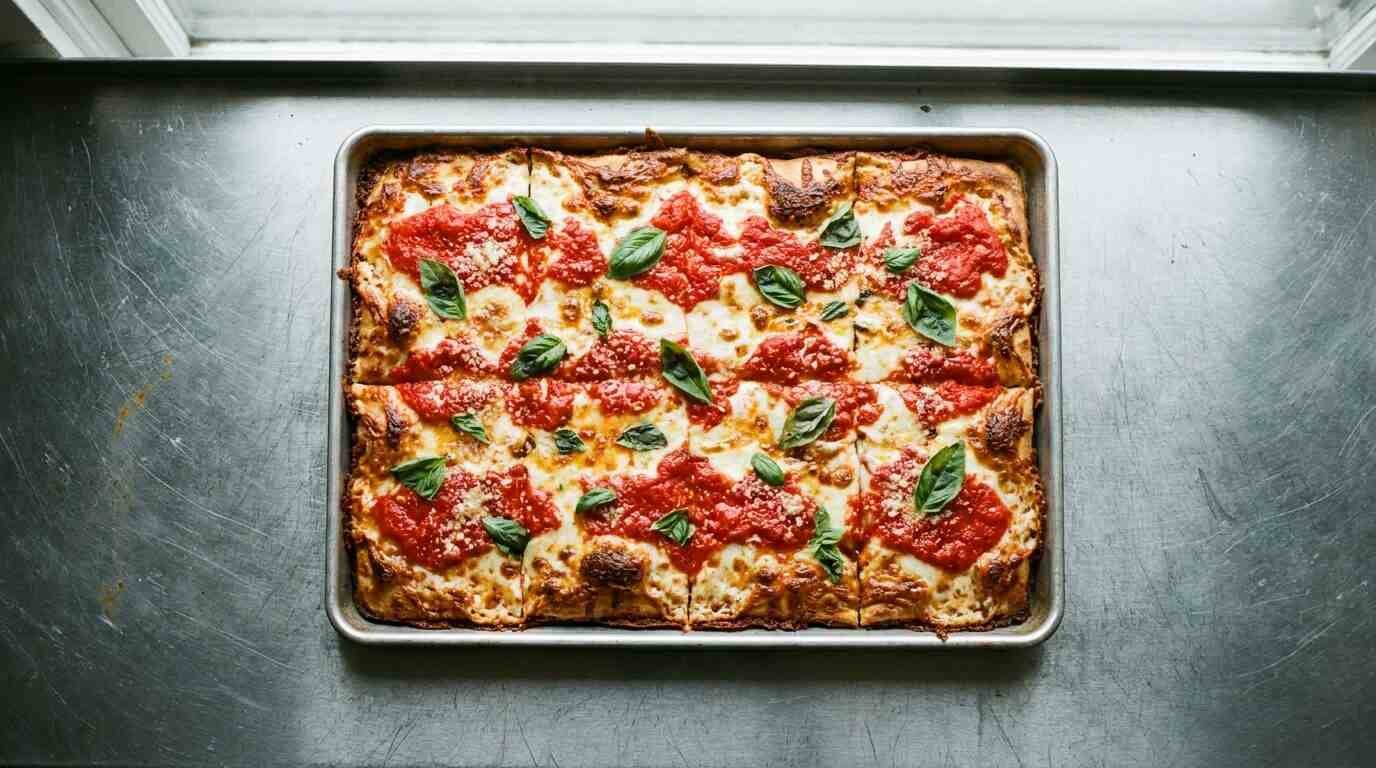
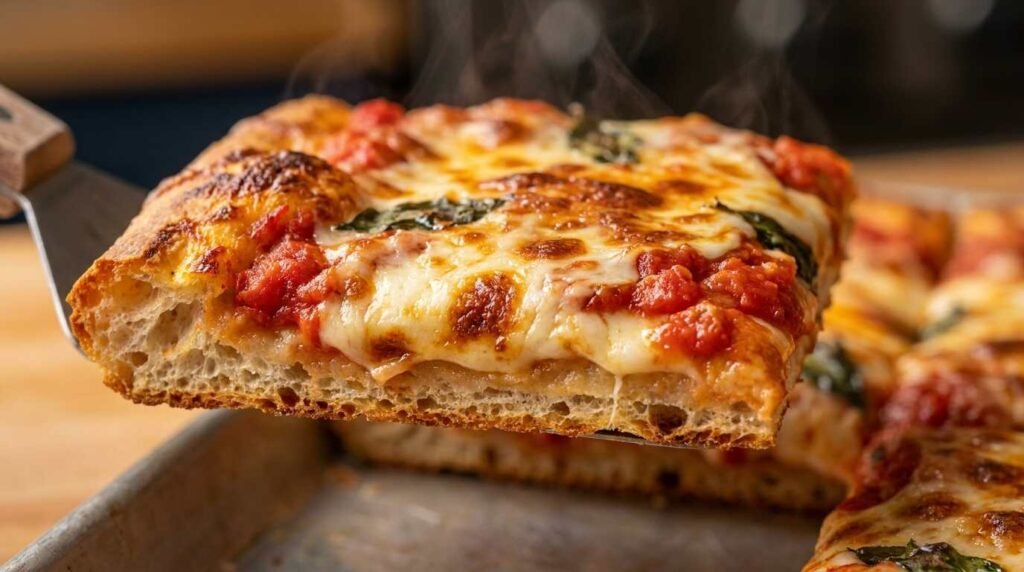
Two years ago you had to know what a grandma slice was. It was the kind of thing a Long Island native explained to a visitor with a little proprietary pride — square, thin-bottomed, cheese laid down before the sauce, cut into modest tiles, nothing like the wide foldable triangle most of the country pictures when it hears the word pizza. Now it is on menus in Phoenix and Portland, anchoring dedicated shops, and generating more short-form video than the Neapolitan pies that food media spent a decade canonizing. Something moved the format from regional shorthand to national default, fast, and the mechanics of that move are more interesting than the usual feel-good food story lets on.
The grandma slice is a useful specimen precisely because its origin is so well documented and so local. You can name the pizzeria, the family, roughly the decade. That specificity makes it possible to watch what happens when a dish with a fixed point of origin gets picked up, flattened, and redistributed by an algorithm that does not care where anything came from.
A Pie That Started in a Home Oven
Before it was anybody’s menu item, grandma-style pizza was a workaround. Southern Italian immigrants who wanted pizza at home but lacked a proper pizza oven did what the equipment allowed: they pressed dough into a rectangular sheet pan, baked it in a standard kitchen oven, and accepted that the result would be thinner and crispier on the bottom than what came out of a bakery’s deck oven. The cheese went down first, partly to keep the crust from going soggy under the sauce. The shape followed the pan. The name followed the cook — this was the pie a grandmother made, not the one a pizzaiolo sold.
That domestic logic is baked into every structural feature of the slice. The thinness is the home oven’s heat ceiling. The square is the sheet pan. The cheese-then-sauce order is a moisture solution. None of it was a stylistic choice; it was a set of constraints that happened to produce something delicious. Understanding that is the key to understanding what gets lost later, when shops adopt the look of the format without the conditions that generated it.
New Hyde Park and the Naming
The leap from home kitchen to commercial fixture has a credible address: Umberto’s in New Hyde Park, opened in 1965 by Umberto Corteo. The family story, recounted in Newsday and elsewhere, is that Corteo would ask his brother to make an off-menu pie like the one their mother baked back in Italy, near Naples. It circulated among friends and staff before it was ever sold. When a thinner Sicilian-style pie eventually made the menu in the 1980s or early ’90s, it was a regular — not a Corteo — who suggested the result felt more like a grandmother’s work than a grandfather’s, and the name stuck.
The Corteos never trademarked it. That detail matters more than it first appears. An untrademarked, easily described, easily replicated format is a thing the world can take freely, and it did. Within a few years other Long Island pizzerias were advertising grandma pies of their own, and the slice that had been one family’s off-menu favorite became a regional category. By 2017 a national ranking placed Umberto’s among the best pizzerias in the country on the strength of it. The local cult was intact. The national contagion had not yet begun.
What Sent It National
Two things had to happen for a regional square to become a coast-to-coast trend. First, a pizzaiolo somewhere outside New York had to taste one, want it, and put in the work to reproduce it — and that has been happening for years through ordinary culinary diffusion, as documented in trade coverage of operators who sampled the style on a Long Island trip and carried it home. That is the slow channel, the one that built grandma pizza’s reach across the country over a decade.
The fast channel is the one that changed everything in the last two years: video. The grandma slice is almost suspiciously well suited to the format the internet now rewards. It is geometric and photogenic. The cheese-first construction creates visible browned edges and lacy cheese skirts that read instantly on a small screen. The square cut yields a tidy, handheld object. A pull shot of the cheese, a top-down of the tray, a crunch you can almost hear — the slice performs. Neapolitan pizza, for all its pedigree, photographs as a soft pale circle. The grandma photographs as content.
The Commodification Problem
Here is where the case study turns. When a format spreads through cooking, the constraints travel with it — the operator who reverse-engineers a grandma pie usually has to learn why the cheese goes first and why the pan and the bake matter. When a format spreads through video, only the appearance travels. A shop can produce something that reads as a grandma slice on camera — square, browned edges, cheese-forward — without the dough fermentation, the careful par-bake, or the restraint that made the original worth eating rather than merely worth filming.
This is the quiet cost of going viral. The dish becomes a visual signature decoupled from its method. The market fills with grandma slices that satisfy the eye and disappoint the mouth, and because most people now meet the format through a screen first, the screen version becomes the reference point. The thing that made it interesting — that it was an honest solution to a real kitchen problem, refined over generations — is exactly the thing the algorithm has no way to transmit.
What Survives the Trip
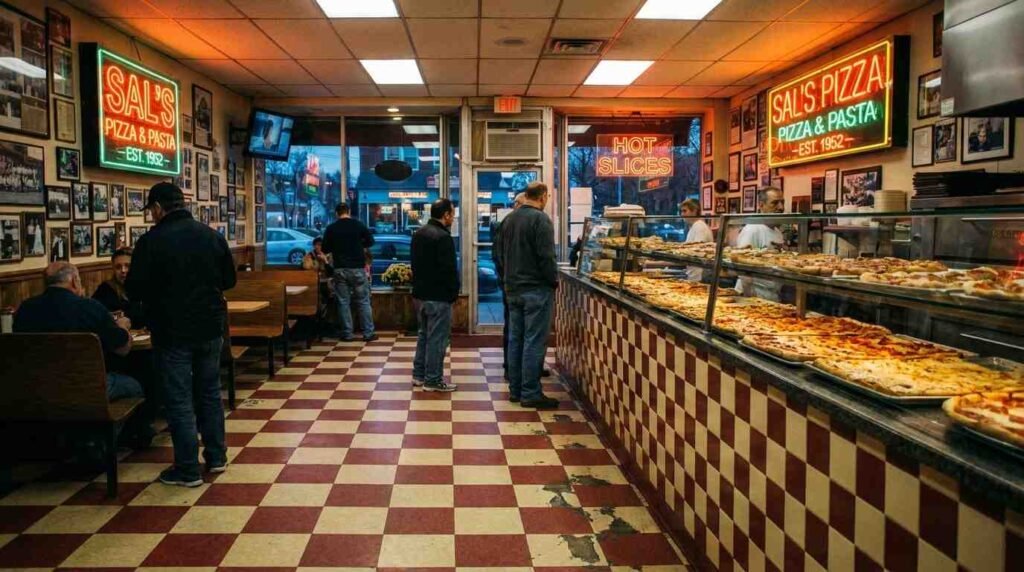
Not everything is lost, and it would be dishonest to pretend otherwise. The diffusion has also put genuinely good grandma pizza in front of people who would never have encountered it, and some of the operators copying it are doing careful, respectful work. A regional format that reaches a national audience and gains a few hundred excellent practitioners along the way is, on balance, a gain for the eater. The question is not whether the spread is good or bad. It is what you have to know to tell the difference once the format is everywhere.
What survives the trip is the structure you can taste: a bottom crust that shattered rather than bent, a fermentation that gave the dough flavor instead of just chew, a sauce bright enough to cut the cheese it sits on top of. Those are the inheritances from the home oven, and they are still the measure. On Long Island, where the format started, you can taste the reference version and calibrate. Everywhere else, the slice arrived through a screen, and the calibration has to be done on purpose.
The Local Stake
There is a small irony in watching the grandma slice conquer the country from the place that made it. Long Island gave the format its name, its first commercial home, and its template, then handed it freely to a world that is now reflecting a flattened version back. None of this diminishes the original. If anything it sharpens the value of being near the source — of being able to eat the slice in the context that produced it, where the thinness and the cheese-first order are not affectations imported from a video but the local way things have always been done.
The grandma slice winning the pizza internet is a clean illustration of how regional food now travels: a real origin, a slow culinary spread, then a sudden visual one that scales the look far faster than the substance. The format will keep multiplying. The number of places making it well will grow more slowly. Knowing what the slice was built to do — and tasting it where it was built — is how you keep the difference in view.
You Might Also Like
- The Grandma Pie Renaissance: Mastering the Crispy, Thin-Crust Sicilian Pizza of Nassau County
- The 10 Best Pizza Places Near Mount Sinai, NY
- How a Jersey joint started pulling in numbers that would embarrass a mid-size hotel