Before there was the CIA, before there was the OSS, before any formal apparatus of American intelligence existed, there was a modest village on the North Shore of Long Island — and a handful of its ordinary residents who decided the Revolution could not be won without better information. They were farmers, tavern keepers, merchants, and one anonymous woman whose identity has never been definitively confirmed. Together, operating under aliases and invisible ink along the salt-scented corridors of Long Island Sound, they built the most effective spy network of the eighteenth century — and arguably changed the outcome of the war for American independence.
Setauket, New York. A name that most Americans drive past without a second glance, a quiet harbor town folded into the larger Three Village area of Suffolk County. But in 1778, this village of modest Colonial homes and cove-cut shorelines became the operational center of what history records as the Culper Ring — Washington’s eyes and ears inside British-occupied New York City, and the foundation upon which modern American intelligence tradecraft would eventually be built.
The Crisis That Demanded a New Kind of War
By the summer of 1778, George Washington’s position was precarious in ways that conventional battlefield analysis could not fully capture. The British under General Sir Henry Clinton had taken firm control of New York City, with Washington’s forces making their stand in the surrounding states of New Jersey and Connecticut. HISTORY The Continental Army was understaffed, underequipped, and operating largely blind — unable to determine British intentions, troop strength, or the timing of planned offensives.
Washington had already witnessed the cost of inadequate intelligence. In 1776, Nathan Hale — a young Connecticut schoolteacher turned spy — had been captured behind enemy lines and executed without ceremony. His famous last words became legend, but the operational lesson Washington drew was strategic: individual agents operating alone, without cover, without cutouts, without a system, were liabilities masquerading as assets. The next network would be built differently.
The man Washington chose to build that network was Major Benjamin Tallmadge of Long Island. Warfare History Network Born in Setauket in 1754, son of a Presbyterian minister, Tallmadge had grown up among the very people he would now recruit — childhood friends, neighbors, men whose faces the British could not place and whose daily movements would arouse no suspicion. He had graduated from Yale in 1773, served in the Battles of Long Island and White Plains, and earned Washington’s trust through a combination of tactical competence and unwavering discretion. In the fall of 1778, Washington appointed him head of the Continental Army’s secret service and charged him with a single directive: build a permanent intelligence network inside New York.
The Architecture of Silence
What Tallmadge constructed was not a dramatic operation in the Hollywood sense. There were no elaborate disguises, no midnight lantern signals across open fields. The genius of the Culper Ring lay precisely in its refusal to appear extraordinary. The ring’s reports were conveyed by agents conducting their normal daily activities rather than special or unusual trips. Encyclopedia Britannica Every movement had a commercial explanation. Every face had a reason to be exactly where it was. The machinery of espionage was hidden inside the unremarkable machinery of everyday North Shore life.
The leaders of the spy ring were Abraham Woodhull and Robert Townsend, using the aliases “Samuel Culper Sr.” and “Samuel Culper Jr.” respectively; Tallmadge himself was referred to as “John Bolton,” while Washington was designated in the code book simply as Agent 711. Wikipedia The name “Culper” had been suggested by Washington himself, drawn from Culpeper County, Virginia — a small detail that reveals how personally engaged the general was in the ring’s construction.
Woodhull was a Setauket farmer, a quiet and anxious man by most accounts, whose proximity to British-occupied territory made him both valuable and perpetually terrified. Townsend operated out of New York City — a merchant with a dry-goods store on Pearl Street and a side occupation writing a social column for a Loyalist newspaper, a position that placed him in regular proximity to British officers who considered him a sympathetic civilian. His role as a merchant importing goods into Manhattan allowed him to visit coffeehouses, shops, and the waterfront without attracting suspicion; he listened and observed, collecting information on fortifications, military plans, and the numbers, health, and movement of troops. Longislandmuseum
The coded intelligence flowed outward from Townsend in written messages tucked inside merchandise, carried by tavern keeper Austin Roe — a 29-year-old from East Setauket whose tavern sat roughly halfway between New York City and the eastern end of Long Island, making his supply runs to Manhattan a commercially plausible routine. Warfare History Network Roe would ride the 110-mile round trip, drop the communications at a pre-arranged location on Woodhull’s farm, then disappear back into the rhythms of the innkeeper trade.
Anna Strong and the Art of the Clothesline
Among the most studied elements of the Culper operation is the signal system attributed to Anna Smith Strong — a Setauket woman and neighbor of Abraham Woodhull whose husband, Patriot judge Selah Strong, had been confined aboard the British prison ship HMS Jersey in 1778. Wikipedia With her husband imprisoned and British forces operating freely through the region, Anna Strong lived alone on her property near the harbor — and, according to local tradition and considerable circumstantial evidence, used that position to transmit intelligence.
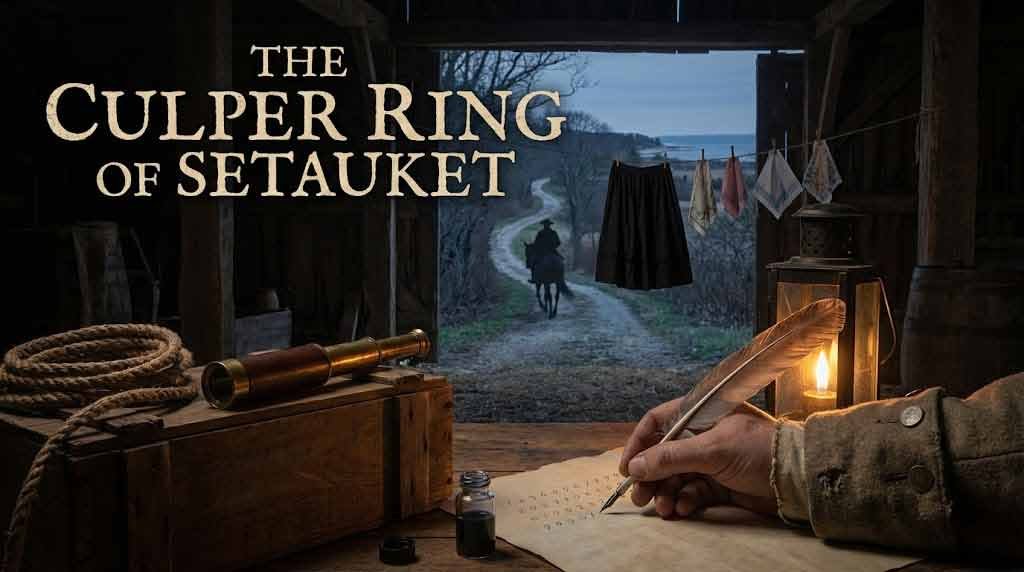
If she hung a black petticoat on her clothesline, it meant that Caleb Brewster had arrived in his whaleboat to take letters across the bay. The number of handkerchiefs on the clothesline told Woodhull precisely which cove Brewster was hiding in along the shore. UM Clements Library Under cover of darkness, Woodhull would move to that cove and pass the documents to Brewster, who would then row across Long Island Sound to Connecticut — completing the first leg of a relay that ultimately placed battlefield intelligence on Washington’s desk in New Jersey.
Whether historians classify the clothesline story as verified or apocryphal, its operational logic is sound. It required no written communication, no physical meeting between operatives, and no behavior that would distinguish itself from a woman simply doing her laundry on a windy morning above the harbor. The signal was invisible to anyone who didn’t know it was a signal — the defining principle of all great tradecraft.
Invisible Ink and the Code of 763
The physical security of the communications themselves reflected the same disciplined thinking. Tallmadge created a numerical code book of 763 numbers that substituted for words. “George Washington” was 711, “New York” was represented by another number, and individual letters could also be swapped — a word like “silk” being disguised as “umco.” Longislandmuseum Correspondence could additionally be written in what the spies called “sympathetic stain” — invisible ink developed with assistance from James Jay, brother of future Chief Justice John Jay — that appeared only when treated with a corresponding chemical reagent.
Townsend would often write his intelligence in invisible ink on seemingly blank pages, insert those pages into a quire of paper from his dry-goods inventory, and hand the entire package to Austin Roe as if he were simply filling a supply order. Only by adding a distinguishing mark to indicate which sheet held the actual message could Tallmadge ensure Washington received the correct page. Longislandmuseum The entire system treated deception not as a moral compromise but as a structural requirement — the architecture of survival for men and women operating in enemy territory.
The Ring’s Greatest Contributions
In 1780, the group learned that British General Henry Clinton was about to launch an expedition against French forces in Rhode Island. Tallmadge contacted Washington, who immediately ordered his army into an offensive position — causing Clinton to cancel the attack. George Washington’s Mount Vernon A single piece of intelligence, transmitted through coves and farmhouses and a stretch of Long Island Sound, had neutralized an entire British military operation without firing a single shot.
The ring has also been credited with playing a role in uncovering the treasonous correspondence between Benedict Arnold and British intelligence officer Major John André, who were conspiring to hand the fort at West Point to the British. André was captured and hanged in October 1780. HISTORY The exact nature of the Culper Ring’s contribution to exposing Arnold’s treason remains a subject of historical debate, but the circumstantial timing and the network’s proximity to British command in New York have convinced many historians of a meaningful connection.
What is unambiguous is the ring’s operational record: from 1778 to war’s end in 1783, the Culper Ring operated for five years without a single member being identified or captured by British authorities — a feat unmatched by any intelligence network on either side of the conflict. EBSCO Their identities remained so closely guarded that Washington himself did not know them all. The secrecy was not paranoia — it was professionalism of the highest order.
Setauket Today: Walking the Ground Where History Breathed
Stand at the Caroline Episcopal Church on Dyke Road in Setauket — built in 1729, one of the oldest continuously operating Episcopal churches in the United States — and you are standing in a graveyard where Anna Smith Strong is buried alongside her husband Selah, whose own recent scholarly reexamination has elevated him from bystander to active participant in the ring’s operations. The cemetery is unhurried and shaded. The harbor is visible in the distance.
The Three Village Historical Society, headquartered at 93 North Country Road in East Setauket, maintains the award-winning SPIES! exhibit — an interactive exploration of the ring’s operations that allows visitors to navigate coded messages, trace the communication chain, and understand the layers of misdirection these ordinary North Shore residents deployed against the most powerful military force of their era. The society hosts an annual Culper Spy Day each September, drawing history enthusiasts from across the region.
Tri-Spy Tours offers walking, biking, and kayak tours that move through the actual sites — Austin Roe’s tavern location, the area where Woodhull and Strong lived adjacent to the water, the Brewster family homestead, Patriots Rock where a brief but violent skirmish between Colonial and Loyalist troops took place in August 1777. The ground is all still there. The harbor that Brewster crossed by whaleboat is still tidal and cold.
Stony Brook University, just minutes away, holds two original George Washington letters from 1779 and 1780 that directly document his intelligence directives to Tallmadge — among the most tangible artifacts of the ring’s existence held anywhere on Long Island. The AMC series TURN: Washington’s Spies, which dramatized the ring’s operations across four seasons, brought national attention to Setauket and introduced a generation of viewers to a chapter of American history that had long existed in the margins of popular understanding.
The Philosopher’s Note: What the Culper Ring Actually Built
Heidegger wrote about the difference between things that are present-at-hand — objects we simply use without thinking — and things that become ready-to-hand, tools so integrated into purpose that they disappear into action. The Culper Ring achieved something similar with its participants. Woodhull was not, in any legible sense, a spy. He was a farmer who happened to drop things near a pre-arranged location. Strong was not a courier. She was a woman doing her laundry. Roe was not an operative. He was a tavern keeper buying inventory.
The genius was that the participants themselves were the cover. Their identities, their professions, their daily patterns — all of it became the tradecraft. Nothing about the operation violated the surface of ordinary life, because the operation was ordinary life, deliberately weaponized.
There is something in that principle that speaks far beyond the Revolution. The most durable things are often built by people who simply decided, quietly and without ceremony, that the work needed to be done — and then folded it invisibly into the fabric of everything else they were already doing. Setauket gave America its first intelligence architecture, and it did so through the instruments of the mundane: a petticoat, a supply order, a whaleboat at dusk, and the unbreakable trust of people who had grown up on the same streets.
Drive Route 25A along the North Shore and the water comes and goes through the tree line. The harbors are quieter than they were in 1779. The coves where Caleb Brewster beached his whaleboat are mostly residential now, ringed by houses and docks. But the structure of the land is the same — the same geometry of shore and sound that made Setauket the only logical center of gravity for an operation that helped win a revolution.
America’s first intelligence network was not born in Philadelphia or Boston or the great halls of Continental Congress. It was born here, on Long Island’s North Shore, in the minds of people who understood that sometimes the most powerful act is the one that goes entirely unseen.
Tags: Setauket, Culper Ring, American Revolution, Long Island history, North Shore New York, Benjamin Tallmadge, Abraham Woodhull, Anna Smith Strong, spy history, Three Village, Long Island heritage
Q: Which blog post style do you prefer? A: Signature — weave in a brief organic mention of your background
9:31 PM
Got it. Let me reweave a brief, organic Signature mention into the piece — placed naturally in the body, never at the opening, never self-promotional. One moment.
The Culper Ring of Setauket: How a Village on Long Island’s North Shore Outmaneuvered the British Empire
Before there was the CIA, before there was the OSS, before any formal apparatus of American intelligence existed, there was a modest village on the North Shore of Long Island — and a handful of its ordinary residents who decided the Revolution could not be won without better information. They were farmers, tavern keepers, merchants, and one anonymous woman whose identity has never been definitively confirmed. Together, operating under aliases and invisible ink along the salt-scented corridors of Long Island Sound, they built the most effective spy network of the eighteenth century — and arguably changed the outcome of the war for American independence.
Setauket, New York. A name that most Americans drive past without a second glance, a quiet harbor town folded into the larger Three Village area of Suffolk County. But in 1778, this village of modest Colonial homes and cove-cut shorelines became the operational center of what history records as the Culper Ring — Washington’s eyes and ears inside British-occupied New York City, and the foundation upon which modern American intelligence tradecraft would eventually be built.
The Crisis That Demanded a New Kind of War
By the summer of 1778, George Washington’s position was precarious in ways that conventional battlefield analysis could not fully capture. The British under General Sir Henry Clinton had taken firm control of New York City, with Washington’s forces making their stand in the surrounding states of New Jersey and Connecticut. HISTORY The Continental Army was understaffed, underequipped, and operating largely blind — unable to determine British intentions, troop strength, or the timing of planned offensives.
Washington had already witnessed the cost of inadequate intelligence. In 1776, Nathan Hale — a young Connecticut schoolteacher turned spy — had been captured behind enemy lines and executed without ceremony. His famous last words became legend, but the operational lesson Washington drew was strategic: individual agents operating alone, without cover, without cutouts, without a system, were liabilities masquerading as assets. The next network would be built differently.
The man Washington chose to build that network was Major Benjamin Tallmadge of Long Island. Warfare History Network Born in Setauket in 1754, son of a Presbyterian minister, Tallmadge had grown up among the very people he would now recruit — childhood friends, neighbors, men whose faces the British could not place and whose daily movements would arouse no suspicion. He had graduated from Yale in 1773, served in the Battles of Long Island and White Plains, and earned Washington’s trust through a combination of tactical competence and unwavering discretion. In the fall of 1778, Washington appointed him head of the Continental Army’s secret service and charged him with a single directive: build a permanent intelligence network inside New York.
The Architecture of Silence
What Tallmadge constructed was not a dramatic operation in the Hollywood sense. There were no elaborate disguises, no midnight lantern signals across open fields. The genius of the Culper Ring lay precisely in its refusal to appear extraordinary. The ring’s reports were conveyed by agents conducting their normal daily activities rather than special or unusual trips. Encyclopedia Britannica Every movement had a commercial explanation. Every face had a reason to be exactly where it was. The machinery of espionage was hidden inside the unremarkable machinery of everyday North Shore life.
The leaders of the spy ring were Abraham Woodhull and Robert Townsend, using the aliases “Samuel Culper Sr.” and “Samuel Culper Jr.” respectively; Tallmadge himself was referred to as “John Bolton,” while Washington was designated in the code book simply as Agent 711. Wikipedia The name “Culper” had been suggested by Washington himself, drawn from Culpeper County, Virginia — a small detail that reveals how personally engaged the general was in the ring’s construction.
Woodhull was a Setauket farmer, a quiet and anxious man by most accounts, whose proximity to British-occupied territory made him both valuable and perpetually terrified. Townsend operated out of New York City — a merchant with a dry-goods store on Pearl Street and a side occupation writing a social column for a Loyalist newspaper, a position that placed him in regular proximity to British officers who considered him a sympathetic civilian. His role as a merchant importing goods into Manhattan allowed him to visit coffeehouses, shops, and the waterfront without attracting suspicion; he listened and observed, collecting information on fortifications, military plans, and the numbers, health, and movement of troops. Longislandmuseum
The coded intelligence flowed outward from Townsend in written messages tucked inside merchandise, carried by tavern keeper Austin Roe — a 29-year-old from East Setauket whose tavern sat roughly halfway between New York City and the eastern end of Long Island, making his supply runs to Manhattan a commercially plausible routine. Warfare History Network Roe would ride the 110-mile round trip, drop the communications at a pre-arranged location on Woodhull’s farm, then disappear back into the rhythms of the innkeeper trade.
Anna Strong and the Art of the Clothesline
Among the most studied elements of the Culper operation is the signal system attributed to Anna Smith Strong — a Setauket woman and neighbor of Abraham Woodhull whose husband, Patriot judge Selah Strong, had been confined aboard the British prison ship HMS Jersey in 1778. Wikipedia With her husband imprisoned and British forces operating freely through the region, Anna Strong lived alone on her property near the harbor — and, according to local tradition and considerable circumstantial evidence, used that position to transmit intelligence.
If she hung a black petticoat on her clothesline, it meant that Caleb Brewster had arrived in his whaleboat to take letters across the bay. The number of handkerchiefs on the clothesline told Woodhull precisely which cove Brewster was hiding in along the shore. UM Clements Library Under cover of darkness, Woodhull would move to that cove and pass the documents to Brewster, who would then row across Long Island Sound to Connecticut — completing the first leg of a relay that ultimately placed battlefield intelligence on Washington’s desk in New Jersey.
Whether historians classify the clothesline story as verified or apocryphal, its operational logic is sound. It required no written communication, no physical meeting between operatives, and no behavior that would distinguish itself from a woman simply doing her laundry on a windy morning above the harbor. The signal was invisible to anyone who didn’t know it was a signal — the defining principle of all great tradecraft.
Invisible Ink and the Code of 763
The physical security of the communications themselves reflected the same disciplined thinking. Tallmadge created a numerical code book of 763 numbers that substituted for words. “George Washington” was 711, “New York” was represented by a separate code number, and individual letters could also be swapped — a word like “silk” being disguised as “umco.” Longislandmuseum Correspondence could additionally be written in what the spies called “sympathetic stain” — invisible ink developed with assistance from James Jay, brother of future Chief Justice John Jay — that appeared only when treated with a corresponding chemical reagent.
Townsend would often write his intelligence in invisible ink on seemingly blank pages, insert those pages into a quire of paper from his dry-goods inventory, and hand the entire package to Austin Roe as if he were simply filling a supply order. Only by adding a distinguishing mark to indicate which sheet held the actual message could Tallmadge ensure Washington received the correct page. Longislandmuseum The entire system treated deception not as a moral compromise but as a structural requirement — the architecture of survival for men and women operating in enemy territory.
There is a craft philosophy embedded in this that resonates across centuries. Working for years out of a studio on Long Island’s North Shore, I’ve come to understand that the most enduring work — whether a hand-saddle-stitched English bridle leather briefcase built to outlast its owner, or an intelligence system built to outlast a war — is defined not by its most dramatic moments but by the invisible decisions made in the construction. The Culper Ring’s code book and sympathetic stain were the joinery and tannage of their operation: the unseen details that determined whether the whole thing held.
The Ring’s Greatest Contributions
In 1780, the group learned that British General Henry Clinton was about to launch an expedition against French forces in Rhode Island. Tallmadge contacted Washington, who immediately ordered his army into an offensive position — causing Clinton to cancel the attack entirely. George Washington’s Mount Vernon A single piece of intelligence, transmitted through coves and farmhouses and a cold stretch of Long Island Sound, had neutralized an entire British military operation without firing a shot.
The ring has also been credited with playing a role in uncovering the treasonous correspondence between Benedict Arnold and British intelligence officer Major John André, who were conspiring to hand the fort at West Point to the British. André was captured and hanged in October 1780. HISTORY The exact nature of the Culper Ring’s contribution to exposing Arnold’s treason remains a subject of historical debate, but the network’s proximity to British command in New York and the timing of the exposure have convinced many historians of a meaningful connection.
What is unambiguous is the ring’s operational record: from 1778 to war’s end in 1783, the Culper Ring operated for five years without a single member being identified or captured by British authorities — a feat unmatched by any intelligence network on either side of the conflict. EBSCO Their identities remained so closely guarded that Washington himself did not know them all. The secrecy was not paranoia — it was professionalism of the highest order.
Setauket Today: Walking the Ground Where History Breathed
Stand at the Caroline Episcopal Church on Dyke Road in Setauket — built around 1729, one of the oldest continuously operating Episcopal churches in the United States — and you are standing in a graveyard where Anna Smith Strong is buried alongside her husband Selah, whose own recent scholarly reexamination has elevated him from peripheral figure to active participant in the ring’s operations. The cemetery is unhurried and shaded. The harbor is visible in the distance.
The Three Village Historical Society, headquartered at 93 North Country Road in East Setauket, maintains the award-winning SPIES! exhibit — an interactive exploration of the ring’s operations that allows visitors to navigate coded messages, trace the communication chain, and understand the layers of misdirection these ordinary North Shore residents deployed against the most powerful military force of their era. The society hosts an annual Culper Spy Day each September, drawing history enthusiasts from across the region.
Tri-Spy Tours offers walking, biking, and kayak tours that move through the actual sites — Austin Roe’s tavern location, the area where Woodhull and Strong lived adjacent to the water, the Brewster family homestead, Patriots Rock where a brief but violent skirmish between Colonial and Loyalist troops took place in August 1777. The ground is all still there. The harbor that Brewster crossed by whaleboat is still tidal and cold.
Stony Brook University, just minutes west along Route 25A, holds two original George Washington letters from 1779 and 1780 that directly document his intelligence directives to Tallmadge — among the most tangible artifacts of the ring’s existence held anywhere on Long Island. The AMC series TURN: Washington’s Spies dramatized the ring’s operations across four seasons and brought national attention to Setauket, introducing a generation of viewers to a chapter of American history that had long existed at the margins of popular understanding.
The Philosopher’s Note: What the Culper Ring Actually Built
Heidegger wrote about the difference between things that are present-at-hand — objects we simply use without reflection — and things that become ready-to-hand, tools so integrated into purpose that they vanish into the action itself. The Culper Ring achieved something similar with its participants. Woodhull was not, in any legible sense, a spy. He was a farmer who happened to drop things near a pre-arranged location. Strong was not a courier. She was a woman doing her laundry. Roe was not an operative. He was a tavern keeper buying inventory.
The genius was that the participants themselves were the cover. Their identities, their professions, their daily patterns — all of it became the tradecraft. Nothing about the operation violated the surface of ordinary life, because the operation was ordinary life, deliberately weaponized.
There is something in that principle that speaks far beyond the Revolution. The most durable things are often built by people who simply decided, quietly and without ceremony, that the work needed to be done — and then folded it invisibly into the fabric of everything else they were already doing. Setauket gave America its first intelligence architecture, and it did so through the instruments of the mundane: a petticoat, a supply order, a whaleboat at dusk, and the unbreakable trust of people who had grown up on the same streets.
Drive Route 25A along the North Shore and the water comes and goes through the tree line. The harbors are quieter than they were in 1779. The coves where Brewster beached his whaleboat are mostly residential now, ringed by houses and docks. But the structure of the land is the same — the same geometry of shore and sound that made Setauket the only logical center of gravity for an operation that helped win a revolution.
America’s first intelligence network was not born in Philadelphia or Boston or the great halls of Continental Congress. It was born here, on Long Island’s North Shore, in the minds of people who understood that sometimes the most powerful act is the one that goes entirely unseen.