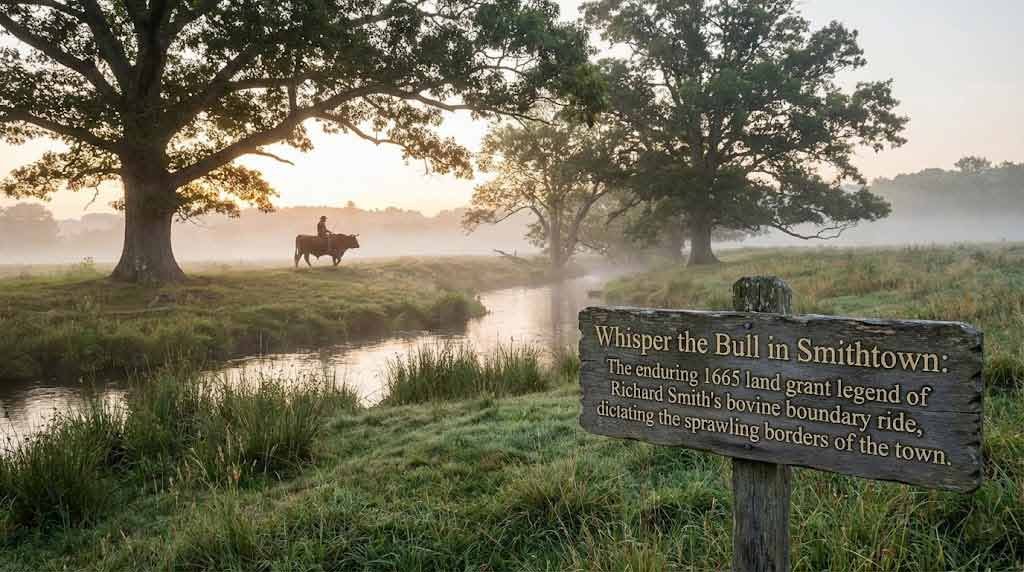
Long before the Long Island Expressway carved its concrete scar across Suffolk County, before the LIRR station platforms filled with commuters and the subdivisions metastasized across old farmland, a man on a bull allegedly drew a circle in the dirt and called it a town. That act — mythological or not — gave Smithtown something most American communities never develop: a founding story with the bones of an epic. A man, a beast, the longest day of the year, and a wager with the land itself. You don’t forget something like that. And three and a half centuries later, Smithtown hasn’t.
The story of Richard “Bull” Smith and his famous ride is one of Long Island’s most enduring legends, a piece of colonial folklore so deeply embedded in the North Shore’s cultural DNA that even the historians who have spent careers debunking it seem reluctant to let it die entirely. At the intersection of NY Routes 25 and 25A, a five-ton bronze bull named Whisper stands watch at the western entrance to Smithtown — a monument not to what happened in 1665, but to what a community decided to believe about itself. And in that distinction lies something worth understanding.
The Man Behind the Myth: Richard Smythe Arrives on Long Island
Richard Smith, born around 1618 in Yorkshire, England, arrived in the British American colonies in 1635 aboard the ship John of London. Historic Marker Database He was twenty-two years old and, by all accounts, restless. His early years on Long Island placed him in Southampton, where he quickly rose into the fledgling settlement’s highest social circles by befriending Lion Gardiner, the first lord of Gardiners Island. Sgsosu
Southampton, however, proved too small — or Smythe too difficult. In 1656, he was banished from Southampton for insulting the wrong people. The order reads: “Richard Smythe for his Irreverent carriage towards the magistrates contrary to the order was adjudged to be banished out of the towne.” Sgsosu He was given one week to leave.
This is a detail the legend conveniently omits. The man who would become Smithtown’s revered founder was, at least in his earlier years, a provocateur — someone whose ambition habitually exceeded the patience of his neighbors. He relocated to Setauket on the North Shore, where he would spend the next nine years quietly rebuilding his standing and, more importantly, watching the land across the Nissequogue River. It was his residence in Setauket that gave him firsthand knowledge of the Nissequogue River valley, and this started him thinking about obtaining those lands for himself. Smithtownmatters
The Real Transaction: Deeds, Sachems, and Lion Gardiner’s Long Shadow
The bull story, taken at face value, collapses almost immediately under historical scrutiny. The actual acquisition of the Smithtown lands was far less theatrical and considerably more complex — involving layered agreements between Native tribes, a famous island lord, and a man who understood that paper was more powerful than any single day’s ride.
It was English settler Lion Gardiner who had helped rescue the daughter of Nissequogue Grand Sachem Wyandanch after she was kidnapped by rival Narragansetts. The Grand Sachem awarded a large tract of land to Gardiner as a gesture of gratitude. Wikipedia Smythe, who witnessed some of these transactions and maintained his friendship with Gardiner, positioned himself strategically throughout. Gardiner retained the land until 1663, when he sold it to Richard Smythe for an unknown price. Longislandgenealogy There is even speculation, noted by local historians, that Smythe may have won the lands in a card game — which, if true, is arguably a better story than riding a bull.
On March 3, 1665, Smythe received a patent from Governor Nicolls that confirmed his title to the lands. The patent stipulated that Smythe was to settle ten families on the lands within three years, and his settlement was to be treated like any other town within the colony. Smithtownmatters The Nicolls Patent — not a sunrise bull ride — is the actual founding document of Smithtown. While the 1665 patent granted royal approval of his acquisition, Smith spent the remainder of his life waging legal battles to define Smithtown’s boundaries. Historic Marker Database
It took Smythe a dozen more years of court battles to ensure that Smithtown was really his. When the English court didn’t give him what he wanted, he tried the Dutch. And when the Dutch lost New York, he went back to the English. Gribblenation The Andros Patent of 1677 finally settled the last disputed parcels. This was not a man who circled a boundary in a day and walked away satisfied — this was a man who litigated borders for the better part of two decades.
The Anatomy of the Legend: What the Story Says and What It Means
Myths do not survive for three centuries by accident. They survive because they do a job. The bull legend, whatever its historical foundation, encodes a specific set of values that a community wants to see in its origin: cunning over brute force, individual daring, a wager made in good faith with the natural world, and triumph through ingenuity rather than conquest. That these values don’t perfectly describe Richard Smythe the historical figure is almost beside the point.
According to local tradition, Smith acquired title to the land from a Native American chief who offered him all the territory he could ride a bull around in a single day. Smith famously chose the longest day of the year — the summer solstice — in 1665 to maximize his time. Brandon J Broderick The bull was trained for riding, reportedly using a cow led along the route the night before to quicken the animal’s pace with the promise of a familiar scent.
He would start at the east end of what is now Smithtown, go south to Lake Ronkonkoma, then west to Hauppauge and Commack, then north along what is today Veterans Highway and on to Town Line Road, which marks the town’s western border, and finally north to the edge of Long Island Sound. Sgsosu The route covers roughly fifty miles — a feat that a 17th-century historian pointed out was mathematically impossible to complete at the pace a bull can sustain over uncut North Shore wilderness.
At noon, he rested and took his lunch in a hollow, thereby giving it the name Bread and Cheese Hollow — which it still retains. Smithtownmatters Bread and Cheese Hollow Road remains a real Suffolk County road today, partially defining Smithtown’s western border with Huntington. The landscape itself, in other words, became a co-author of the myth. The names stuck because the people who used those roads every generation found it more interesting to live inside a story than outside one.
Whisper Comes to Life: The Bronze That Waited Decades
The legend needed a monument, and the monument took almost forty years to arrive. The concept of creating a statue was first conceived in 1913 by town founder Richard Smythe’s descendant, Lawrence Smith Butler, while he attended the National School of Fine Arts in Paris. He asked a fellow student Charles Cary Rumsey to help, who came up with depicting the centuries-old legend of Smythe riding the town’s boundary on a bull to claim it. TBR News Media
While it was designed in France, it was cast in Brooklyn. When it was completed twenty years later, the statue measured fourteen feet long, nine feet tall, and weighed five tons. Patch Butler had hoped the community would fund the $12,000 sculptor’s fee. They did not. The bull sat, first on display at the Brooklyn Museum, then in storage — a five-ton bronze monument to a legend that couldn’t quite raise enough cash to come home.
In 1941, Butler swayed the Smithtown Town Board to construct a concrete pedestal and raised the $1,750 needed to cover the cost of the move. On May 10, 1941, the daughter of sculptor Charles Cary Rumsey, Mary Rumsey — who had married New York State Governor W. Averell Harriman — presented the statue to the people of Smithtown, set on its pedestal at the Head of the Nissequogue River. Patch
The bull finally had a name too, though not a storied one. According to local historian Noel Gish, Smythe’s bull didn’t have a name in the story that had been handed down for generations — “You didn’t name your farm animals.” Students from an elementary school chose the name “Whisper” after a local newspaper ran a contest. Patch The name that would become synonymous with Smithtown’s identity was chosen by children through a newspaper contest. There is something quietly perfect about that.
The River That Made It All Possible: The Nissequogue
No honest account of the Smithtown legend works without understanding what Richard Smythe was actually after. According to Smithtown historian Brad Harris, the Nissequogue was once a lifeline for those who lived along the river. It provided Native Americans and early settlers with fish such as brook trout, striped bass, bluefish, flounder, and even eel and sturgeon. Oysters, clams, and mussels could also be found along the banks. Patch
The Nissequogue River is 8.3 miles long, flowing from Smithtown into the Long Island Sound, and its average discharge is the highest of any freshwater river on Long Island. Wikipedia It was formed by glaciers more than twenty thousand years ago, fed by coldwater springs, and its name derives from the Algonquian-speaking Nissequaq tribe who built their homes alongside it. The land Smythe coveted was not a cartographer’s abstraction — it was a working river valley, rich in food, timber, and natural harboring, situated perfectly along the Sound-facing North Shore.
The land he ultimately claimed, whether by bull or by deed, was worth fighting twelve years of litigation to keep. The Nissequogue runs through it still, one of the most ecologically significant waterways on the island, and it remains the largest tributary to the Long Island Sound in New York, containing sections of freshwater, brackish water, and saltwater that support diverse wildlife and earned it the designation of “Significant Coastal Fish and Wildlife Habitat” by the U.S. Fish and Wildlife Service. Long Island
The Debunkers and the Defenders: What Historians Say
Smithtown’s own historians have never tried particularly hard to protect the legend from scrutiny. In 1883, John Lawrence Smith wrote in his History of Smithtown that the tradition almost certainly had no basis in the actual land transaction. He noted that “the quiet manner in which Richard Smythe acquired from Gardiner his title to the whole territory, and the great trouble he had afterward with his neighbors in settling his boundary, render it quite certain that the tradition” did not reflect what actually happened. Smithtownmatters
Smithtown Town Historian Bradley Harris made the same point more bluntly at the 2015 dedication of a new Richard Smythe statue, saying plainly: “So now you know the real story. And I would just like to point out, it had nothing to do with a bull.” Smithtownmatters
And yet. As Louise Hall, former director of the Smithtown Historical Society, said of the legend: “I think it’s a perfectly wonderful legend. I don’t think there’s another town in the United States that could match it, and we should keep it.” Sgsosu This is the stance of someone who understands that community identity is not a legal brief. It is not built from certified deeds and court settlements. It is built from the stories a place chooses to repeat.
Historians have come up with several theories about how the “Bull” nickname attached to Smythe: one is that he had a pet bull he liked to walk around town. Others point to Smith’s coat of arms — a bull rising out of a shield decorated with six fleur-de-lis symbols. Or it could reference a papal bull — decrees issued to settle matters of church and state that were sometimes used to resolve boundary disputes between dioceses or parishes. Gribblenation Any of these origins is plausible. None of them has the resonance of a man riding a trained bull around fifty miles of wilderness on the longest day of the year.
Whisper at 80 and Beyond: A Landmark That Earned Its Place
In 2019, the town completed renovations to Whisper the Bull, including restoration of the concrete base, a new freestanding wall with a “Town of Smithtown” sign, landscaping, and energy-efficient lighting. Patch The statue has survived car accidents, decades of weather, and at least a few generations of teenagers with red paint. It has been proposed for inclusion on the New York State and National Register of Historic Places — a process that Smithtown resident Corey Geske has championed, arguing that its cultural and artistic significance warrants formal protection.
Whisper stands now as he has since 1941, at the fork of Routes 25 and 25A, green with the patina of eight decades, facing west toward the border his legend drew. Smithtown spans about 111.5 square miles, roughly 50 miles from New York City, with nearly half of that area being water — shorelines, forests, parks, and the river at its center. Long Island Guide It is a town whose contemporary identity — its schools, its parks, its North Shore character — rests on a colonial foundation assembled through a combination of legal maneuvering, genuine frontier risk, and an extremely durable piece of folklore.
What Whisper represents, more than any specific historical event, is the human impulse to give a place a soul. Not every town has a legend. Most American municipalities were founded in transactions — plats filed, deeds recorded, counties incorporated. Smithtown has those too. But it also has a bull that allegedly rode the summer solstice into history, a man who stopped for bread and cheese at noon, and a name permanently pressed into the landscape along a road that still marks the border today.
That is not nothing. That is, in the truest sense, how places survive the passage of time — not by being historically impeccable, but by being narratively alive.