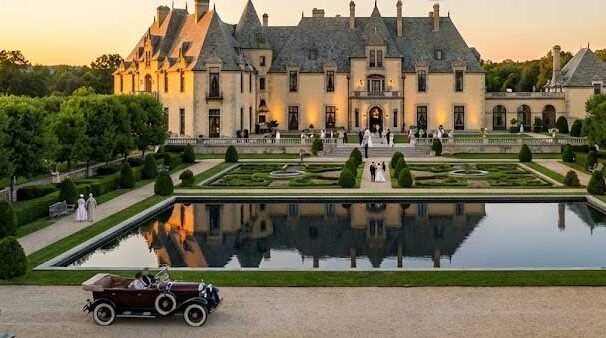
Long before the Hamptons became synonymous with East Coast wealth, before the word ‘estate’ conjured visions of oceanfront glass boxes and hired landscapers, there was the Gold Coast — a stretch of Long Island’s North Shore so saturated with ambition, capital, and architectural grandeur that F. Scott Fitzgerald used it as the moral backdrop for the twentieth century’s most enduring novel. And of all the palatial homes that once rose from its hills, none was more deliberate, more defiant, or more enduring than Oheka Castle.
Standing on the highest natural point on Long Island — a hill that Otto Hermann Kahn himself spent two full years constructing — Oheka is not merely a monument to wealth. It is a monument to refusal. To the refusal to be diminished, excluded, or rendered invisible by the social machinery of early twentieth-century America. That this 127-room, 109,000-square-foot French château still stands, hosting weddings and welcoming guests on the same grounds where royalty once arrived via private airstrip, is itself a testament to something deeper than architecture. It is a testament to the enduring power of vision against exclusion.
Otto Hermann Kahn: The King of New York Who Built His Own Kingdom
Born in 1867 in Mannheim, Germany, Otto Kahn arrived in the United States with a financial mind so precise and a cultural sensibility so refined that he would eventually be called, without irony, ‘the King of New York.’ Working through the investment firm Kuhn, Loeb & Co., Kahn became one of the most powerful financiers in American history, reorganizing the finances of the nation’s largest railroad systems — the Union Pacific, the Missouri Pacific, the Baltimore and Ohio — with a composure that impressed even the formidable E.H. Harriman.
But Kahn’s ambitions were never purely financial. He was a lifelong patron of the arts who helped transform the Metropolitan Opera into a world-class institution, funded prizes for Black artists during an era of profound racial injustice, and co-founded New York’s Jewish Federation. His son Roger Wolff Kahn would become a celebrated jazz musician and composer, inheriting his father’s love of music — a love that Otto had himself been steered away from in boyhood when his father counseled him toward banking, with the understanding that profits would be used to fund culture. He kept that promise for the rest of his life, earning the nickname ‘Otto the Magnificent.’
His likeness, two years after his death in 1934, would be used as the model for ‘Mr. Monopoly’ — the top-hatted, monocled figure adorning the world’s most famous board game. The irony that a Jewish financier who spent his life being excluded from elite social clubs became the face of capitalism’s most iconic game is not lost on history.
Built in Defiance: The Story Behind the Castle’s Creation
The origins of Oheka are rooted in rejection. When Kahn attempted to join social clubs in Morristown, New Jersey — where he had built his first country estate, Cedar Court — he was denied membership because he was Jewish. When Cedar Court was then destroyed by fire in 1905, Kahn made a decision that would consume nearly a decade and an estimated $11 million dollars (approximately $158 million in today’s currency): he would build something so grand, so fireproof, so architecturally authoritative, that no one could look away.
He purchased 443 acres of potato fields and woodland on Long Island’s Gold Coast, then spent two years — before a single stone was laid — engineering the hill on which the estate would sit. The goal was elevation: literal, symbolic, and social. He commissioned the celebrated architectural firm Delano & Aldrich, responsible for some of the Gold Coast’s most distinguished mansions, to design a French château in the mode of the Loire Valley. And then he turned to the Olmsted Brothers — the landscape dynasty that included Frederick Law Olmsted, the architect of Central Park — to design the grounds.
Landscape architect Beatrix Farrand was subsequently brought in to design a series of garden rooms and an amphitheater south of the grand parterre. The result was a formal axial sunken garden in the French manner — clipped greens, gravel parterres, reflecting pools, and water terraces — screened from the entrance drive by high hedging, creating the impression of entering not a home but a sovereign estate. Golf architect Seth Raynor designed an 18-hole course that wound around the castle and its gardens. There were greenhouses, a working farm and dairy, an indoor lap pool, tennis courts, a racetrack, and a private airstrip. A full-time staff of 126 employees maintained the property and the lives of those within it.
Gatsby’s Shadow: Oheka and the Literature of the American Dream
It has long been acknowledged that F. Scott Fitzgerald drew on the Gold Coast as the geographic and moral setting for The Great Gatsby. The novel’s fictional West Egg and East Egg are recognizable distortions of the real communities that lined the North Shore — communities built by industrialists, financiers, and railroad men who, like Jay Gatsby, understood that in America, the right kind of house could rewrite a man’s biography.
Oheka, with its sweeping formal gardens and its position on the highest point of Long Island, is frequently cited as a partial inspiration for Gatsby’s estate. Whether Fitzgerald ever attended one of Kahn’s legendary parties — events that could host as many as 600 guests, with guests of royal rank arriving by private aircraft while the staff navigated the premises through a network of underground tunnels — is not definitively documented. But the parallels are unmistakable: the Jewish outsider who builds the grandest house, who throws the most lavish parties, who entertains the very society that once closed its doors to him.
Orson Welles drew the connection even more explicitly. In his 1941 masterpiece Citizen Kane, photographs of Oheka’s exterior were used to portray the fictional Xanadu — the decaying palace of the self-made media magnate Charles Foster Kane. The image of power, grandeur, and ultimately, isolation, could not have found a more fitting physical form.
Decline, Ruin, and a Hundred Arson Attempts That Failed
Otto Kahn died in 1934 at the age of 67, and with him died the era of Oheka’s glory. His widow Addie sold the estate to the City of New York, which repurposed it — with a certain lack of imagination — as a retreat for Department of Sanitation workers, briefly renaming it ‘Sanita.’ During World War II it became a training center for Merchant Marine radio operators. In 1948, the Eastern Military Academy purchased the castle and 23 surrounding acres, bulldozed the gardens, subdivided the grand rooms, and painted over the walls.
When the Academy closed in 1979, Oheka stood empty. Over the next four years, more than 100 documented arson attempts were made on the structure — a number that would have reduced most buildings to rubble. But Kahn, who had built in response to fire, had anticipated exactly this. His insistence that Delano & Aldrich design in steel and concrete made Oheka one of the first entirely fireproof private residences in the country. The building survived every attempt. The walls that had been built to outlast social exclusion proved equally resistant to destruction.
In 1984, Long Island developer Gary Melius purchased Oheka and began what would become the most expensive private residential restoration in United States history. The road was not smooth — financing collapsed in 1988, and the property changed hands before Melius reacquired it. In 2014, he was shot three times in the head while sitting in his car outside the castle, an event that made national headlines and added yet another chapter to a story that seemed constitutionally incapable of being ordinary. He survived. Oheka survived. As of July 2025, Melius filed for Chapter 11 bankruptcy protection to prevent a foreclosure sale, listing $63 million in liabilities and $93 million in assets — yet another turn in a saga that has always found a way to continue.
The Architecture of Aspiration: What Oheka Actually Looks Like
To walk the grounds of Oheka today is to understand that Kahn was not simply building a house. He was building an argument. The château’s façade — limestone and concrete, designed in the French Renaissance style — presents an unbroken authority of line and proportion. Thirty-nine fireplaces operated throughout the original structure. The grand staircase rising from the entry foyer was modeled on the Château de Fontainebleau. The ballroom, the dining room, the library — each was calibrated to impress without ostentation, to demonstrate that wealth and culture were not merely compatible but inseparable.
Kahn purchased 4,000 roof slates from the same Vermont quarry — Rising & Nelson Slate Co. — that had supplied the original material. The formal gardens have been restored with 2,505 boxwoods planted around the reflecting pools, 44 London Plane trees in the formal garden (replacing the originals), and 500 red cedars now lining West Gate Drive. Approximately 85 percent of the estate and its gardens have been restored to their original design. The castle is today listed on the National Register of Historic Places and is a member of Historic Hotels of America, the official program of the National Trust for Historic Preservation.
The OHK Bar & Restaurant, operating within the castle today under Executive Chef Raed Jallad and sommelier Samantha Bellando, continues the estate’s tradition of curated hospitality — a culinary program designed to match the gravity of the space that contains it.
Oheka in Culture: From Citizen Kane to Succession
Few private estates have accumulated a cultural biography as dense as Oheka’s. Beyond its role as partial muse for Fitzgerald and visual stand-in for Xanadu in Citizen Kane, the castle has served as the fictional ‘Shadow Pond’ in the USA Network series Royal Pains, which ran from 2009 to 2016. HBO’s Succession — perhaps the defining television portrait of dynastic American wealth in the twenty-first century — also used Oheka as a backdrop, lending its stone corridors and manicured grounds to a story about the collapse of inherited power.
R&B singer Brandy filmed her 1995 music video ‘Brokenhearted,’ directed by Hype Williams and featuring Wanya Morris, inside the castle’s interiors. Countless fashion shoots, editorial spreads, and celebrity weddings have followed. The castle has been voted the number one most unforgettable wedding venue by WE TV — a distinction that would have deeply amused Otto Kahn, who hosted his daughter Maud’s wedding in the Grand Ballroom in 1920, making her the estate’s first bride.
Visiting Oheka Today: What to Expect
Oheka Castle is located at 135 West Gate Drive, Huntington, NY 11743. The estate operates as a luxury hotel with 32 guest rooms and suites, a full-service restaurant and bar, and one of the most celebrated wedding and event venues on the East Coast.
The castle is approximately 50 miles east of Midtown Manhattan via the Long Island Expressway. For reservations, dining inquiries, and event bookings, visit oheka.com or call (631) 659-1400. The Friends of OHEKA, a not-for-profit organization, continues to advocate for the estate’s preservation and public awareness — information available at friendsofoheka.org.
Worth noting for the serious enthusiast: the castle’s underground tunnel system — extended and cleared under Melius’s ownership, reportedly reaching as far as Cold Spring Harbor — remains one of its more dramatic architectural features, a reminder that even in the age of lavish entertaining, the machinery of a great house preferred to operate out of sight.
What Oheka ultimately represents is not the excess of the Gilded Age but its contradiction. Here was a man denied entry into the rooms of his social peers who responded not with retreat but with construction — who looked at 443 acres of Long Island farmland and decided that the answer to exclusion was to build something the excluders could not ignore, could not destroy, and could not outlast. He succeeded on every count. The clubs that barred him are gone. The prejudices that shaped those decisions have been, if not vanished, at least publicly disgraced. And Oheka stands, restored to something approaching its original grandeur, welcoming guests who arrive not by private airstrip but by memory, curiosity, and the persistent human desire to stand inside a place where something extraordinary once happened and still does.
There is a lesson in stone here, if one is willing to read it: that what is built with genuine conviction — built to last, built to matter, built with the care of someone who has something to prove — has a way of outlasting everything that was built merely to impress. Otto Kahn knew this. The castle proves it still.
Sources
Wikipedia — Oheka Castle: https://en.wikipedia.org/wiki/Oheka_Castle
Historic Hotels of America — History of Oheka Castle: https://www.historichotels.org/us/hotels-resorts/oheka-castle/history.php
World History Encyclopedia — Oheka Castle: https://www.worldhistory.org/article/1767/oheka-castle/
The Times of Israel — ‘Facing 1900s New York Anti-Semitism, a Banker Built This Castle’ (2020): https://www.timesofisrael.com/facing-1900s-new-york-anti-semitism-a-banker-built-this-castle-you-can-visit/
Oheka Castle Official Website — History: https://www.oheka.com/history.htm
Friends of OHEKA — OHEKA & Friends: https://www.friendsofoheka.org/oheka-and-friends
The Cultural Landscape Foundation — Oheka Castle: https://www.tclf.org/oheka-castle
Town of Huntington, NY — Oheka Castle: https://huntingtonny.gov/content/13747/99530/16521/default.aspx