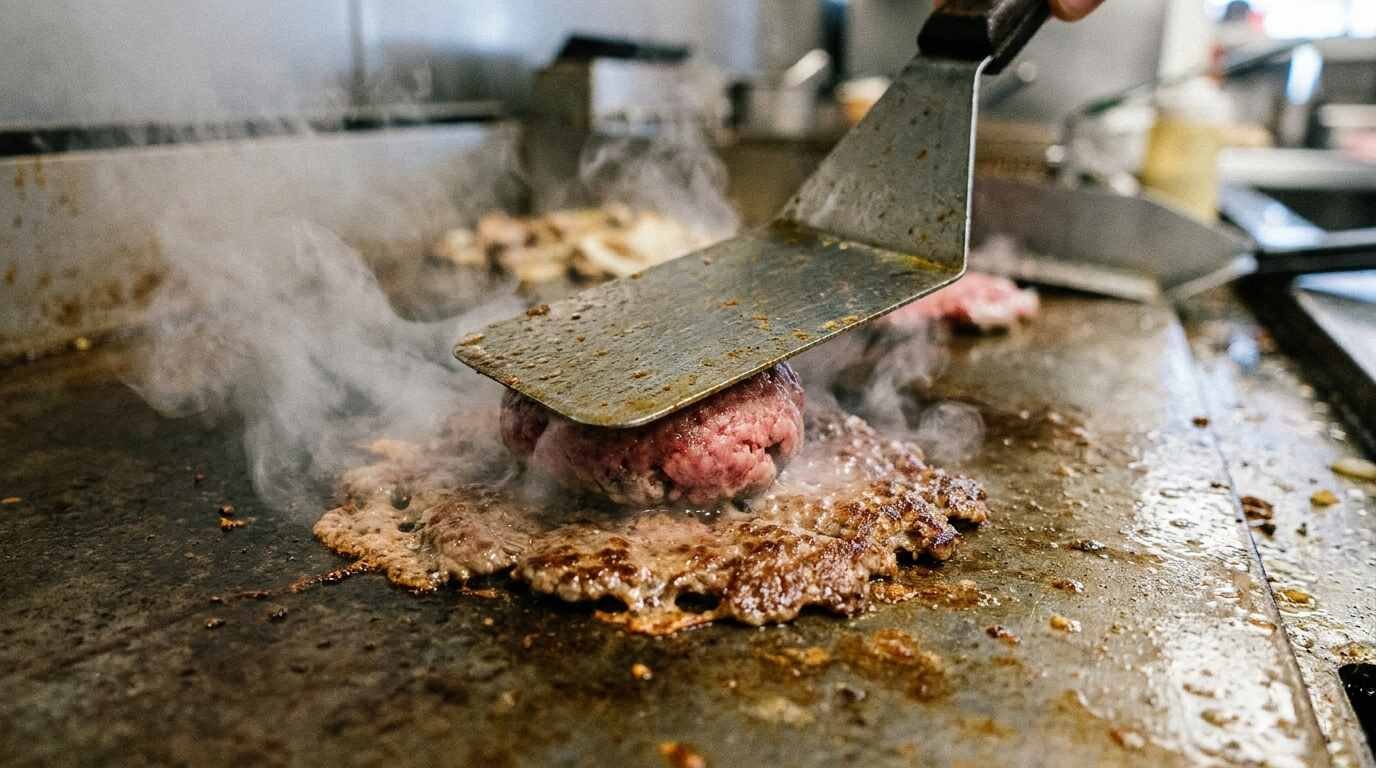
The internet is at war over burger geometry. Out here we’re just trying to get a good crust.
The Burger Civil War Playing Out in Your Comments Section
Food TikTok in spring 2026 is doing what it does: taking something people have cooked for generations, framing it as a discovery, and turning the discovery into a conflict. The smash burger versus the stacked burger is the current field of battle. Video after video, side-by-side cook-offs, callout posts, “I tried both and here’s the verdict” content from people who learned to cook on the internet and are now adjudicating one of the oldest technical questions in the American kitchen.
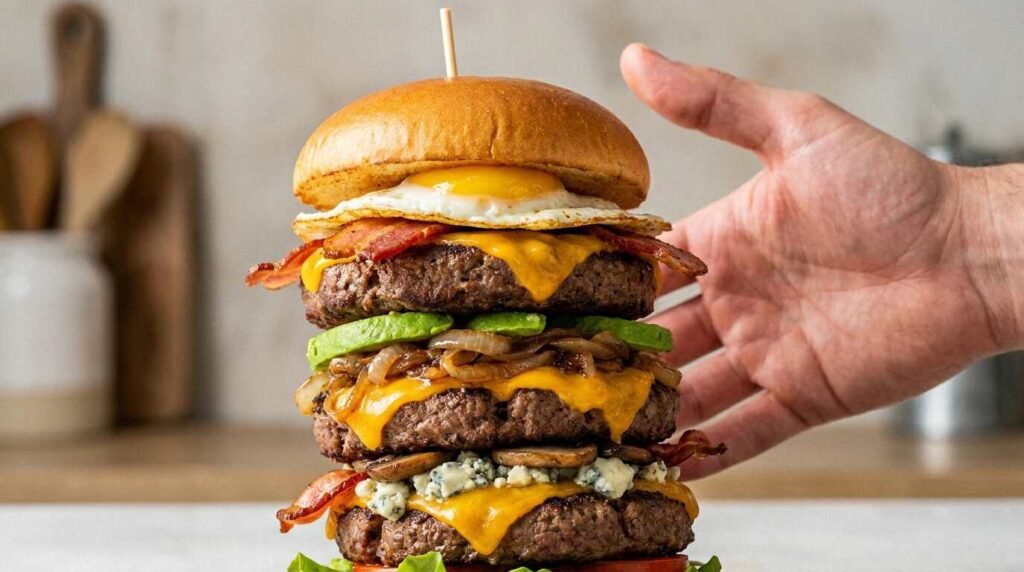
The blog Time for Burgers, which covers burger culture with more seriousness than the genre typically gets, laid out the stakes clearly: “If smash burgers represent technique perfection, the Burger Stack Challenge represents pure, unapologetic excess.” Their read on the stack — at least five patties, structural chaos, filmed eating as performance — is accurate. The smash side is framed as disciplined, technical, almost religious. The stack side is maximalism as spectacle. Both of these things existed before TikTok. Neither camp seems to know that.
What’s real: the smash burger moment has genuinely blown up. The hashtag #smashburger has pulled millions of views in 2026. Menus across the country have been quietly rewritten around it. One article from a food industry trade outlet put it plainly: “In 2026, the menu is a feed.” Restaurants are designing plates for the camera. The smash burger films beautifully — you see the beef hit the griddle, the spatula come down, the edges lace up and crisp. It’s tactile through a screen. The stack does something different: it films as scale, as absurdity, as challenge. Both are content formats that happen to also be food.
What a Smash Burger Actually Is — and Isn’t
Let me strip the content layer away and explain the technique, because most of the TikTok debate conflates method with myth.
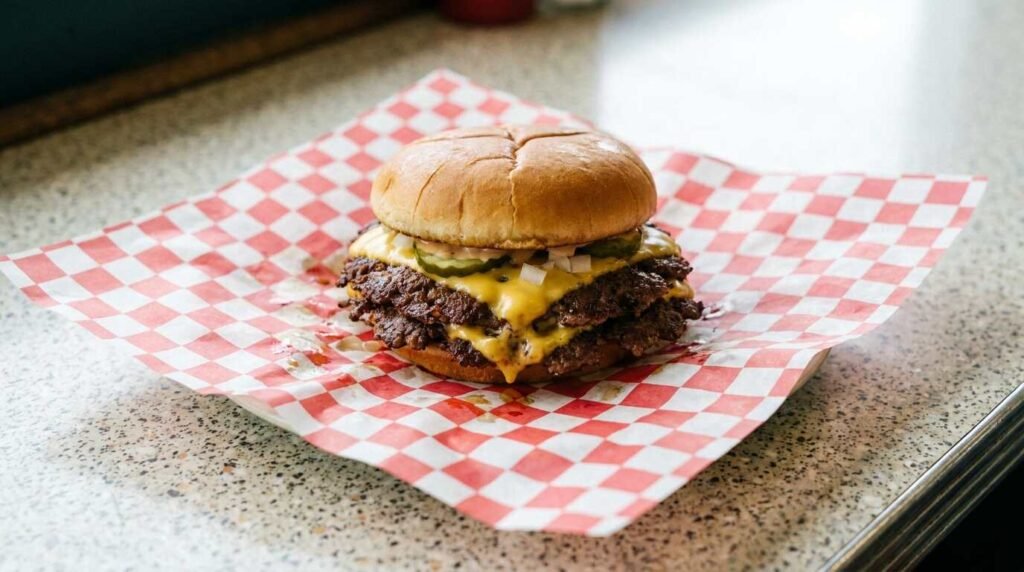
A smash burger is ground beef — typically a loose ball of 80/20 — pressed hard and fast onto a screaming-hot flat-top or cast iron surface. The pressure and heat do two things simultaneously. First, they maximize surface contact, which means more of the meat is in direct contact with the cooking surface at once. Second, and this is the part that matters most: that contact drives the Maillard reaction hard and fast across the widest possible area. The edges go dark and crispy. The fat renders immediately. The moisture that would otherwise steam the patty from the inside gets driven out and replaced with crust.
The Maillard reaction isn’t a trend. It’s a hundred-and-something-degree chemistry event named after a French chemist. It’s why bread browns. It’s why a sear smells like that. It is, in practice, the whole reason cooking over high heat tastes better than boiling.
The technique isn’t new. It traces to Depression-era Oklahoma, where thin-smashed burgers were a way to stretch beef and maximize the griddle. Shake Shack built a modern chain on a version of it. Home cooks on TikTok “discovered” it around 2021 and have been taking credit ever since. The smash itself didn’t change. The ring light did.
The Stacked Burger Isn’t New. It’s Just Taller.
The “Burger Stack Challenge” — multiple patties, multiple cheese slices, architectural ambition, structural failure — is content that has existed in some form since the YouTube era. The format is: make something too big to eat normally, film yourself eating it, watch the views come in. It’s the same logic as the food challenge genre that’s been running since the early 2010s. TikTok sped it up and made it prettier.
But behind the spectacle, there’s a legitimate cooking question: does a thick patty produce a better burger than a smashed one?
Honestly? It depends on what you’re going for. A thick, properly cooked 8-ounce patty — medium-rare in the center, good sear on the outside — has textures a smash burger can’t replicate. You’re getting a range from pink and yielding at the center to caramelized at the crust. That’s a different experience than two thin smashed patties with cheese melted between them. Neither is wrong. They’re different architectures producing different results. A diner serves both. A flat-top can do both. The “war” is manufactured.
Twenty-Five Years at the Flat-Top Taught Me This
I’ve been cooking burgers on a commercial flat-top since 2000. Before that I was eating burgers at my parents’ kitchen table in Brooklyn, where the question of format never came up because my mother’s cooking didn’t have a content strategy.
What I know from twenty-five years behind a counter: the beef matters more than the method, the heat matters more than the tool, and the window between undercooked and overcooked is about ninety seconds of your full attention. Every burger debate on the internet is really a debate about control — about which technique gives you more command over the outcome. The smash partisans are right that more surface contact means more crust. The stack defenders are right that thickness gives you a margin for moisture. Both are correct about their preference and wrong to make it universal.
The burger I’m most proud of at the Heritage Diner isn’t technically complicated. It’s good beef, properly heated surface, seasoned right, not fussed over. The bun matters. The cheese matters. What doesn’t matter is whether it was formed by gravity or force.
If you want to go deeper on how the flat-top handles different proteins and techniques, my piece on what the flat-top does to a diner egg covers the temperature science in detail. The same surface, the same principles.
Format Is Politics. Taste Is Truth.
Here’s what the burger war is actually about, and I say this without mockery because it’s a real and interesting cultural phenomenon.
Food TikTok has turned cooking preference into identity. Smash burger people are a tribe. Stack people are a tribe. The debate generates content. The content generates engagement. The engagement generates more content. The underlying question — which burger do you actually like to eat, alone in your kitchen, without filming it — gets lost in the discourse.
This is what happens when food leaves the domain of appetite and enters the domain of aesthetics. The burger stops being a thing you’re hungry for and becomes a position you’re holding. Wheon, a food-industry site tracking TikTok trends in 2026, put it well: “TikTok-native food businesses are pulling away from everyone else.” The camera is rewriting the menu faster than the palate is.
What a diner offers — and what diners have always offered — is a place where the camera isn’t the point. You sit down. You order. You eat what you ordered, ideally while it’s still hot. The feedback loop is direct: you liked it or you didn’t. No comments section. No algorithm. Just the thing itself.
The burger format war will resolve when TikTok moves to the next debate. The flat-top will still be there. The answer will still be the same. Good beef. High heat. Pay attention.
You Might Also Like: Why Smithtown Diners Outlived Every Chain That Tried to Replace Them | The Naugahyde Booth: Working-Class Diner Seating and What It Says About Postwar America
Sources
- Time for Burgers — Social Media & Viral Burger Trends: How TikTok and Instagram Are Reshaping Burger Culture (November 2025): https://timeforburgers.com/posts/social-media-viral-burger-trends
- Thirstybear.com — Smash Burger Recipe: The Trending Technique (April 2026): https://www.thirstybear.com/smash-burger-recipe/
- Wheonx.com — TikTok Food Trends Dominating Restaurant Menus in 2026: https://wheonx.com/tiktok-food-trends-dominating-restaurant-menus-in-2026/
- Woke Waves — How TikTok Food Trends Are Changing Restaurant Menus Worldwide (March 2026): https://www.wokewaves.com/posts/tiktok-food-trends-changing-restaurants
- Burger Divas — The Great Patty Debate: Smash vs. Stacked (October 2025): https://www.burgerdivas.com/post/the-great-patty-debate-smash-vs-stacked