Hunger makes philosophers of everyone. When the stock market crashed in October of 1929 and the decade that followed stripped millions of Americans down to the bone — no savings, no work, no meat on the table — something remarkable happened on the south shore of Long Island. People walked to the water. They pulled on boots, grabbed rakes, and waded into the shallows of the Great South Bay to do what their Shinnecock neighbors had done for ten thousand years before them: they dug for clams.
What emerged from those tidal flats and shoreline kitchens wasn’t just a survival dish. It was a masterwork of necessity — the Long Island clam pie. At its most stripped-down, it required flour, lard, potatoes, onions, and whatever hard-shell clams the bay had to offer that morning. No butcher’s bill. No ration card. Just the bay, a bull rake, and the kind of cooking intelligence that only scarcity teaches.
This is a story about that dish — where it came from, what it meant to eat it, what the Great South Bay gave to the people who needed it most, and why a pie born in desperation deserves a permanent place on the American culinary canon.
Before the Crash: A Bay That Fed Empires
Long before European settlers arrived on Long Island in the 1640s, the Shinnecock people — whose name translates to “people of the stony shore” — had built an entire civilization around the shellfish of the South Shore. For at least 10,000 years, the “People of the Stony Shore” gathered fish, mussels, scallops, and clams, and cultivated oyster gardens along a vast stretch of land and waters on and around what is now called Long Island. The quahog clam — the same hard-shell variety later baked into Depression-era pies — was so central to Shinnecock culture that it served as the raw material for wampum, the beaded currency of the northeastern tribes. They were a sea-faring people noted for their manufacture of beads from the Northern quahog clam and whelk shells called wampum, used by many Indians as currency, in trade, and for recording important events on ceremonial belts.
By the colonial era, that same bay had become the economic engine of the entire state. The Great South Bay earned a staggering reputation: at its peak in the mid-twentieth century, the Great South Bay produced half the clams eaten in the United States. The Doxsee Clam Company, founded in Islip in 1865, processed and shipped Long Island clams to New York City markets and beyond — advertising not just the clam meat but clam juice, believed at the time to have medicinal value. The bay was so abundant that the term “clam digger” — meant as a slur by New Yorkers looking down their noses at Long Islanders — was worn on the South Shore like a badge of honor. In 1975, more than 675,000 bushels of hard clams were harvested from Great South Bay alone, and there were more than 8,000 licensed baymen.
These were waters that could feed a nation. And when that nation fell into economic ruin, they did exactly that.
What the Depression Did to the American Table
The Wall Street collapse of 1929 rewrote American food culture overnight. Meat was more of a scarcity and was not served at every Depression meal. When used, it was often combined with potatoes, onions, rice, macaroni, biscuits, and other extenders. Breadlines stretched around city blocks. Soup kitchens became the architecture of daily survival. Peanut butter bread, bean soup, dandelion green salads, and Depression cake — made without butter, milk, or eggs — filled plates across the country.
But geography determined destiny. Those who lived inland, far from forests or waterways, faced a different kind of scarcity than those who lived on the water. Families living near hunting and fishing sources were able to supplement their Depression-era diets with highly desirable meat sources. And on Long Island’s South Shore, where the Great South Bay stretched wide and accessible, the supplemental protein didn’t require a gun or a license or any money at all. It required a rake, a bucket, and the willingness to stand knee-deep in saltwater.
Clams were, in the brutal arithmetic of the Depression kitchen, almost free. The poorest able-bodied man could rake and shuck clams, one of the most abundant foods. Like bluefish and pancakes, clam pie allowed a housewife to feed a family with little more than flour, lard, and readily available seafood. The social stigma that existed in parts of New England — where clams were considered food fit only for the destitute — never took hold on the East End. Here, eating what the bay gave you wasn’t embarrassing. It was common sense. It was survival wrapped in pastry.
The Dish Itself: Architecture of Necessity
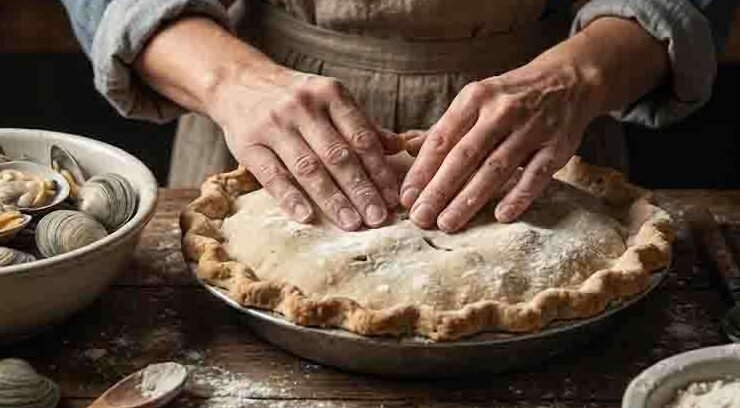
The Long Island clam pie is a study in restraint. Its structure follows the logic of a larder running low: a simple shortening or lard-based crust encasing a filling of chopped hard-shell clams, diced potatoes, and onion, bound with milk, clam broth, and sometimes a beaten egg. In winter, that was the whole equation. In summer, when kitchen gardens were flush, a cook might expand the filling with tomatoes or fresh herbs.
Clam pie isn’t just one thing — and that’s because it’s mostly a dish of access. In winter, it’s a larder dish, comprising what you have on hand: potatoes, salt pork or bacon, dried herbs, onions, milk, a little water. The recipe was never written in stone because it was never intended to be. It was written in whatever the pantry had left.
A 1948 recipe preserved by the Ladies Village Improvement Society of East Hampton — compiled in a 300th anniversary cookbook marking the founding of the town — offers a window into the Depression-era version: one cup of finely chopped clams, a beaten egg, three-quarters of a cup of milk, a splash of clam broth, dry mustard, chopped parsley, a dash of pepper, and butter. Baked between two crusts at 350 degrees for an hour. A cream sauce on the side, if circumstances allowed.
By the late 1930s, there were more than a handful of iterations, including a recipe from the Rattray family using soft and hard clams and fresh parsley, a recipe from Mrs. William Conrad with minute tapioca and crumbled milk crackers, presumably for texture, and a pie served with a decadent cream sauce on the side, lingering Depression notwithstanding.
The variations read less like creative expression and more like a record of what each household had on hand — and what they were willing to substitute when they didn’t. Tapioca for thickening instead of cream. Crumbled crackers for texture when milk was scarce. The pie adapted itself to whoever was making it, which is the mark of a dish that belongs to a place, not to a recipe book.
The Bonacker Culture and the Micro-Regional Dish
The center of clam pie culture on Long Island was the East Hampton community known as “Bonackers” — the descendants of those original British settlers who had arrived in the seventeenth century and built their lives in direct relationship with the bay. These were clamming families, fishing families, families for whom the South Shore was not a vacation destination but a working landscape that demanded respect and reciprocity.
Of all the dishes associated with the East End, including sweet corn, Peconic Bay scallops, and Long Island duck, the sometimes joke-inspiring clam pie might qualify best as a recipe that tells a story about the area’s culinary heritage.
Food historian Sandra Oliver, author of Saltwater Foodways, points to something important here. While dozens of seafood pie variations existed in eighteenth-century New England cookbooks — oyster pie, lobster pie, cod pie — clam pie appears to be a distinctly Long Island phenomenon. Around northern New England, there was a bit of embarrassment associated with eating clams, considered worthy only for Indians, for baiting cod hooks, or for people who couldn’t afford anything else. Long Island rejected that embarrassment wholesale. The clam was not a poor man’s protein. It was the bay’s gift, and on the East End, you did not refuse gifts from the water.
East Hampton bayman Albie Lester learned his clam pie recipe by watching his grandmother make it — and she would use the extra pastry dough from the crust to roll cinnamon buns, wasting nothing. That detail — the cinnamon buns born from the leftover scraps — might be the most Depression-era sentence in all of Long Island food history.
The Bay as Provider: A Relationship Deeper Than Hunger
To understand the clam pie as a Depression food, you have to understand what the Great South Bay represented to Long Islanders — not as a resource to be extracted, but as a living system they depended on and largely understood. The Shinnecock had stewarded those waters for millennia. The baymen who came after them inherited, however imperfectly, a knowledge of the tides, the clam beds, the seasonal rhythms of a bay that gave generously when treated with care.
Clamming and oystering reached their peak during the nineteenth and early twentieth centuries. The bay was renowned for its hard clams, often referred to as “quahogs,” which were harvested in vast quantities. By the time the Depression arrived, that abundance had been built up over centuries. The bay was not a food pantry that could be raided indefinitely — something Long Islanders would learn painfully in the decades that followed — but in the 1930s, it was full enough to absorb the pressure of families who had nowhere else to turn.
Clams didn’t require refrigeration in the winter. They could be kept alive in cold water. They were high in protein, iron, and B vitamins — nutritional facts the Depression-era cook didn’t have access to in clinical terms but understood intuitively through the vitality they felt after a bowl of clam chowder or a slice of clam pie still warm from the oven. The pie, in that sense, was not just food. It was medicine. It was morale.
What the Clam Pie Tells Us Now
The Long Island hard clam was once the greatest fishery in the history of New York State. In the 1970s, two out of three hard clams eaten in the United States came from Long Island. That era is gone. Overharvesting, development, nitrogen runoff from hundreds of thousands of cesspools and septic systems, and the resulting brown tides collapsed the Great South Bay clam population by more than 99% from its 1970s peak. The baymen who once numbered in the thousands dwindled to a few hundred. The bay that fed Depression-era families through sheer abundance became a cautionary tale about what happens when a region forgets its relationship with the water that sustained it.
But the story doesn’t end there. Scientists at Stony Brook University, working with the Nature Conservancy and the Shinnecock Kelp Farmers — who have been restoring shellfish to those same waters their ancestors cultivated for ten thousand years — have documented a 1,700 percent increase in hard clam populations in Shinnecock Bay since restoration began. The bay can come back. It is coming back.
The clam pie, in this context, is more than culinary nostalgia. It is a document of what Long Island was capable of — a self-sufficient, bay-connected food culture that could feed itself in the worst economic catastrophe in American history without trucking in a single ingredient from outside. Flour, lard, potatoes, onions, clams, and a hot oven. That was the Depression-era equation, and it held.
A Recipe Worth Reviving
Reviving the clam pie in 2025 isn’t an act of poverty tourism. It’s an act of reclamation — of a local food culture, of a relationship with the bay, of a cooking intelligence that valued craft and seasonality over convenience and cost. The dish that sustained South Shore families through the 1930s is, by any modern culinary standard, exceptional: deeply savory, textured by potato and onion, with the brininess of fresh clam broth permeating every layer of a short, lard-based crust.
The 1948 L.V.I.S. recipe still works. A lard crust, because lard makes a more honest pastry than butter for this kind of coastal savory pie. Hard-shell littleneck or cherrystone clams, chopped fine. Potato, milk, a little clam broth, dry mustard for depth, fresh parsley for brightness. An hour in a moderate oven. A cream sauce on the side if you’re feeling generous.
What it asks of the cook is attention, not expense. What it gives back is a connection to a place and a history that most Long Island food culture has largely forgotten — a dish that began in a tidal flat and ended on a kitchen table, built entirely from what the Great South Bay, in its generosity, chose to give.
Sources:
- Edible Manhattan — “Eat Drink Local Profile #32: Clams” (ediblemanhattan.com)
- The East Hampton Star — “Deep-Dish Bonac: A Social History of Clam Pie” (easthamptonstar.com)
- Slow Food — “World Food: The Pleasures and Past of the Bonac Clam Pie” (slowfood.com)
- The Fisherman — “The Great South Bay: From Bountiful Waters to a Conservation Challenge” (thefisherman.com)
- Stony Brook University News — “Scientists Recover Collapsed Clam Population and Water Quality in Shinnecock Bay” (news.stonybrook.edu)
- The Nature Conservancy — “Turning the Tide: Shinnecock Women Kelp Farmers” (nature.org)
- Encyclopedia.com — “Food 1929–1941” (encyclopedia.com)
- Native American Rights Fund — “Exercising Shinnecock Nation Fishing Rights” (narf.org)
- NY Seafood Council via nyangler.com — Great South Bay clam harvest statistics (nyangler.com)