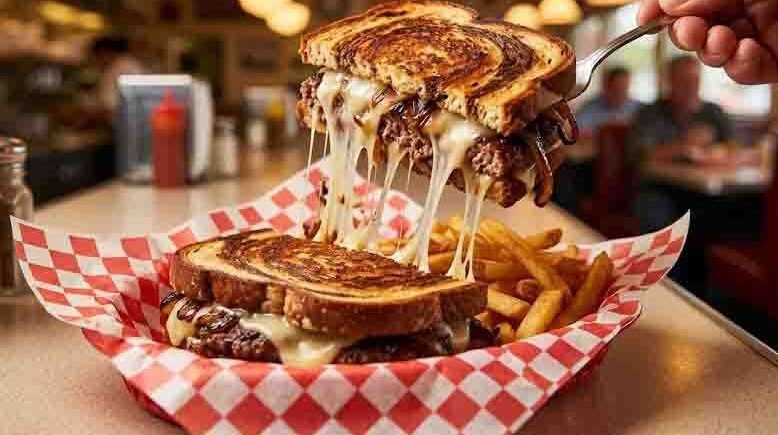
Few sandwiches hit the way a good patty melt does. It’s not quite a burger, not quite a grilled cheese — it’s both, pressed together on a hot griddle until the bread goes golden, the cheese gets gooey, and the onions practically melt into the beef. Done right, it’s one of the best things a diner kitchen can produce. Done wrong, it’s a soggy mess with rubbery onions and cheese that never really melted.
The difference between the two comes down to a few simple things most people skip.
Where It Came From
The patty melt has been a diner staple since the late 1940s. Most food historians point to a California restaurateur named Tiny Naylor — owner of a short-order chain in Los Angeles — as the guy who put it together first. His version was straightforward: a beef patty on rye bread with Swiss cheese and caramelized onions, griddled flat. His son Biff spread it across their family’s restaurant group and the sandwich took off from there.
It never really changed. No reinvention needed. The original formula still works.
The Onions Are the Hard Part
This is where most people cut corners, and it shows. You cannot rush caramelized onions. The recipes that say “10 to 15 minutes” are lying to you. Real caramelized onions take 40 minutes, minimum, over medium-low heat. That’s the truth.
What’s happening when you slow-cook onions is pretty remarkable. Raw onions are mostly water — about 89% — with natural sugars locked up inside. As the heat builds, that water evaporates, the sugars release, and the onions start to brown. The color change happens because sugar and amino acids react to heat, producing hundreds of new flavor compounds in the process. That’s why properly done onions taste sweet, savory, nutty, and rich all at once. It’s not one thing happening — it’s dozens of things at the same time.
To do it right: slice your onions thin, start them in butter over medium-low heat, add a pinch of salt early. Stir them every few minutes but let them sit between stirs so they get actual contact with the pan. If they start to stick and darken at the bottom, splash in a little beef broth or white wine and scrape it up — that adds flavor too. After about 40 minutes they should be deep golden brown, soft, and jammy. That’s what you want on a patty melt. Not pale, not barely golden — dark, sweet, and concentrated.
The Beef: Keep It Simple
Use 80/20 ground beef — that’s 80% lean, 20% fat. The fat is what keeps the patty juicy and gives it flavor. Lean beef makes a dry patty, and a dry patty on a patty melt is a disaster.
Shape the patty thin and flat, roughly the same shape as your bread slice. This isn’t a thick burger — it’s a flat patty that cooks through fast and keeps the whole sandwich balanced. Season with salt, pepper, and a little Worcestershire. Handle the meat as little as possible when shaping it so it stays tender.
Cook on a cast iron pan or griddle over medium-high heat. Let it sit without touching it for a few minutes until a proper brown crust forms, then flip once. You’re aiming for just cooked through. For a thin patty, that’s about three minutes per side on a hot surface. Pull it and don’t wipe the pan — the leftover bits in there will flavor your bread when you griddle the sandwich.
Why Swiss Cheese Works
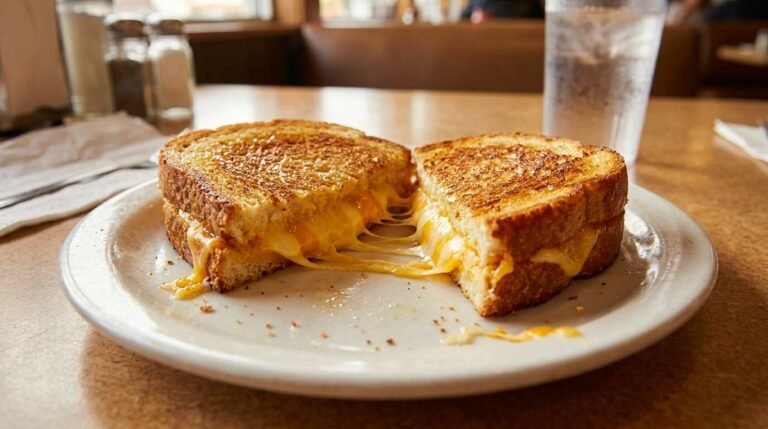
Swiss cheese is the traditional choice and it earns the spot. It melts smooth and stretchy rather than oily or clumpy. That has to do with how it’s aged — the process breaks the proteins down in a way that lets them melt evenly without separating into a greasy puddle. Skip the pre-sliced packaged stuff if you can. Get it cut at the deli counter, sliced a little thicker than standard. Two slices per sandwich — one against each piece of bread — so the cheese melts from both sides toward the middle.
The Assembly
Layer it: Swiss cheese on the bread, then the beef patty, then the caramelized onions, then another slice of Swiss against the top bread. Butter the outside of both bread slices and lay the whole thing down on a medium-low griddle. Press it gently. Two to three minutes per side until the bread is deep golden and the cheese is fully melted through. Don’t rush this on high heat — you’ll burn the bread before the cheese melts.
Cut it diagonally and serve immediately. The cheese pull happens in that first thirty seconds while everything is still hot.
At The Heritage Diner, we’ve been making patty melts for twenty-five years. The menu evolves, the ingredients change with the seasons, but the patty melt stays the same. Because it was already right.
Visit us at 275 Route 25A, Mount Sinai, NY — heritagediner.com
Sources:
- Colony Diner: What Is a Patty Melt? (2023)
- Chowhound: How the Patty Melt Became a Beefy Diner Staple (2024)
- National Onion Association: Faster Caramelized Onions with Baking Soda (2018)
- Beef It’s What’s for Dinner: Classic Beef Patty Melt
- The Kitchn: Classic Patty Melt Recipe (2025)