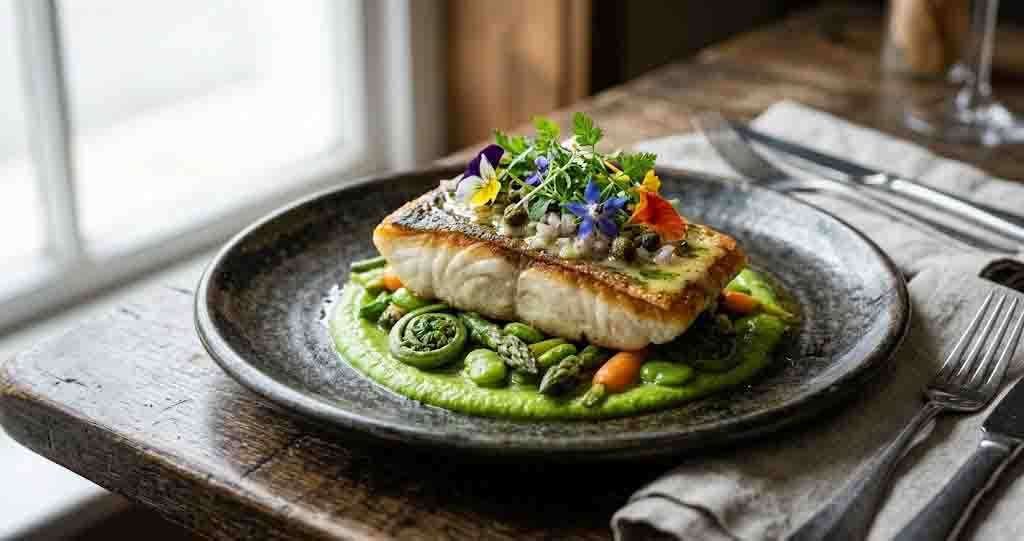
Forget the sauce for a moment. Set aside the edible flowers, the fiddlehead ferns, the bright smear of pea purée underneath. Strip the plate down to its foundation and you’ll find the whole argument resting there: a piece of fish, seared skin-down in a hot pan, achieving something that looks simple and is anything but.
That golden crust — lacquered, crackling, architecturally precise — is the result of a hundred small decisions made correctly in sequence. And if even one of them is off, the whole thing collapses.
That’s the story worth telling.
Why Most Home Cooks Get It Wrong
Pan-searing fish is one of those techniques that looks effortless on a plate and feels catastrophic in the kitchen — at least the first dozen times. The fish sticks. The skin tears. The flesh falls apart before you can get a spatula under it. You end up with something gray and steaming instead of bronze and crisp.
The culprit is almost always the same: moisture, heat, or timing — usually all three.
Fish, unlike chicken or red meat, carries significant surface moisture. That moisture, when it hits the pan, creates steam. Steam is the enemy of a sear. Instead of browning, the fish braises in its own liquid, turning the skin soft and the flesh chalky. The fix is straightforward but requires discipline: pat the fish completely dry with paper towels, season it, and let it sit uncovered in the refrigerator for at least thirty minutes before cooking. This draws additional moisture to the surface, which you then blot away. It sounds obsessive. It works.
The pan temperature is the second variable most people misread. Cast iron or stainless steel — not nonstick — should be preheated over medium-high heat until it’s genuinely hot before any fat goes in. When you add the oil and it shimmers immediately, moving fast across the surface, you’re ready. That’s the window. A cold pan means stuck fish. A pan that’s too cool the moment the fish hits means the same result.
The Science Behind the Crust
What you’re chasing with a hard sear is the browning of proteins and sugars at the surface of the fish — a reaction that begins around 280°F and accelerates above 300°F. At that temperature, the surface moisture evaporates almost instantly, and the skin begins to contract and crisp rather than steam and soften.
This is why pressing the fish gently into the pan in the first thirty seconds matters. As the skin heats, it tightens and curls, lifting the center away from the surface. A gentle press with a fish spatula keeps contact even and consistent. You’re not forcing anything — you’re just maintaining the relationship between the skin and the heat long enough for the crust to set.
Once the crust sets, the fish will release on its own. This is the rule professionals live by: if it’s sticking, it’s not ready to flip. Wait. The pan is telling you something. Listen to it.
Choosing the Right Fish
Not every fish sears equally well. The best candidates share a few traits: firm flesh that holds together under high heat, skin that crisps rather than dissolves, and enough fat content to stay moist through the cooking process.
Halibut, striped bass, branzino, black sea bass, and salmon are the workhorses of the pan sear. Each behaves slightly differently. Salmon has enough internal fat to be forgiving — it can handle a degree or two of overcooking without turning to chalk. Halibut is leaner and less forgiving; the window between cooked and overdone is narrow, measured in minutes. Branzino and black sea bass have thin, delicate skin that crisps beautifully but requires a lighter touch.
Whatever the fish, the principle holds: dry surface, hot pan, skin-down first, patience.
Building the Plate Around the Protein
The image that inspired this post — a thick fillet of white fish, seared to a deep golden crust, plated over a vivid green purée with spring vegetables, capers, and edible flowers — is a study in restraint. Every element earns its place.
The pea purée isn’t decoration. It’s acidity and sweetness in concentrated form, a counterweight to the richness of the seared fish. The fiddlehead ferns and asparagus tips add texture and a slightly bitter edge that keeps the palate from going soft. The capers bring a briny punch. The edible flowers are last — color, delicacy, a signal that the cook cared about the whole picture, not just the protein.
This is how you build a composed plate: start with the protein, understand its flavor profile, and work outward from there. Every component should either contrast or complement what the fish brings. Nothing should compete with the crust.
The Finishing Move: Basting
Professional cooks finish a pan-seared fish with basting, and it’s worth adopting at home. Once the fish is flipped — or kept skin-down throughout if you prefer — tilt the pan slightly and add a knob of butter, a crushed garlic clove, and a few sprigs of thyme. As the butter foams, use a spoon to continuously ladle it over the flesh. This adds flavor, moisture, and a glossy finish that no amount of sauce can replicate.
The process takes ninety seconds. It transforms a good sear into a great one.
What the Plate Is Really Saying
There’s a version of cooking that performs for the camera — stacked high, heavily sauced, engineered for a scroll-stopping photograph. And then there’s cooking that performs for the person sitting across the table, where the goal is a single moment of recognition: this is exactly right.
The pan-seared fish is that second kind of cooking. It doesn’t ask for your attention. It earns it — through technique, through restraint, through the quiet confidence of a crust that says everything it needs to say before the fork even touches the plate.
That’s the standard worth chasing. Not perfection for its own sake, but precision in service of something real.