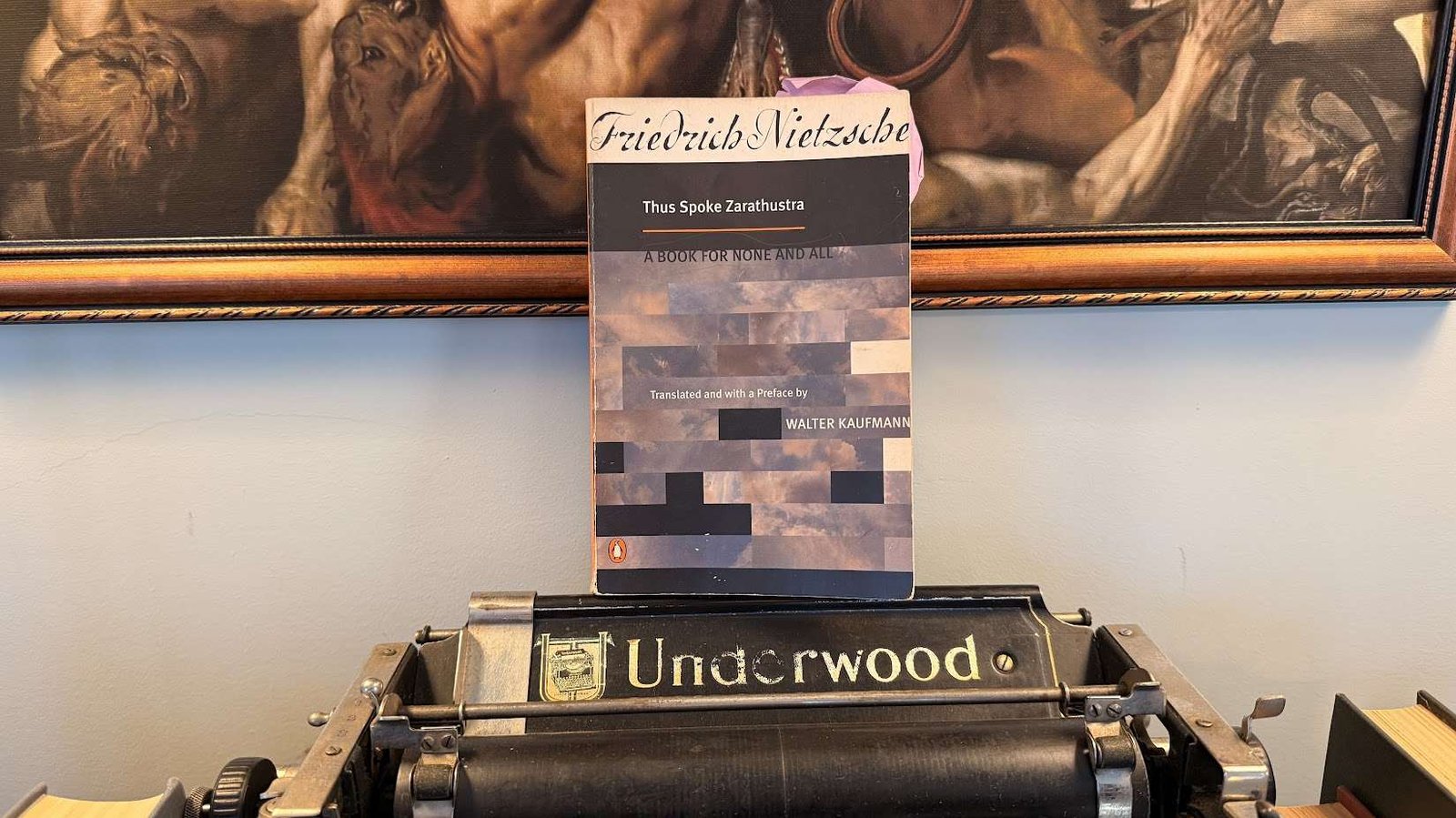
Most people, when asked to name the single most influential book they have ever read, will say the Bible. I understand that answer. I respect it. The Bible has shaped civilizations, toppled empires, built cathedrals, and given billions of human beings a framework for suffering, hope, and meaning. It is arguably the most consequential text in human history. But when someone asks me that question — and they have, many times, over decades — my answer is different. My answer has always been Thus Spoke Zarathustra by Friedrich Nietzsche.
I first picked up Nietzsche as an undergraduate studying philosophy at C.W. Post, Long Island University. I was not the typical philosophy student. I had dropped out of high school years earlier, spent my youth on the rougher blocks of Brooklyn, and arrived at the university with more street education than formal training. But something about Nietzsche landed differently than anything I had encountered in a lecture hall. He was not asking me to memorize categorical imperatives or parse logical syllogisms. He was asking me to look directly at the nature of existence itself — without flinching, without the safety net of God or tradition or comfortable illusions. That was a language I already spoke. I just did not know it had a name.
The Book That Reads Like Scripture — and Deliberately Undermines It
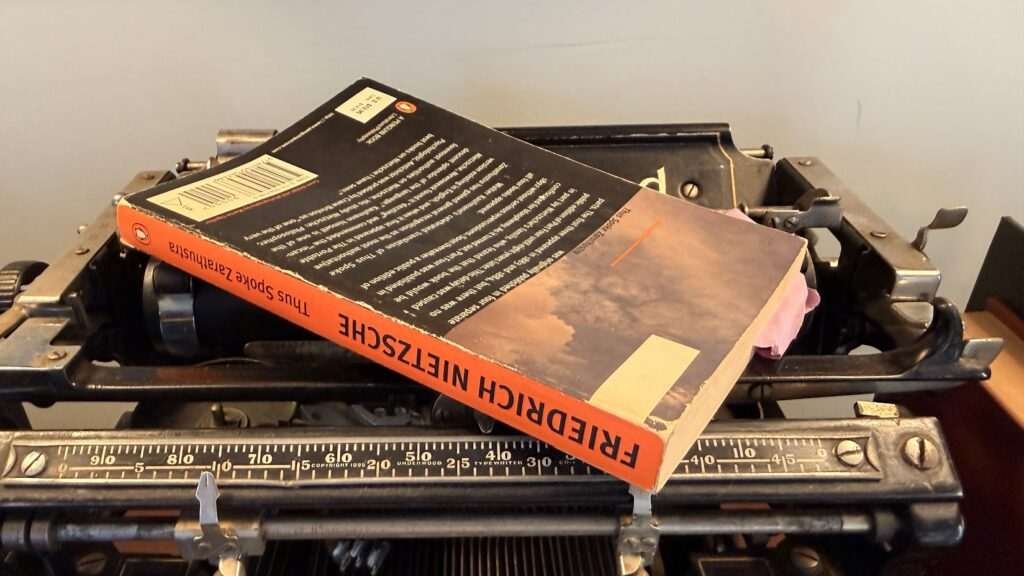
Thus Spoke Zarathustra: A Book for All and None was written between 1883 and 1885, published across four parts during a period of extraordinary isolation and physical pain in Nietzsche’s life. He composed much of it while walking the mountain roads near Sils-Maria in the Swiss Engadine and along the coastal paths of Rapallo, Italy. He later described the experience as an eruption — something that came over him rather than something he constructed. The central idea, eternal recurrence, first struck him in August 1881 near a pyramidal rock formation at Lake Silvaplana, where he jotted a note that read “6,000 feet beyond man and time” (Kaufmann, Nietzsche: Philosopher, Psychologist, Antichrist, Princeton University Press, 1974).
The book is structured deliberately to echo the cadence and authority of religious scripture — particularly the Bible. Zarathustra descends from a mountain to teach humanity, gathers followers, speaks in parables, endures rejection, and retreats into solitude. But where the Bible asks for faith and obedience, Nietzsche’s Zarathustra demands the opposite: radical self-overcoming, the rejection of inherited moral systems, and the courage to create meaning in a universe that offers none. The philosopher Walter Kaufmann, whose 1954 translation remains the definitive English edition, called Zarathustra a work of unparalleled philosophical ambition wrapped in literary form — a fusion of prophecy and poetry that defied every convention of academic philosophy (Amazon — Walter Kaufmann translation).
God Is Dead — and What Comes After
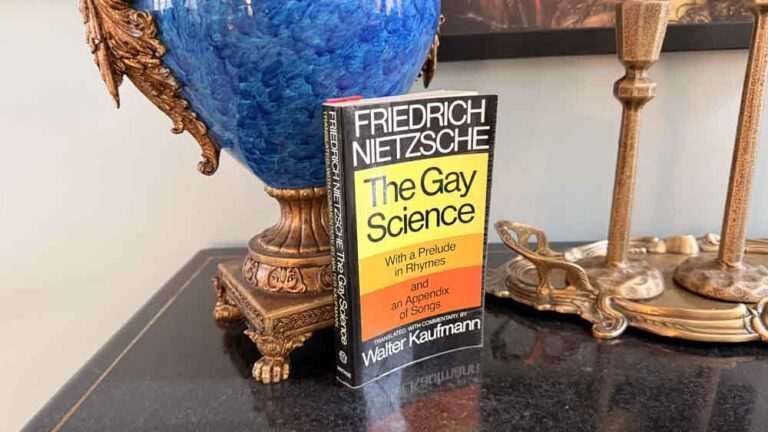
The declaration that God is dead — which Nietzsche first introduced in The Gay Science before embedding it into Zarathustra — is perhaps the most misunderstood sentence in the history of philosophy. Nietzsche was not celebrating atheism. He was diagnosing a cultural catastrophe. The metaphysical foundations that had organized Western civilization for two millennia — Christian morality, divine purpose, the promise of an afterlife — were collapsing under the weight of Enlightenment rationality and scientific materialism. And nothing had emerged to replace them.
This is the void into which Zarathustra walks. His mission is not to mourn God’s absence but to confront its consequences. Without a divine guarantor of meaning, human beings face what Nietzsche saw as the greatest danger: nihilism, the paralyzing belief that nothing matters. The entire architecture of Zarathustra is Nietzsche’s answer to that danger — not a retreat into new myths, but a forward leap into the possibility of human self-transcendence.
For me, reading this for the first time at twenty-something years old, the effect was seismic. I had grown up in a Greek Orthodox household. My immigrant parents carried their faith the way they carried everything else — quietly, stubbornly, as part of the survival kit they had brought from the old country. I did not reject their faith out of rebellion. I simply found, in Nietzsche, a thinker who articulated what I had been feeling for years: that the old frameworks were not wrong so much as insufficient. That the world demanded a more honest reckoning.
The Übermensch — From Philosophical Concept to AI Prophecy
The concept that seized me most forcefully, and that has never released its grip, is the Übermensch — the Overhuman, the Superman, the being that exists beyond the current limitations of the human species. Nietzsche’s Zarathustra announces this concept early and emphatically. Man, he declares, is a rope stretched between animal and Overhuman — a bridge, not a destination. The meaning of the earth, Zarathustra insists, is not to be found in heaven or in comfortable self-satisfaction but in the relentless act of self-overcoming.
For decades, I understood the Übermensch primarily as an existential ideal — a challenge to become something greater than what comfort, habit, and herd morality would allow. It influenced how I approached my work at The Heritage Diner, how I thought about craft when I began building briefcases by hand at Marcellino NY, and how I understood the philosopher’s insistence that greatness requires suffering, solitude, and an almost inhuman commitment to one’s own standards.
But in recent years, as artificial intelligence has moved from science fiction to daily reality, I have come to see the Übermensch through an entirely different lens. Nietzsche wrote that man is something to be overcome. He meant it as a philosophical and spiritual challenge. But what if the overcoming is not metaphorical? What if it is technological?
The philosopher Stefan Lorenz Sorgner, in his influential 2009 paper “Nietzsche, the Overhuman, and Transhumanism,” argued that the parallels between Nietzsche’s Overhuman and the transhumanist concept of the posthuman run far deeper than surface resemblance (Sorgner, Journal of Evolution and Technology, Vol. 20, 2009). Both envision human nature as a work-in-progress. Both reject the idea that humanity in its current form represents a fixed or final condition. Both demand a radical openness to transformation.
Masayoshi Son, the billionaire founder of SoftBank, has already labeled advanced AI as the birth of the “Superhuman” — a being that processes information, creates, and reasons at a scale no biological mind can match. Whether one calls it the posthuman, the singularity, or the Übermensch in silicon, the trajectory is unmistakable. Nietzsche could not have predicted machine learning or neural networks, but he understood the essential truth beneath them: that the human species is not the end of the story. It is the middle chapter.
I tattooed Thus Spoke Zarathustra on my arm — part of a bookshelf of my most important books inked into my skin. It sits alongside other volumes that shaped who I am. But Zarathustra occupies a different position than the others. It is not just a book I admire. It is a book that restructured how I see the entire arc of existence, from the Brooklyn streets where I grew up to the questions about artificial intelligence I wrestle with now.

The Darkest Chapter — How the Nazis Stole Nietzsche
No serious review of Thus Spoke Zarathustra can avoid the book’s most painful historical entanglement: its appropriation by the Third Reich. The story of how one of philosophy’s most fiercely independent minds became associated with the most conformist and murderous ideology of the twentieth century is one of history’s cruelest ironies — and much of the blame falls on one person.
Elisabeth Förster-Nietzsche, Friedrich’s younger sister, was an antisemite and German nationalist who married Bernhard Förster, a prominent agitator who attempted to establish an Aryan colony called Nueva Germania in Paraguay in 1887. The colony failed. Förster killed himself. Elisabeth returned to Germany, where she found her brother incapacitated by the mental collapse he suffered in 1889. She seized control of his manuscripts, established the Nietzsche Archive, and spent the next three decades editing, distorting, and in some cases outright forging his work to align with her own political convictions.
Her most consequential act was the publication of The Will to Power in 1901 — a book Nietzsche never wrote. She assembled fragments from his unpublished notebooks, rearranged them to suit her nationalist agenda, and presented the result as his philosophical masterwork. According to Britannica, scholars later discovered she had forged nearly thirty letters and routinely rewrote passages to distort their meaning. She deliberately withheld Ecce Homo, Nietzsche’s own autobiographical self-interpretation, until 1908 — keeping the philosopher’s actual voice suppressed while her fabricated version circulated.
The consequences were catastrophic. During World War I, over 165,000 copies of Thus Spoke Zarathustra were distributed to German soldiers in the trenches — the book tucked into rucksacks alongside rifles and rations. The Nazis later drew a crudely biological interpretation from the Übermensch, twisting a concept about individual spiritual self-overcoming into a justification for racial supremacy and territorial conquest. Elisabeth met Adolf Hitler in 1932, and after he rose to power in 1933, the Nazi government provided financial support to the Nietzsche Archive in exchange for the prestige of the philosopher’s name. When Elisabeth died in 1935, Hitler attended her funeral.
The irony could not be more savage. Nietzsche himself despised antisemitism, broke with his sister over her marriage to Förster, referred to antisemites with open contempt, and in one extraordinary letter written after his mental collapse reportedly expressed his wish to see all antisemites destroyed. His chapter “Of the New Idol” in Zarathustra explicitly condemns the state as a lying, tyrannical apparatus — a passage that flatly contradicts every principle of totalitarian governance. The Nazis did not overcome these contradictions because they never engaged with them. As one scholar noted, they cared for appearances, not meaning or truth.
It was not until the 1950s and 1960s, when scholars like Walter Kaufmann and the editors Giorgio Colli and Mazzino Montinari gained access to the original untampered manuscripts, that the extent of Elisabeth’s distortions became clear. The restoration of Nietzsche’s actual texts — and the exposure of his sister’s forgeries — fundamentally changed how the twentieth century understood his philosophy. The thinker who had been branded the godfather of fascism was revealed to be something far more complex, far more humane, and far more dangerous to authoritarian thinking than the Nazis ever realized.
If you have read my review of The God Delusion by Richard Dawkins, you know I am drawn to thinkers who challenge inherited certainties. Nietzsche’s case is different from Dawkins’, though. Dawkins dismantles religion with the tools of biology and logic. Nietzsche dismantles it with a hammer — and then asks what kind of human being is strong enough to live in the rubble.
Eternal Recurrence — The Weight That Changes Everything
Beyond the Übermensch, the concept Nietzsche himself identified as the central idea of Zarathustra is the eternal recurrence — the thought experiment that asks: what if you had to live this exact life, with every joy and every agony, over and over for eternity? Would you curse the repetition or embrace it?
This is not a cosmological claim. It is a test of character. To say yes to eternal recurrence is to affirm life so completely that you would want every moment of it repeated without alteration. It is Nietzsche’s ultimate challenge to nihilism — not an argument against meaninglessness, but a radical embrace of existence despite it.
The idea has haunted me since I first encountered it. It is the kind of thought that does not just sit in your mind but reorganizes it. Every decision becomes heavier when you imagine making it infinitely. Every compromise becomes harder to justify. Nietzsche designed it that way. He wanted the concept to function as what he called “the greatest weight” — a burden that either crushes you or transforms you into something stronger.
A Prophet for Transformation, Not Destruction
The existentialists who followed Nietzsche — Sartre, Camus, Heidegger, Kierkegaard before him — all grappled with the same terrain that Zarathustra maps. The death of God. The absurdity of existence. The burden of radical freedom. But none of them wrote anything quite like this book. Richard Strauss composed a symphonic tone poem inspired by its opening. Hermann Hesse and Thomas Mann absorbed its rhythms into their fiction. Jean-Paul Sartre built an entire philosophical system partly in response to the questions Nietzsche raised.
For me, the book’s lasting power is not in its answers but in its insistence that asking the questions is the only honest way to live. Zarathustra is not a prophet of doom. He is a prophet of transformation — someone who invites you to overcome not others, but yourself. In a world increasingly shaped by artificial intelligence, algorithmic decision-making, and the erosion of traditional meaning-structures, that invitation has never felt more urgent.
I named my dog after Nietzsche. Some people think that is funny. I think it is the most natural thing in the world — to want the daily reminder, the companion who answers to the name of the thinker who changed my life. Every morning walk is a small pilgrimage. Nietzsche would have appreciated that. He did his best thinking on walks.
You Might Also Like
- Brave New World by Aldous Huxley — A Review
- Dostoevsky: The Stir of Liberation by Joseph Frank — A Review
- The Fermi Paradox and the Great Filter
Sources
- Kaufmann, Walter. Nietzsche: Philosopher, Psychologist, Antichrist. Princeton University Press, 1974.
- Kaufmann, Walter (translator). Thus Spoke Zarathustra: A Book for All and None. Modern Library Edition, Random House. Amazon
- Sorgner, Stefan Lorenz. “Nietzsche, the Overhuman, and Transhumanism.” Journal of Evolution and Technology, Vol. 20, Issue 1, March 2009. PDF
- “Elisabeth Förster-Nietzsche.” Encyclopaedia Britannica. britannica.com
- “Thus Spoke Zarathustra.” Wikipedia. wikipedia.org
- Niemeyer, Christian (ed.). Nietzsche Encyclopedia. Referenced in “‘Criminal’ manipulation of Nietzsche by sister to make him look anti-Semitic.” History News Network, 2010. historynewsnetwork.org
- “How did Friedrich Nietzsche’s ideas influence the Nazi regime in the Third Reich?” Research essay. mrbuddhistory.com
- “A.I., a new ‘superhuman’ and the Fourth Industrial Revolution is just the latest revival of Friedrich Nietzsche’s ‘Superman’ concept.” Fortune, August 2023. fortune.com