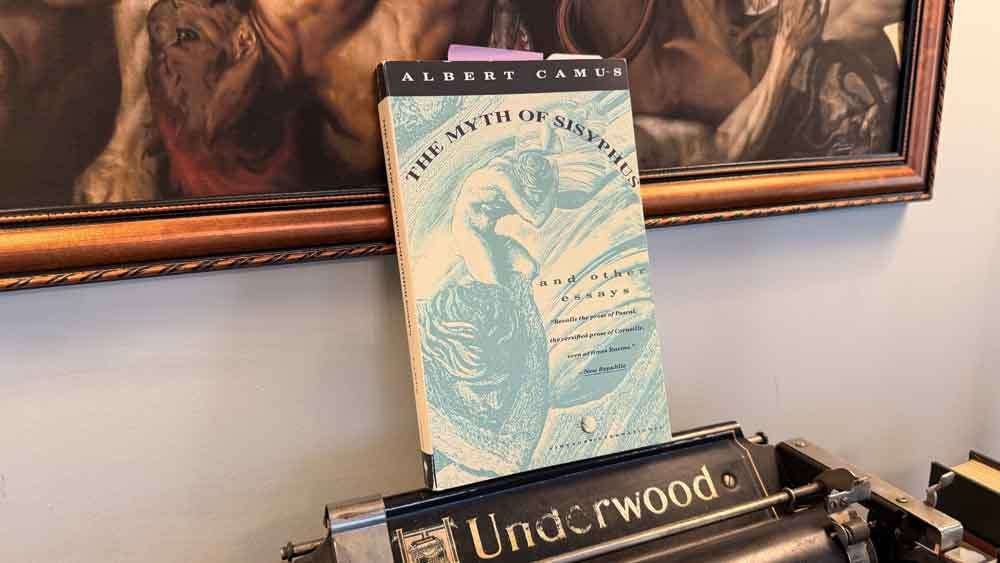
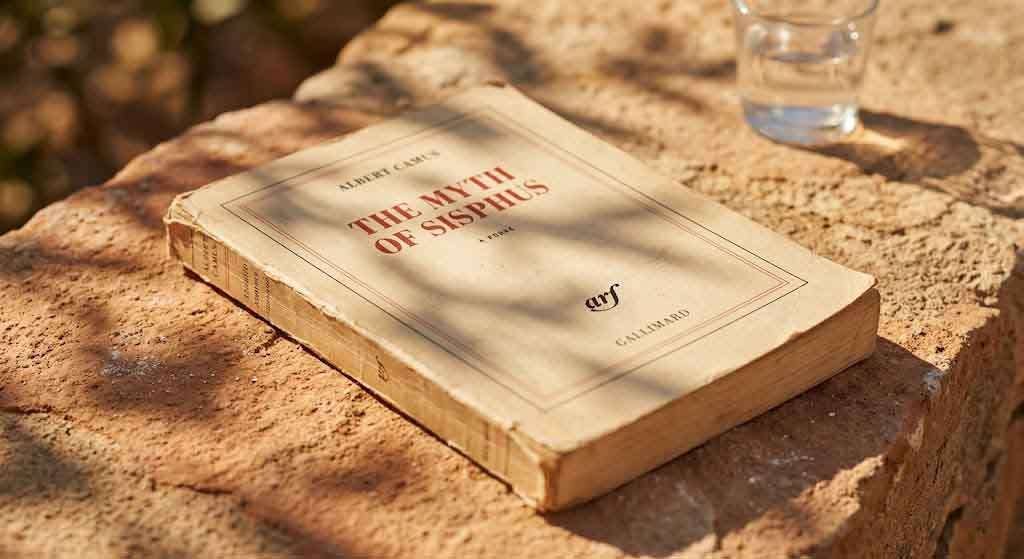
Camus opens The Myth of Sisyphus with what is still one of the most arresting first sentences in twentieth-century philosophy: “There is but one truly serious philosophical problem, and that is suicide.” He is not being dramatic. He is being precise. And the precision of that opening is everything — because what follows is not a meditation on despair but its exact opposite: a sustained, beautifully argued case for why life, in the face of its own absurdity, is worth living, worth fighting, worth embracing with both hands.
I have been reading Albert Camus for most of my adult life. Of all the writers who have shaped the way I think, he is among the most essential — not because he gives easy answers, but because he refuses to. Where Nietzsche hands you a hammer and tells you to smash the old tablets, Camus hands you a mirror and asks you to look clearly at what is actually there, without flinching, without the comfort of religion, ideology, or false hope. That refusal — honest, rigorous, and somehow still warm — is what makes him irreplaceable.
The Myth of Sisyphus, published in 1942 alongside The Stranger, is not my favorite of his books. Thus Spoke Zarathustra occupied a different kind of earthquake in my life — but Camus operates in a register that Nietzsche, for all his volcanic force, cannot quite reach: a kind of lucid tenderness toward ordinary human suffering. This book is close to the top. And it deserves to be read slowly, more than once, preferably when you’re living through something that demands explanation.
The Life Behind the Work
Albert Camus was born in 1913 in Mondovi, Algeria — then a French colonial territory — to a family of the poorest working class. His father, Lucien, was a farm laborer of French-Alsatian descent who was killed at the Battle of the Marne in 1914, when Albert was less than a year old. He had no memory of the man. His mother, Catherine, was illiterate, partially deaf, and largely speechless — a woman shaped entirely by physical labor and silence. She raised Albert and his older brother in a two-room apartment in the working-class Belcourt neighborhood of Algiers, with no electricity and no running water, alongside her own mother and a disabled uncle.
That childhood — marked by poverty, by a father who was an absence, by a mother whose silence was not coldness but its own form of presence — runs underneath everything Camus ever wrote. He never romanticized deprivation. He described it plainly, in his autobiographical novel The First Man, as both his wound and his foundation. “Poverty,” he wrote, “was never a misfortune for me: it was always balanced by the richness of light.” The Mediterranean sun over Algiers, the sea, the physical world in its sheer sensory abundance — these were not backdrop for Camus. They were philosophical materials.

He was rescued from the trajectory of factory work by a schoolteacher named Louis Germain, who recognized something in the boy and fought to get him a scholarship to the lycée. Camus would later name Germain in his Nobel Prize acceptance speech — one of the most moving moments in the history of that ceremony. He went on to study philosophy at the University of Algiers, was diagnosed with tuberculosis at seventeen, joined and then left the Communist Party, worked as a journalist, founded a theatre company, and by his late twenties had written the foundational texts of what would become known as Absurdist philosophy: The Stranger, The Myth of Sisyphus, and the play Caligula, all produced or published during the German occupation of France.
He was killed in a car accident on January 4, 1960. He was forty-six years old. The manuscript of The First Man — the novel many believed would have been his masterpiece — was found in the mud beside the wreckage. He had a train ticket in his pocket that he had exchanged for a last-minute car ride.
That irony — a man who had written so precisely about the absurdity of human fate, killed by chance, at the height of his powers — has the quality of a myth. Which is fitting. Because Camus understood myths better than almost anyone.
The Absurd: What It Actually Means
The word “absurd” gets used loosely — as a synonym for ridiculous, for surreal, for the darkly comic. Camus means something precise by it, and the precision matters. The Absurd, in his framework, is not a property of the world alone, nor of the human mind alone. It is what arises in the collision between the two. The human being cries out for clarity, for reason, for meaning — and the world returns silence. That gap, that confrontation between our hunger for coherence and the universe’s fundamental indifference, is the Absurd.
Camus identifies three possible responses to this condition. The first is physical suicide — the literal ending of the confrontation by ending one’s life. He dismisses this not with contempt but with logic: suicide does not resolve the Absurd; it simply surrenders to it. The second response is what he calls “philosophical suicide” — the leap of faith, the embrace of religion or ideology that fills the void with false meaning. He is equally critical of this. Thinkers like Kierkegaard, Jaspers, and Shestov, he argues, correctly identified the Absurd but then flinched from it, escaping into transcendence rather than holding the tension. Camus refuses the escape.
The third response — the only intellectually honest one, in his view — is revolt. To live within the Absurd. To acknowledge it fully, to refuse both despair and false comfort, and to keep living, keep creating, keep loving, anyway. This is not optimism. It is something harder and, in my reading of it, far more admirable: a kind of defiant clarity.
Sisyphus, the Hero
The image Camus ends with is the one that has lasted. Sisyphus, condemned by the gods to roll his boulder up a hill for eternity, only to watch it tumble back down each time — this is Camus’ figure for the human condition itself. Repetitive, futile, stripped of any divine purpose or cosmic reward.
And yet. Camus asks us to imagine Sisyphus happy.
Not happy despite his condition. Happy within it. Because the struggle itself is enough to fill a human heart. Because the boulder belongs to Sisyphus. Because his fate is his own, and the full acknowledgment of that — without illusion, without complaint, without appeal to gods who have already delivered their verdict — is itself a form of freedom. “One must imagine Sisyphus happy.” It is the most counterintuitive conclusion in the history of Western philosophy, and it is also, in the way that the best ideas are, obviously true the moment you see it.
I have come back to that image dozens of times over the years. Running a diner for twenty-five years is its own form of Sisyphean labor — the prep that begins again each morning, the same tasks executed at the same hours, the knowledge that the work is never finished, only temporarily complete. Camus taught me that this is not a reason for resignation. It is the shape of a life fully inhabited.
The Essays: Beyond the Centerpiece
The volume extends beyond the title essay into a collection of shorter philosophical and literary pieces that deserve more attention than they typically receive. Camus writes on Kafka, on Don Juan, on the actor, on the creator — each as a variant of the Absurd hero, each choosing engagement over escape. His reading of Kafka is particularly striking: where most critics find Kafka’s work suffused with hope for transcendence, Camus insists it is a portrait of the Absurd sustained with perfect fidelity, never resolved, never leaped beyond.
There is also a searching piece on Dostoevsky — whose novels Camus read as existential documents as much as fiction — that illuminates how the Absurd functions differently when pushed toward the religious than when held secular. These essays are not supplementary. They are the philosophical method demonstrated in action: the same lens, turned on different materials.
Why Camus Still Matters
There is a generation that discovered Camus through The Stranger in high school and left him there, as if he were a phase — a gateway drug to real philosophy, something to outgrow. This is a mistake. The older you get, the more precisely Camus describes the actual texture of adult experience: the repetition, the uncertainty, the love that coexists with full knowledge of mortality, the work that goes on without guarantee of legacy or reward.
What separates him from the existentialists he was often grouped with — Sartre, de Beauvoir, the Parisian intellectual establishment — is not politics or biography, though those differences were real and eventually corrosive to his relationships. It is tone. Sartre is cold, rigorous, cerebral. Camus is warm without being sentimental, precise without being bloodless. He writes like a man who has actually suffered, who has felt the Mediterranean sun on his skin and lost people he loved and found the world both unbearable and beautiful, sometimes in the same afternoon.
His Nobel Prize citation, awarded in 1957, described his work as illuminating “the problems of the human conscience in our times.” That is accurate but insufficient. What Camus actually did was rarer: he took the most difficult question a person can face — why bother? — and answered it without lying. He said: because the boulder is yours. Because the hill is real. Because the moment of walking back down, before you begin again, belongs entirely to you.
That is enough. Camus spent his whole short life arguing that it is enough. On my best days, I believe him.
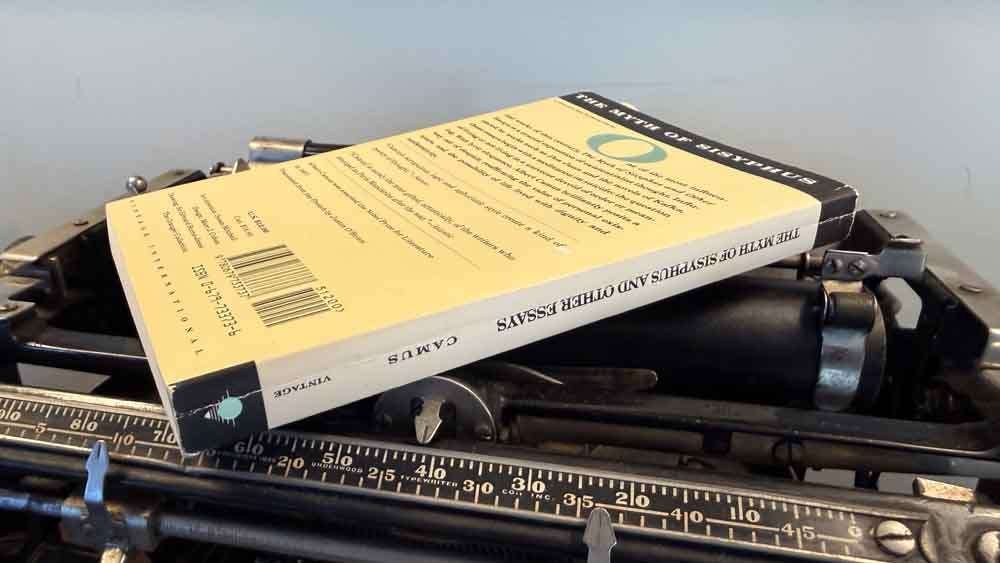
Pick up The Myth of Sisyphus and Other Essays in the Vintage International edition — Justin O’Brien’s translation is the standard, and it holds the voice well. Read the title essay first, then return to the shorter pieces. Give it time. It asks for patience, not speed.
Sources
- Camus, Albert. The Myth of Sisyphus and Other Essays. Trans. Justin O’Brien. Vintage International, 1991. Amazon
- Todd, Olivier. Albert Camus: A Life. Trans. Benjamin Ivry. Alfred A. Knopf, 1997. Amazon
- Camus, Albert. The First Man. Trans. David Hapgood. Vintage International, 1996. Amazon
- Zaretsky, Robert. A Life Worth Living: Albert Camus and the Quest for Meaning. Harvard University Press, 2013. Harvard University Press
- Nobel Prize Committee. “Albert Camus — Nobel Prize in Literature 1957.” NobelPrize.org
- Sartre, Jean-Paul. “Albert Camus.” Situations IV. Gallimard, 1964.