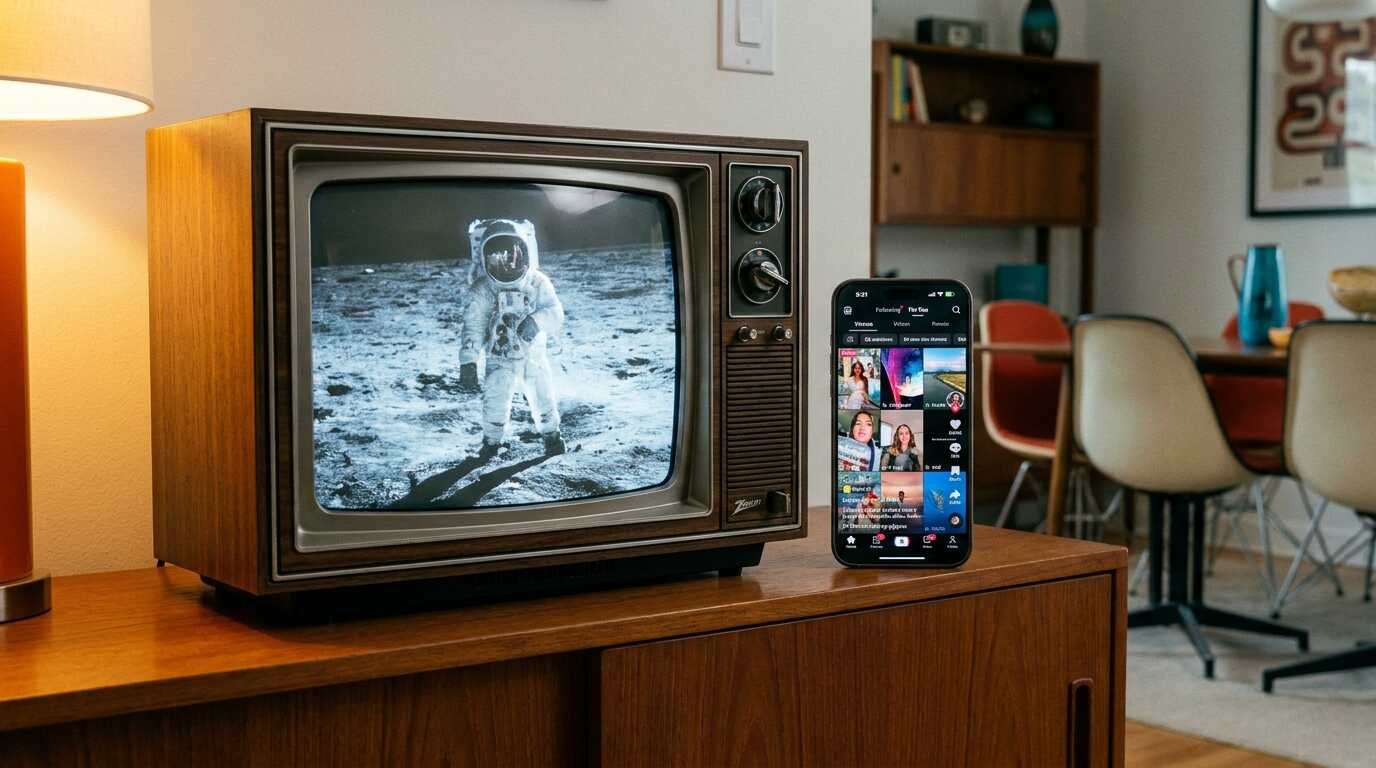
Marshall McLuhan published Understanding Media in 1964 — two years before the first episode of Star Trek, twenty-five years before the World Wide Web, and decades before a platform would exist where a teenager in Ohio could command the attention of forty million strangers by lip-syncing in a moving car. He couldn’t have known any of that. What he understood was media structure: how the form of a communication technology shapes what it does to the people who use it, independent of whatever content moves through it. That structural insight is why his framework keeps outlasting the technologies it was built to describe.
The Hot/Cool Distinction, Stated Precisely
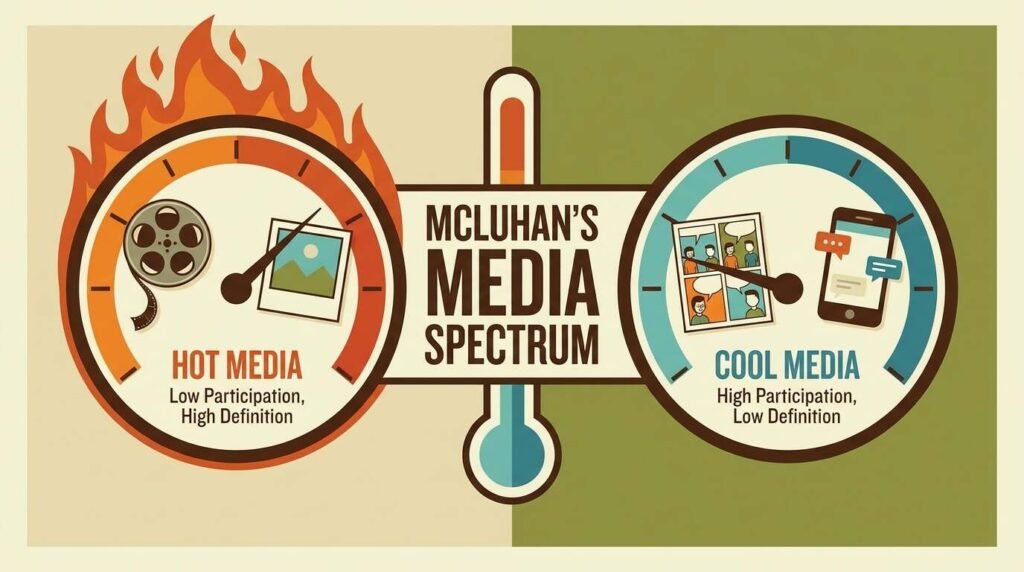
McLuhan’s terminology is slippery enough that it’s worth stating the distinction carefully before applying it anywhere. A hot medium is high-definition — it delivers so much information through a single sense that the receiver doesn’t need to fill in much. Film is hot. Radio is hot. A photograph is hot. A cool medium is low-definition: it delivers less data and demands that the audience participate actively to complete the meaning. The telephone is cool. Cartoons are cool. Television, counterintuitively, McLuhan called cool — its low-resolution image (at least by the standards of his era) required the viewer to actively assemble the picture.
The implication is that hot and cool media produce different psychological states in their audiences. Hot media create passive receivers; the work is done for them. Cool media create active participants; they have to complete the message themselves. This is not a moral distinction — McLuhan wasn’t calling television better or worse than film. He was making a claim about cognitive engagement. For the fullest version of his argument, the Understanding Media review on this site covers the original text in depth.

Why the Framework Is Genuinely Difficult to Apply
The strongest objection to McLuhan isn’t that his ideas are wrong — it’s that they resist falsification. “High definition” and “low definition” are not quantified. The claim that television is cool while radio is hot relies on categorical judgments about sensory engagement that McLuhan doesn’t ground empirically. Critics in media studies have spent decades pointing out that the hot/cool taxonomy can be made to fit almost any technology with enough post-hoc adjustment.
This is a real problem. McLuhan’s framework is not a scientific theory in the Popperian sense — there’s no obvious experiment that would definitively refute it. What it is, more precisely, is an analytical vocabulary: a set of distinctions that, applied with care, make certain features of media behavior visible that would otherwise be hard to articulate. That’s a more modest claim than McLuhan himself usually made, but it’s also a more defensible one. And defensible is what keeps a framework useful across sixty years and several technological eras.
Applying the Taxonomy to Contemporary Platforms
TikTok is an interesting test case. By McLuhan’s criteria, it sits in an unusual position. The video itself is high-definition — polished production, often with professional lighting, fast editing, and dense audio layering. By that measure, it should be hot: a passive-receiver medium. But the comment section, the duet feature, the remix culture that the platform’s algorithm actively promotes — all of this generates intense participatory demand. Users don’t just watch; they respond, remix, ironize, extend. The platform is architecturally designed to produce that participation.
If McLuhan is right that cool media generate tribal warmth — a sense of collective participation and group identity — then TikTok’s tribal dynamics are exactly what his framework predicts. The platform’s community formation is extraordinarily fast and extraordinarily intense. Fandoms, political movements, subcultures, and memes condense and disseminate at speeds that have no precedent. McLuhan argued that cool media pull people into collective identities in ways that hot media don’t. Whatever the mechanism, the observation holds.
Contrast this with podcasts. The podcast is arguably the hottest medium currently in widespread use: a single-sense (audio) high-definition experience, typically long-form, requiring the listener to follow extended arguments or narratives with limited participatory demand during the listening itself. Podcasts produce loyalty and attention but not the same kind of rapid tribal formation that TikTok generates. Their audiences are devoted but less feverish. McLuhan would recognize the difference immediately.
The Attention Economy as a McLuhan Problem
The contemporary debate about social media and cognition tends to reach for neuroscience — dopamine loops, attention fragmentation, the quantified decline of sustained reading. These are real phenomena. But McLuhan offers a structural frame that the neuroscience doesn’t: the claim that the form of a medium alters the cognitive habits of its users, not just their mood states. “We shape our tools,” he wrote, “and thereafter our tools shape us.” The shaping isn’t metaphorical. It’s architectural.
If cool, participatory media train audiences to expect active input, then sustained exposure to platforms that demand constant response may be reconfiguring what reading feels like. A book — hot, linear, high-definition in McLuhan’s sense — makes demands of a kind that cool platforms never make. The passivity it requires is not cognitive inactivity; it requires sustained, non-participatory attention. That capacity appears to be eroding in measurable ways across multiple populations. Neil Postman saw a version of this coming too — his argument in Technopoly that technology doesn’t just add to culture but restructures it from the inside runs parallel to McLuhan’s structural critique, and is worth reading alongside it.
What McLuhan Got Wrong, and Why It Matters Less Than It Should
McLuhan was wrong about television being cool in any straightforward sense — contemporary television, with its 4K resolution, Dolby surround sound, and cinematic production values, is about as high-definition a medium as exists. His timing was anchored to the technology of his moment. He was also wrong, or at least loose, about the political implications of global connectivity: his “global village” prediction leaned optimistic in ways the internet has not vindicated. Shared media environments have produced tribalism as readily as solidarity.
But here’s what makes the framework survive its errors: the core structural insight — that the ratio of sensory engagement to participatory demand determines a medium’s social and cognitive effects — turns out to be robust even when specific applications fail. McLuhan was wrong about which technologies would be hot and cool as they evolved. He was right about what hot and cool do. That’s a more durable kind of correctness than he sometimes gets credit for, precisely because it doesn’t depend on any particular technology remaining fixed.
You Might Also Like
- Technopoly by Neil Postman — The Prophet Nobody Wanted to Hear
- Understanding Media: The Extensions of Man — Marshall McLuhan
- Cargo Cult Science
Sources
- McLuhan, M. (1964). Understanding Media: The Extensions of Man. McGraw-Hill.
- McLuhan, M., & Fiore, Q. (1967). The Medium Is the Massage. Bantam Books.
- Levinson, P. (1999). Digital McLuhan: A Guide to the Information Millennium. Routledge.
- Gordon, W. T. (2010). McLuhan: A Guide for the Perplexed. Continuum.
- Carr, N. (2010). The Shallows: What the Internet Is Doing to Our Brains. W. W. Norton.
- Postman, N. (1992). Technopoly: The Surrender of Culture to Technology. Knopf.