
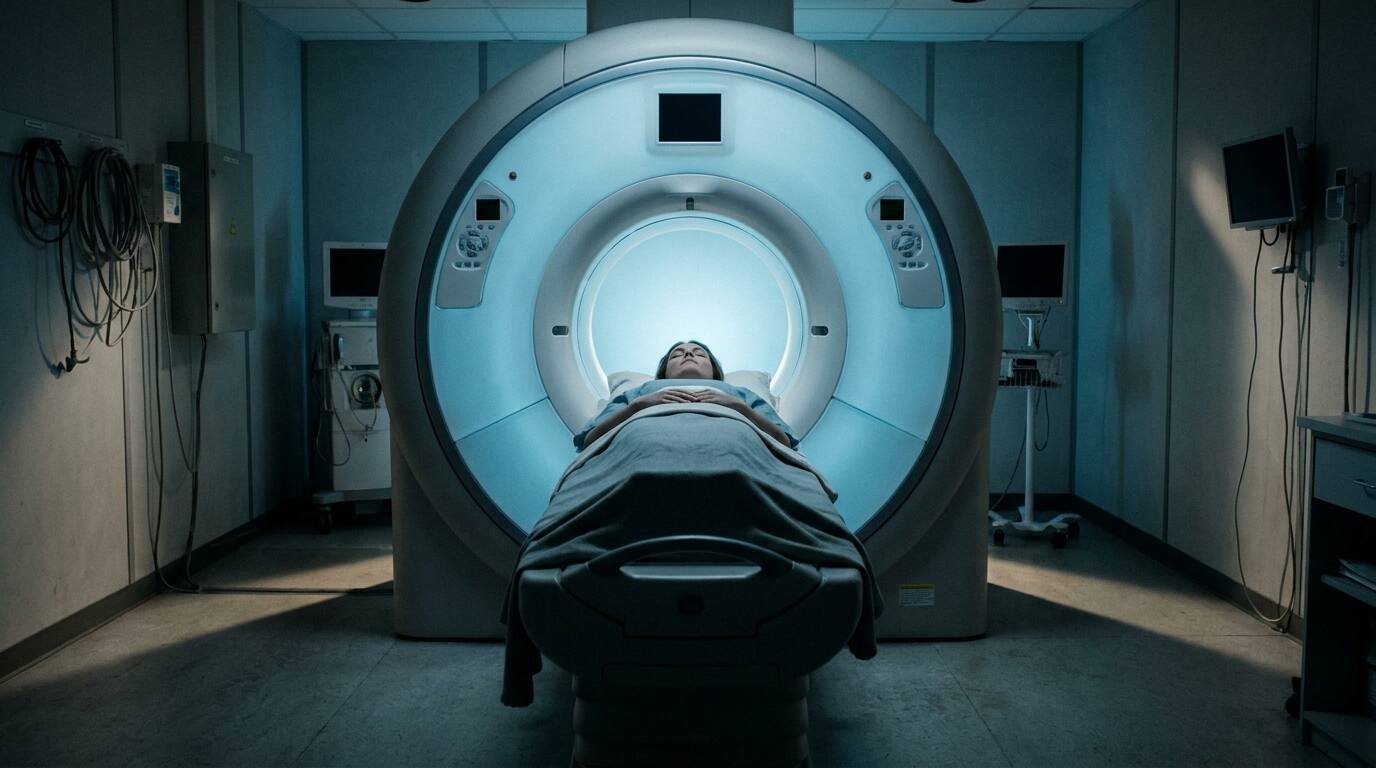
For most of neuroscience’s history, the brain at rest was treated the way engineers treat machine noise — something to suppress, subtract out, discard. When researchers scanned subjects performing cognitive tasks with positron emission tomography in the 1980s and 90s, they dutifully established a baseline: a quiet resting state the brain would return to between experiments. That baseline wasn’t the point. It was the control condition. The thing they were waiting to be over.
What nobody expected was that the baseline was doing something.
The Accidental Finding
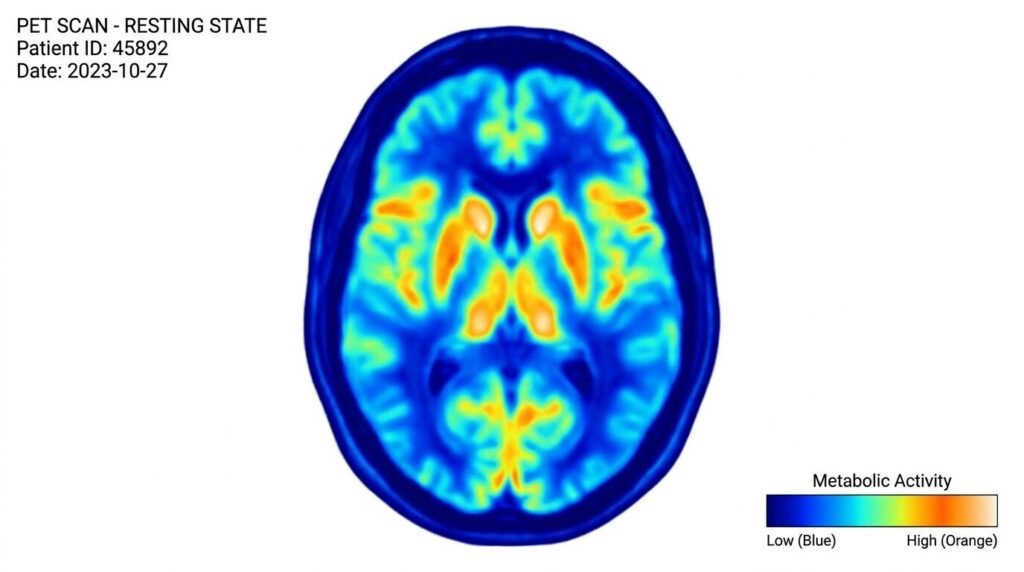
Marcus Raichle, a neurologist and imaging pioneer at Washington University School of Medicine, had been studying brain metabolism with PET for years when his group noticed a pattern that didn’t fit the standard framework. Certain brain regions — in the medial prefrontal cortex, the posterior cingulate cortex, the precuneus — consistently showed elevated activity when subjects were simply resting quietly with eyes closed. More strikingly, those same regions consistently deactivated when a demanding task was introduced. They went down when everything else went up.
This was the opposite of what task-activation neuroscience expected. The regions weren’t silent during rest — they were running. The implication was uncomfortable: the brain had an organized, ongoing mode of activity that tasks were interrupting, not initiating. Raichle’s 2001 paper in Proceedings of the National Academy of Sciences formalized the observation and gave it a name: a default mode of brain function.
Why the Field Resisted
The initial reception was skeptical — not hostile, but cool. Cognitive neuroscience had spent its productive decades building a research paradigm around task-evoked responses. You gave subjects something to do, you measured the activation, you mapped the function. Rest was methodologically necessary but scientifically inert. The idea that the intervals between tasks were themselves neurologically rich didn’t just complicate the data; it challenged the entire architecture of what a brain-imaging experiment was supposed to be measuring.
There was also the problem of interpretation. Resting-state activity is harder to pin down than task-evoked activity. When a subject presses a button in response to a visual cue, the neural correlates have a clean referent. When a subject lies quietly in a scanner, their mind could be anywhere. Critics argued the default mode signal was a methodological artifact — noise masquerading as pattern. It took several years of converging evidence to shift that consensus. The broader argument about what the brain’s physical structure is even doing — whether neurons are sufficient to explain experience — is covered in depth in The Conscious Mind by David Chalmers, which tackles the hard problem from a different but adjacent angle.
What the Network Actually Does
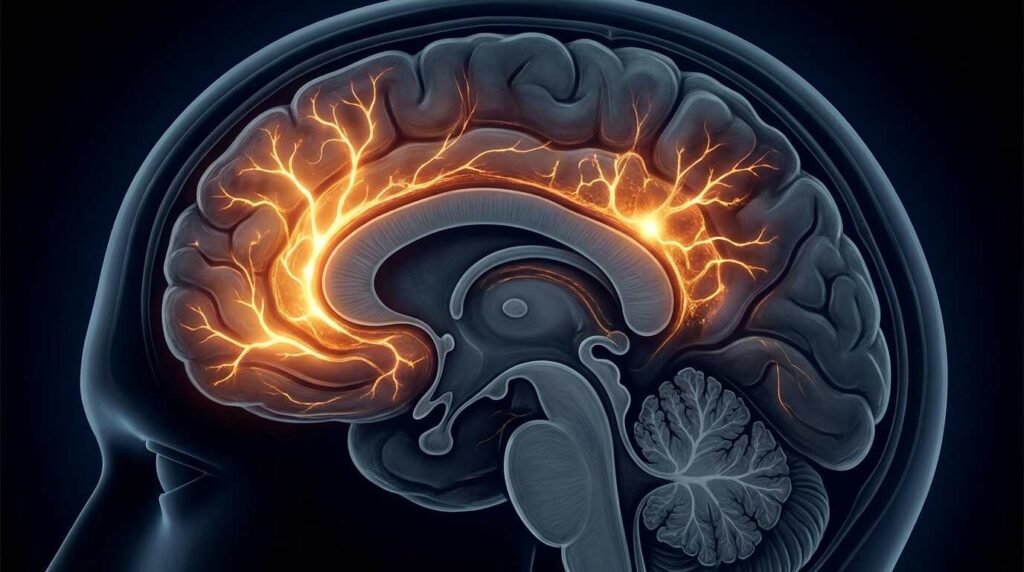
Subsequent research established that the default mode network is not passive. It is active in a way that is highly specific and functionally coherent. Three broad domains of cognition are now consistently linked to DMN engagement: autobiographical memory retrieval, prospective thinking (imagining future events), and self-referential processing — the mental work of modeling yourself in relation to the world.
A landmark 1995 study by Nancy Andreasen and colleagues — predating the formal DMN concept — had already noted that spontaneous, unconstrained thinking engaged the posterior cingulate cortex and medial prefrontal cortex at levels comparable to deliberate autobiographical recall. The implication was that what the brain does when “doing nothing” is continuous self-narration: consolidating memory, rehearsing futures, maintaining the story of who you are. The DMN, as it came to be understood, is the neural substrate of mental time travel. It runs the simulation of self. Francis Crick pushed a related argument in a very different direction — that consciousness itself is nothing more than the firing of neurons — which you can read about in The Astonishing Hypothesis.
When the Network Breaks Down
The clinical implications of DMN research clarified quickly after the network’s discovery. In patients with major depression, the default mode network shows hyperactivation — specifically, ruminative loops in the medial prefrontal cortex that appear to sustain negative self-referential thought. The network doesn’t just idle; it fixates. That observation reframes what depression partly involves neurologically: not just a deficit of positive affect but an overengagement of the self-modeling apparatus, running the same painful autobiographical simulations on repeat.
Schizophrenia presents a different kind of disruption. Multiple fMRI studies have documented that in schizophrenic patients, the DMN fails to deactivate normally during task performance and shows abnormal connectivity between its subsystems. Autobiographical memory retrieval — one of the specific cognitive functions the DMN supports — is measurably impaired, with reduced activation in medial frontal and posterior cingulate regions compared to healthy controls. The coherent self-model that the network ordinarily maintains appears fragmented. The link between past experience and future projection, what researchers call “mental time travel,” becomes unreliable.
The Epistemology of the Discarded Interval
There is a recurring pattern in science where the most important data sits inside what researchers have designated as methodologically inert. The resting-state signal was treated as interference for roughly two decades of brain-imaging research. When Raichle’s group stopped treating it as such and asked what the signal actually was, the answer turned out to be foundational to understanding cognition, identity, and psychiatric illness. It’s a dynamic that has a parallel in evolutionary biology — the idea that what looks like noise or redundancy often turns out to be load-bearing — as explored in Organoid Intelligence, which examines what happens when you try to grow thinking tissue outside a body entirely.
The practical consequence is now well-established: resting-state fMRI, which measures functional connectivity during quiet rest rather than task performance, has become a major paradigm in clinical and basic neuroscience. It allows researchers to characterize network organization across the whole brain without requiring subjects to perform specific tasks — a significant advantage in populations that can’t comply with experimental protocols. The data Raichle’s field once discarded is now the primary signal.
The Brain’s Ongoing Work
What the default mode network ultimately reveals is that the brain’s most important function may not be responding to the world — it may be maintaining itself as a coherent entity within the world. The construction of autobiographical memory, the projection of self into imagined futures, the continuous low-level modeling of identity: these are not luxuries that happen when tasks are absent. They are the underlying architecture of what it means to have a self.
Raichle’s finding reoriented the field’s understanding of what a brain does during a cognitive experiment. The task engages one system. The interval between tasks engages another. Both matter. The decades of neuroscience that treated rest as a methodological placeholder had, without realizing it, been measuring consciousness with one eye closed.
Sources
- Raichle, M.E., et al. (2001). “A default mode of brain function.” Proceedings of the National Academy of Sciences, 98(2), 676–682. https://www.pnas.org/doi/10.1073/pnas.98.2.676
- Raichle, M.E. (2015). “The Brain’s Default Mode Network.” Annual Review of Neuroscience. https://www.annualreviews.org/content/journals/10.1146/annurev-neuro-071013-014030
- Buckner, R.L., Andrews-Hanna, J.R., Schacter, D.L. (2008). “The Brain’s Default Network.” Annals of the New York Academy of Sciences.
- Autobiographical memory and default mode network function in schizophrenia: an fMRI study. Psychological Medicine. https://pmc.ncbi.nlm.nih.gov/articles/PMC7856411/
- 20 years of the default mode network: a review and synthesis. PMC. https://pmc.ncbi.nlm.nih.gov/articles/PMC10524518/