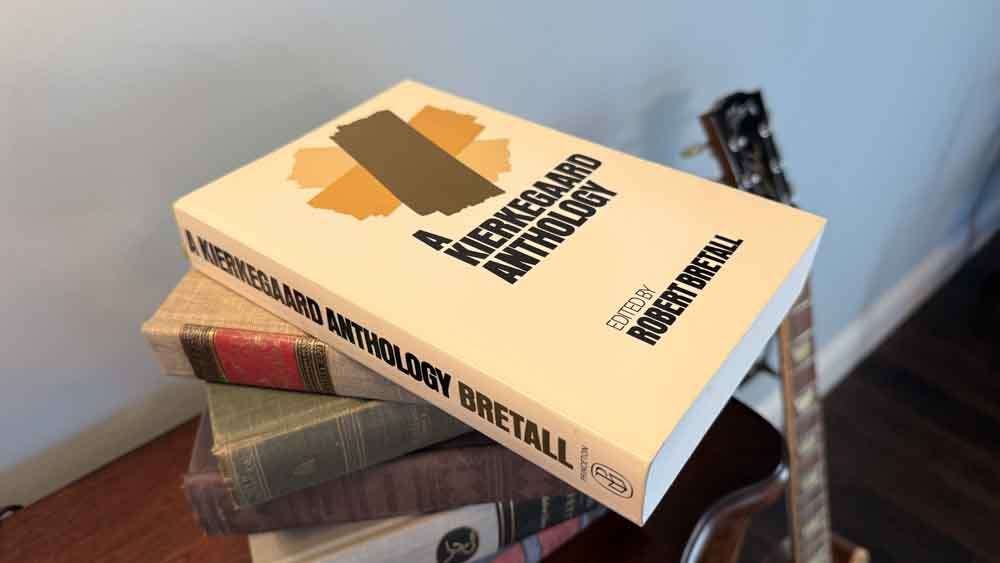
Reading Kierkegaard as someone who arrived through Nietzsche is, to put it plainly, disorienting. It is something like walking into a room you expected to be empty and finding it occupied by someone who not only anticipated your arrival but has already prepared an argument against everything you came in believing. Robert Bretall’s A Kierkegaard Anthology — published by Princeton University Press and still one of the most intelligently curated single-volume introductions to the Dane’s work — puts you in that room and locks the door.
I came to existentialism wearing Nietzsche’s coat. The Will to Power, the Übermensch, the death of God — these were not just philosophical positions for me. They were a grammar. A way of organizing the world into sovereign acts of self-creation against a backdrop of cosmic indifference. Nietzsche gave me a language for refusing victimhood, for transforming suffering into fuel. That language felt permanent.
Then came Kierkegaard.
The Problem of the Prior Existentialist
It is a persistent irony that Kierkegaard and Nietzsche — who never read each other, who lived in different countries and died a generation apart — are perpetually bound together in the philosophical literature as the twin fathers of existentialism. Both rejected Hegel’s grand systematic rationalism. Both understood that the human being is not a category but a specific, suffering, choosing individual. Both wrote with a ferocity that academic philosophy could barely contain.
But there the resemblance becomes treacherous. Nietzsche declared God dead and dared humanity to live without the comfort of transcendence. Kierkegaard performed a move of devastating intellectual courage in the opposite direction: he acknowledged the full weight of human despair, subjected God to rigorous rational scrutiny, and then leapt — not blindly, but willfully, eyes open — into faith. His “leap of faith” (Springet) was not the retreat of a weak mind. It was the conclusion of a powerful one.
Bretall’s anthology makes this case quietly but effectively. By arranging selections chronologically and pseudonymously — Either/Or, Fear and Trembling, Philosophical Fragments, Concluding Unscientific Postscript, The Sickness Unto Death — the reader watches Kierkegaard construct his argument from the ground up, stage by stage, persona by persona.
The Three Stages and the Architecture of Despair
What makes Kierkegaard genuinely formidable — and what the Bretall anthology captures well — is that he does not arrive at faith cheaply. He earns it through a relentless diagnosis of what it means to be human without it.
His three stages of existence — the aesthetic, the ethical, and the religious — are not abstract taxonomy. They are portraits of recognizable human lives. The aesthete lives for sensation, novelty, and the cultivation of experience. It is a sophisticated position — and Kierkegaard gives it every advantage in Either/Or through the voice of “A,” who argues for it with genuine eloquence. But the aesthete’s life is ultimately self-consuming. Novelty runs dry. The self that lives only for its own stimulation finds, at bottom, nothing.
The ethical stage offers structure, duty, the social contract — but it too runs into a wall. The ethical life demands consistency with a standard that the individual, in Kierkegaard’s view, can never fully meet. This is where despair enters not as an emotion but as an ontological condition. In The Sickness Unto Death, written under the pseudonym Anti-Climacus, Kierkegaard writes with clinical precision about the self that fails to become itself — the self that is in despair not because it has lost something external, but because it has failed to take hold of what it actually is.
The passage in Bretall’s selection that stopped me completely was this description of the forms of despair: the despair of not willing to be oneself, the despair of willing to be oneself without grounding in the power that constituted it. It is an architectural rendering of psychological collapse — and it holds up against anything in contemporary psychology or literature.
Nietzsche Would Have Had a Problem With This
Here is where my own conflict sits.
Nietzsche’s response to despair is transfiguration. You do not flee your suffering — you metabolize it. The amor fati, the love of fate, is the Nietzschean counter to despair: embrace everything that has made you, including the pain, and become the creator of your own values. The Übermensch is not a superhuman in the comic-book sense. He is the person who refuses to let the absence of cosmic meaning produce nihilism, who instead generates meaning from within.
Kierkegaard’s response to despair is fundamentally different — and rationally uncomfortable for a Nietzschean. He does not deny the weight of the human condition. He sits with it longer and more honestly than almost any philosopher before him. But his conclusion is that the self cannot constitute itself in isolation. That the self, held only by itself, collapses inward. The leap to faith — to a relationship with the Absolute, with God — is not the abandonment of reason. It is the recognition of reason’s limits, which is itself a rational act.
I find myself unable to dismiss this. That is the problem Kierkegaard presents to someone who arrives through Nietzsche: he makes his argument in good faith, without sentimentality, with the full force of a first-rate philosophical mind, and then hands you something you cannot simply reject. You have to wrestle with it. Or you have to admit you are not really interested in the argument, only in the conclusion you already prefer.
Bretall as Curator
Robert Bretall’s editorial hand is present but light — exactly right for a thinker as resistant to summary as Kierkegaard. The anthology’s brief introductions to each work are useful without being presumptuous. Bretall does not interpret for you. He organizes, contextualizes, and steps aside.
What makes this volume particularly valuable is the inclusion of the Journals, where Kierkegaard speaks in his own undisguised voice. These entries reveal a man of extraordinary psychological complexity — self-aware to the point of agony, driven by a sense of singular vocation, haunted by his broken engagement to Regine Olsen, and deeply aware that his work would not be appreciated until long after his death. There is something in the journals that the pseudonymous works do not fully expose: the cost of thinking this rigorously, this honestly, this unrelentingly.
If you have read Thus Spoke Zarathustra and felt its force, the Bretall anthology is the necessary counterweight. Not because it overturns Nietzsche — it doesn’t — but because it insists on the question Nietzsche brackets: what do you do with the self that cannot will its own coherence into existence? What do you do with the despair that the Übermensch never quite addresses?
The Seducer’s Diary and the Limits of the Aesthetic
One section of the anthology that deserves particular attention is the excerpt from “The Seducer’s Diary,” the concluding piece of Either/Or. It is one of the most disturbing things in the philosophical canon — not because it is graphic, but because it is so internally coherent. Johannes the Seducer is not a villain in the conventional sense. He is an aesthete taken to his logical extreme: a man who turns human beings into objects of experience, who stages his own emotional life as a kind of theatre, who cannot encounter anything without immediately converting it into material for his own refinement.
Kierkegaard’s point is that the aesthetic stage, pursued to its end, produces something monstrous — not through malice but through the total evacuation of ethical relationship. The Seducer is brilliant, articulate, and completely hollow. Reading him is like watching a fire that produces no heat — all light, no warmth.
Nietzsche’s aesthete — the person who creates values, who turns life into art — is, in Kierkegaard’s framework, still susceptible to this same hollowness. That is the charge, and it is not easy to shake.
What Remains
I have not resolved the tension between these two thinkers. I am not sure resolution is the right goal. Philosophy at its best does not hand you conclusions — it gives you better questions, sharper instruments for examining the questions you were already living with.
What Bretall’s anthology did for me was make Kierkegaard unavoidable. Not as a historical figure, not as a curiosity, but as a genuine philosophical adversary — someone who looked at the same terrain Nietzsche looked at and came back with a different report, one that cannot be dismissed without honest engagement.
If you have read The God Delusion and feel settled in your materialism, this anthology will unsettle something. If you have read Nietzsche and feel certain about the self-creating subject, Kierkegaard will put pressure on exactly that certainty. He will not do it loudly. He will do it the way all great thinkers do: by asking a question you thought you had already answered, and showing you, with quiet precision, that you hadn’t.
A Kierkegaard Anthology, edited by Robert Bretall, is available from Princeton University Press. It remains one of the finest entry points into one of philosophy’s most essential and demanding voices.
You Might Also Like:
- Thus Spoke Zarathustra by Friedrich Nietzsche — The Book That Rewired My Understanding of Everything
- Steppenwolf by Hermann Hesse
- The God Delusion by Richard Dawkins — A Review
Sources:
- Bretall, Robert (ed.). A Kierkegaard Anthology. Princeton University Press, 1946. https://press.princeton.edu/books/paperback/9780691019628/a-kierkegaard-anthology
- Kierkegaard, Søren. The Sickness Unto Death. Translated by Alastair Hannay. Penguin Classics, 2004. https://www.penguinrandomhouse.com/books/286818/the-sickness-unto-death-by-soren-kierkegaard/
- Kierkegaard, Søren. Either/Or. Translated by Howard V. Hong and Edna H. Hong. Princeton University Press, 1987. https://press.princeton.edu/books/paperback/9780691020419/eitheror
- Kierkegaard, Søren. Fear and Trembling. Translated by Alastair Hannay. Penguin Classics, 2005. https://www.penguinrandomhouse.com/books/286789/fear-and-trembling-by-soren-kierkegaard/
- Stanford Encyclopedia of Philosophy. “Søren Kierkegaard.” https://plato.stanford.edu/entries/kierkegaard/
- Stanford Encyclopedia of Philosophy. “Friedrich Nietzsche.” https://plato.stanford.edu/entries/nietzsche/