
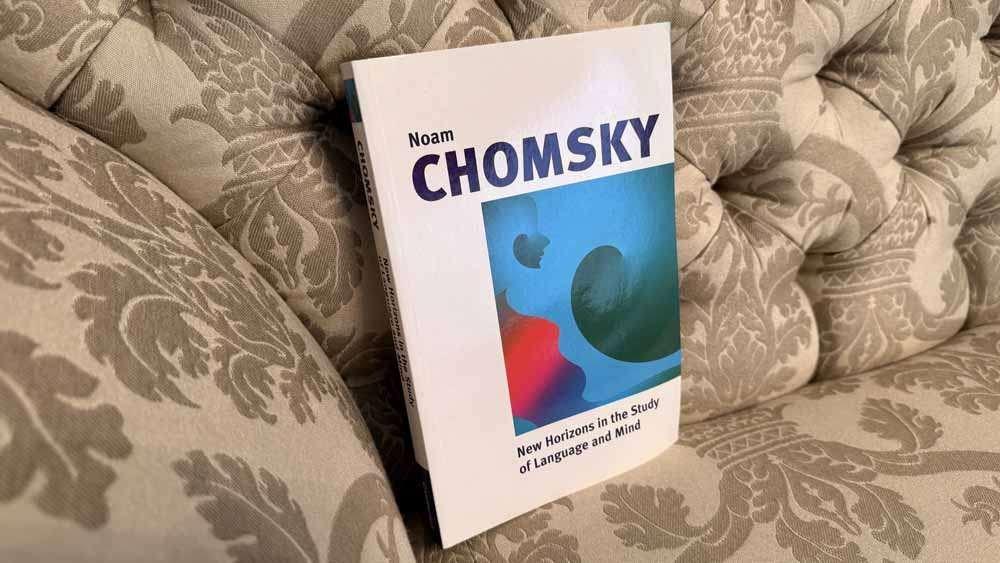
Every decade or so, a book arrives that doesn’t just add to a conversation — it resets the terms of the debate entirely. Noam Chomsky’s New Horizons in the Study of Language and Mind is that kind of book, though it arrived quietly, dressed in academic prose, with none of the fanfare it deserved. Published in 2000, it remains one of the most precise and unsettling challenges to the dominant assumptions of cognitive science, artificial intelligence, and the philosophy of mind. If you’ve ever wondered what separates human language from the outputs of the most sophisticated AI systems, this is where you go to find the honest answer.
The Central Argument: Language Is Not Behavior
Chomsky opens by drawing a line that most researchers in computational linguistics prefer to ignore. Language, he argues, is not primarily a tool for communication. That may sound counterintuitive — language is how we talk to each other, after all. But Chomsky’s point is deeper: the capacity for language is an internal biological property of the human mind, a cognitive organ that grew through evolutionary processes, and its study should be modeled on the natural sciences, not on behavioral observation. This is the internalist position, and it sits in direct opposition to the externalist view that dominates machine learning — the idea that language can be fully captured by mapping statistical patterns across enormous bodies of text.
This distinction is not academic hairsplitting. It determines everything about what you think AI language systems can actually do. If language is fundamentally behavioral — a pattern of input and output — then a system that processes enough data and produces grammatically coherent responses has, in some meaningful sense, learned to use language. If language is fundamentally internal — a generative computational system embedded in human biology — then no amount of pattern recognition gets you there. You’ve built a very sophisticated echo, not a speaker.
The Universal Grammar Thesis, Restated
Chomsky’s earlier work on Universal Grammar argued that humans are born with an innate language faculty — a set of structural constraints and principles that all human languages share, regardless of surface differences. New Horizons doesn’t retreat from that position. It sharpens it. Chomsky revisits the “poverty of the stimulus” argument with renewed force: children acquire language, including its most abstract grammatical structures, on the basis of input so incomplete and inconsistent that no learning algorithm working from the outside in could account for it. The only explanation that holds is that the deep architecture of grammar is already there, waiting to be triggered.
For anyone who has spent time thinking about how AI systems like large language models actually work, this argument lands with real weight. These systems are trained on billions of words. A human child acquires the fundamentals of language with exposure to a fraction of that data, in a fraction of the time, and arrives at a level of grammatical intuition that no current model reliably replicates. When a five-year-old effortlessly understands that “the horse that kicked the cow jumped over the fence” means the horse jumped — not the cow — she is deploying a form of structural knowledge that no one explicitly taught her. Chomsky’s question is: where did that come from? The externalist answer is unsatisfying. The internalist answer, uncomfortable as it is for the AI industry, fits the evidence.
The Philosophy of Science at Work
What distinguishes this book from Chomsky’s more polemical writing is the care with which he frames the epistemological stakes. He isn’t simply defending his own theory — he’s arguing about the right way to do science. In several of the most valuable chapters, he draws parallels between linguistics and physics: just as Newtonian mechanics abstracted away from the messy complexity of actual falling bodies to arrive at elegant formal laws, linguistics should abstract away from the surface noise of actual speech to find the underlying computational system. The goal is explanatory adequacy, not descriptive coverage.
This is a direct rebuke to the data-maximalist approach that drives most contemporary AI research. The instinct in machine learning is to throw more data at the problem — more parameters, more tokens, more compute. Chomsky’s framework suggests that this instinct, however productive in narrow engineering terms, is philosophically confused about what kind of thing language actually is. You can describe more and more behavior without ever explaining the mechanism that generates it. The map, no matter how detailed, is not the territory.
His reading of the history of science here is genuinely illuminating. He points out that the “Galilean revolution” in physics was not a triumph of observation — it was a triumph of idealization, of willingness to set aside complicating real-world factors in order to isolate core principles. Cognitive science, he argues, has been too reluctant to make this move, clinging to behavioral data when it should be building formal models of internal computation.
Where Chomsky Draws the Line on AI
Chomsky does not frame this book as an intervention in AI debates — it predates the current LLM era by two decades — but it reads, in 2025, as prophetic. His central objection to the behavioral paradigm maps almost perfectly onto the limitations that critics of large language models have identified: the absence of genuine understanding, the brittleness under novel conditions, the inability to distinguish knowing a grammar from having memorized collocations. A system trained on text is not studying language in Chomsky’s sense. It is studying the residue of language — the traces that language leaves on surfaces, stripped of the internal structure that generates them.
This is not technophobia. Chomsky is not arguing that these systems are useless. He is arguing that calling what they do “language understanding” is a category error, and that the category error matters because it leads researchers and the public to wrong conclusions about what has been achieved. If you review how current AI models actually work locally on commodity hardware, the gap between impressive pattern completion and genuine linguistic competence becomes palpable in a way that no amount of benchmark scores quite captures.
The Mind–Body Problem, Quietly Dissolved
One of the more surprising moves in New Horizons is Chomsky’s treatment of the mind–body problem. Rather than taking a side in the familiar debate between physicalists and dualists, he suggests that the framing itself may be confused. The “body” that philosophers have in mind when they talk about physical explanation has evolved significantly since Descartes — Newton’s mechanics already introduced notions (action at a distance, for example) that were considered occult by mechanical philosophy. The mind is no more mysterious than gravity once was. The question is whether we have the right conceptual tools yet to formalize it.
This is a quietly radical position. It doesn’t dismiss the hard problem of consciousness — it contextualizes it, suggesting that our difficulty may be more about the limits of our explanatory frameworks than about some irreducible mysteriousness in mental phenomena. For a reader who has wrestled with the intersection of evolutionary biology and cognition — the way Richard Dawkins approaches the gene in The Selfish Gene as a replicator operating across generational time — Chomsky’s naturalism feels like a natural companion. Both are committed to the idea that the mind is part of the natural world, explicable in principle by the same methods we use to explain everything else, even if our current methods fall well short.
What Remains Unresolved
New Horizons is not a book without tensions. Chomsky’s internalism, rigorous as it is, leaves some important questions underspecified. If language is a biological organ, how exactly did it evolve? Chomsky has always been somewhat agnostic on the evolutionary story — frustratingly so for readers who want a complete picture. He has suggested that the key computational properties of language, particularly what he calls “Merge” (the recursive operation that allows sentences to be embedded within sentences without limit), may have arisen as a byproduct of other cognitive developments rather than through direct selection pressure for communication. This is a fascinating hypothesis, but it remains a hypothesis.
The critics — Steven Pinker among them — have argued that Chomsky’s resistance to adaptationist accounts of language leaves the evolutionary story incomplete. That disagreement runs through cognitive science like a fault line, and New Horizons does not resolve it. What it does is clarify what the internalist position actually claims and what it doesn’t, which is useful work regardless of where you come down on the evolutionary question.
The Verdict
New Horizons in the Study of Language and Mind is not an easy read. Chomsky writes with the density of someone who has spent fifty years thinking more carefully than almost anyone else about a single problem, and the prose assumes a reader willing to keep up. But the effort is repaid many times over. This is a book that changes the questions you ask — not just about language, but about mind, about science, and about the particular cultural moment in which we have decided to call our best statistical models “intelligent.”
In an era of breathless claims about what AI can and cannot do, Chomsky offers something rarer than optimism or pessimism: precision. He asks what we actually mean when we say a system understands language, and then he shows, methodically and without mercy, why the answer matters. Whether or not you accept every element of the Minimalist Program that runs through these pages, that question — rigorously posed — is worth every hour you spend with this book.
You Might Also Like:
- On the Origin of Species by Charles Darwin — The Book That Changed Everything We Thought We Knew About Life
- The Selfish Gene by Richard Dawkins — The Book That Unlocked Darwin for Me
- An Introduction to Logic and Scientific Method by Morris R. Cohen & Ernest Nagel — A Review
Sources:
- Chomsky, Noam. New Horizons in the Study of Language and Mind. Cambridge University Press, 2000. https://www.cambridge.org/us/universitypress/subjects/linguistics/general-linguistics/new-horizons-study-language-and-mind
- Chomsky, Noam. Syntactic Structures. Mouton, 1957. Foundational text establishing the generative grammar framework.
- Chomsky, Noam. The Minimalist Program. MIT Press, 1995. https://mitpress.mit.edu/9780262531283/the-minimalist-program/
- Pinker, Steven. The Language Instinct. William Morrow, 1994. Key counterpoint on the evolutionary origins of language. https://stevenpinker.com/publications/language-instinct
- Hauser, Marc D., Noam Chomsky, and W. Tecumseh Fitch. “The Faculty of Language: What Is It, Who Has It, and How Did It Evolve?” Science 298, no. 5598 (2002): 1569–1579. https://www.science.org/doi/10.1126/science.298.5598.1569
- Norvig, Peter. “On Chomsky and the Two Cultures of Statistical Learning.” 2011. https://norvig.com/chomsky.html