Descartes made a mistake. Not a small one — not the kind you catch in a footnote and move on from. He drove a wedge through the middle of human experience and called it philosophy. Mind here. Body there. Thinking on one side, feeling on the other. And for three hundred years, we built entire civilizations of thought on top of that split. Science, medicine, education, law — all quietly resting on the premise that reason is the clean thing, the reliable thing, and emotion is the static you learn to tune out.
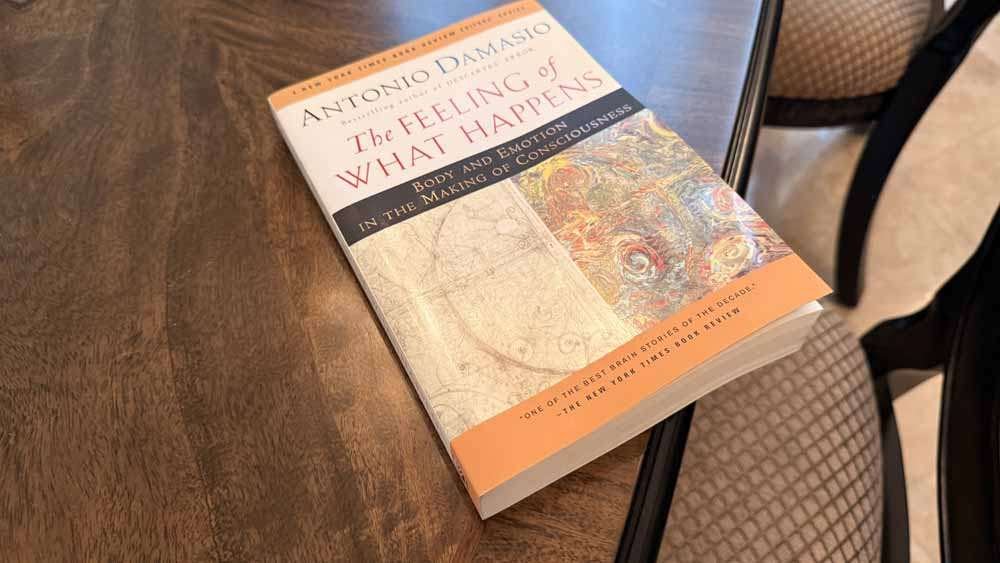
Antonio Damasio wrote The Feeling of What Happens to show you just how badly that premise has aged.
What the Book Is Actually About
Published in 1999, the book sits at the intersection of neuroscience and philosophy of mind. Damasio — a neurologist at the University of Iowa at the time, now at USC — spent years studying patients with specific kinds of brain damage, and what he found kept pointing in the same uncomfortable direction. People who lost the ability to feel emotion didn’t become more rational. They became worse at making decisions. Stripped of the very thing Descartes had warned us to distrust, they couldn’t navigate ordinary life. They’d spend forty-five minutes deciding where to eat lunch. They’d make ruinous choices, serially, without apparent distress. The signal that everyone assumed was noise turned out to be load-bearing.
The book builds this argument carefully across three interlocking claims. First, that the body and brain are a single integrated system, not master and instrument. Second, that emotion and feeling are not the same thing — emotion is the outward biological process, feeling is the private inner report of that process — and this distinction matters enormously. Third, that consciousness itself — the sense of being a self having an experience — is constructed from the body’s continuous internal reporting. You know you exist because your body keeps telling you how it’s doing. Cut that signal, and the self begins to dissolve.
Somatic Markers and the Gut That Thinks
The concept at the heart of the book is the somatic marker — Damasio’s term for the bodily signal that precedes and shapes deliberate reasoning. Before you consciously weigh the pros and cons of a decision, your body has already voted. A flutter in the chest. A slight nausea. A physical sense of rightness or wrongness that arrives faster than language. These are not distractions from thinking. According to Damasio, they are the scaffolding on which thinking runs.
This is where the book gets genuinely unsettling, because it doesn’t just challenge how we understand pathological cases. It challenges how we understand ordinary cognition — the everyday experience of making a call, following an instinct, knowing something without being able to say how. What you call a gut feeling isn’t a failure of analysis. It’s an earlier, faster, evolutionarily older form of analysis, running in parallel with the cortex and feeding results upward.
The philosopher in me wants to read this alongside Heidegger’s Stimmung — the concept of mood as the pre-cognitive attunement that shapes how the world discloses itself to us before reflection begins. Damasio lands on similar territory from a completely different direction. Where Heidegger arrived through phenomenological analysis, Damasio arrives through lesion studies and neuroimaging. They’re describing, I think, the same underlying structure from opposite ends.
Consciousness as the Body’s Self-Portrait
The later sections of the book are the most philosophically ambitious, and the most demanding. Damasio wants to explain consciousness — not just emotion, not just decision-making, but the actual felt sense of being a subject. His answer is layered. There is a proto-self, a moment-to-moment neural map of the body’s internal state. There is core consciousness, the flash of subjectivity that arises when the organism registers how an object is changing the proto-self. And there is extended consciousness, the narrative, autobiographical self that requires memory and language and allows you to locate yourself in a continuous story.
What strikes me about this architecture is its fragility — and how much of it depends on the body remaining legible to itself. Damasio’s patients with damaged insula and anterior cingulate cortex don’t just lose emotional coloring. They lose the sense of ownership over their own mental states. They become, in a clinical and terrifying sense, strangers to themselves. The self, Damasio argues, is not a fixed entity lodged somewhere in the brain. It is an ongoing act of construction, rebuilt moment to moment from bodily signals. Which means it can be interrupted. It can degrade. And it requires the full participation of the body to hold itself together.
This is a long way from Descartes’ cogito — the one thing he thought could not be doubted. Damasio suggests that even the certainty of I think, therefore I am depends on a felt body doing the thinking.
Where It Strains
The book is not without friction. Damasio writes in a style that is lucid but occasionally circular — he circles the same terrain from multiple directions, which helps with comprehension but can make the argument feel longer than it needs to be. Some of the neuroscientific detail, particularly around the brain structures involved in consciousness, has also been revised and contested in the decades since publication. The full neural account of consciousness remains genuinely open, and Damasio’s framework, while powerful, is one serious proposal among several. Readers looking for settled answers won’t find them here — though that is perhaps not the book’s fault so much as the nature of the problem.
There is also a quiet tension in the book between the descriptive and the philosophical. Damasio is careful, professionally careful, to stay close to the evidence. But the implications of his argument — for ethics, for law, for how we educate children, for how we understand moral intuition — press constantly against the margins of what he’s willing to claim. You finish the book feeling that the full philosophical consequences are still waiting to be drawn out.
Why It Still Holds
Twenty-five years on, The Feeling of What Happens reads less like a bold hypothesis and more like a corrective that has been quietly absorbed into the culture without ever quite getting the credit it deserves. The language of somatic markers has filtered into behavioral economics, into clinical psychology, into design thinking, into the way coaches talk about athletic intuition. The idea that emotion is information rather than interference has become something of a consensus position, at least in the more empirically grounded corners of psychology. Damasio helped put it there.
For anyone who has engaged seriously with evolutionary biology — readers who have spent time with The Selfish Gene or On the Origin of Species — Damasio reads as a necessary downstream chapter. Darwin showed us that cognition is continuous with biology. Dawkins showed us that behavior is shaped by deep evolutionary pressures operating below the level of conscious intention. Damasio shows us where those pressures live in the brain, and what happens when the circuitry breaks. The three books belong on the same shelf.
For anyone working through the existentialists — anyone who has sat with Nietzsche’s Zarathustra or the enclosed world of Sartre’s No Exit — the book opens a different kind of conversation. The existentialists were deeply interested in the body as the site of existence, in anxiety as a form of knowing, in authenticity as something that must be felt rather than merely reasoned toward. Damasio gives that tradition a neuroscientific foundation it never asked for but might have welcomed.
The Argument That Stays With You
The most lasting contribution of the book may be the simplest: the demonstration that you cannot separate what you know from how you feel. Not because feeling is a shortcut to knowledge, but because feeling is a form of knowledge — older, faster, and in many respects more accurate than the slow deliberative reasoning we’ve been taught to privilege. The body is not a vehicle for the mind. It is the condition of the mind’s possibility. And that changes, if you take it seriously, almost everything downstream.
Descartes was wrong. And it took four centuries, a neurologist with exceptional patients, and a willingness to follow the evidence wherever it pointed to prove it.
Sources
- Damasio, Antonio. The Feeling of What Happens: Body and Emotion in the Making of Consciousness. Harcourt Brace, 1999. https://www.penguinrandomhouse.com/books/331211/the-feeling-of-what-happens-by-antonio-damasio/
- Damasio, Antonio. “Descartes’ Error: Emotion, Reason, and the Human Brain.” Putnam, 1994. https://www.penguinrandomhouse.com/books/236660/descartes-error-by-antonio-damasio/
- Heidegger, Martin. Being and Time. Harper & Row, 1962 (orig. 1927). https://www.harpercollins.com/products/being-and-time-martin-heidegger
- LeDoux, Joseph. The Emotional Brain. Simon & Schuster, 1996. https://www.simonandschuster.com/books/The-Emotional-Brain/Joseph-LeDoux/9780684836591
- Bechara, Antoine, Damasio, H., Damasio, A. R. “Emotion, Decision Making and the Orbitofrontal Cortex.” Cerebral Cortex, 2000. https://academic.oup.com/cercor/article/10/3/295/433847