Most briefcases sold today are theater. The frame is pressed cardboard. The “leather” is a polyurethane film stretched over bonded scraps, glued in place, and destined to peel at the corners within two years. The buckles are cast zinc. The stitching is machine-run nylon, every hole punched and threaded in seconds by a process that couldn’t care less about tension or alignment. You buy it. It looks the part. Then it falls apart, and you buy another one. That’s the business model.
English bridle leather briefcases are not that business model. They are the direct opposite of it — structurally, philosophically, and in terms of what they actually do to your hand when you pick one up. The weight alone tells you something has changed.
This post covers the full story: what English bridle leather is, where it comes from, why the tanning process it requires cannot be rushed, and what separates a briefcase built from it — from anything else on the market. It is also the definitive guide to how Marcellino NY builds its cases, from the first cut of hide to the final edge burnish, and why a six-month lead time is not an inconvenience. It is the proof.
What English Bridle Leather Actually Is
The name comes from its original application. Bridle leather was developed in England to outfit horses — reins, harnesses, saddle straps — equipment that needed to flex under load, resist water, and hold its integrity under years of sustained pressure. The leather had to be firm without being brittle. Strong without being stiff. Alive enough to move, but structured enough to hold.
To achieve that, English tanneries developed a process called pit tanning — specifically, a bark-tannage using oak galls and tree bark extract — that pulled the tanning agents slowly and deeply into the hide. Not quickly. Not efficiently. Slowly. A full-grain hide submerged in progressively stronger tanning pits over a period of weeks, sometimes months, until the collagen fibers throughout the entire cross-section of the hide were fully saturated and stabilized.
This is the key distinction. Chrome tanning — which accounts for roughly 80 to 90 percent of all leather produced globally — deposits chromium sulfate salts into the hide in hours. It is fast, inexpensive, and produces a soft, flexible leather with consistent color. It also produces leather that, at a microscopic level, has been tanned only partially — the surface and mid-layers, but not necessarily the full depth. Over time, chrome-tanned leather dries from the inside out. It cracks. The fibers lose cohesion. A chrome-tanned briefcase exposed to five years of commuting humidity, summer heat, and daily loading cycles will show its age badly.
Vegetable tanning — the category that bark tanning falls under — produces leather with an entirely different internal structure. The tannins bond with the collagen at a molecular level throughout the full thickness of the hide. The result is leather that is denser, firmer, and capable of developing a patina rather than degrading. It does not peel. It does not crack under normal use. It darkens, deepens, and becomes more itself over decades of use.
English bridle leather takes vegetable tanning and pushes it one step further. After the tanning pits, the hides are subjected to a process called “stuffing” — worked with hot tallow, beeswax, and neatsfoot oil that are driven into the fibers under heat and pressure. This creates a leather that is internally lubricated at the fiber level, resistant to moisture penetration, and capable of maintaining structural integrity under sustained mechanical stress. The surface has a characteristic waxy bloom — a white haze that forms on the surface and wipes off to reveal a deep, burnished finish underneath. That bloom is not a flaw. It is the visible evidence of the fat-liquoring inside.
For a deeper understanding of the pit-tanning process and the English tannery tradition, see English Bridle Leather: Sedgwick Tannery and the Last of the Old World Tanners — and for a direct comparison of how vegetable and chrome tanning differ in practice and longevity, read Vegetable Tanning vs. Chrome Tanning: What You’re Actually Paying For.
Where the Leather Comes From: Sedgwick & Co.
There are very few tanneries in the world still producing genuine English bridle leather. One of the oldest and most respected is Sedgwick & Co., a Walsall-based tannery operating since 1870. Sedgwick produces bridle leather for saddlers, harness makers, and a small number of leather goods makers who demand the real thing. Their process has not changed in any essential respect from the one their founders used. The pits are the pits. The bark is the bark. The time is the time.
Marcellino NY sources exclusively from Sedgwick. This is not a marketing decision. There is no substitute for this material at this quality level. The hides arrive already stuffed, already firm, already bloomed. A Marcellino craftsman picking up a panel of Sedgwick bridle leather for the first time understands immediately why every other leather on the market is a compromise. The density is different. The weight is different. The way it resists the knife and then yields cleanly at the cut — it is different in a way that is immediately physical.
Full-Grain: The Only Grade That Matters for This Application
Before a Sedgwick hide ever reaches a cutting table, it has been selected. English bridle leather starts as full-grain cowhide — the topmost surface of the hide, with the natural grain structure intact. No sanding. No buffing. No correction. The surface you see is the surface that existed on the animal.
This matters for reasons that go beyond aesthetics. The grain layer of a hide is the densest, most tightly interlocked layer of collagen fibers in the entire cross-section. It is the layer that evolved to resist abrasion, puncture, and moisture. When you sand it down — as is done with “top grain” leather to remove scars and blemishes and produce a uniform surface — you remove precisely the layer that made the leather durable. What remains beneath it is softer, less dense, and structurally inferior.
Genuine leather, the lowest grade, is not leather at all in any meaningful sense. It is the compressed fibrous underside of a split hide, bonded with adhesive, and surfaced with polyurethane. It will last roughly as long as any other consumer product is designed to last — long enough to get through the return window, not much longer.
The Full Grain vs. Top Grain vs. Genuine Leather post breaks down exactly what each grade means structurally and why the distinction matters when you’re buying something you intend to carry for thirty years. Understanding this before you buy anything made of leather is not optional — it is the single most important piece of information available to any informed buyer.
The Anatomy of a Marcellino NY Briefcase
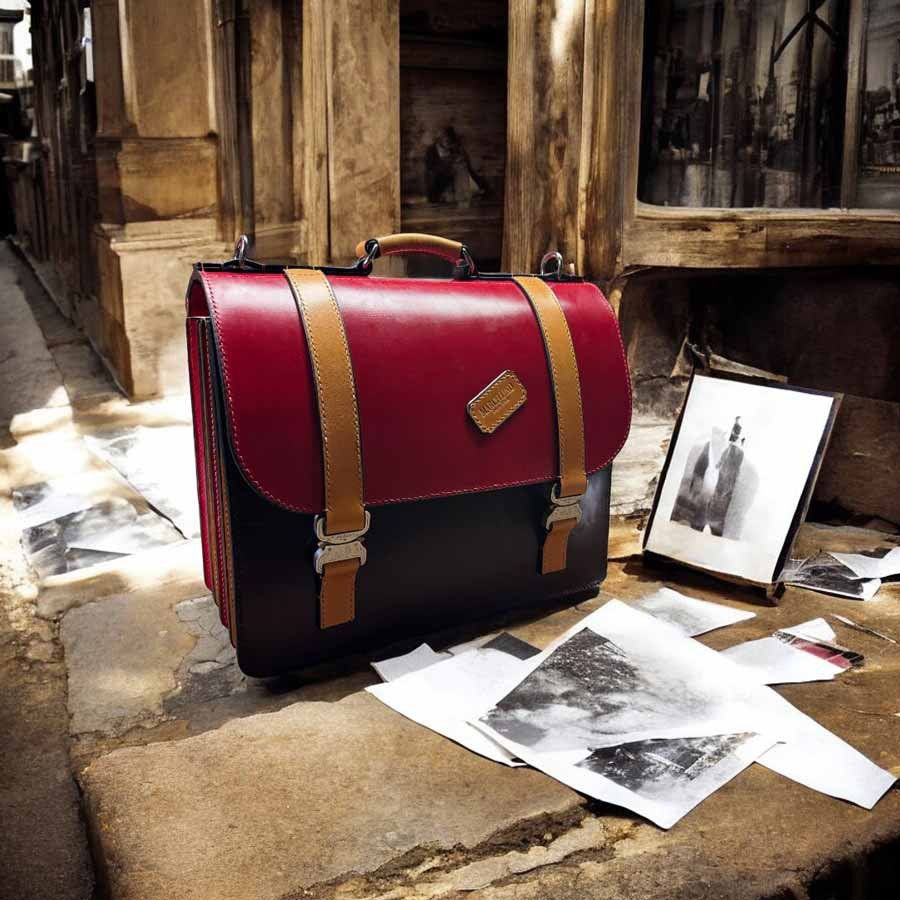
A Marcellino NY English bridle leather briefcase is not assembled. It is constructed. The distinction is not rhetorical.
Assembly describes a process where standardized components are joined by workers following a repeatable sequence. It is efficient, consistent, and appropriate for high-volume production. Construction describes a process where a single craftsman takes responsibility for every structural decision a piece requires — how a panel is oriented relative to the hide’s spine for maximum strength, how much allowance to leave at a corner before turning the edge, where a stitch line must run to distribute load across a gusset evenly under weight. These are not decisions a machine makes. They are not decisions a line worker following a template makes. They are decisions made by a craftsman who understands what the briefcase is going to be asked to do for the next several decades.
The internal frame of a Marcellino case uses no cardboard, no chipboard, no plastic stiffeners. The structure comes from the leather itself — the same quality of structure that allowed a English bridle harness to hold a horse at full gallop. The gusset is cut from the same hide as the body panels, oriented so the fiber direction runs perpendicular to the stress axis. The handles are built up in layers — not single-ply with decorative stitching over the top, but laminated panels of bridle leather that develop load-bearing strength across multiple fiber orientations.
For the complete breakdown of how each structural component is designed and built, see Anatomy of a Bespoke Briefcase: How a Marcellino NY English Bridle Leather Case Is Built by Hand.
Saddle Stitching: The Seam That Does Not Fail
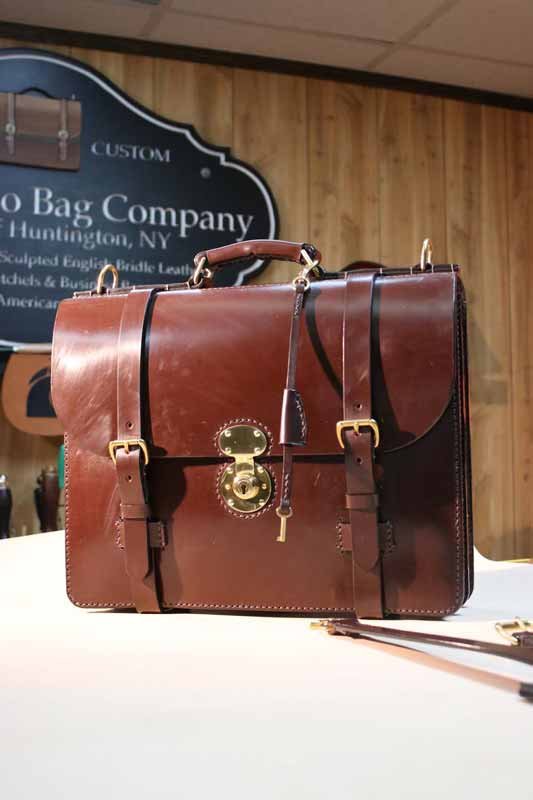
Every seam on a Marcellino NY briefcase is saddle stitched by hand. This requires two needles, one thread, and a level of manual engagement that machine stitching cannot replicate or replace.
In saddle stitching, the thread passes through each pre-awled hole in a figure-eight pattern — one needle through from each side, the thread crossing inside the thickness of the leather. This produces a seam where each stitch is independently locked. If one stitch breaks, the seam holds. The thread on either side of the break is not free to run or unravel. The failure is local and contained.
Compare this to the lockstitch produced by a standard industrial sewing machine. In a lockstitch seam, the upper and lower threads are looped around each other at every stitch. When one stitch breaks — as happens under repeated mechanical stress — the loop is freed, and the stitch on either side can begin to unravel. A machine-stitched seam on a briefcase under daily load does not fail all at once. It fails incrementally, stitch by stitch, until the seam opens.
Saddle stitching also produces a physical mark that is readable to anyone who knows what they are looking for. The diagonal angle of each stitch in a hand-saddle-stitched seam is controlled by the craftsman’s tension and angle. Every stitch is slightly different from every other stitch. A machine-stitched seam is optically uniform. That uniformity is not a sign of quality — it is a sign of automation.
The full technical case for saddle stitching, and what it looks like on a finished piece versus machine work, is covered in The Lost Art of Saddle Stitching: Why Machines Can’t Replicate the Soul of a Hand-Sewn Seam.
Hardware: Solid Brass and Nothing Else
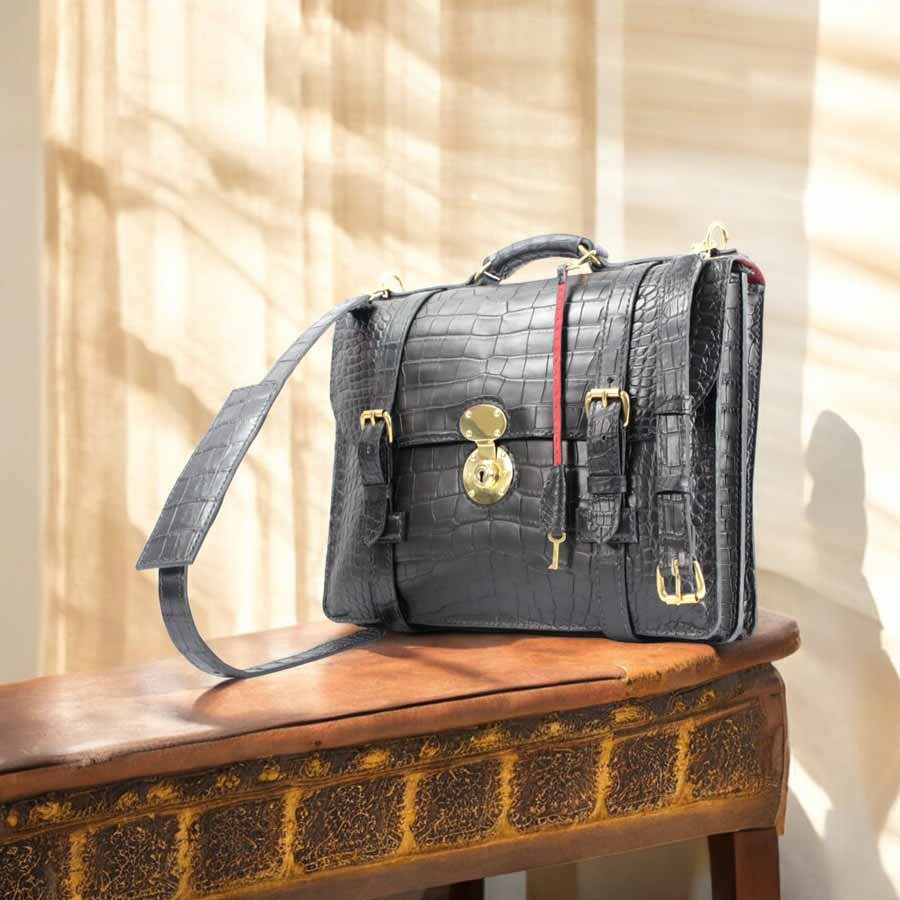
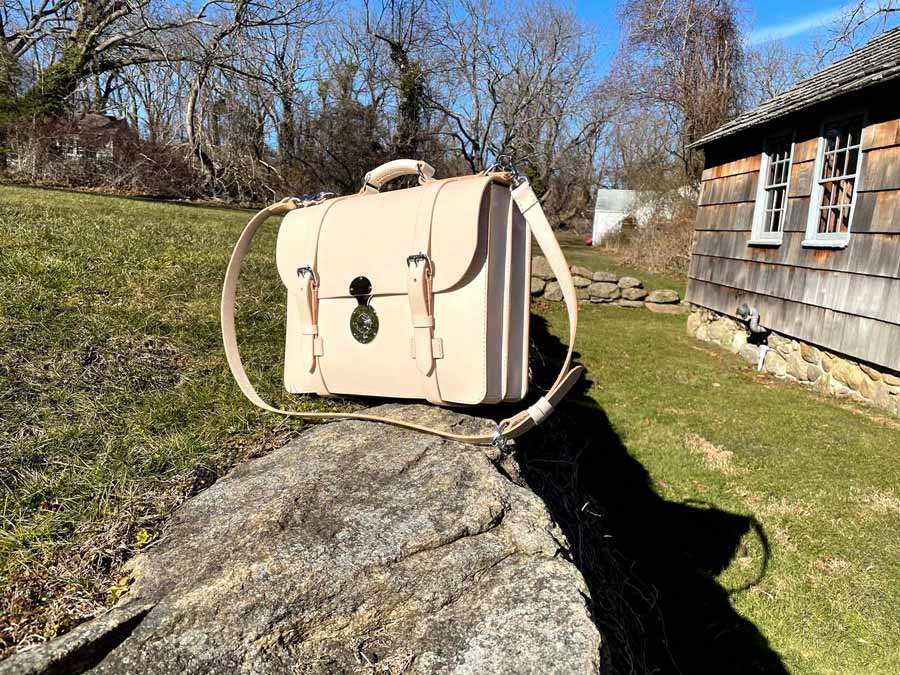
The buckles, D-rings, and closures on a Marcellino NY briefcase are solid brass. Not brass-plated. Not zamak with a yellow finish. Solid brass — an alloy that does not rust, does not corrode under normal atmospheric conditions, develops its own patina over time, and will outlast the leather it is attached to if the leather is properly maintained.
Zamak is a zinc-aluminum-magnesium alloy used to cast hardware for the majority of the briefcase market. It is inexpensive to produce, takes plating well, and looks identical to brass hardware when new. Under sustained use — contact with sweat, humidity cycling, mechanical wear — zamak hardware begins to pit, the plating separates, and the underlying alloy corrodes. A zamak buckle on a briefcase carried daily in a New York City commute will show its failure within three to five years. A solid brass buckle carried under the same conditions will age gracefully for as long as the briefcase exists.
For more on how bespoke hardware functions as a structural and aesthetic component of a high-end leather case, see Bespoke Hardware: How High-End New York Artisans Utilize Solid Brass and Palladium.
The Six-Month Lead Time Is Not the Problem. It Is the Point.
Marcellino NY operates on a commission basis with lead times that typically run six months or longer. For a market conditioned by next-day delivery, this seems like a liability. It is the opposite.
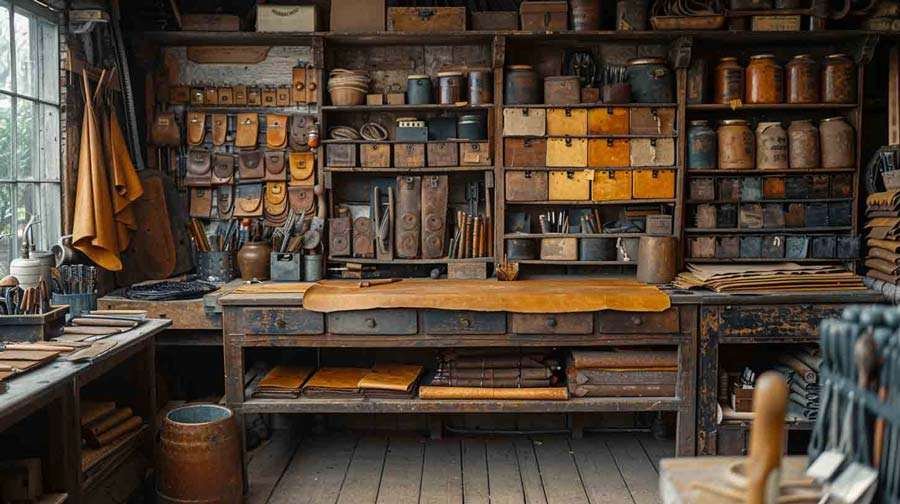
A six-month lead time means the piece is made to your specifications, built start to finish by a craftsman who has time to do it correctly, and not one of forty identical units moved through a production line to hit a quarterly shipping target. The leather has been selected, not pulled from a bin. The stitching is not a speed exercise. The edge finishing — the burnishing and waxing that seals every cut edge against moisture infiltration and fraying — is done to a standard that would be economically impossible at volume.
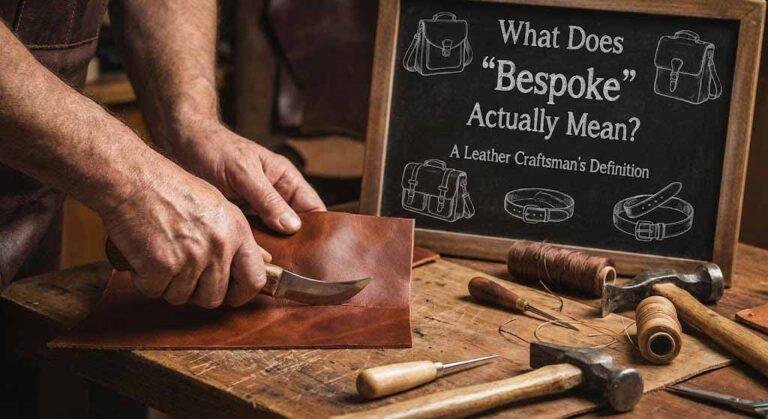
It also means the object you receive is genuinely bespoke. Not bespoke in the marketing sense — not a monogram embossed on a factory bag and called custom. Bespoke in the original sense: spoken for in advance, made to order, not available to anyone else in the same configuration. If you want a deeper look at what that word actually means and how it has been systematically diluted by the fashion industry, read The Word They Stole: What ‘Bespoke’ Actually Means, From a Man Who Still Stitches Every Hole by Hand.
The broader philosophy behind building leather goods that outlast their owners — the 100-year object, the anti-consumption argument made in craft — is explored in A Briefcase That Outlives You: The 100-Year Leather Goods Philosophy.
How Marcellino NY Compares to the Field
The leather briefcase market contains a wide range of options at different price points and with different claims to quality. Understanding where Marcellino NY sits in that field — and why — requires looking at the actual differences in material, construction, and philosophy, not just price.
Marcellino NY vs. Frank Clegg examines two American makers with genuinely similar commitments to hand craftsmanship, and where their philosophies diverge. Marcellino NY vs. Ghurka compares an American bespoke operation to a heritage brand that has moved significantly toward import production. Marcellino NY vs. Swaine Adeney Brigg looks at the English tradition itself and who is carrying it forward — the 300-year-old British house, or the American maker who is still cutting by hand on Long Island. The Marcellino NY vs. Berluti and Marcellino NY vs. Bottega Veneta posts address the European luxury market specifically — what you are paying for in those price categories, and whether the craft justifies it.
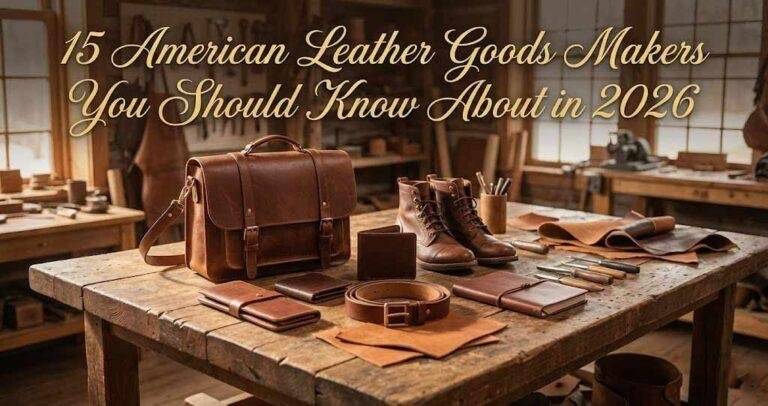
For a broader look at the American leather goods landscape and where genuine craft still exists, see 15 American Leather Goods Makers You Should Know About in 2026 and Why American-Made Leather Goods Cost More (And Why It’s Worth It).
What to Look For When Buying Any English Bridle Leather Briefcase
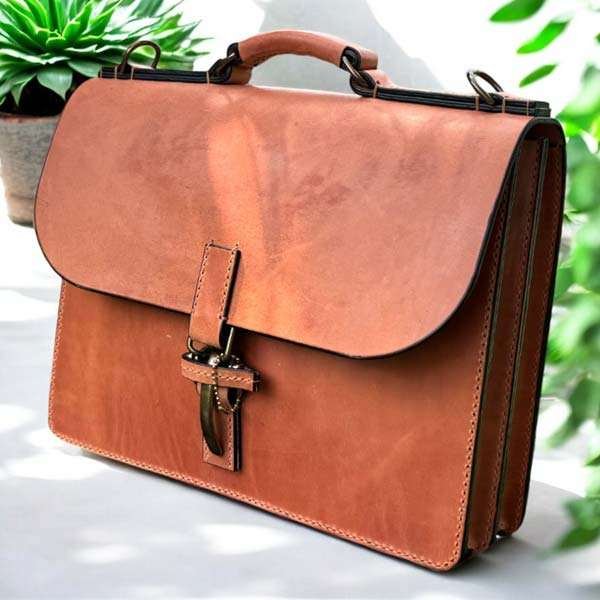
If you are evaluating any briefcase sold as English bridle leather — from Marcellino NY or from any other maker — these are the things that actually matter:
Tannage verification. Ask specifically where the leather was sourced and how it was tanned. “Full-grain” and “vegetable-tanned” are not the same as English bridle leather. English bridle leather is a specific type of vegetable-tanned, stuffed hide. Sedgwick & Co. in Walsall is the most well-known producer. If a maker cannot tell you the tannery, that is an answer.
The waxy bloom. New English bridle leather will have a surface bloom — a whitish haze that is the surface expression of the internal fat-liquoring. This wipes off. If a briefcase sold as bridle leather has no bloom and feels immediately soft and supple, it is likely a standard vegetable-tanned or chrome-tanned hide, not bridle.
Edge treatment. Cut edges on a bridle leather briefcase should be burnished — rubbed smooth with a wood slicker under friction heat and sealed with beeswax or a water-based edge paint. An unfinished or raw-painted edge on a piece sold at premium prices is a warning.
Stitching angle. Turn the briefcase over and look at the seams. Hand saddle stitching has a visible diagonal slant to each stitch and slight variation in spacing. Machine lockstitching is perfectly uniform with no diagonal. The former takes hours per seam. The latter takes seconds.
Hardware weight. Solid brass hardware has a specific weight and density. Hold the buckle in your palm. If it feels light — lighter than a belt buckle, lighter than a coin — it is probably zinc alloy.
Internal structure. Press the back panel of the body between your thumb and fingers. English bridle leather at a proper thickness for a briefcase will resist this pressure firmly. It should not flex easily. If it gives with light pressure, the leather is either too thin, improperly tanned, or internally reinforced with something that is not leather.
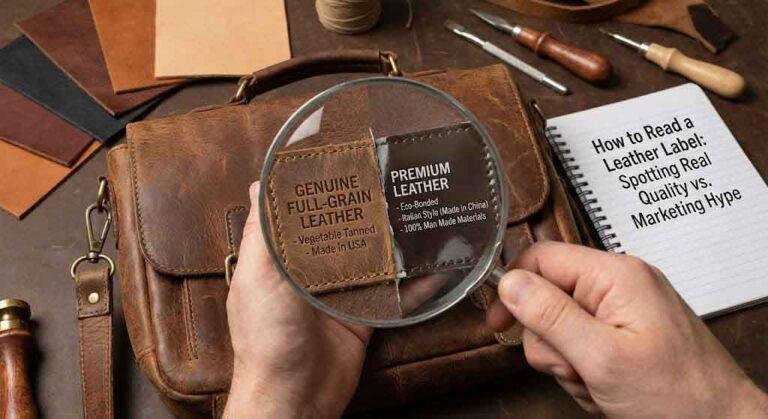
For a practical guide to reading what labels and marketing language actually mean when shopping leather goods, see How to Read a Leather Label: Spotting Real Quality vs. Marketing Hype and Why Your $500 Briefcase Uses Cardboard (And How to Tell).
The Patina Argument
English bridle leather does not age. It develops. These are different things.
A chrome-tanned briefcase ages — the surface coating breaks down, the fibers beneath dry out, the structure softens and eventually collapses. The piece becomes less than it was.
An English bridle leather briefcase develops — the surface darkens and deepens with handling oils, the structure remains intact and in some respects improves as the internal fats continue to condition the fibers, the hardware acquires a patina that references the specific history of that object. A Marcellino NY briefcase carried daily for ten years is not a ten-year-old object. It is an object that has ten years of documented use on its surface and is structurally no closer to failure than it was when new. This is what the leather industry means when it talks about heirloom goods — and it is why A Briefcase That Outlives You is not a marketing claim. It is a material fact.
For the North Shore perspective on how full-grain leathers hold up in coastal humidity and salt air specifically, see The Patina of the North Shore: Sourcing Full-Grain Leathers for Coastal Climates.
Starting a Commission
Marcellino NY commissions begin at marcellinony.com. The process starts with a consultation — dimensions, configuration, hardware preference, thread color, any structural customizations. Lead times are quoted at the time of commission and have historically run six months or longer depending on current workload.
This is not the place to start if you need a briefcase by Friday. It is the right place to start if you intend to carry the same briefcase for the rest of your career and hand it to someone when you are done with it.
You Might Also Like
- Anatomy of a Bespoke Briefcase: How a Marcellino NY English Bridle Leather Case Is Built by Hand
- What Your Briefcase Says About You: A New York Professional’s Guide
- Long Island’s Hidden Artisan Economy: From Leather Workers to Oyster Farmers
Sources
- Sedgwick & Co. — Walsall, England
- Waterer, J.W. Leather and Craftsmanship. Faber and Faber, 1950.
- Thomson, R.H. “Vegetable Tannins.” Recent Advances in Phytochemistry, Vol. 1. Appleton-Century-Crofts, 1968.
- Covington, A.D. Tanning Chemistry: The Science of Leather. Royal Society of Chemistry, 2009. https://doi.org/10.1039/9781847559913
- Leather Working Group — Tanning Process Overview. https://www.leatherworkinggroup.com/
- The Worshipful Company of Leathersellers — Historical Records. https://www.leathersellers.co.uk
- Marcellino NY — marcellinony.com