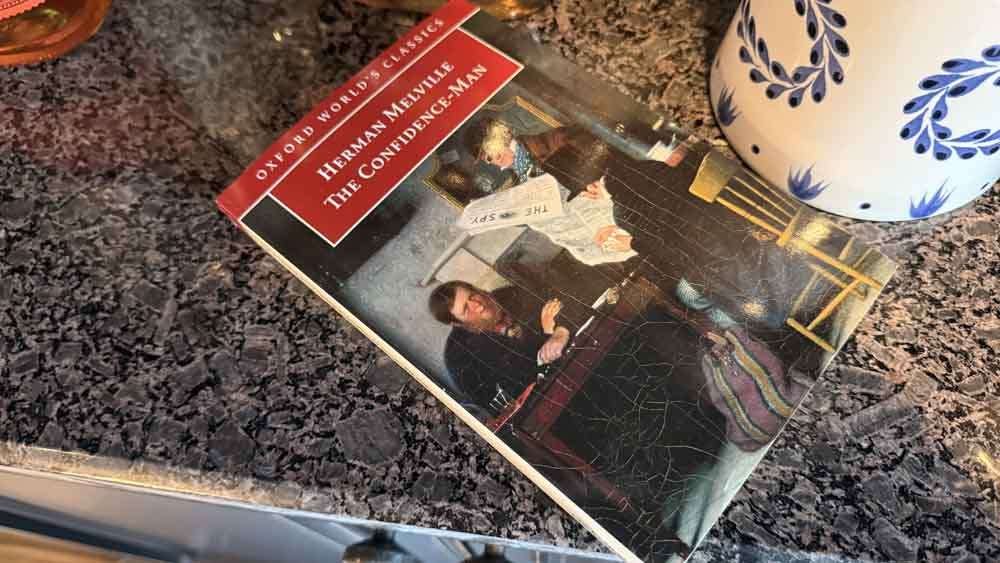
Every April Fools’ Day, a stranger boards a Mississippi steamboat. He changes his face, his name, his story. Sometimes he’s a crippled Black man begging for coins. Sometimes he’s a transfer agent for a mining company. Sometimes he’s a cosmopolitan philosopher dispensing warmth and wisdom. He is all of them. He is none of them. And by the end of Herman Melville’s The Confidence-Man: His Masquerade, published in 1857, you’re not entirely sure whether you’ve been conned, enlightened, or both.
This is the book Melville wrote after Moby-Dick failed commercially. After the critics turned on him. After the public decided they didn’t want what he was actually selling. Which is perhaps the only fitting origin story for a novel about a country that mistakes salesmanship for virtue and optimism for wisdom.
April Fools, April Faith
The date matters. Melville sets the entire novel on April 1st — April Fools’ Day — and he’s not subtle about it. Every transaction on the Fidèle (the ship’s name means “faithful” in French — Melville was not a man who did things accidentally) is a test of credulity. The passengers are asked, again and again, to have confidence. To trust. To give. The con man’s great weapon is not cleverness. It’s the social pressure not to seem suspicious. Not to be the cynic in the room.
This is what made the book feel, when I first read it, like it had been written last week. The steamboat moves down the Mississippi — democracy in motion, America in microcosm — and the game being played is the same game that gets played in every transaction between strangers. How much do you believe? How much do you demand proof? And what does your answer say about you?
The Theology of Trust
Melville frames confidence — the act of trusting a stranger — as a kind of secular religion. His confidence man is a shape-shifter whose ultimate argument is always the same: a person who demands evidence before extending faith is a lesser human being. Suspicious. Cold. Un-Christian. He weaponizes the American gospel of optimism. He turns goodwill into a lever.
It’s a devastating observation. Because Melville isn’t saying trust is bad. He’s saying that trust weaponized as social obligation — trust you’re shamed into, trust you perform to appear moral — is a machine that runs on the goodness of ordinary people and enriches whoever controls the mechanism. The con man on the Fidèle never threatens anyone. He never lies outright. He manipulates the way a culture manipulates: through expectation, through the implied judgment of your peers, through the suggestion that doubt is a character flaw.
I’ve run a diner on Long Island’s North Shore for twenty years, and I’ve watched enough transactions between strangers to know that Melville had it right. People don’t get conned because they’re stupid. They get conned because they want to be the kind of person who believes in people.
The Darkness Behind the Optimism
What unnerves readers — what has always unnerved readers — is that Melville never identifies the con man as evil. He gives the reader no comfortable villain. The confidence man might, in certain lights, be the most honest character in the book. He at least knows the game is being played. The passengers, with their genteel faith and their small donations, are participating in their own manipulation without ever quite seeing it.
Nietzsche would have appreciated the move. In Thus Spoke Zarathustra, Zarathustra warns against the man who flatters the crowd — who tells people what they want to hear to extract what he needs. Melville’s confidence man is that figure dressed in American democratic clothes. He doesn’t rule by force. He rules by making you feel good about handing him your wallet.
The Missouri Bachelor is the only passenger who consistently refuses to bite. He is crude, suspicious, combative — and Melville writes him not as a hero but as a kind of tragic figure. His immunity to the con has cost him his capacity for warmth. Melville’s point is not that the cynics win. His point is that the choice between naive faith and corrosive suspicion is itself the trap. The Fidèle offers no third option.
Masquerade as American Identity
The confidence man wears nine different faces across the novel. Scholars have argued for decades about whether they’re all the same figure or different ones — Melville leaves it genuinely ambiguous. That ambiguity is the novel’s deepest argument. In a country built on self-invention, on the idea that you can arrive as one thing and become another, the masquerade isn’t a crime. It’s the founding mythology.
Benjamin Franklin invented himself. Andrew Carnegie invented himself. The entire promise of the New World was that origin doesn’t define you — performance does. What you can make people believe you are is, in some meaningful sense, what you are. The confidence man just takes that premise to its logical end. He is the American Dream with the mask off. Or maybe with another mask on. It’s hard to tell.
Melville published this novel on April 1, 1857. Within weeks, the country entered a severe financial panic. Banks failed. Speculation had run wild. People had extended confidence to institutions and instruments they didn’t understand, because to seem suspicious was to seem unsophisticated. Melville didn’t predict the Panic of 1857. He diagnosed the conditions that made it inevitable.
Why It Failed and Why That Matters
The book sold almost nothing. Contemporary reviewers were baffled or dismissive. The London Illustrated Times called it “a book of masquerades.” The New York Day Book thought it nihilistic. Nobody wanted to sit with a novel that offered no resolution, no villain to punish, no confidence to be rewarded. Melville was asking readers to look at the engine underneath American optimism, and American optimism, by definition, doesn’t want to look at its own engine.
He never published another novel. He spent the last decades of his life as a customs inspector on the New York docks — a man whose job was, appropriately, to decide what was real and what was being smuggled. He died in 1891 nearly forgotten. The Confidence-Man wasn’t seriously reassessed until the twentieth century, when scholars began to understand that Melville hadn’t failed to write an entertaining novel. He’d succeeded in writing an uncomfortable one.
Reading It in 2020
Pick this book up now and you will feel the specific chill of recognition. The confidence man’s pitch — trust me, what do you have to lose, are you really going to be the one person who doesn’t believe — runs through every screen you look at. The masquerade doesn’t require a steamboat. It scales.
What Melville understood, and what the book transmits across 160 years with undiminished force, is that the con doesn’t work on greed. It works on virtue. It works on the human desire to be a person who gives people the benefit of the doubt. The moment you understand that, you understand why it never really goes away. The machine runs on the best part of us.
That’s the harder thing. Not that there are confidence men in the world. That they need us to be good.
You Might Also Like: Thus Spoke Zarathustra by Friedrich Nietzsche | No Exit by Jean-Paul Sartre
Sources
- Melville, Herman. The Confidence-Man: His Masquerade. Oxford World’s Classics. Oxford University Press, 2009. https://global.oup.com/academic/product/the-confidence-man-9780199555048
- Tanner, Tony. Introduction to The Confidence-Man. Oxford World’s Classics, 1989. (Reprinted in OUP editions.)
- Parker, Hershel. Herman Melville: A Biography, Volume 2, 1851–1891. Johns Hopkins University Press, 2002.
- Levine, Robert S., ed. The Cambridge Companion to Herman Melville. Cambridge University Press, 1998. https://www.cambridge.org/core/books/cambridge-companion-to-herman-melville/
- Branch, Watson G. Melville: The Critical Heritage. Routledge, 1974.