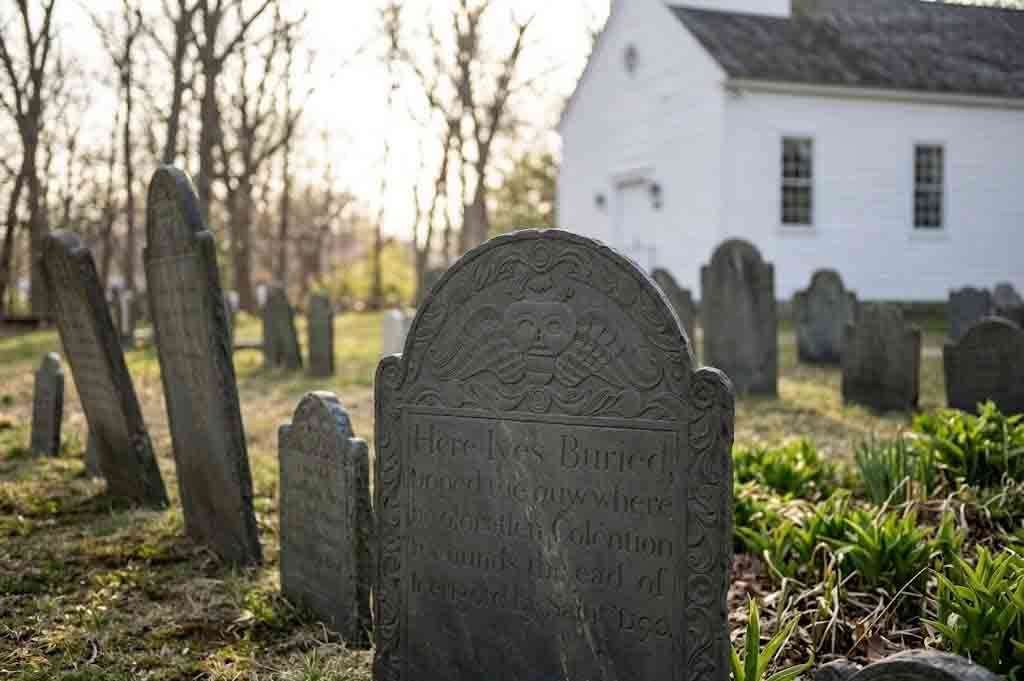
Walk through the burial ground at Caroline Church in Setauket — the one where bullet holes from the Battle of Setauket still scar the walls of the sanctuary next door — and you’re surrounded by messages. Not inscriptions. Not the familiar “Here Lies” and the dates that follow. The messages are carved into the stone itself, in images: grinning skulls sprouting wings, weeping trees bent toward urns, hands locked in a grip that neither party can release. Most locals walk past them every day without a second thought. A few stop and wonder. Almost nobody can read them anymore.
That’s the strange thing about a visual language. It only works as long as the living remember what the dead were trying to say.
The Death’s Head: When Puritans Stared Mortality in the Face
The oldest gravestones on Long Island’s North Shore don’t comfort you. They confront you. The earliest surviving carved markers in Suffolk County — slate slabs from the early-to-mid 1700s — feature an image called the death’s head: a human skull, usually winged, with hollow eye sockets and a skeletal grin. It looks menacing to modern eyes. That was the point.
The Puritan settlers who established the first communities in Setauket, Brookhaven, and Southold didn’t believe cemeteries should make you feel better. They believed cemeteries should make you think about your own death. The death’s head was a memento mori, a Latin phrase meaning “remember that you will die.” It wasn’t morbid to them. It was honest. The blank eyes and bared teeth said what the living couldn’t bring themselves to say at the kitchen table: your time is short, your soul is accountable, and the ground beneath your feet is waiting.
Long Island had no quarriable stone of its own, so every colonial gravestone — except the rough fieldstone markers of the very poor — was imported. Archaeologist Gaynell Stone documented over 4,300 stones from 164 Long Island cemeteries in her study published in Historical Archaeology, and found that most came from workshops in New England, New Jersey, or lower Manhattan. The death’s head style that appeared on Long Island in the 1730s was already standard across New England, but the pattern of motifs here diverged. Long Island sat between two culture spheres — the English Puritan north and the Dutch colonial south — and the gravestones reflect that tension. The stones themselves were traded goods, carried by the same coastal shipping networks that moved grain and lumber and salt cod.
You can still find death’s heads in the Setauket Presbyterian Church burial ground, which was added to the National Register of Historic Places in 1996. Revolutionary War soldiers are buried there. So is Abraham Woodhull — codename Samuel Culper Sr., the farmer who anchored the Culper Spy Ring that helped George Washington outmaneuver the British. His stone doesn’t need a winged skull to carry weight. But the ones around him still do.
The Cherub: When Theology Softened the Skull
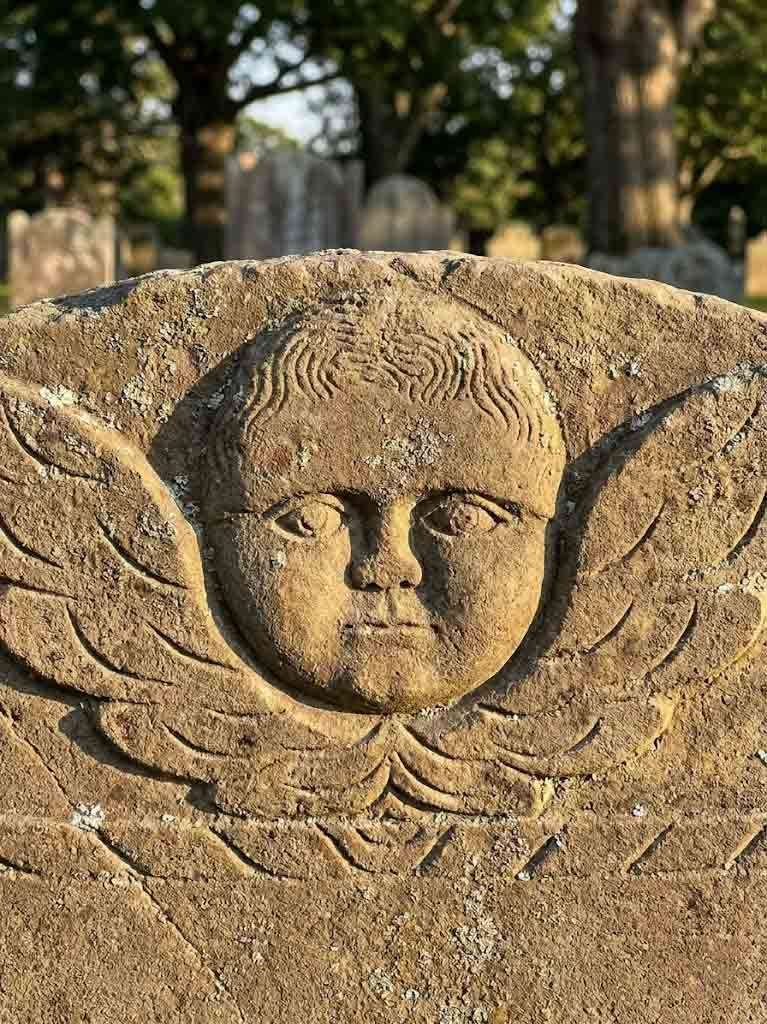
Sometime in the second half of the eighteenth century, a shift happened in the burial grounds. The death’s head didn’t vanish overnight, but its features started to change. The hollow eyes filled in. The skeletal grin became lips. The wings remained, but the face beneath them turned human — round-cheeked, sometimes smiling, unmistakably childlike. Scholars call this the soul effigy or the winged cherub, and its rise tracks directly with a theological earthquake called the Great Awakening.
Jonathan Edwards and the revivalist preachers who swept through the colonies in the 1730s and 1740s introduced a revolutionary idea: that God’s relationship with humanity wasn’t purely punitive. Love was now equal to reason. Salvation was possible not just through terror but through grace. The graveyards registered the change before the churches did. The Northport Historical Society has documented this evolution on Long Island specifically, noting how the soul effigy replaced the death’s head as communities shifted from reminding the living they would die to assuring them the dead were somewhere better.
The inscriptions shifted too. Instead of “Here lies the body of,” which emphasized the corpse in the ground, epitaphs began stressing resurrection and reunion. The language moved from the dirt to the sky.
At Caroline Church — organized in 1723 and originally named Christ Church in honor of Queen Caroline — the burial ground acquired in 1734 contains markers that span both eras. You can stand in one spot and see the skull give way to the cherub across a few decades of stone. The 2024–25 Caroline Church Cemetery Restoration Project, led by Robert von Bernewitz of the Three Village Historical Society and the Long Island Cemetery Preservation Group, cleaned and reset hundreds of these markers, making many of the carvings legible again for the first time in generations.
The Weeping Willow and the Urn: Grief Goes Classical
By the early 1800s, the cherub had given way to something else entirely: the urn and the weeping willow. This wasn’t theology anymore. This was aesthetics.
The Greek Revival swept American culture in the decades after the Revolution, and the new republic wanted its mourning to look dignified, classical, restrained. The willow — a tree that flourishes no matter how many branches are cut — became a symbol of sorrow that persists and renews. In Christian tradition, it was also linked to the gospel. The urn was purely decorative in this context; it didn’t contain ashes. Cremation was uncommon in nineteenth-century America. The urn represented the soul, and when draped with a carved cloth or veil, that fabric symbolized the barrier between the living and the dead — the thinnest membrane in the universe, the one everybody crosses exactly once.
These markers were typically carved in white marble, which was an expensive upgrade from the slate and sandstone of the colonial era. The problem is that marble weathers badly. In the corrosive salt air of Long Island Sound, many of these stones have become nearly impossible to read. The irony is brutal: the families who spent the most on permanence ended up with the most fragile monuments. The old Puritan death’s heads, carved in durable slate, often survive in far better condition than the polished marble that replaced them.
The Wreck of the Lexington in 1840 — the steamship fire that killed over 140 people in Long Island Sound — left graves scattered across North Shore communities. Many of those markers, placed in the urn-and-willow era, have deteriorated to near-illegibility. The disaster changed maritime law. The gravestones changed nothing. They just stood there dissolving, which is maybe the most honest commentary on grief that any symbol could offer.
Clasped Hands: Marriage, Brotherhood, and the Grip Beyond Death
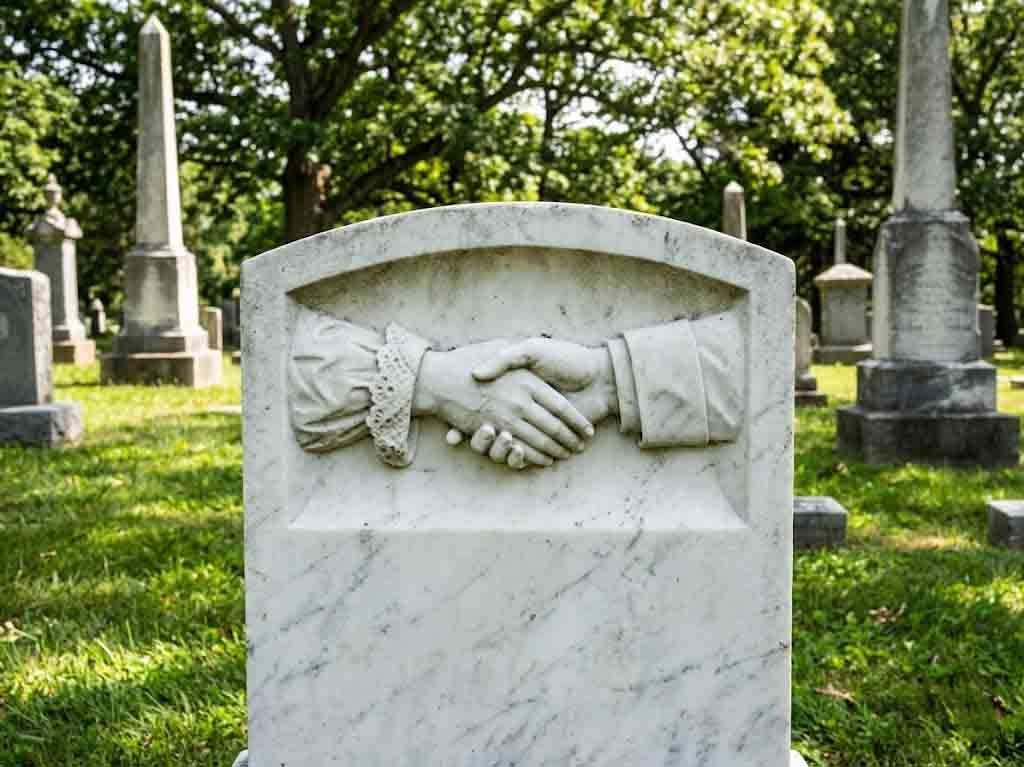
Walk into any mid-to-late nineteenth-century section of a Three Village cemetery and you’ll find them: two hands, locked in a handshake, carved into the face of the stone. They’re everywhere. And they carry more information than they appear to.
The clasped hands symbol emerged during the Victorian era’s transformation of death from a grim reality into a sentimental occasion. In ancient Rome, the handshake had symbolized loyalty and trust. By the 1800s, it appeared on tombstone after tombstone across America, representing a farewell between the living and the dead — or, more often, a promise of reunion. Historian Lynn Rainville observed that changes in attitudes toward death during this Romantic Era cut across religious lines, replacing warnings of mortality with expressions of love and comfort.
The details matter. If you look closely at the cuffs on the carved sleeves, you can often determine the gender of each figure. Straight, buttoned cuffs indicate a man. Lace or ruffled cuffs indicate a woman. When a man’s hand reaches from behind to clasp a woman’s hand, it typically means the husband died first and is welcoming his wife into the afterlife. The reverse means the reverse. On family plots, clasped hands between identical male cuffs might indicate fraternal bonds — membership in organizations like the Freemasons or the Independent Order of Odd Fellows.
Researchers Gary S. Foster and Lisa New Freeland, writing in the Journal of the Illinois State Historical Society, catalogued the range of meanings: farewell to earthly existence, reunion in heaven, matrimony, solidarity, partnership. The symbol was so versatile it could mean almost anything about human connection. Which is probably why it became the most common motif of the century.
The Masonic Square and Compass: Secret Societies in Plain Sight
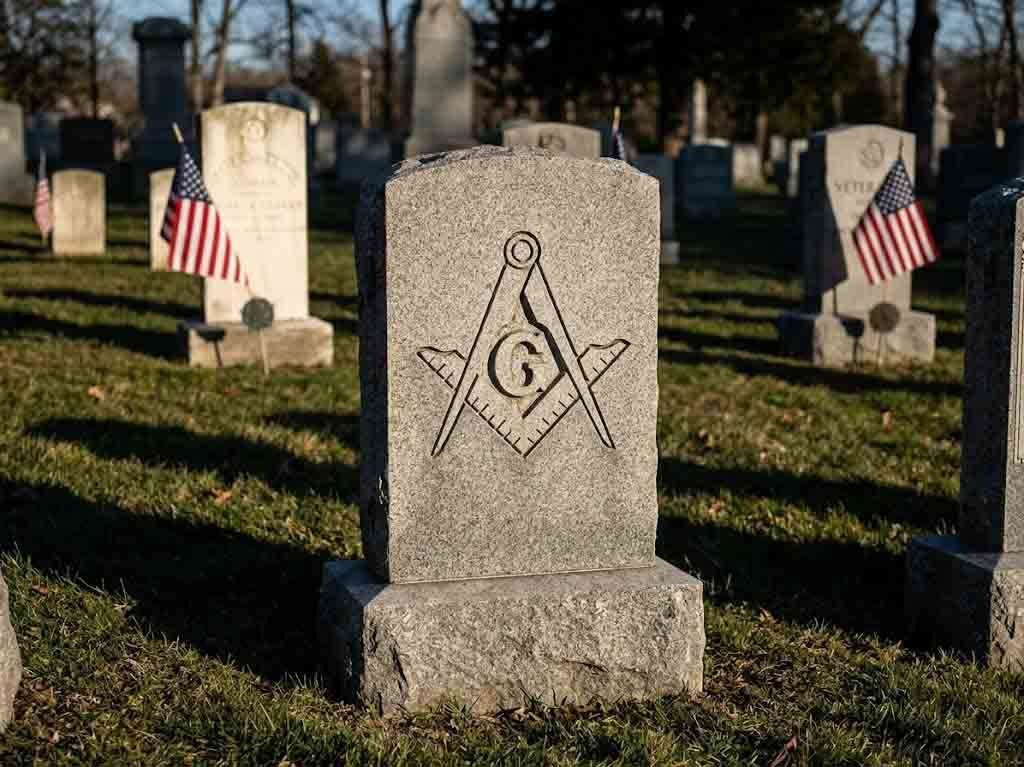
Scattered among the clasped hands and weeping willows, you’ll find a symbol that has nothing to do with theology and everything to do with fraternity: the square and compass, often with the letter “G” centered between them. This is the mark of a Freemason.
Freemasonry arrived on Long Island formally in 1793, when Huntington Lodge No. 26 was chartered — the first Masonic lodge in what is now Nassau and Suffolk Counties. The petition to form it was led by Moses Blachly, and its membership drew brothers from Setauket to Hempstead. George Washington himself had toured Long Island in April 1790, visiting several towns and meeting with fellow Masons from the military lodges that had operated during the Revolution. Two of Washington’s stops on that tour — at Blydenburg’s Tavern in Smithtown and the Onderdonk house in Roslyn — would later be connected to the founding of the Island’s first lodges.
By 1797, Suffolk Lodge No. 60 was meeting in Smithtown, and it eventually settled in Port Jefferson, where it still operates today as the oldest Masonic lodge in Suffolk County. The Hawkins-Mount Homestead in Stony Brook served as a meeting place for the lodge in 1802, and its owner, Major Jonas Hawkins, had been a member of the Culper Spy Ring. Freemasonry and the Revolution were tangled together on the North Shore from the start.
The square and compass on a gravestone told the community something specific: this man belonged to a brotherhood that valued moral architecture. The compass represented the ability to control base impulses. The square represented moral rectitude — the capacity to measure one’s behavior against a straight and honest standard. Together, they were a declaration of character made in stone, readable to anyone who knew the code. Theodore Roosevelt, a Mason of Matinecock Lodge No. 806 in Oyster Bay, would have recognized these symbols instantly in any North Shore cemetery. So would Franklin D. Roosevelt, who visited Jephtha Lodge No. 494 in Huntington in 1931 and joked that the Island should be called “Longer Island” after his traffic-plagued drive.
Inverted Torches, Broken Columns, and the Grammar of Loss
Some symbols in the cemetery work like adjectives. They modify the noun of death itself, telling you not just that someone died but how the living felt about it.
An inverted torch — a torch turned upside down, sometimes still depicted as burning — means the flame of life has been extinguished. The image traces back to ancient Roman funeral processions, where actual torches were carried inverted. When the flame still burns on the carved torch, the message shifts: death has occurred, but life continues beyond it. A single image carrying two meanings, depending on a detail most people miss.
A broken column means a life cut short. You see these most often on the graves of younger people — a pillar that should have stood for decades, snapped before it reached its full height. Draped columns add another layer: the fabric over the break represents the veil between this world and the next, the same metaphor that appears on draped urns.
A lamb, nearly always, marks the grave of a child. The association is biblical — Christ as the Lamb of God — but it also carries the simpler connotation of innocence. In nineteenth-century North Shore cemeteries, where child mortality was devastatingly common, these lambs appear with a frequency that catches you off guard.
Anchors show up too, particularly in the maritime communities along the Sound. Port Jefferson — where the Mather family built a shipbuilding empire in the nineteenth century — has gravestones where the anchor represents not just hope (its original Christian meaning) but a literal life lived at sea. A broken chain attached to an anchor means death came for the sailor. The link between the living and the dead, snapped.
Reading the Stones: What This Language Tells Us About Who We Were
The remarkable thing about gravestone symbolism isn’t the symbols themselves. It’s the fact that an entire community once shared a visual vocabulary for the things they couldn’t say directly. In an era before grief counselors and social media memorial pages, the gravestone was the public statement. It was the last word, carved where weather and time and passersby would see it for as long as stone endured.
The shift from death’s heads to cherubs to urns and willows to clasped hands and fraternal emblems maps perfectly onto the cultural evolution of Long Island’s North Shore. Puritan severity gave way to revivalist hope, which gave way to classical dignity, which gave way to Victorian sentimentality and civic identity. Each generation told the dead — and each other — what mattered most to them. Mortality. Salvation. Beauty. Connection. Belonging.
The Long Island Cemetery Preservation Group, co-founded by Robert von Bernewitz, Chris Ryon (the Village Historian of Port Jefferson), and Dave Thompson of the Smithtown Landing Cemetery Association, has restored six cemeteries and done preservation work at four more across the North Shore. At St. George’s Manor Cemetery on Strong’s Neck — the resting place of Selah and Anna Strong, central figures in the Culper Spy Ring — volunteers from the DAR, the Strong family descendants, and the Strong’s Neck Civic Association cleaned and reset 130 headstones in 2025. When the last marker was set, they held a ceremony. Because the language of stone only survives if someone still bothers to read it.
Next time you drive down 25A and pass one of these old burial grounds — in Setauket, Stony Brook, Port Jefferson, Smithtown — pull over. Walk the rows. Look at the carvings. You’re not visiting a cemetery. You’re reading a letter that took three centuries to write, addressed to anyone patient enough to stop and translate.
You Might Also Like:
- The Culper Ring of Setauket: How a Village on Long Island’s North Shore Outmaneuvered the British Empire
- Before Salem: The Witch Trial That Defined Long Island’s Soul
- The Wooden Leviathans of Port Jefferson: The Mather Family’s 19th-Century Shipbuilding Empire
Sources:
- Stone, Gaynell. “Sacred Landscapes: Material Evidence of Ideological and Ethnic Choice in Long Island, New York, Gravestones, 1680–1800.” Historical Archaeology, Vol. 43, No. 1, 2009. https://link.springer.com/article/10.1007/BF03377119
- Baugher, Sherene, and Frederick Winter. “Early American Gravestones: Archaeological Perspectives on Three Cemeteries of Old New York.” Archaeology, Vol. 36, No. 5, 1983. https://archive.archaeology.org/8309/etc/gravestones.html
- Northport Historical Society. “Symbols in the Cemetery.” https://www.northporthistorical.org/symbols_in_the_cemetery
- Foster, Gary S., and Lisa New Freeland. “Hand in Hand Til Death Doth Part: A Historical Assessment of the Clasped-Hands Motif in Rural Illinois.” Journal of the Illinois State Historical Society, Vol. 100, No. 2, Summer 2007.
- Seifried, Ronald J. Long Island Freemasons. Arcadia Publishing, 2020. https://tbrnewsmedia.com/book-review-long-island-freemasons/
- Caroline Episcopal Church of Setauket. “History.” https://www.carolinechurch.net/history
- Ferrara, Scott R. “Three Village Historical Society / Long Island Cemetery Preservation Group.” TBR News Media, October 2025. https://tbrnewsmedia.com/tag/three-village-historical-society/
- Setauket Presbyterian Church and Burial Ground. Wikipedia. https://en.wikipedia.org/wiki/Setauket_Presbyterian_Church_and_Burial_Ground
- Hijiya, James A. “American Gravestones and Attitudes toward Death: A Brief History.” Proceedings of the American Philosophical Society, Vol. 127, No. 5, October 1983.
- Craftsmen Online. “Huntington No. 26: Long Island’s First Masonic Lodge.” https://craftsmenonline.com/new-york-masonic-history/huntington-no-26-long-islands-first-masonic-lodge/