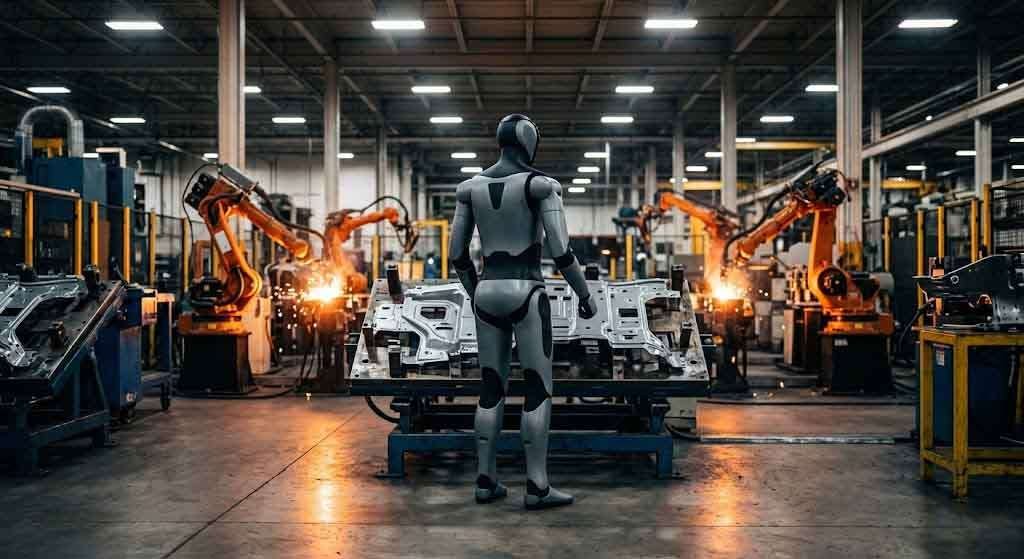
BMW’s Spartanburg plant in South Carolina employs roughly 11,000 people. As of this month, at least one of them stands five feet six inches tall, weighs 130 pounds, has sixteen degrees of freedom per hand, and doesn’t collect a paycheck. Its name is Figure 02, and it was built by a California startup that didn’t exist three years ago. The robot picks sheet metal parts from a rack, positions them on a welding fixture with millimeter precision, and does it again. And again. It doesn’t take a smoke break. It doesn’t file for workers’ comp. It doesn’t argue with second shift about who left the coffee pot empty. It just works.
This isn’t a concept video or a trade show stunt. Figure AI and BMW signed a commercial agreement in January 2024, and by the time you’re reading this, that robot has been running real production tasks inside a functioning automotive plant — the first humanoid to do so at any BMW facility worldwide. The implications of that sentence land harder if you sit with it for a minute.
What Figure 02 Actually Is
Figure 02 is the second-generation humanoid from Figure AI, a company founded in 2022 by Brett Adcock, who previously built the recruiting platform Vettery and the electric aviation company Archer Aviation. The robot is an upgrade over its predecessor in almost every dimension that matters. Three times the onboard computing power. Six RGB cameras feeding a large vision model that lets the machine perceive and interpret its environment in real time. Hands with sixteen degrees of freedom per unit and grip strength comparable to an adult human’s. A battery fifty percent larger than the first generation, integrated directly into the torso for better balance during movement.
The whole package walks on two legs, sees through cameras, hears through microphones, and speaks through built-in audio. It weighs about 60 kilograms and stands just under five-seven — roughly the global human average, which is not a coincidence. The world was built for human bodies. Doorways, staircases, factory aisles, shelving units — all of it designed around our proportions. If you want a general-purpose robot that can operate in spaces already built for people, you build something shaped like a person. That logic sounds simple. Executing it at a level where an automaker trusts it on a live production line is anything but.
What separates Figure 02 from the demonstration clips that circulate on social media is the environment it operates in. This isn’t a controlled lab with perfect lighting and a scripted sequence. BMW’s Spartanburg plant is one of the largest automotive facilities in the country, producing hundreds of thousands of vehicles a year. The body shop where Figure 02 works is already full of six-axis industrial robots welding at full speed. The humanoid has to function inside that existing infrastructure without disrupting the line, without injuring a human worker, and without losing placement accuracy under the vibration and noise of an active manufacturing floor.
The Race to the Factory Floor
Figure AI isn’t alone in this arena. Tesla has been making noise about Optimus, its own humanoid robot, since Elon Musk introduced the concept at AI Day in 2021. The pitch is aggressive: a general-purpose humanoid priced under $30,000 at scale, designed to handle tasks that are boring, repetitive, or dangerous. Musk has said he expects thousands of Optimus units working inside Tesla’s own factories by the end of 2025, with external sales potentially following in 2026.
The gap between Tesla’s ambition and its current reality is wide. Optimus is still in its prototype phase — the Gen 2 model showed improved hands (eleven degrees of freedom), faster walking speed, and lighter weight, but the robot hasn’t been deployed in any production capacity comparable to what Figure 02 is doing at BMW. Tesla’s advantage is its manufacturing scale and its existing AI infrastructure from the Full Self-Driving program. Its disadvantage is that humanoid robotics is a different beast than autonomous vehicles, and transferring software from one domain to the other isn’t as clean as a keynote slide might suggest.
Meanwhile, Boston Dynamics retired its hydraulic Atlas robot and unveiled an all-electric redesign aimed at commercial applications. Agility Robotics has Digit working in Amazon warehouses. Apptronik is developing Apollo with a focus on manufacturing and logistics. Chinese companies like Unitree and UBTECH are pushing lower price points, with some models reportedly coming in under $100,000. The humanoid robotics market is no longer a curiosity. It’s a capital allocation war, and the first company that cracks general-purpose utility at a sustainable cost will own a market that Goldman Sachs projects could reach $38 billion within a decade.
The Economics That Keep Me Up at Night
Here’s where the conversation shifts from fascinating to uncomfortable. Figure AI just announced BotQ, its own vertically integrated manufacturing facility in California, designed to produce up to 12,000 humanoid robots per year. The company has raised over $750 million in funding from investors including Microsoft, NVIDIA, Intel, and Jeff Bezos. Industry estimates peg Figure 02’s cost somewhere in the $30,000 to $50,000 range per unit, though the company also appears to be exploring a Robot-as-a-Service model at roughly $1,000 per month per robot.
Run those numbers against a human worker. The average fully loaded cost for a production employee in the United States — wages, benefits, insurance, payroll taxes — sits between $60,000 and $85,000 a year. That’s for one shift. A humanoid robot running two or three shifts per day, five to seven days a week, with no overtime, no health insurance, and no turnover, represents a cost structure that no amount of union negotiation can match. A $50,000 robot that works ten hours a day, five days a week, pays for itself in under a year against the fully loaded cost of the human it supplements. At $1,000 a month in a service model, the math is even more lopsided.
I’m not being glib about this. I’ve run a diner for twenty-five years. I’ve watched labor costs climb every single year. I’ve seen what happens to the economics of a small business when minimum wage increases hit and health insurance premiums spike simultaneously. The temptation to replace a human with a machine that never calls in sick is real, and pretending otherwise is dishonest. But the temptation and the consequence are two different animals. The temptation is an accounting problem. The consequence is a community problem.
What This Means for Long Island
Suffolk County still has manufacturing. Not at the scale of the Republic Aviation days, when Grumman employed tens of thousands and the F-14 Tomcat was assembled in Bethpage. But companies along the Route 110 corridor, in Hauppauge Industrial Park, in Ronkonkoma and Bohemia — they build things. Precision instruments, aerospace components, medical devices, packaging, food production. These are middle-class jobs held by people who live in communities like Mount Sinai, Miller Place, and Sound Beach. They coach Little League teams and eat breakfast at diners.
The National Association of Manufacturers estimates that the industry will need to fill 3.8 million jobs over the next decade. That sounds like opportunity until you realize that a significant portion of those openings exist because the workforce is aging out. The average manufacturing worker in the United States is older than the national labor force average, and the pipeline of younger workers isn’t keeping pace. The World Economic Forum projects that AI and automation could shift nine percent of manufacturing roles globally by 2030 — not eliminating them entirely, but transforming them into positions that require digital literacy, robotics maintenance, data analysis, and systems oversight.
Suffolk County’s workforce development infrastructure includes places like Wilson Tech, which trains high school juniors and seniors from eighteen school districts across Babylon, Smithtown, and Huntington. Stony Brook University runs Centers of Excellence in advanced manufacturing and technology through its Office for Research and Innovation. The Long Island Manufacturing Extension Partnership connects small manufacturers with resources to adopt new technologies. These programs exist. The question is whether they’re funded, scaled, and fast enough to match the pace at which the factory floor is changing.
Because here’s the thing nobody in the robotics industry wants to say plainly: the displacement isn’t coming in five years. It’s here. Figure 02 worked a production line at BMW in 2024. Tesla plans to deploy thousands of units by year’s end. The cycle time between prototype and deployment has collapsed from decades to months. The person welding sheet metal in Spartanburg today and the person assembling components in Hauppauge tomorrow are looking at the same horizon — and the shape walking toward them doesn’t look like their replacement. It looks like their coworker’s replacement. Then their shift’s. Then theirs.
Adaptation, Not Panic
The instinct when facing these numbers is either denial or dread. Neither is useful. What is useful is recognizing that every previous wave of industrial automation — from the spinning jenny to the robotic spot welder — created categories of work that didn’t exist before the disruption. CNC machinists didn’t exist before CNC machines. The person who maintains, programs, and troubleshoots a fleet of humanoid robots on a factory floor is a job category that barely exists today but will be in ferocious demand within five years.
The workers who thrive will be the ones who pair traditional mechanical knowledge — the kind you get from running a press brake, calibrating a fixture, or reading a tolerance spec — with the digital fluency to monitor autonomous systems, interpret sensor data, and intervene when the AI makes a decision that doesn’t account for the reality on the ground. The hybrid technician. The person who understands both the wrench and the algorithm.
Programs like the ARM Institute’s RoboticsCareers.org are trying to map this transition, connecting manufacturers with training pathways in automation and robotics. On Long Island specifically, Stony Brook’s Strategic Partnership for Industrial Resurgence works directly with local manufacturers to modernize operations. The question isn’t whether the training exists — it’s whether it reaches the forty-seven-year-old machinist in Deer Park who has twenty years of floor experience and zero interest in going back to school, but who needs those new skills to keep eating.
The Machine That Builds the Machine
Figure AI’s BotQ facility represents something even more disorienting than robots on a BMW line: it’s a factory where robots will eventually help build other robots. The company plans to use its own humanoids for material handling and component assembly on the BotQ production floor, creating a feedback loop that drives down manufacturing cost per unit while simultaneously increasing output. They’ve redesigned their entire robot architecture around manufacturability — switching from CNC machining (which took a week per part) to injection molding, die casting, and stamping processes that produce the same components in under twenty seconds.
This is the part that should command attention from anyone running a manufacturing operation of any size. The convergence of AI-powered autonomy, human-form-factor design, and mass production economics means the cost curve on these machines is heading in only one direction. The humanoid robot that costs $50,000 today will cost $30,000 in two years and possibly $20,000 in five. At that price point, the machine competes not just with American factory labor but with labor markets globally. The economic argument for reshoring manufacturing — already strengthened by tariff policy and supply chain fragility — gets radically stronger when the labor cost variable is a capital expenditure on a robot rather than a wage obligation to a workforce.
Where We Stand
The BMW deployment is a proof of concept. It’s narrow — sheet metal placement, not final assembly. It’s supervised, not fully autonomous in every dimension. But it’s real. The robot loaded parts into a welding fixture on an active production line in the body shop of a plant that builds X3 and X4 SUVs. It did this alongside existing industrial automation and human workers. It met cycle time requirements. It demonstrated millimeter-level accuracy. And the data it generated is already informing the design of Figure 03, which will be faster, more reliable, and cheaper to produce.
The labor market is going to look different in 2030 than it does today. Not unrecognizably different — there will still be welders, machinists, and assembly line workers. But the ratio of human hands to robotic ones will shift, and the skill set required to remain employable in manufacturing will shift with it. Long Island’s industrial economy, smaller and more specialized than the automotive giants of the Midwest and South, has a particular vulnerability and a particular advantage: vulnerability because the employers are smaller and less capitalized for rapid technology adoption, and advantage because specialized, high-mix, low-volume production is exactly the kind of work that general-purpose humanoids aren’t yet good at.
That advantage has an expiration date. The whole point of general-purpose design is that it eventually becomes good at everything.
You Might Also Like:
- The Grapes of Wrath: A Tale of Hope and Despair in the Great Depression
- Understanding Media: The Extensions of Man — Marshall McLuhan
- The Man in the High Castle: A Dystopian Vision of an Alternate Reality
Sources:
- Figure AI — Figure 02 Production at BMW
- BMW Group Press Release — Successful Test of Humanoid Robots at Plant Spartanburg
- Figure AI — BotQ: A High-Volume Manufacturing Facility for Humanoid Robots
- ASSEMBLY Magazine — Humanoid Robots Complete Trial Project at BMW Assembly Plant
- National Association of Manufacturers — Manufacturing Workforce Data
- World Economic Forum — Future of Jobs Report 2025
- Long Island Manufacturing Extension Partnership — Workforce Development
- RoboticsCareers.org — ARM Institute
- Wikipedia — Optimus (robot)
- Goldman Sachs — Humanoid Robot Market Projections