When Édouard Manet submitted Le Déjeuner sur l’herbe to the Paris Salon of 1863, the rejection was not merely aesthetic. It was institutional. The gatekeepers of the academy could not classify what they were seeing — and things they cannot classify, institutions tend to refuse. That particular refusal eventually produced the Salon des Refusés, which many art historians now regard as the birth of modern art. The story is worth revisiting today, because the art world is undergoing another classificatory crisis — one driven not by a brushstroke but by an algorithm. The question being asked in museum boardrooms, auction house previews, and university art departments from Chelsea to Culver City is the same question that plagued the Second Empire academicians: What, precisely, is this? And who decided it was art?
AI-generated work has moved from novelty to market force with a velocity that has left institutions scrambling to write policies for a medium that did not exist when their last strategic plans were drafted. The global AI art market was valued at approximately $3.2 billion in 2024, with projections placing it near $40.4 billion by 2033 — a compound annual growth rate of 28.9% that very few traditional creative markets can rival. By 2025, AI-generated art is projected to represent 5% of the total contemporary art market — a small share, but one that has arrived with disproportionate noise and, in some cases, disproportionate prices.
The adaptation of traditional galleries and auction houses to this new reality is neither a simple capitulation nor a principled resistance. It is something far more complicated: a negotiation between the economic pressures of an evolving collector base, the philosophical legacy of institutions built on provenance and authenticity, and the urgent creative energy of a generation of artists who have decided the machine is a studio tool, not an adversary.
The Auction House as Bellwether
Few moments clarified the stakes of this negotiation more sharply than Christie’s Augmented Intelligence sale, which ran from February 20 to March 5, 2025, at the Rockefeller Center in New York. The sale featured over 20 lots by pioneers in artificial intelligence-driven creativity — including Refik Anadol, Alexander Reben, Harold Cohen, and Claire Silver — and marked the first time a major auction house had hosted an auction exclusively dedicated to AI-generated art.
The sale amassed $728,784 — outpacing its $600,000 projection. Nearly half of bidders, 48 percent, identified themselves as Millennials or Gen Z, while 37 percent were first-time buyers at Christie’s. The highest-grossing lot, Refik Anadol’s Machine Hallucinations – ISS Dreams – A, fetched $277,200 — well above its $200,000 estimate.
The auction did not proceed quietly. An open letter signed by nearly 4,000 individuals urged Christie’s to cancel the event, alleging that AI-generated artworks rely on datasets trained using copyrighted material without compensation. The artists whose petition circulated among galleries and studios were making a concrete economic claim: that the models powering these tools consumed their work without consent or remuneration, and that institutional endorsement of the output legitimized an act of extraction.
Christie’s response was instructive. The auction house defended the legitimacy of the featured artists, framing AI as a tool for creative expansion rather than replacement, stating that “the artists represented in this sale have strong, existing multidisciplinary art practices, some recognized in leading museum collections.” The framing is deliberate: the work is authenticated not by the output but by the artist. The human hand remains, even when it is metaphorical.
In November 2024, Sotheby’s had already made waves by selling a portrait of Alan Turing created by Ai-Da, an AI-powered humanoid robot, for over $1 million. The twin data points — Christie’s and Sotheby’s both endorsing AI-generated work within months of each other — signal that the two most powerful arbiters of market value in the traditional art world have decided that the question of whether AI art belongs is settled. What remains unsettled is everything else.
What Authenticity Means When Authorship Is Distributed
The concept of authenticity in fine art has always been more legally constructed than philosophically pure. Academic research on auction pricing has found that provenance, pedigree, exhibition history, and certification affect hammer prices significantly — with mandatory certification reporting generating price premiums of over 37% compared to lots without such documentation. In other words, authenticity is not merely an aesthetic judgment; it is a financial architecture.
AI-generated art stress-tests that architecture at every joint. The question of authorship — who made this, and in what sense — does not have a clean answer when the generative model is trained on millions of existing images, the prompts are supplied by a human, and the final composition is selected from thousands of iterations. A majority of survey respondents hold the view that art requires a human touch, while nearly half say they cannot distinguish AI-generated art from human-made work when the attribution is withheld. The perceptual problem and the philosophical problem are not the same problem, but galleries are being asked to solve both simultaneously.
The artists featured in Christie’s Augmented Intelligence offered one answer: treat the AI as a medium, not an author. Alexander Reben, who installed a painting robot at Christie’s New York that physically applied brushstrokes to canvas every time a bid was placed, argued that “AI expands creative potential, offering new ways to remix and evolve artistic expression rather than replace it.” The argument is structurally identical to the one photographers made in the 1860s and video artists made in the 1970s — each new medium arrives as an imitation of art, and each eventually forces a redefinition of the category.
Daniel Ambrosi, whose dreamscape Central Park Nightfall was offered at Christie’s, noted that the historical resistance was familiar. He invoked the term “Impressionist,” once used to disparage a new manner of painting in 19th-century Paris, and suggested that critics calling AI work “low-effort slop” were operating in a tradition with a poor predictive record.
Museum Strategy: The Case of MoMA and Refik Anadol
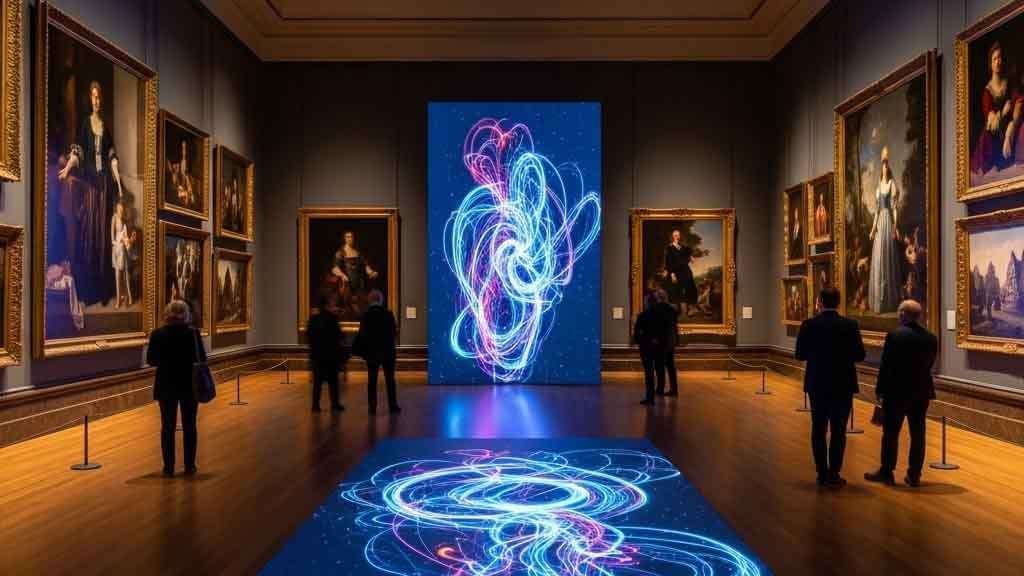
If the auction houses have moved toward commercial integration, the leading museums have pursued a more curatorial, and sometimes more contested, path. The most significant institutional experiment of the past several years remains Refik Anadol’s Unsupervised at the Museum of Modern Art in New York, which opened in November 2022.
Anadol trained a sophisticated machine-learning model to interpret the publicly available data of MoMA’s collection — more than 138,000 works spanning over 200 years of modern art — and deployed it as a large-scale real-time installation in the museum’s Gund Lobby, where the work continuously generated new and evolving imagery informed by changes in light, movement, acoustics, and weather outside.
The work was originally slated for three months but was extended to nearly a year. More than three million people came to see it, making it one of the most visited exhibitions in MoMA’s recent history. Visitors spent an average of 38 minutes with the installation — a figure worth setting against the 2017 study finding that museum visitors typically spend roughly 27 seconds looking at any given artwork.
Critical reception was pointedly divided. MoMA curator Paola Antonelli described the installation as a meditation on technology, creativity, and the future of art-making. Artnet critic Ben Davis was considerably less reverent, calling the work “an extremely intelligent lava lamp” and questioning whether MoMA’s commercial arrangements with the associated NFT collection created an institutional incentive to fast-track this category of work into the canon.
The debate is not merely aesthetic. It raises a structural question about what role museums play when they choose to platform a medium: Do they certify it, or do they investigate it? The distinction matters enormously to artists who have spent careers working within a curatorial framework that rewards depth, context, and critical positioning — qualities that are harder to evaluate when the generative process is opaque.
What MoMA accomplished, regardless of where one stands aesthetically, is the creation of a reference point. Anadol’s Unsupervised became the first generative AI artwork to enter MoMA’s permanent collection — a fact that changes the conversation the same way a work entering the Louvre changes the conversation. Institutions do not just display value; they assign it.
The Copyright Fault Line
Beneath every gallery decision, every acquisition, and every policy statement runs the same unresolved legal current: who owns the material that trains the model, and what rights, if any, does the original creator retain over outputs derived from their work?
Critics of Christie’s 2025 sale pointed specifically to the use of Midjourney and Stable Diffusion, tools trained on LAION datasets, arguing that these models consumed artists’ work without consent to build commercial products that now compete directly with those same artists. The argument is not frivolous. It reflects a genuine structural tension in how large language and image models are built and deployed.
Debates over originality and authorship — who truly creates the work — are intensifying, particularly as AI-generated pieces gain traction at auctions. Economists worry that an oversupply of AI-generated work could devalue human artistic labor, a concern that surfaced in discussions at the Sharjah Biennial.
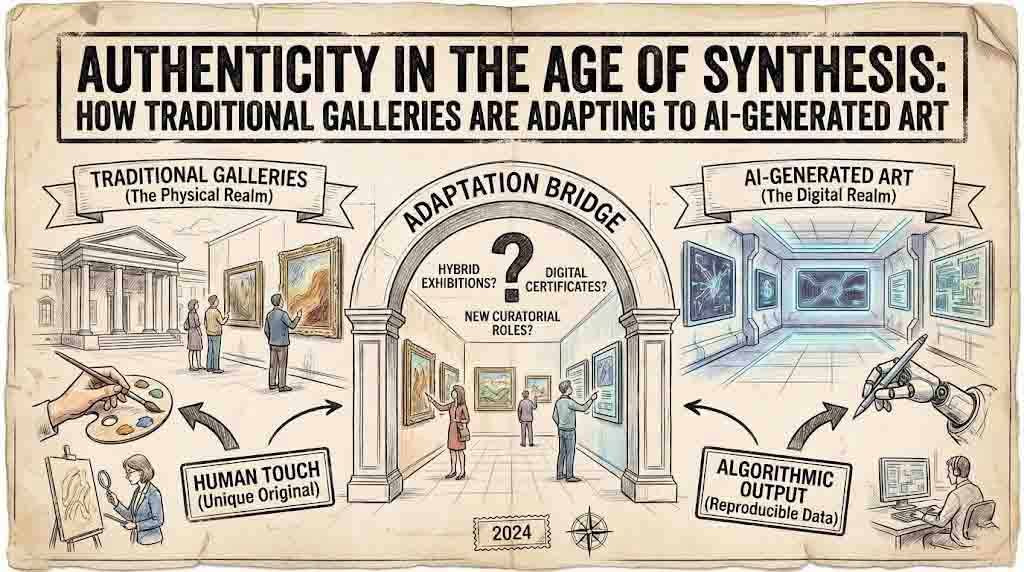
Galleries navigating this landscape are making curatorial decisions with legal dimensions they are not fully equipped to assess. Some have begun requiring disclosure of AI tools used in production. Others have implemented provenance documentation standards similar to those used for traditional media. A few have avoided the category entirely, preferring to wait for legal and market frameworks to stabilize before committing institutional capital and credibility.
Through blockchain technology, digital artworks can now obtain secure authentication methods for trading, creating new revenue possibilities for AI artists — while simultaneously raising new questions about intellectual property that existing legal frameworks were not designed to answer. The traditional gallery system was built around scarcity. A painting can be in one place. AI-generated work can be reproduced infinitely, and the concept of an original is not always meaningful. NFTs represent one technological response to that problem, but they do not resolve the underlying philosophical question of what uniqueness means when the generative process is essentially a sampling of prior human expression.
The Emerging Curatorial Language
Despite the friction — or perhaps because of it — galleries and museums have begun developing a curatorial vocabulary for AI work that distinguishes between categories, rather than treating the medium as monolithic. The most useful emerging distinction is between AI as a generative tool used by an established artist with an existing practice, and AI as a primary author operating with minimal human direction.
Christie’s Vice President Nicole Sales Giles articulated this distinction clearly: “These are not works where someone typed a prompt and hit generate. The artists represented have strong, existing multidisciplinary practices, some recognized in leading museum collections. The works in this auction are using artificial intelligence to enhance their bodies of work.” The implicit argument is that the human artist’s contextual depth — their conceptual history, their critical positioning, their relationship to the materials — is what the collector is acquiring. The AI is the medium, not the artist.
This framing is gaining traction in gallery contexts where the conversation has moved from “is this art” to “what kind of art is this, and how do we evaluate it.” Contemporary observers note that the emphasis in AI-assisted work has shifted from market novelty to quality and concept, merging tradition with innovation — a sign that the medium is maturing past its speculative phase.
Some galleries are now experimenting with AI-powered curation tools that analyze viewer behavior, recommend works, and arrange exhibitions in ways that optimize engagement — using AI not only to create art but to present it. The implications for traditional curatorial practice are significant. If an algorithm can pattern-match visitor interests with collection strengths more efficiently than a human curator, what is the human curator’s remaining function? The answer, presumably, is the same one photographers gave when asked about their function relative to painters: interpretation, context, and meaning.
The Photography Analogy, Revisited
The history of photography’s admission into the gallery system offers the most useful template for thinking about what is happening now, though it is not a perfect fit. Photography arrived in the mid-19th century and spent the better part of a century fighting for institutional legitimacy. It was dismissed as mechanical, as mere reproduction, as the death of painting. It eventually achieved canonical status not by winning that argument but by making it irrelevant — by producing works so clearly expressive, so clearly anchored in individual vision, that the philosophical objections became academic.
Barry Threw, executive and artistic director of Gray Area, a digital culture incubator in San Francisco, captured the dual pressure galleries face: “Given the lack of sufficient public funding for the arts, especially in the United States, artists are right to be concerned about the uncritical adoption of heavily monetized technologies that could only be developed with the benefit of their work. However, the history of art is a history of technology development, and we desperately need artists to engage with new technologies like AI to help metabolize, understand, and communicate the abrupt social changes they create.”
The phrase “metabolize” is worth pausing on. Galleries and museums have historically been among the institutions that perform exactly that function — taking the raw material of cultural disruption and processing it into something a broader public can examine, question, and ultimately absorb. Whether the current wave of institutions is doing that work with sufficient critical rigor, or whether they are simply following the money toward a medium that has proven capable of generating collector enthusiasm, is a question that will take another decade to fully answer.
What is clear is that the refusal strategy is no longer viable. Traditional galleries are now featuring AI art exhibitions alongside conventional works, and educational institutions are incorporating AI art tools into their curricula, recognizing that future artists will need fluency in both traditional techniques and digital technologies. The gate has opened. The more interesting question now is who controls the discourse once the crowd has moved inside.
The story of how the art world reckons with AI-generated work is still being written — in acquisition decisions, in legal briefs, in curatorial statements, and in the 38 minutes that three million people chose to spend watching a machine dream at the Museum of Modern Art. The institutions that emerge with credibility will be the ones that do not simply endorse or reject the medium, but that insist on asking what distinguishes the meaningful from the merely novel — a question that has always been the gallery’s actual job, regardless of what hangs on the walls.
Sources
- Christie’s Augmented Intelligence Sale Results — ARTnews, March 2025. https://www.artnews.com/art-news/market/christies-ai-art-sale-augmented-intelligence-controversy-surpasses-expectations-1234734870/
- Christie’s AI Art Auction Controversy — Artnet News, March 2025. https://news.artnet.com/art-world/christies-ai-art-auction-controversy-artists-weigh-in-2614666
- Christie’s AI Art Auction Sparks Controversy — NPR, February 2025. https://www.npr.org/2025/02/17/nx-s1-5296911/christies-ai-art-auction-protests
- Refik Anadol: Unsupervised — Museum of Modern Art, New York. https://www.moma.org/calendar/exhibitions/5535
- Refik Anadol AI Museum Dataland — Artnet News, September 2024. https://news.artnet.com/art-world/refik-anadol-ai-museum-dataland-2543122
- Global AI in the Art Market Statistics 2025 — ArtSmart.ai. https://artsmart.ai/blog/ai-in-the-art-market-statistics/
- AI-Generated Art and the Future of Digital Galleries — AkoCanvas, May 2025. https://www.akocanvas.com/2025/05/ai-generated-art-and-the-future-of-digital-galleries-in-2025/
- How Artists Are Using AI in Their Creative Practice in 2025 — Artinfoland Magazine. https://magazine.artinfoland.com/how-artists-are-using-ai-in-their-creative-practice-in-2025/
- Current Art Trends According to the AI: A 2025 Snapshot — ArtMajeur Magazine. https://www.artmajeur.com/en/magazine/2-art-news/current-art-trends-according-to-the-ai-a-2025-snapshot/338833
- In Art We Trust — Management Science / INFORMS, 2022. https://pubsonline.informs.org/doi/10.1287/mnsc.2022.4633
- Christie’s First AI Art Auction — Jingna Zhang Photography Blog, February 2025. https://zhangjingna.com/blog/2025/2/10/christies-first-ai-art-auction-legitimizing-the-unauthorized-use-of-copyrighted-works
- Refik Anadol, MoMA, and AI Art on 60 Minutes — ARTnews, 2025. https://www.artnews.com/art-news/news/refik-anadol-moma-ai-art-60-minutes-debate-1234774176/
- Unsupervised — Feral File Substack, 2025. https://feralfile.substack.com/p/modern-dreams-refik-anadols-unsupervised