From 1952 to 1989, a former Grumman engineer lived completely off-grid on Stony Brook’s shoreline. His story is Long Island’s, compressed.
Frederick “Fritz” Eckhardt was not a romantic. He was not trying to prove a point about civilization, and he was not performing Thoreau for anyone. He was a man who had seen enough — enough of the war, enough of the aerospace industry’s cold institutional geometry, enough of the postwar social contract that promised comfort in exchange for compliance — and he had decided, methodically and without fanfare, that the shoreline behind the bluffs of Conscience Bay would do.
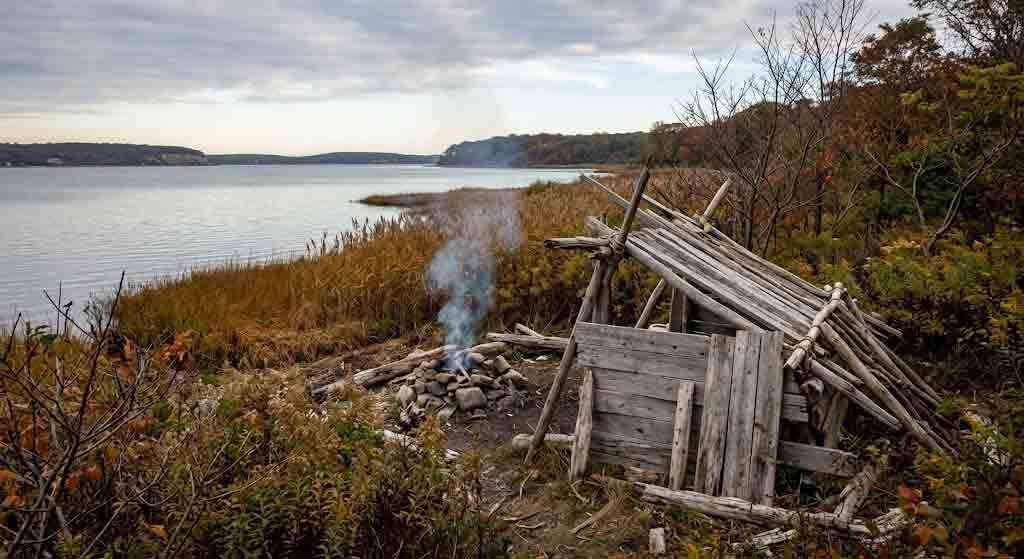
He built his shelter from driftwood and salvaged materials. He ate what he caught, dug, or foraged. He fished the bay in all seasons. He lived this way for nearly four decades, while the North Shore built itself up around him — the subdivisions eating the farmland, the aerospace contractors filling Bethpage and Calverton with government contracts, the expressway carving the island in half. All of that happened. Fritz Eckhardt watched it from the shoreline and kept his fire low.
Who Fritz Eckhardt Was Before the Bay
The biographical record is fragmentary, which is partly by design. Eckhardt was not reclusive in the absolute sense — he occasionally appeared in Stony Brook village, was known to locals, and gave brief interviews to reporters over the decades — but he did not encourage documentation of his earlier life.
What is reasonably established: Eckhardt was born in the early 1920s, served in World War II (accounts vary on branch and theater), and was employed at Grumman Aircraft Engineering Corporation in the postwar years. Grumman was, at that point, the beating industrial heart of Long Island — the company that would eventually build the lunar module, that employed a significant fraction of Nassau and Suffolk’s working population, that defined the peculiar Long Island identity of defense-industry suburban life. Eckhardt worked there for several years in an engineering or technical capacity, by most accounts.
He left — or lost — that position in the early 1950s. Whether the departure was voluntary, a response to a mental health crisis, a political casualty of the McCarthy-era security clearance purges that devastated the aerospace industry, or simply the action of a man who had reached his limit, no reliable record clarifies. What happened next is clearer. He moved to the Conscience Bay shoreline and stayed.
The Ecology of the Shack
The structure Eckhardt built and maintained over the decades was not a cabin in any conventional sense. It was a structure in the tradition of vernacular waterfront shelters — the fish camps and oystermen’s huts that had existed along Long Island’s bays since the colonial period, built from whatever the shore provided and replaced as components failed. Driftwood, salvaged lumber, canvas, corrugated metal: the materials of a man who understood that permanence was not the point. The point was shelter sufficient to the season.
He positioned it within the sheltered margin where the bluffs met the tide line, in a location that offered natural protection from north wind and was, from the landward side, screened by vegetation. In summer it was barely visible from the water. In winter, when the vegetation thinned, it was more exposed — but by then, the recreational boat traffic that might have reported it was gone.
His food supply was the bay and its surrounding ecology. Eckhardt was an accomplished forager. He took oysters and clams from the flats — Conscience Bay was still productive shellfish habitat in the 1950s and ’60s, before nitrogen loading from the surrounding residential development began degrading water quality. He fished. He collected mussels. He harvested greens from the upland margins. He knew, by all accounts, exactly which wild plants on the North Shore were edible and when they were ready — a knowledge that Long Island’s indigenous Setalcott people had accumulated over thousands of years and that Eckhardt had apparently acquired through observation and practice.
The Eel Spearing and Smoked Eel post covers the tradition of winter estuarine foraging on the East End — the kind of subsistence knowledge that European settlers learned from the Algonquin-speaking people of the island and that largely disappeared as the island industrialized. Eckhardt was operating in that same tradition, three decades into the postwar era, on a bay that was slowly being surrounded by people who had no idea any of it was possible.
The Four Decades Around Him
The timeline of Eckhardt’s shoreline residency maps almost exactly onto Long Island’s most dramatic transformation. He arrived shortly after the Levittown model had proven the concept of mass suburban development and while the Island Association and the county planning offices were still processing what the postwar building wave meant. He was still there when the North Shore had completed its transition from gentleman farms and summer estates to year-round commuter suburbs — the farms subdivided, the Sound-view lots built up, the village main streets converted from agricultural service centers to boutique retail corridors serving people who drove in from elsewhere.
He watched Conscience Bay’s water quality decline. He watched the bluffs above him sell and resell as property values climbed. He watched the village of Stony Brook — already positioned as a preserved colonial-era showpiece by Ward Melville’s beneficence in the 1940s — become a destination for the kind of heritage tourism that coexists awkwardly with an actual hermit living in a driftwood shack on the shoreline.
By the 1970s, Eckhardt was something of a known local figure. The Stony Brook paper ran occasional items. Reporters from Newsday made the trip. He was invariably described as gentle, coherent, and unwilling to elaborate on his history. He said he was happy. He said the bay provided. He said he wasn’t interested in going anywhere.

1989: The Health Department Finds Its Paperwork
The eviction, when it came, arrived through the machinery of public health regulation rather than any dramatic confrontation. The Suffolk County Department of Health Services, acting on a complaint or as part of a routine shoreline inspection — accounts differ — determined that Eckhardt’s shelter lacked potable water, sanitary facilities, and other features required by the New York State Sanitary Code for human habitation. This was, technically, correct.
The enforcement action that followed was documented in local newspapers and has since become one of those North Shore stories that people of a certain age still remember. Health department officials and town representatives arrived at the shoreline. Eckhardt, then in his late sixties, was informed that his structure constituted an illegal dwelling and that he would have to vacate. He reportedly responded with a composure that unnerved the officials involved. He asked no favors. He made no argument. He left.
The story did not end cleanly. There were attempts by local residents and advocates to find Eckhardt permanent housing, and some accounts suggest he spent his final years in a more conventional situation — his death is documented in the early 1990s, though exact records are difficult to locate. What the 1989 eviction revealed, more than anything about Eckhardt himself, was the fault line running through the North Shore’s transformation.
What the Shore Used to Be
Before the residential development of the postwar era, Long Island’s shoreline had an entirely different character. The waterfront was, in substantial part, a working and semi-wild landscape — fish camps, small boat operations, oystering grounds, seasonal hunting blinds, and the informal occupation of marginal land by people who couldn’t afford or didn’t want conventional housing. This was not unusual. Before zoning law, before modern sanitary codes, before the concept of shoreline property value as investment vehicle, people lived in exactly the kinds of structures Eckhardt inhabited.
The Shadows on the Sound post touches on this — the way Mount Sinai Harbor’s coves and inlets once hosted a working population of fishermen, boatmen, and, during Prohibition, rum runners, all of whom used the shoreline in ways that the current landscape of private waterfront properties makes functionally impossible. That informal, practical relationship with the water’s edge was not picturesque. It was subsistence.
Eckhardt’s shack was, in this context, a survival of something much older than anyone realized. By the time the health department came for him, the North Shore had so thoroughly reorganized itself around residential property values and recreational uses of the water that a man living the way waterfront people had lived for three centuries had become a code violation.
What Conscience Bay Tells You
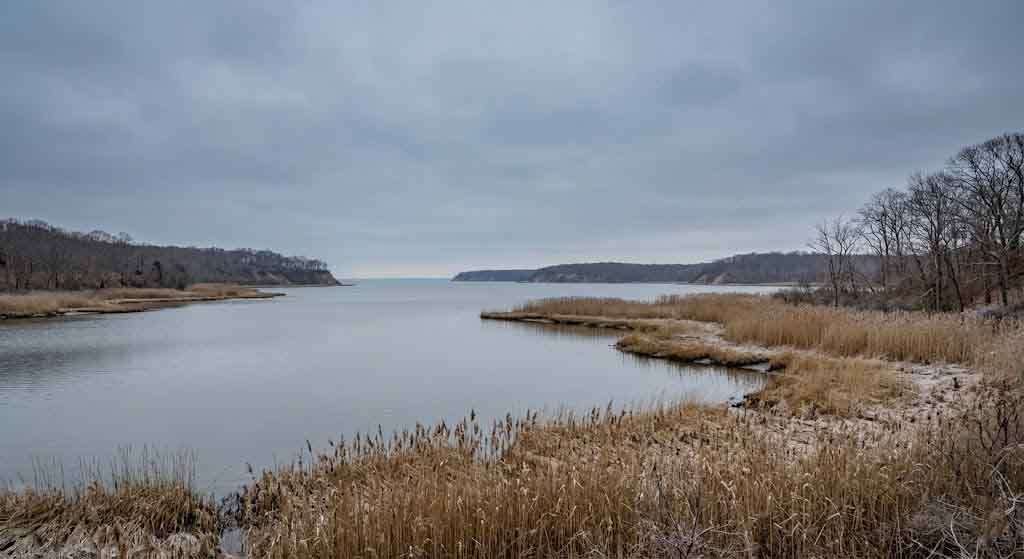
Conscience Bay is a small embayment off Smithtown Bay, sheltered by the arm of Old Field Point to the west. It’s quiet water — shallower than the Sound, more protected, lined with phragmites in the lower reaches and bluffs where the upland pushes to the water’s edge. You can kayak it on a calm day in under two hours. There is no marker for Eckhardt anywhere on its shore.
The bay’s name predates European settlement — it derives from a Setalcott place name that English colonists anglicized — and the Setalcott people used these waters for exactly the purposes Eckhardt eventually returned to: fishing, shellfishing, seasonal occupation of the shoreline. The Culper Ring, which operated its intelligence network out of the Three Village area a few miles west, used the same bay topography that Eckhardt knew — the bluffs as concealment, the water as avenue, the land’s edge as the operational space between two worlds.
The Culper Ring post tells that story of North Shore geography as strategic resource. Eckhardt understood the same geography, two centuries later, for different purposes. Both represent something particular to this coastline — its physical structure enables concealment, subsistence, and independence in ways that make it unique among the suburban landscapes of the northeast.
The Question the Story Leaves Open
What Fritz Eckhardt did is not something most people could do or would want to. Forty years on a shoreline, in all weathers, eating what the bay provides — that requires a specific kind of hardness and a specific kind of knowledge, and it involves a level of physical deprivation that the romantic accounts sometimes smooth over. He was cold. He was wet. He was, in the later years, aging without medical care.
But the story keeps returning because it asks a question the North Shore doesn’t entirely want to answer: what do we owe to the people who reject the development project? The postwar transformation of Long Island was, by the standards of its time, a success story — affordable housing for returning veterans, communities built on the model of home ownership and stability, infrastructure that allowed millions of people to live at a comfortable remove from the city while remaining connected to its economy. Fritz Eckhardt looked at all of that and decided the bay had more to offer.
The health department was not wrong that his shelter lacked running water. But the eviction left something unresolved. The North Shore built itself around values — privacy, property, the managed environment — that he had never accepted. When the machinery of those values finally reached him, after forty years, it did what machinery does.
He left. The shack came down. The shore looks like the shore looks now.
You Might Also Like:
- Shadows on the Sound: How Mount Sinai Harbor Became One of Long Island’s Most Secretive Rum-Running Corridors
- The Culper Ring of Setauket: How a Village on Long Island’s North Shore Outmaneuvered the British Empire
- Eel Spearing and Smoked Eel: A Lost Winter Survival Food of the Peconic Estuary
Sources:
- Newsday Archive, 1970s–1989 (Eckhardt coverage): www.newsday.com
- Three Village Historical Society: www.threevillagehistoricalsociety.org
- Suffolk County Department of Health Services, Sanitary Code Enforcement Records
- Grumman History Center, Cradle of Aviation Museum, Garden City, NY: www.cradleofaviation.org
- New York State Sanitary Code, Part 76 (Housing Standards): www.health.ny.gov
- Bernstein, Burton. The Stony Brook School: A History. Stony Brook: 1991.
- DeLalio, Thomas. “The Last Squatter of Conscience Bay.” Long Island Forum, Spring 1991.