Everybody wants local oysters on the menu. Almost nobody’s willing to pay what it takes to pull them from the bottom of the Sound.
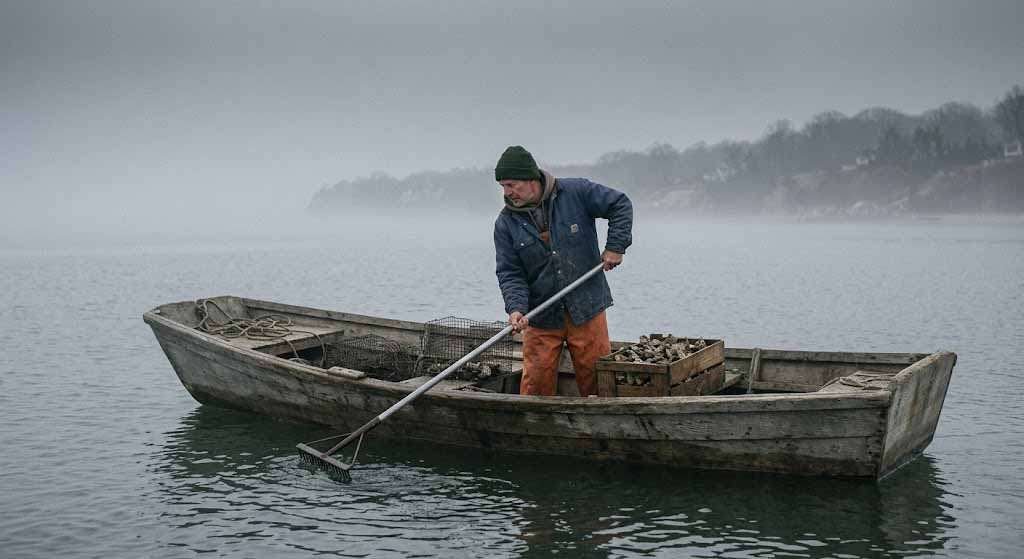
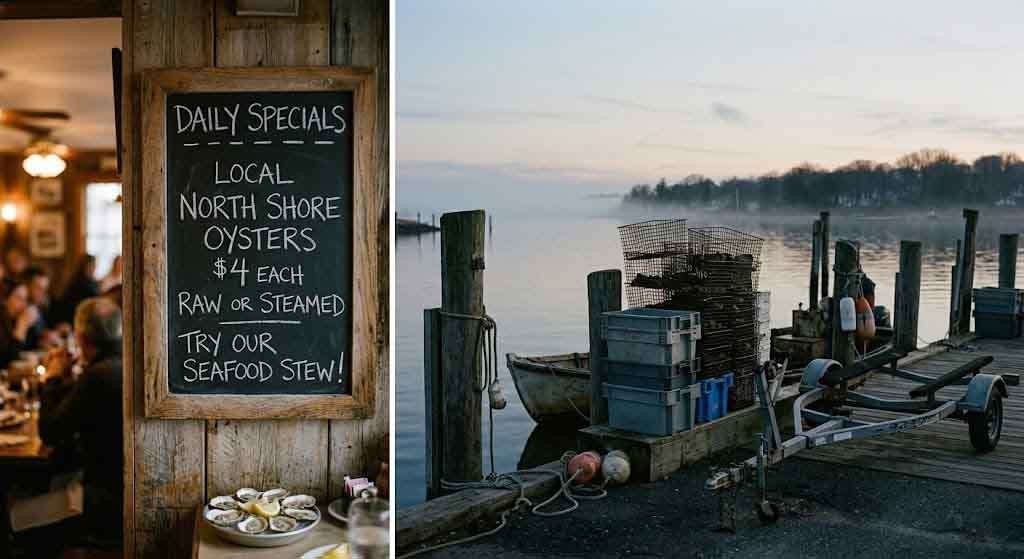
Walk into any restaurant on the North Shore right now and you’ll see them listed with the same reverence as a single malt — hand-harvested, local, sustainable, priced at four dollars a piece on the half shell with a sliver of mignonette and a wedge of lemon. The room feels it’s ordering something noble. Back out on the water, a man in his sixties with arthritic hands is trying to figure out if this year’s closures left him enough certified acres to break even.
That gap — between the romance of the local oyster and the economics of actually producing one — is where the North Shore’s baymen have been living for decades. Understanding it requires going past the menu.
The Permit Architecture
Commercial shellfishing in New York State operates under a layered system that is not cheap and is not simple. State law requires commercial harvesters to hold a DEC permit to conduct any shellfish harvesting activities. That’s the floor. On top of it sit the town-level permits, which vary by municipality and carry their own residency requirements, gear restrictions, seasonal limitations, and zone designations. Towns like Oyster Bay enforce additional rules about what tools can be used and when, down to prohibitions on harvesting under power. Some baymen work under sailcraft or rely on currents to move their boats — not as a romantic throwback, but because the law in their specific harbor requires it.
Fees for individual commercial permits typically run from a few hundred dollars up into the thousands depending on the town and license category, but the permit cost itself is almost beside the point. The real overhead is regulatory compliance across multiple jurisdictions, and the cost of the boat, gear, and time spent navigating closures.
Boats and Equipment
Most baymen work from open-deck boats ranging from 18 to 24 feet in length, purpose-built to give them access to shallow beds while carrying a day’s worth of harvest in sacks or containers. A used working boat in this range — something seaworthy enough to be out in November on Long Island Sound — runs anywhere from $15,000 to $50,000 depending on condition and rigging. Factor in the outboard or inboard motor, annual maintenance, storage, fuel, and the inevitable cost of a bad storm season, and you are looking at a significant capital investment for a small-scale, one-person operation.
The tools themselves — hand tongs, wire baskets, harvest bags, dredge equipment — are modest. The real cost is the infrastructure supporting the operation. Licensing fees, mooring fees, fuel, boat insurance, and the time spent on compliance add up to thousands per year before a single oyster is sold.
Water Quality and Closed Acres
This is where the economics really break down. You cannot harvest oysters — or any shellfish — from waters the state has not certified as clean. Shellfish may only be taken from areas designated by DEC as certified for harvest, and those certified areas shrink and shift based on water quality testing. When a harbor or portion of the Sound is flagged for poor water quality, the beds close. Harvesters go home.
As recently as August 2025, the DEC revised Part 41 sanitary regulations to include new closures affecting North Shore harvesting areas. Twenty acres of Long Island Sound were downgraded from certified year-round to uncertified year-round, and 26 acres of Cold Spring Harbor were downgraded to seasonally uncertified from May through October — which is precisely peak season when the money gets made.
The underlying driver of those closures is nitrogen. For decades, Long Island Sound has had a chronic problem with bottom water hypoxia — oxygen depletion caused by nutrient pollution from wastewater treatment plants, stormwater, septic systems, and fertilizer runoff. These hypoxic waters are unable to sustain life, leading to die-offs of fish and shellfish.
Progress has been made. Through infrastructure investments of more than $2.5 billion to improve wastewater treatment, the total annual nitrogen load to Long Island Sound is now roughly 47 million pounds less than the yearly discharge in the early 1990s. But progress at the state and regional scale does not translate cleanly into open beds for a single bayman working a small stretch of Oyster Bay Harbor. Despite this broader progress, hypoxic zones still occur each summer, and beach closures, shellfish bed closures, and other water quality impairments persist throughout the Sound and its embayments.
Forty-two percent of the bays and harbors around the Sound received a C grade or lower in Save the Sound’s 2024 report card. Nitrogen pollution — coming from fertilizer and aging septic systems that end up in the Sound through stormwater runoff — was identified as the primary culprit.
A bayman has no influence over that chemistry. He can manage his gear and his harvest methods with precision. He cannot manage what the suburbs are putting in the ground.
What an Oyster Actually Sells For
The economics of the selling side are no friendlier. Long Island growers sell oysters at wholesale from 55 to 65 cents each, and from 75 to 85 cents to restaurants — and that’s assuming competitive local growers. Farmers from outside the region can undercut those prices further. Meanwhile, the restaurant takes that 75-cent oyster and puts it on the menu at four dollars.
The math is not generous. A strong day’s work pulling oysters by hand from a moving boat might yield several hundred oysters, depending on the bed density and the size of the certified area available. At wholesale rates, that is a few hundred dollars — gross, before fuel, before permit costs, before maintenance, before the days lost to weather or closure. The North Shore bayman is not getting rich on this.
What he is doing is maintaining a food system. The baymen of Oyster Bay harvest hard clams, steamer clams, and oysters by hand raking in waters from five to sixty feet deep, year-round regardless of weather. They are not a novelty. They are a supply chain. The difference is that the supply chain has no pricing power.
The Dredging Problem
Compounding all of this is the industrial competition. All day, all week, every week of every year, hydraulic shellfish dredge ships operate in Oyster Bay Harbor — and the Town of Oyster Bay permits it. The North Oyster Bay Baymen’s Association has spent years fighting this in court, arguing that unrestricted hydraulic dredging devastates the bottom that hand-harvesters depend on. The lawsuit against the Town, the Frank M. Flower Oyster Company, and the state of New York continues. The baymen are not done.
But fighting a legal battle costs money, too. Organizing, advocacy, time out of the water — it all comes out of the same thin margin the individual bayman is already trying to manage.
A Trade Without Successors
The average North Shore bayman today is in his early sixties. The math on that is not complicated. This is a trade that requires physical resilience — working an open deck in December, hauling gear in rough water, navigating regulations that require constant attention — combined with the kind of embedded local knowledge that takes years to develop. You need to know the bottom. You need to know which closes are predictable and which are surprises. You need to know where the seed sets and where it doesn’t.
That knowledge doesn’t transfer through a brochure. It transfers on the boat, over years, from one generation to the next. When the baymen themselves don’t see a viable economic argument for a young person entering the trade — given current permit costs, closure risks, wholesale pricing, and industrial competition — the succession plan disappears.
Cornell researchers who testified before Congress on Long Island Sound’s importance described growing up on the Sound with fathers who were baymen, boat builders, and oyster farmers working the harbors of Long Island’s North Shore. That generational continuity is precisely what is fraying.
For a deeper look at how Long Island’s relationship with its waters has shaped the region’s economy and identity, see Rum Row and the Freeport Bootleggers: Long Island’s Clandestine War on the Water and The Forgotten Montauk Surfman’s Chowder: Cooking with Seawater at the 1800s Life-Saving Stations.
What Would Actually Help
The framework for change is not mysterious. Water quality improvements that expand certified acreage directly benefit baymen by increasing the area they can legally work. Restrictions on industrial dredging in harbors where hand harvesters operate would protect both the beds and the livelihoods that depend on them. Pricing transparency — getting restaurants and distributors to acknowledge what a hand-harvested local oyster actually costs to produce — would apply pressure on the wholesale price floor.
None of it is simple. Water quality is a regional infrastructure problem that costs billions to address incrementally. Industrial dredging is a political battle backed by commercial interests with deeper legal resources than any individual fishing association. And pricing pressure in the restaurant industry moves slowly, if at all.
What isn’t complicated is the bottom line: the North Shore’s baymen are a finite resource operating on a deteriorating margin. They are the reason the local oyster exists as something other than a branded fantasy on a menu. If that matters — and it should — then the conversation about what those oysters cost needs to start with the people pulling them out of the water, not with the mignonette.
You Might Also Like:
Rum Row and the Freeport Bootleggers: Long Island’s Clandestine War on the Water
The Forgotten Montauk Surfman’s Chowder: Cooking with Seawater at the 1800s Life-Saving Stations
North Shore vs. South Shore: The Lifestyle Comparison Nobody’s Done Right
Sources:
New York State DEC — Shellfishing Regulations
New York State DEC — Regulatory Changes for Shellfish Harvest Areas (August 2025)
North Oyster Bay Baymen’s Association
NEIWPCC — Reducing Long Island Sound’s Hypoxic Waters (October 2024)
Save the Sound / Long Island Sound Partnership — Clean Waters and Healthy Watersheds
WSHU — Long Island Sound Water Quality Sees Significant Improvement (October 2024)
U.S. EPA — Long Island Sound Water Quality Improving
Long Island Press — Shellfish Wars: Long Island Baymen Blast Oyster Fest (May 2024)
Cornell Chronicle — Long Island Sound Critical for Fishers (January 2024)