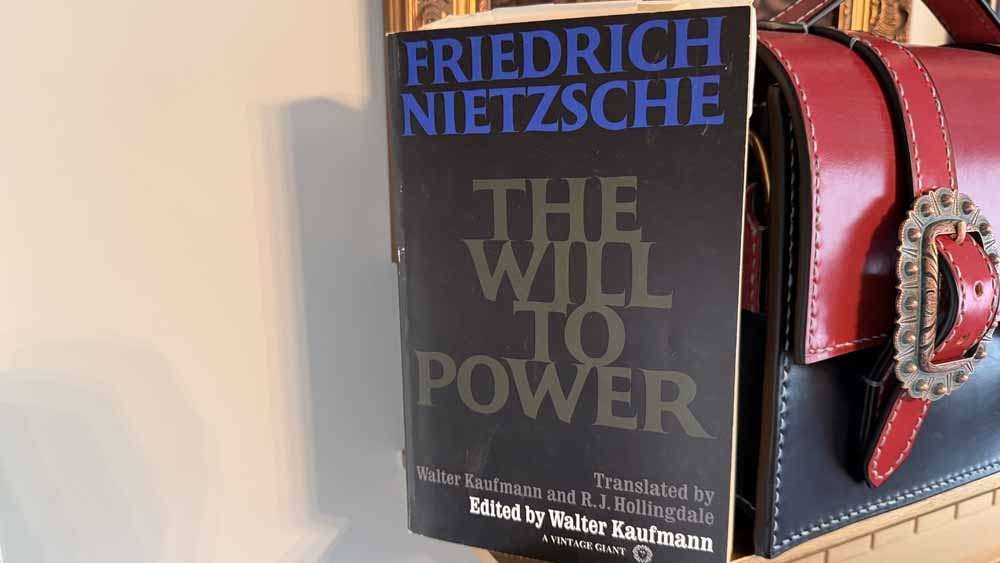
The Will to Power arrives with more baggage than almost any philosophical text ever written. Before you read the first aphorism, you’re already contending with a century of distortion — fascist appropriation, academic revisionism, pop-culture reduction. The book has been drafted into service for ideologies Nietzsche would have despised. Understanding what it actually says requires first clearing away what people think it says.
Most people hear “will to power” and picture domination. A boot on a throat. A strongman at a podium. The language of conquest. That reading didn’t come from the text. It came from Nietzsche’s sister, Elisabeth Förster-Nietzsche, who assembled this collection after his mental collapse, selectively edited the fragments, and handed a curated version to the Nazi propaganda machine. The damage was thorough and deliberate. It has taken scholars decades to undo it.
What Nietzsche Actually Meant
Power, for Nietzsche, is not something you exert over others. It is something you develop within yourself.
The will to power is fundamentally the drive toward self-overcoming — Selbstüberwindung — the relentless pressure inside a living organism to grow, to master its own resistances, to become more fully what it is. In Nietzsche’s framework, even weakness has a will to power: resentment is weak power, guilt is weak power, the urge to make others feel small is the will to power of someone who has no real strength left. “What is good?” he asks. “All that heightens the feeling of power in man, the will to power, power itself.” That’s not a call to conquest. That’s a psychological diagnosis of vitality.
The confusion runs deep because “power” in English carries the wrong connotation. In German, Macht can mean force, but it also carries the sense of capacity — the power to do, to create, to generate. When Nietzsche writes about the will to power, he is describing what Schopenhauer called the will to live, but upgraded: not mere survival, but the drive to expand, to overcome, to transform resistance into growth. It’s closer to what a sculptor means when she says the stone resists her — and she loves it for that.
The Book That Wasn’t
Here’s what complicates any straightforward reading: The Will to Power is not a book Nietzsche wrote. It is a posthumous compilation of his private notebooks, assembled by his sister from roughly 1,067 fragments spanning the late 1880s. Nietzsche had sketched plans for a four-volume work by that title, then abandoned the project. He scattered these notes across notebooks he never intended to publish. Elisabeth found them, arranged them to suit her purposes, and released the collection as if it were a completed philosophical masterwork.
This matters because Nietzsche thought in fragments — deliberately. His published works are aphoristic by design, not because he couldn’t sustain an argument, but because he distrusted the kind of systematic philosophy that marches lockstep from premise to conclusion. He wanted his readers to work. He was suspicious of anything that arrived too neat. So reading The Will to Power as a coherent doctrine, the way Elisabeth wanted you to, is already a betrayal of Nietzsche’s method.
Walter Kaufmann’s translation and annotation, published in 1967, was the serious scholarly corrective — the edition that restored contextual integrity and challenged the Nazi-friendly reading point by point. If you’re reading this book, that’s the edition to use.
The Psychology of Strength and Weakness
Strip away the political distortion, and what you find in these fragments is something more interesting than a theory of domination: a psychology of vitality and its opposite.
Nietzsche is obsessed with what he calls ressentiment — the slow-burning resentment of those who cannot create, so they destroy. The weak, in his framework, do not simply fail to pursue power. They invert it. They build moral systems designed to call strength evil and weakness virtuous, to make the powerful feel guilty for being powerful. Christianity, democracy, socialism — Nietzsche reads them all as expressions of ressentiment, as collective revenge fantasies of the powerless against the strong. “The doctrine of equality,” he writes at one point. “There is no more venomous poison in existence.” He’s not defending inequality as a social policy. He’s describing what he sees as a psychological mechanism: the tendency to disguise envy as morality.
You don’t have to accept this. I don’t accept all of it. But the diagnostic value is real. Watch any institution long enough and you’ll see the pattern — the impulse to bring someone down rather than build something up, dressed in the language of fairness. Nietzsche named it with unusual precision.
Self-Mastery as the Central Practice
The pieces that stick with me are the ones where Nietzsche turns the lens inward. The will to power is ultimately a demand you place on yourself. “The secret for harvesting from existence the greatest fruitfulness and the greatest enjoyment,” he writes in a related context, “is — to live dangerously.” The danger he means is not physical. It’s existential. The danger of making demands on yourself that you might fail to meet.
I spent years building a craft that nobody asked me to build. Each piece of bridle leather that comes off my bench has been worked against its own resistance — the hide doesn’t want to be a briefcase any more than raw material wants to be anything. You impose a form on it, and the imposition costs you. That’s not metaphor. That’s how I understand self-overcoming in practice: not the absence of resistance, but the refusal to let resistance be the final word.
Nietzsche’s will to power points at something like that. The man who overcomes himself — his laziness, his resentment, his comfort — is more powerful in Nietzsche’s sense than any strongman who overcomes his enemies. The conquest Nietzsche actually cares about is internal.
The Overman Problem
The fragments in The Will to Power also sketch the idea of the Übermensch — poorly translated as Superman, better understood as the Overman, the one who has fully outgrown inherited morality and created their own values. This is the idea that Elisabeth weaponized most effectively for fascist propaganda, and it’s the idea most worth rescuing.
Nietzsche’s Overman is not a racial type, not a political category, not a physical specimen. He is a psychological achievement. The person who has looked at the void — at the death of God, at the collapse of inherited meaning — and not retreated into resentment or nihilism, but created something new. “Man is something that must be overcome,” Nietzsche writes in Thus Spoke Zarathustra. The overcoming is of your own smallness, your own herd instincts, your own desire for approval.
It’s worth reading the Zarathustra alongside this text. I wrote about what that book did to my thinking elsewhere, but the two texts illuminate each other. Zarathustra is the performance; The Will to Power is the anatomy.
The Misread That Persists
The academic corrective is well-established at this point. Scholars like Kaufmann, Maudemarie Clark, and Brian Leiter have spent careers demonstrating that the fascist Nietzsche is a fabrication. The problem is that the correction stays inside the academy while the distortion continues to circulate everywhere else. The internet has not helped.
You still find people on one side who invoke Nietzsche to justify domination, and people on the other side who dismiss Nietzsche entirely because of the association. Both have been robbed. The actual text — the psychology of self-overcoming, the critique of ressentiment, the demand that you stop moralizing your weakness and start developing your strength — is useful in ways that neither camp can access.
Read it for what it is: an incomplete, posthumously assembled, editorially compromised set of philosophical fragments written by a man in the last productive years of his sanity, before his mind gave out and his sister rewrote his legacy. Read it carefully. Read it with Kaufmann’s notes. Push past the reputation and find the actual argument.
The argument is that power — real power — runs inward.
Sources
- Nietzsche, Friedrich. The Will to Power. Translated by Walter Kaufmann and R.J. Hollingdale. Vintage, 1968. Amazon
- Kaufmann, Walter. Nietzsche: Philosopher, Psychologist, Antichrist. Princeton University Press, 1950. Amazon
- Clark, Maudemarie. Nietzsche on Truth and Philosophy. Cambridge University Press, 1990. Amazon
- Leiter, Brian. Nietzsche on Morality. Routledge, 2002. Amazon
- Aschheim, Steven E. The Nietzsche Legacy in Germany: 1890–1990. University of California Press. Amazon