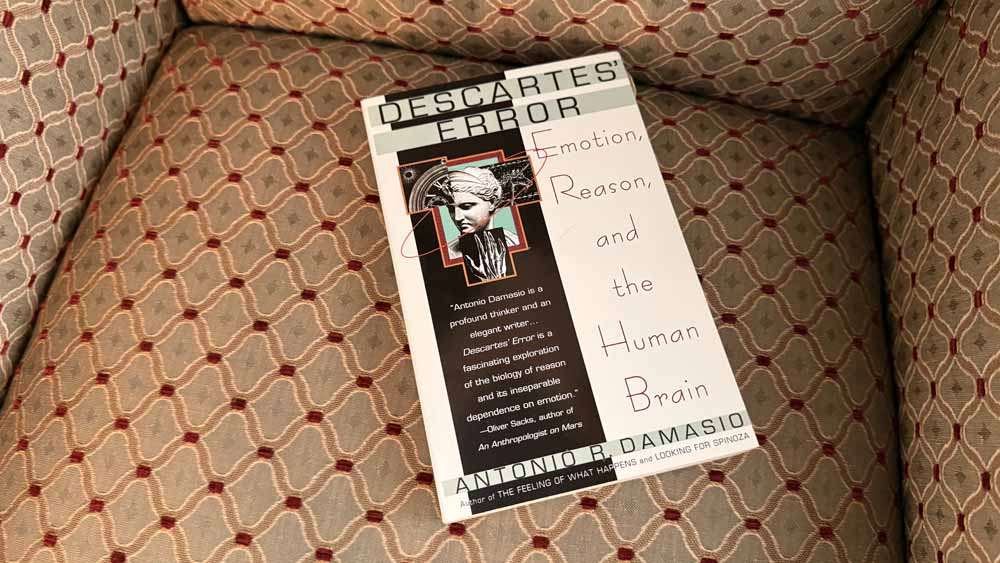
Rene Descartes drew a line down the middle of the human being and called it philosophy. On one side: the mind — rational, immaterial, the seat of reason and the soul. On the other: the body — meat, sensation, the unreliable animal. The mind thinks. The body feels. And the two, he argued, are fundamentally separate substances sharing a temporary address. Three and a half centuries later, Antonio Damasio showed up with a brain scanner, a stack of clinical case files, and a simple, devastating argument: Descartes was wrong.
Descartes’ Error, published in 1994, is one of those rare books that doesn’t just add to a field — it reorganizes how you think about yourself. Damasio was, at the time of writing, head of neurology at the University of Iowa and already a respected figure in cognitive science. What he brought to this book wasn’t a theoretical argument. It was evidence. Decades of it. Patients with specific brain lesions. Behavior patterns that made no sense under the old model and complete sense under his new one.
The Man with the Spike Through His Head
The book opens with Phineas Gage — an 1848 case that Damasio uses as the hinge of the entire argument. Gage was a Vermont railroad foreman, calm, reliable, well-liked. A construction accident drove an iron tamping rod through his skull, entering below his left cheek and exiting through the top of his head. He survived. Physically, he recovered. His memory was intact. His language was intact. His intelligence, by all outward measures, was intact.
But Gage was not Gage anymore. The people who knew him said so plainly. He became irreverent, obstinate, fitfully inconsistent — unable to follow through on plans, unable to make decisions in his own best interest, apparently indifferent to the social consequences of his behavior. His frontal lobes, specifically the ventromedial prefrontal cortex, had been destroyed.
Damasio spent years studying modern patients with similar lesions. What he found was exactly what Gage’s case suggested: damage to those regions produced people who were, by clinical measures, intelligent — and by practical measures, unable to function. They couldn’t hold a job. They couldn’t sustain relationships. They made terrible financial decisions. Not because they couldn’t reason, but because they couldn’t feel their way through a decision. The emotional apparatus that normally guides and weights our choices was gone.
This is the core of the book, and it flips everything.
The Somatic Marker Hypothesis
The reigning assumption in philosophy and cognitive science, inherited from Descartes, was that reason works best when emotion is excluded. Think clearly, not emotionally. Logic is the engine; feeling is the noise. Damasio watched his patients destroy their own lives with logical consistency and no affect whatsoever — and built an alternative theory he called the somatic marker hypothesis.
The idea is this: the body keeps score of experience in a way the conscious mind cannot fully track. When you face a decision, your brain rapidly surveys your stored history of similar situations — and it doesn’t just pull up the facts. It pulls up the emotional residue. A flutter in the chest. A tightening in the gut. A subtle baseline shift in your physical state. These are somatic markers — body-based signals that flag certain options as dangerous, or promising, or familiar, or wrong. They don’t make the decision for you. But they narrow the field. They pre-sort the options before conscious deliberation even begins.
Without them, every decision becomes an infinite loop. Damasio describes his patients sitting for hours trying to schedule a simple appointment, weighing every possible slot with equal emotional weight, unable to just pick one because nothing felt more right than anything else. Their reasoning was intact. Their computation was working. What was broken was the signal that tells you when you’re close to a good answer.
The lesson, understated in the text but impossible to miss: rationality is not opposed to emotion. Rationality depends on it.
Descartes as the Problem
Damasio names the problem directly in the title and doesn’t soften it. The Cartesian split — cogito ergo sum, the thinking thing separate from the extended thing — has been the operating system for Western philosophy of mind, ethics, economics, and artificial intelligence for three centuries. The “rational actor” in economics. The dispassionate judge in law. The clinical distance prized in medicine. All of them assume that the best version of a decision is one scrubbed of feeling. Damasio spends the back half of the book arguing, carefully, that this assumption has cost us.
He’s not making a case for pure emotionalism — for going with your gut against all evidence. His argument is more precise than that. Emotion and reason are not opposites. They are not even separate systems. They are layers of the same architecture. The limbic system, which handles emotion, is not a primitive interloper in a rational brain — it is woven into the prefrontal cortex, constantly communicating, constantly contributing. Cut that connection and the person doesn’t become more rational. They become less capable.
The Body as Instrument of Mind
What Damasio offers is a picture of the body as the instrument through which the mind operates — not merely a vessel the mind inhabits. Emotion is not something that happens to reason. It is how reason is embodied. The shiver of wrongness you feel when someone lies to you. The weight in your chest before you make a decision you already know is bad. The warmth of recognition when something clicks. These are not interruptions to your cognitive process. They are the process.
Why It Still Matters
Damasio published this in 1994. The case studies he presents were accumulated across the 1970s and 80s. You might reasonably ask whether neuroscience has moved past it. The answer is that the book’s core thesis has been largely supported, refined, and extended by subsequent research. The somatic marker hypothesis remains actively studied and influential. The general claim — that emotion and cognition are integrated rather than opposed — is now closer to scientific consensus than it was three decades ago.
But the cultural reception hasn’t caught up. We still talk about “thinking with your head” as opposed to “thinking with your heart,” as though these were geographically distinct operations. We still tell people to “be rational” as a way of telling them to suppress what they feel. We still build AI systems modeled on pure computation and then wonder why they fail at the kinds of judgment that come naturally to a five-year-old. Damasio’s correction is thirty years old and still hasn’t fully landed.
Part of what makes the book essential is that it connects clinical neuroscience to the oldest questions in philosophy — and does it in prose that never loses you. Damasio is Portuguese-American, trained in both Europe and the United States, and he writes with the precision of a clinician and the patience of a teacher. He builds each chapter on the last. He doesn’t ask you to take the conclusion on faith; he earns it case by case.
The Error That Outlived the Philosopher
Descartes himself can be excused. He was working in the seventeenth century, without neuroscience, without imaging, without any real understanding of how the brain produced consciousness. He made the best philosophical move available to him. The error was not his alone — it was the paradigm’s. The mistake belongs to everyone who inherited the split and refused to question it.
Damasio’s book is that question, asked with evidence. The body is not what the mind escapes. It is what the mind is made of. Emotion is not the enemy of reason. Strip it away and reason collapses. Gage knew this, in the way that people who’ve lost something always know it best. We know it every time we make a decision that our gut disagreed with and paid the price. We just haven’t always had the neuroscience to explain why.
You Might Also Like
- The Ghost in the Machine: Descartes, Dennett, and the Mind That Built the Modern World
- The Feeling of What Happens by Antonio Damasio — A Review
- Civilization and Its Discontents by Sigmund Freud — The Book That Saw the Twentieth Century Coming
Sources
- Damasio, Antonio R. Descartes’ Error: Emotion, Reason, and the Human Brain. Putnam, 1994. Penguin Random House
- Damasio, Antonio R. The Feeling of What Happens: Body and Emotion in the Making of Consciousness. Harcourt, 1999.
- Harlow, J.M. “Passage of an Iron Rod Through the Head.” Boston Medical and Surgical Journal, 1848. NIH/PubMed Central
- Bechara, A., Damasio, H., Tranel, D., & Damasio, A.R. “Deciding Advantageously Before Knowing the Advantageous Strategy.” Science, vol. 275, no. 5304, 1997. Science.org
- University of Southern California, Brain and Creativity Institute. Antonio Damasio faculty profile