
Edward O. Wilson published Sociobiology: The New Synthesis in 1975 and spent the next two decades explaining himself. Not because he was wrong. Because he was right about something people weren’t ready to hear.
I came to Sociobiology before Consilience. That’s the order that matters if you want to understand what Wilson was actually doing when he sat down to write the later book. Sociobiology cracked something open in me — the argument that social behavior in animals, including humans, has evolutionary roots wasn’t just a biological claim. It was a philosophical earthquake. It meant that the things we do to each other, the hierarchies we build, the alliances we form, the ways we love and betray — all of it has a history older than civilization. Older than language. Older than God. That book rewired how I see people.
Then came the protests. Harvard colleagues dumped water on Wilson’s head at a scientific conference. Students stormed his lectures. The accusation was that he was smuggling genetic determinism through the back door of biology — that by locating human social behavior in evolutionary history, he was giving a scientific pass to racism, sexism, and every other brutality dressed up as nature’s verdict. Wilson spent years absorbing that. By the time he wrote Consilience in 1998, he knew exactly what he was walking back into.
The Unification Project
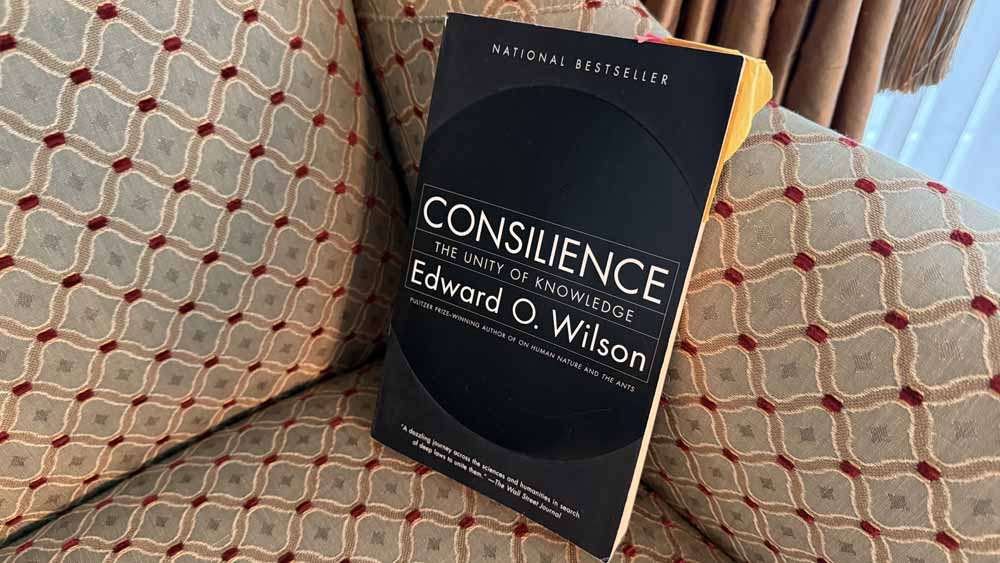
Consilience is a big book with a simple idea: that all human knowledge — natural science, social science, the humanities, the arts — is ultimately reducible to a unified set of explanatory principles rooted in the natural world. Wilson borrows the term from William Whewell, the nineteenth-century philosopher who used it to describe the way scientific theories from separate fields sometimes converge on the same truth. Wilson wants more than convergence. He wants unification.
The argument runs like this: physics underlies chemistry, chemistry underlies biology, biology underlies human behavior and culture. If we follow that chain patiently and honestly, we stop treating the humanities as a separate magisteria — a protected zone where humans get to be exempt from the same forces that govern everything else. Literature, music, ethics, religion — Wilson is willing to drag all of it into the light of evolutionary explanation. Not to diminish it. To understand it.
That is a serious intellectual ambition. The kind that takes nerve.
The Shadow He Carried
Here is what I think is actually happening in Consilience, and why reading it without Sociobiology means you’re missing the real story.
Wilson is not starting fresh. He is completing a project that nearly destroyed his professional reputation. Every chapter in Consilience that touches human behavior — and there are many — carries the weight of what happened in 1975. He writes more carefully now. He qualifies more. He makes a point of distinguishing between genetic influences and genetic determinism, between saying that evolution shaped the brain and saying that our fate is written in our DNA. The nuance is real. But so is the scaffolding underneath it, and the scaffolding is Sociobiology.
The academic left that came after him in the seventies made a specific argument: that applying evolutionary biology to human social behavior was politically dangerous. Wilson’s answer, implicit in every chapter of Consilience, is that ignorance is more dangerous. That we do not stop war, poverty, or tribalism by refusing to ask where those behaviors come from. That the humanities have been floating in a philosophical vacuum for too long, treating human nature as infinitely plastic, shaped entirely by culture — and that this assumption has its own political consequences, consequences nobody talks about.
He’s right. I’ve believed that since I first read Dawkins — the gene’s-eye view of behavior, the logic of natural selection working on social animals, the whole framework that The Selfish Gene by Richard Dawkins laid out, sits underneath Consilience like a foundation someone poured before Wilson put up his walls. Wilson and Dawkins arrive at the same territory from different directions. Wilson from entomology and evolutionary biology. Dawkins from gene-centered selection. They don’t agree on everything, but they agree on the thing that matters: that human beings are not exempt from Darwinian explanation.
Where the Book Works
The strongest sections of Consilience are the ones where Wilson is writing about biology — natural selection, genetics, the evolution of the brain. Here he’s on home ground and the prose reflects it. Clear, precise, confident. He is one of the great natural history writers of the twentieth century and it shows.
His chapters on the arts are more uneven, but they’re also the most interesting, because they’re the most contested. Wilson argues that aesthetic preferences have evolutionary origins — that the landscapes we find beautiful, the stories we respond to, the moral emotions we feel when reading fiction, all reflect the conditions under which the human brain was shaped over millions of years. He is not saying art is nothing but biology. He is saying art is also biology, and that understanding the biology doesn’t diminish the art any more than understanding how a guitar string vibrates diminishes the music.
I find that convincing. More convincing than the alternative, which is the humanities professor’s answer: that all aesthetic response is culturally constructed, historically contingent, impossible to generalize. That answer has always struck me as a way of avoiding the question rather than answering it.
Where He Overclaims
Wilson’s weakest moments are when he implies that the consilience project is nearly complete — that if we just keep pulling the threads, everything will connect. It won’t. Not because the idea is wrong, but because the gap between neurochemistry and lived human experience is not a gap that patience alone can close. The Selfish Gene shows you the mechanism. Consilience shows you the vision of unification. Neither of them fully crosses the distance between the gene and the poem.
That’s not a damning criticism. It’s an honest one. The question Wilson is asking — whether human knowledge can be unified under a single explanatory framework — is one of the most important questions anyone can ask. The fact that he doesn’t fully answer it doesn’t mean the attempt isn’t worth making.
Consciousness is the wall he runs into hardest. He knows it. He circles it, describes it carefully, acknowledges it is the hardest problem, then moves on. I’ve looked at that wall from other directions — Merleau-Ponty’s phenomenology of embodied perception, the whole tradition of trying to get at experience from the inside out — and I don’t think the wall goes away when you approach it from evolutionary biology either. Maybe it never does. Maybe that’s the point.
What the Controversy Was Really About
The political attacks on Sociobiology were not really about science. Wilson understood that. What the protesters were defending was a particular vision of human freedom — the idea that because we are not wholly determined by our genes, we are wholly free to become whatever we choose. Wilson’s work threatened that idea, and the response was political, not intellectual.
Consilience is, among other things, Wilson’s patient restatement of the case after twenty years of being called a fascist for it. He is gentler in tone. More diplomatic in framing. But the core claim is the same: that human nature exists, that it was shaped by evolution, and that any serious account of human social life — from art to ethics to war — has to reckon with that.
He spent his career trying to make that case. Darwin made it first in a form the world could barely absorb. Wilson spent fifty years trying to complete the project. Consilience is the most ambitious attempt he ever made.
Whether you think he succeeded depends on how much you’re willing to follow the thread. I followed it a long time ago, and I haven’t been able to let go of it since.
Sources
- Wilson, E.O. Consilience: The Unity of Knowledge. Knopf, 1998. https://www.amazon.com/Consilience-Knowledge-Edward-Wilson/dp/067976867X
- Wilson, E.O. Sociobiology: The New Synthesis. Harvard University Press, 1975. https://www.hup.harvard.edu/books/9780674816244
- Segerstrale, Ullica. Defenders of the Truth: The Battle for Science in the Sociobiology Debate and Beyond. Oxford University Press, 2000. https://global.oup.com/academic/product/defenders-of-the-truth-9780192862150
- Dawkins, Richard. The Selfish Gene. Oxford University Press, 1976. https://www.amazon.com/Selfish-Gene-Anniversary-Landmark-Science/dp/0198788606
- Whewell, William. The Philosophy of the Inductive Sciences. Parker, 1840. https://archive.org/details/philosophyinduc02whewgoog